-
-
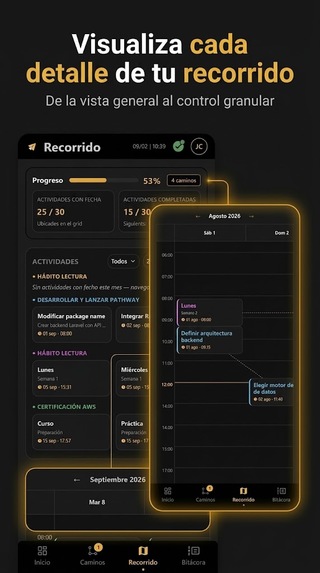
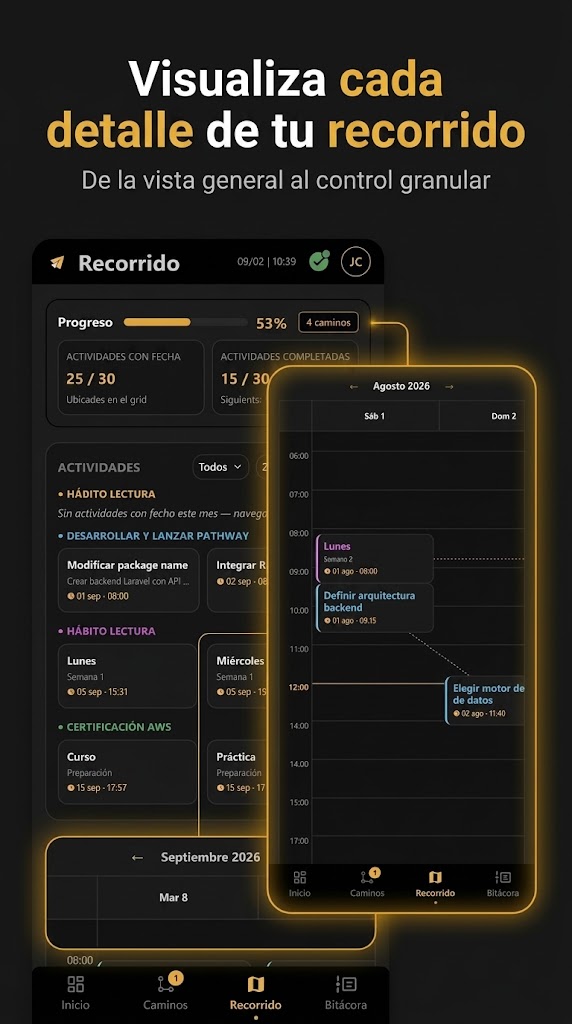
Observa el recorrido
-
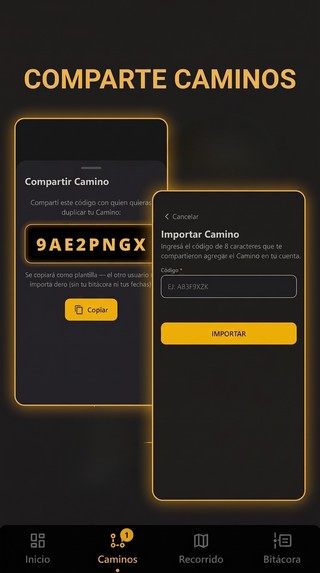
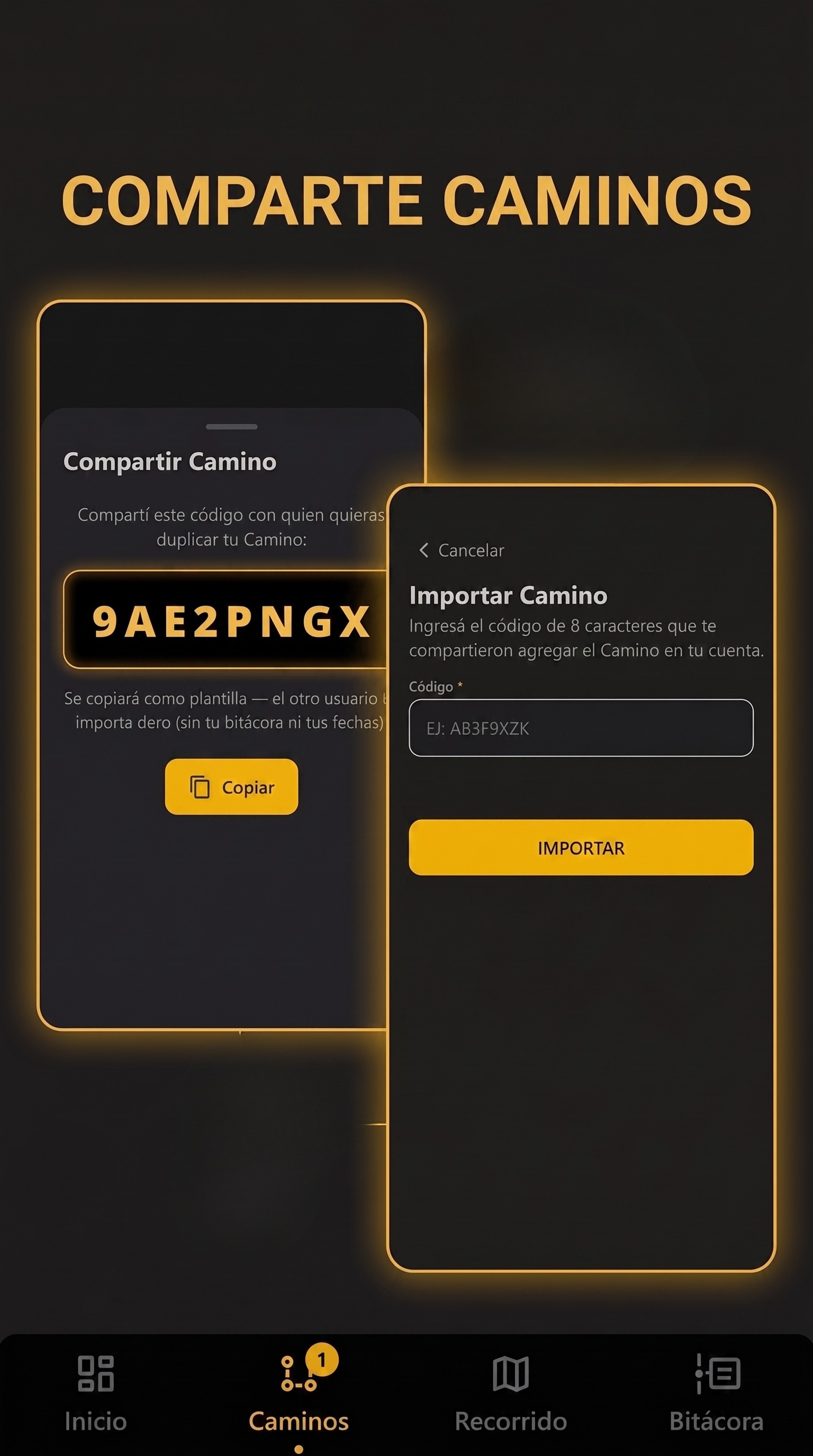
Puede compartir tus pasos
-
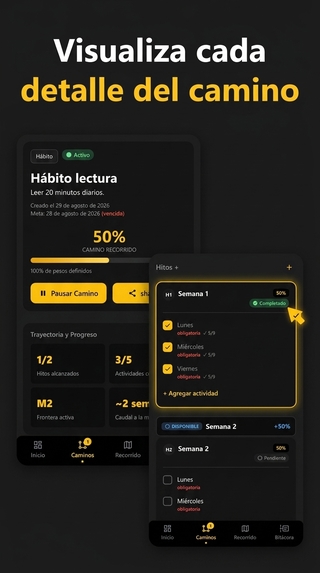
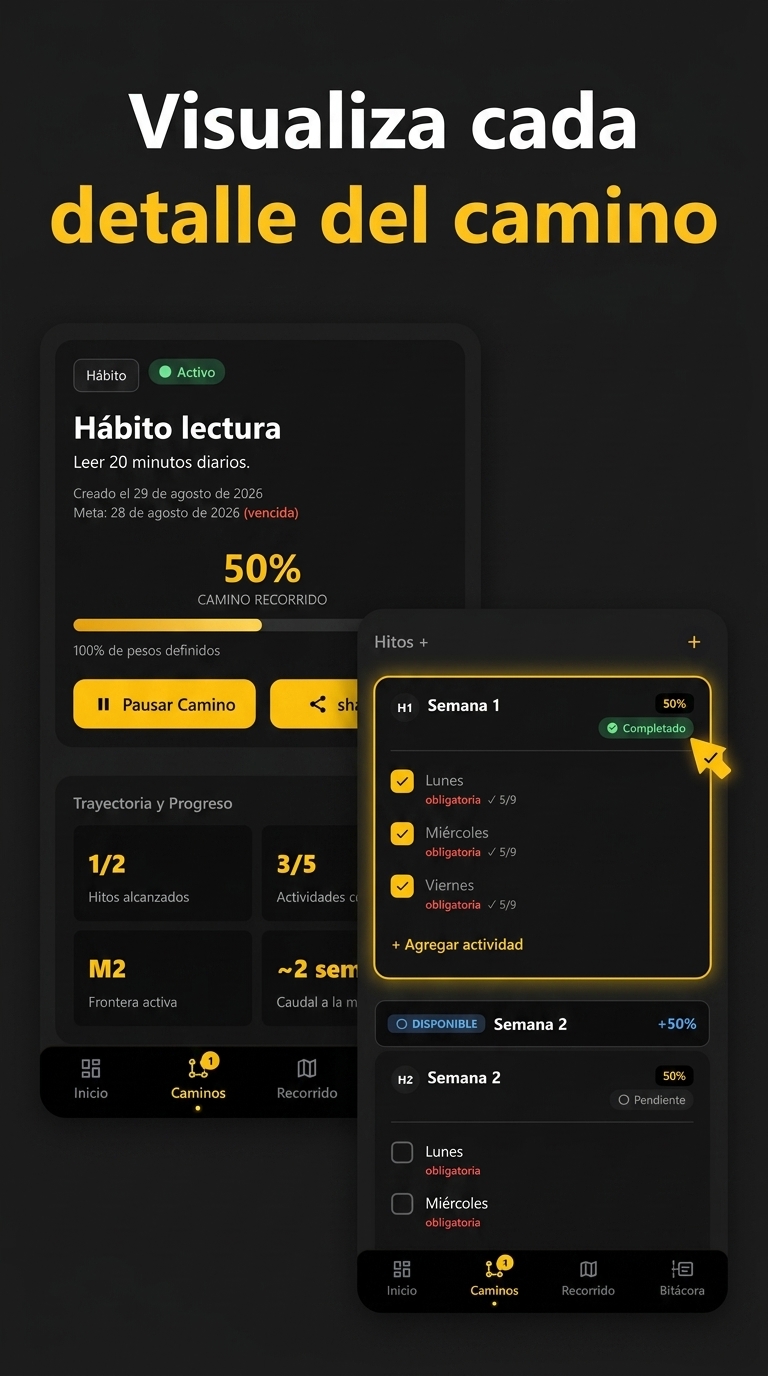
Visualiza lo que debes completar
-
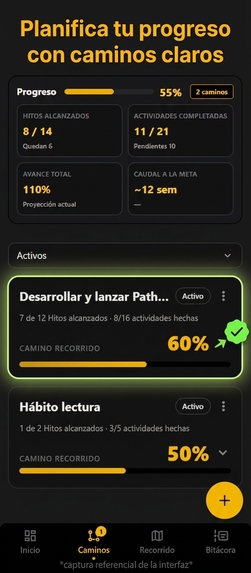
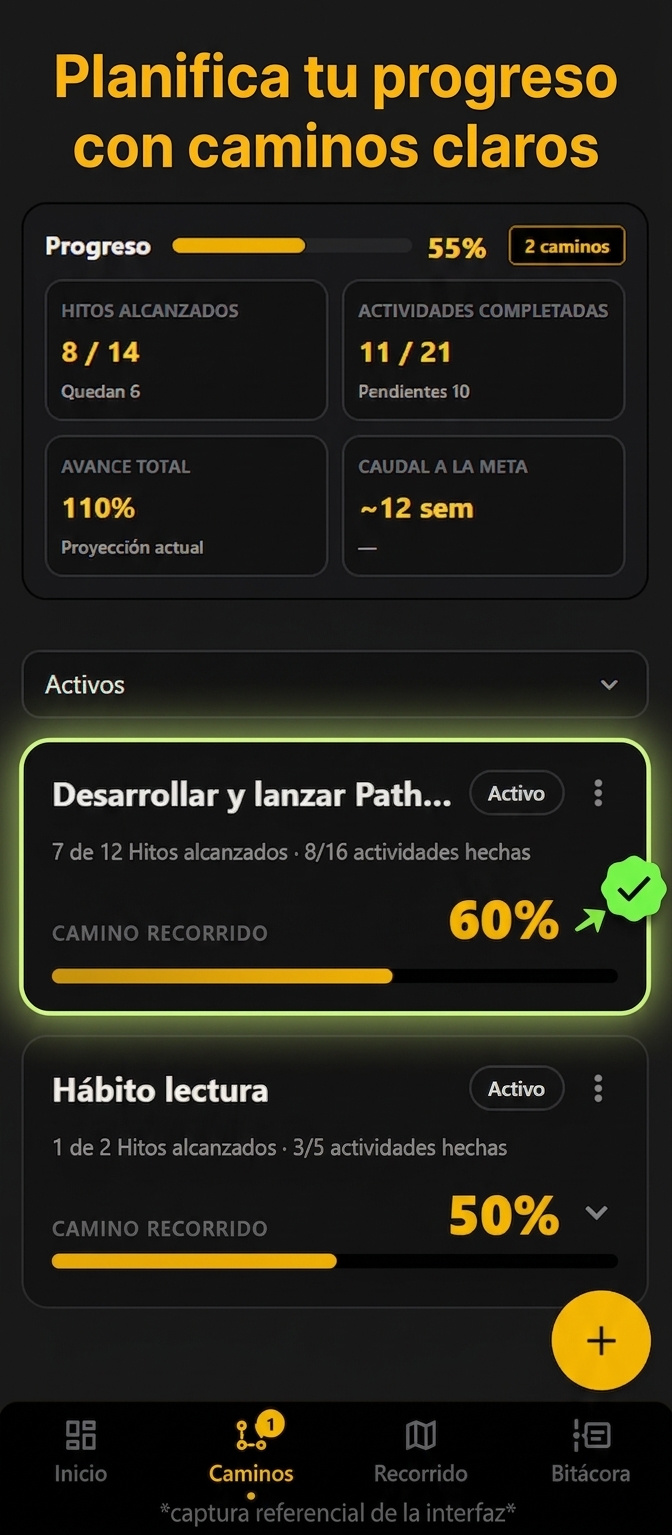
Planifica pasos a seguir
-

icono de app

Inspiration
Pathway was born from a fairly simple idea that I try to apply both in my life and in software development: what is not measured cannot be improved.
We often set goals with the full intention of achieving them; we want to learn something new, improve professionally, exercise, read more, or simply become a better version of ourselves. The problem is that, after a while, it's difficult to know if we're really making progress.
Most habit-tracking apps operate on a fairly basic system: done or not done. You tick a box and that's it. But that doesn't necessarily mean you're any closer to your goal.
Because of my interest in productivity and measuring results, I began to see goals differently. Not as something that is simply achieved or not, but as a process where you need to observe your progress, identify if you are improving, and make decisions based on that. The idea is to create a tool that allows you to transform a goal into something you can follow step by step, making visible progress that is usually difficult to notice.
What Item does
Pathway is a mobile application for Android that helps turn personal goals into measurable progress.
Instead of focusing solely on completing tasks, Pathway seeks to show the evolution of a goal over time.
The application allows:
Define goals: establish qualitative or quantitative objectives. Record progress: Save small progress frequently. Visualize progress: See how a goal is progressing over time. Receive suggestions: Get recommendations on what action might make the most sense as a next step, based on your history.
The central idea is to turn a goal into a feedback loop:
Because simply measuring for the sake of measuring isn't very useful. The real value lies in using that information to make better decisions.
How we built Item
Pathway will be developed in 15 days by the team members, so from the beginning we had to prioritize quite a bit.
The development was accompanied by AI agents specifically configured to support each of these stages.
The idea was not simply to tell an AI "make me the application", but to first establish what was to be built, why, how it was going to be done and what criteria it had to meet.
At a technical level, the project uses:
- Backend :* Laravel with Sanctum for authentication and a versioned REST API using /api/v1/.
- Mobile:* React Native + Expo for Android. State management : Zustand , chosen for its low weight and for allowing selective subscriptions to the state.
- Database :* PostgreSQL, mainly for its handling of concurrent writes and native support for JSONB.
- Architecture :* Modular Monolith , with layered architecture and some lightweight DDD principles.
- Testing :* TDD based on the specifications defined during SDD.
- Deployment :* VPS, preparing the way to incorporate PgBouncer when the number of concurrent connections increases.
Challenges we ran into
The main challenge was time. Building a mobile app, backend , authentication, database, progress tracking, and a suggestion system in just 10 days, with a small development team, forced us to prioritize a lot. We had to define what was truly necessary for the MVP and what could wait for a future version, so we left out some more advanced features.
We also had to make some important technical decisions, such as state management. Pathway is designed to receive frequent progress updates, so unnecessary re-renders could become a problem as the application grew. We ultimately chose Zustand because of its selective subscriptions and for keeping state management relatively lightweight. Another key point was choosing the database management system, as we needed to handle concurrent writes and semi-structured data for features like hints and qualitative goals. PostgreSQL, especially its JSONB support, ended up being a better choice for the project. At the same time, we identified the issue of concurrent connections and the future need to incorporate other integrations as the application grows.
Finally, working with AI also presented a challenge. The speed it enables is quite high, but without a clear structure, technical decisions can become inconsistent. That's why ADRs were important during development: we wanted to document not only what we were implementing, but also why we were doing it that way. This allows us to maintain the context of decisions even as the project grows and we need to revisit decisions made weeks or months earlier.
Accomplishments that we're proud of
Beyond having finished an MVP in just a few days, there are some things about the project that I consider especially important:
- *7 ADRs * to document important architectural decisions.
- A complete SDD-TDD flow, connecting specifications with implementation and testing.
- An AI agent scheme configured to support different stages of development.
- An architecture based on Laravel + React Native + PostgreSQL ready to continue growing.
- Use of JSONB from the beginning, keeping in mind the needs of the suggestion system.
- Condition to avoid depending on a heavier state system than necessary.
What we learned
Probably the main lesson was to confirm that measuring is not enough; you have to turn measurement into action.
A metric that simply records what happened is useful. But a metric that helps you decide what to do next is much more powerful.
I also learned several things on a technical level.
The * ADRs * turned out to be more useful than I expected. They not only serve to document architecture, but also to preserve the reasoning behind a decision.
I also confirmed that small technical details can become important depending on how the product behaves. In Pathway , for example, frequent progress updates make efficient state management quite essential.
And finally, something that became quite clear to me while working with AI:
AI greatly accelerates development, but it needs limits and context.
With clear specifications, documented decisions, and testing, it becomes a much more powerful and consistent tool.
What's next for Pathway
The MVP is just the beginning.
The next most important step is to improve the management of qualitative goals. Not everything important in life can be measured simply with a number. For example, "I want to be a better listener" requires other types of indicators and monitoring.
We also want to continue improving the suggestion engine so that it can better interpret different types of progress and recommend more useful actions.
In the future, it would also be interesting to incorporate collaboration features, such as shared goals and accountability. partners and follow-up among friends.
But the main idea of Pathway remains:
to make progress visible in order to improve it.
Because when you can see where you were, where you are now, and where you are moving towards, a goal stops feeling like something distant and starts to become a path you can travel step by step.

Log in or sign up for Devpost to join the conversation.