-
-
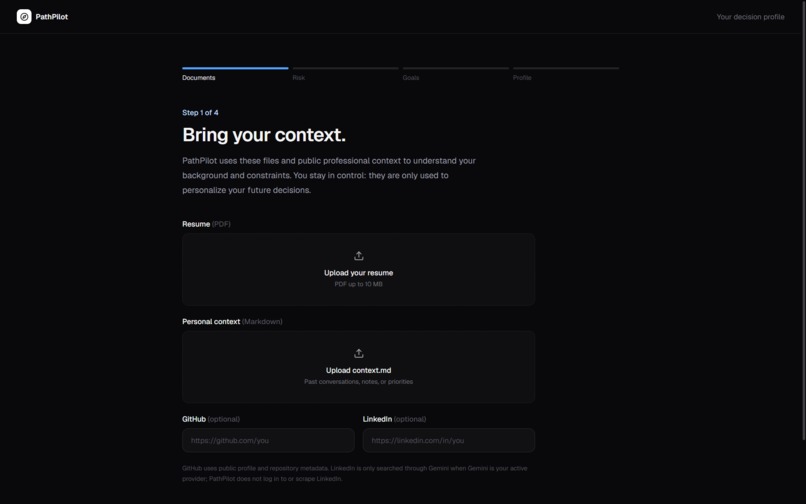
Decision Profile
-
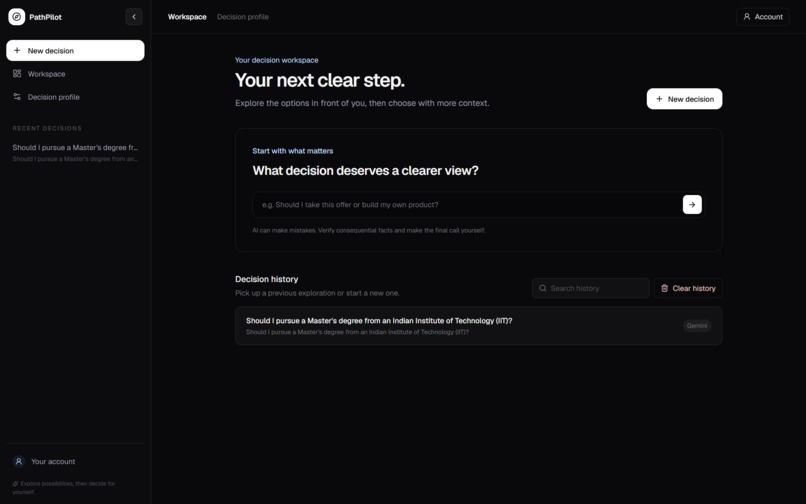
Workspace
-
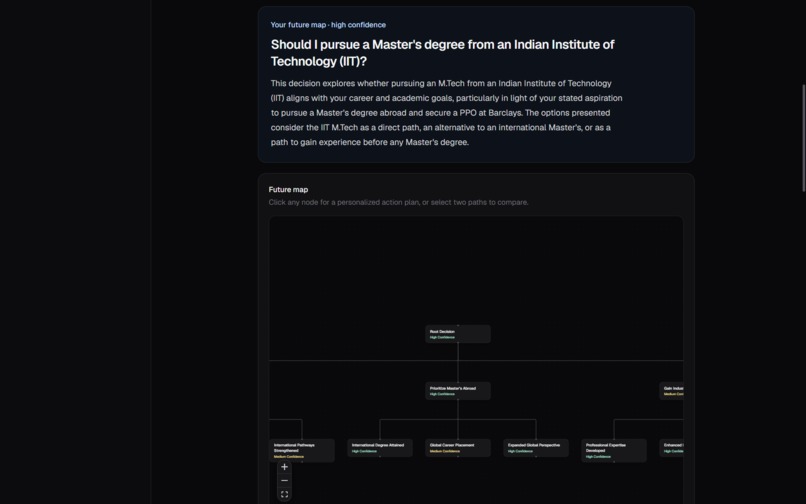
Decision Flowchart
-

Landing

Inspiration
Every day, people ask AI important questions like:
- Should I pursue a master's degree?
- Should I switch careers?
- Should I move abroad?
- Should I start a company?
Most AI assistants return a single answer. But life decisions rarely have one correct solution. They involve uncertainty, tradeoffs, and multiple possible outcomes.
I wanted to build something that helps people think through decisions instead of simply answering them. That's how PathPilot started.
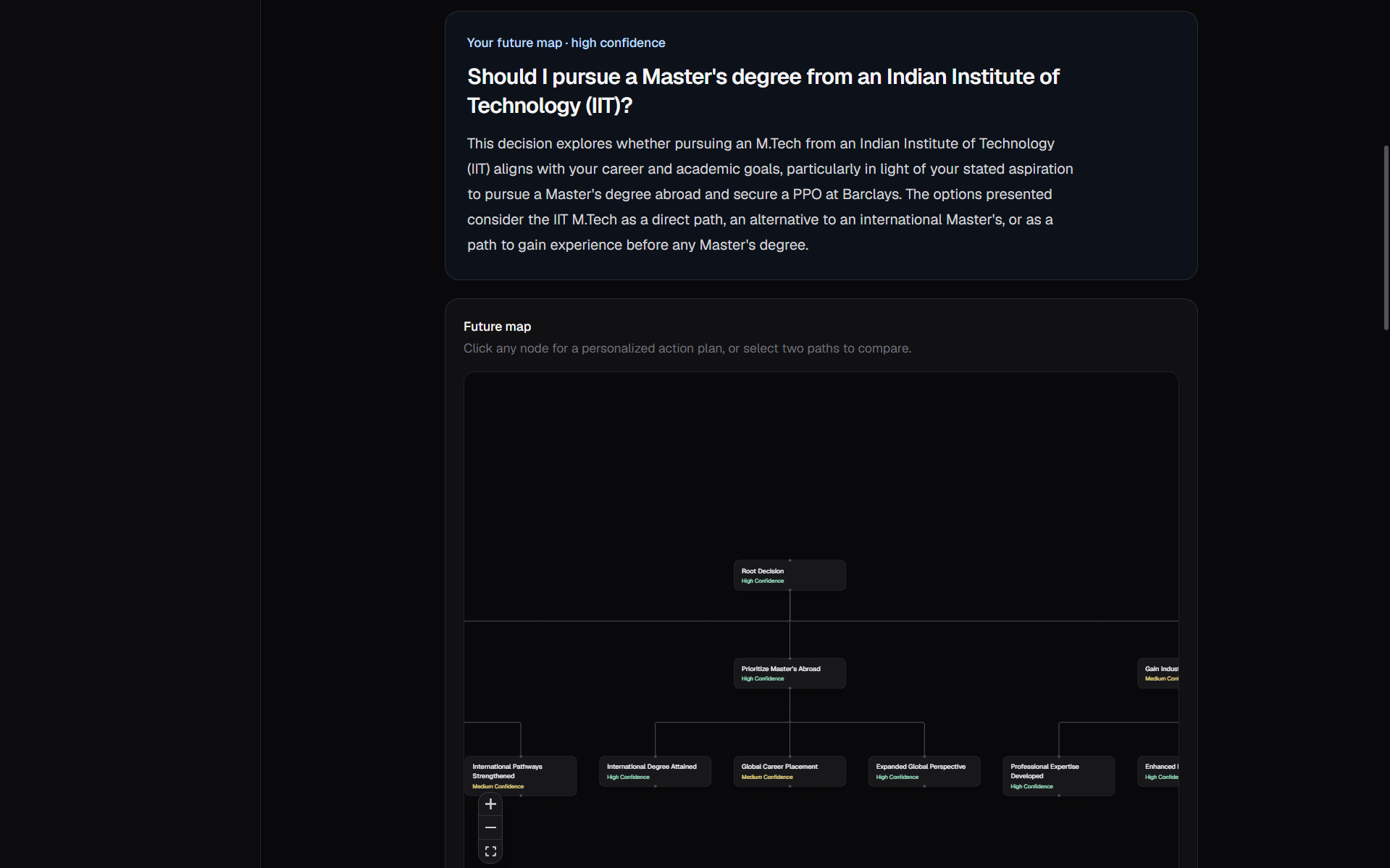
Instead of giving one recommendation, PathPilot generates an interactive map of possible futures so users can understand where different choices might lead.
What it does
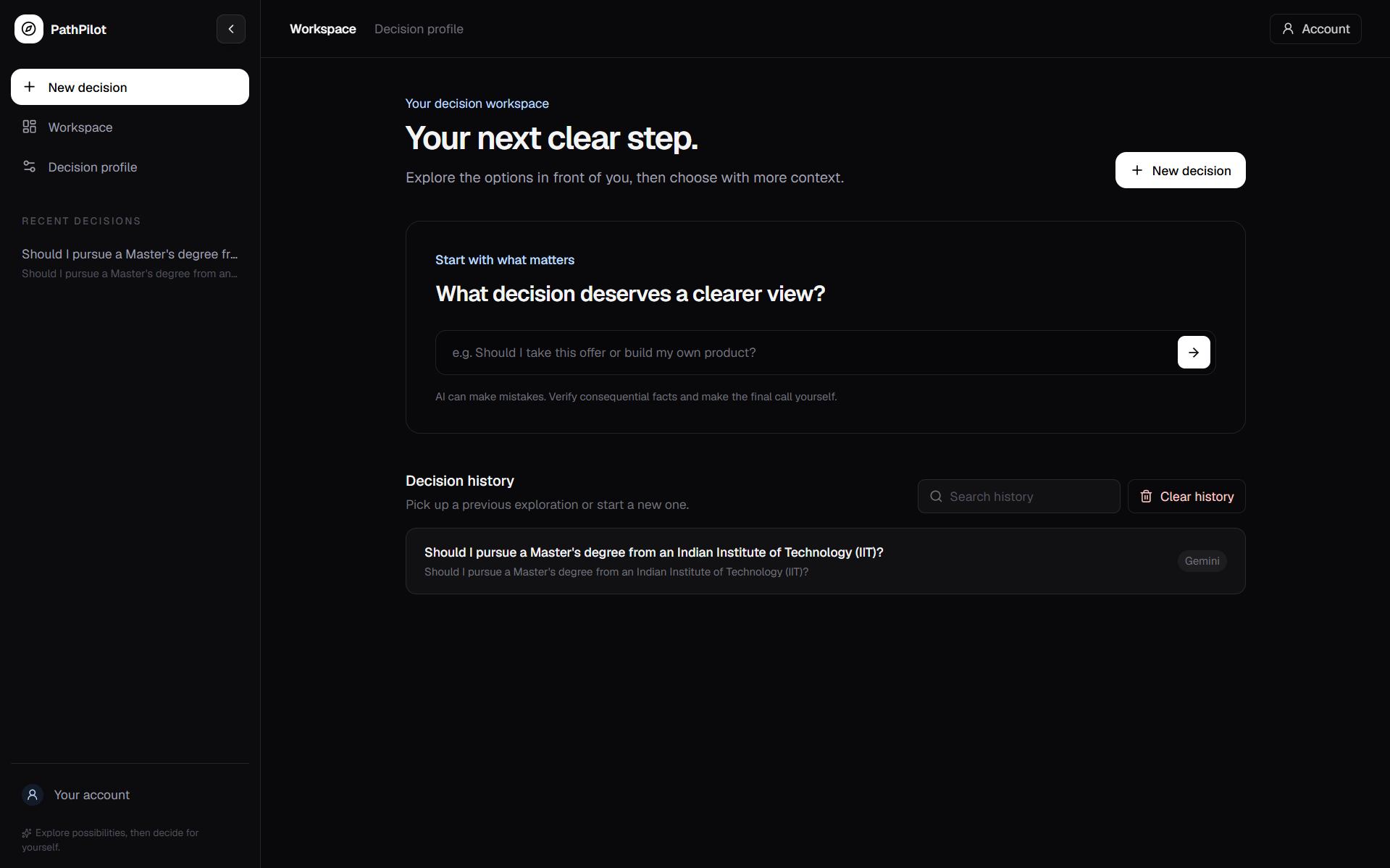
PathPilot is an AI decision simulator that combines personal context, retrieval, live web research, and structured reasoning.
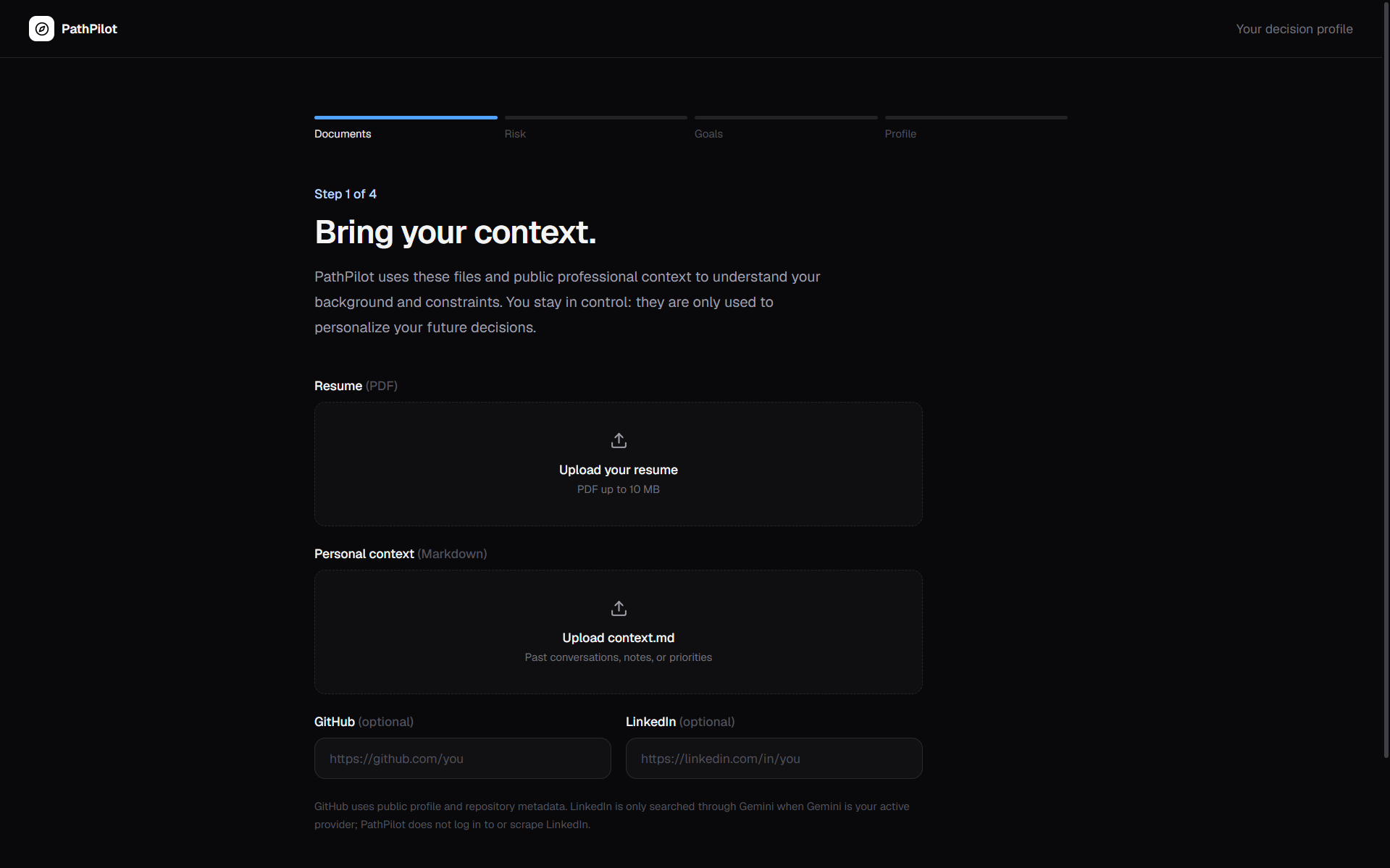
Users can upload their resume, add LinkedIn and GitHub information, and include personal notes to build a profile. When a decision is submitted, PathPilot retrieves relevant personal context, performs live web research, and uses GPT-5.6 to generate an interactive decision tree.
Each branch represents a possible future with supporting evidence, assumptions, risks, unknowns, and confidence levels. Users can expand branches, compare different paths side by side, and generate personalized execution plans with timelines and actionable next steps.
The goal isn't to replace human judgment. It's to make complex decisions easier to understand.
How I built it
The application is built with Next.js and Supabase.
Personal information is indexed using OpenAI embeddings and pgvector to enable retrieval-augmented generation. Before every analysis, GPT-5.6 performs live web research using the Responses API. The retrieved context and research results are combined to generate a structured decision tree following a strict JSON schema.
The decision tree is visualized using React Flow with automatic graph layout powered by Dagre. Users can continue expanding nodes to explore deeper scenarios, compare alternative futures, and generate personalized execution plans.
Throughout development, I collaborated extensively with Codex. It accelerated implementation of the RAG pipeline, API routes, React Flow visualization, JSON schema generation, and debugging across the application.
Challenges I ran into
One of the biggest challenges was making the AI return a consistent decision tree instead of free-form text. Designing a reliable JSON schema that could power an interactive graph required several iterations.
Another challenge was combining live web research with retrieved personal context while keeping the responses structured and relevant.
Designing the visualization was also interesting because I wanted users to explore decisions naturally rather than reading a long AI response.
What I learned
This project reinforced that the quality of AI applications depends just as much on product design as on the model itself.
Rather than asking the model to produce a better paragraph, structuring its reasoning into an interactive visualization creates a much more useful experience.
I also learned a lot about building RAG pipelines, working with structured outputs, graph visualizations, and integrating GPT-5.6 with live web research.
What's next
There are several directions I'd like to explore:
- More personalized recommendations using long-term memory
- Financial and cost projections for different decision paths
- Multi-agent reasoning for deeper scenario analysis
- Collaboration features for mentors and career advisors
- Real-time updates as market conditions change
The long-term vision is to build an AI that helps people navigate life's biggest decisions with more confidence by exploring possibilities instead of providing a single answer.
Built With
- ai
- codex
- dagre
- embeddings
- framer-motion
- gpt-5.6
- javascript
- llm
- nextjs
- openai
- pgvector
- postgresql
- rag
- react
- react-flow
- responses-api
- supabase
- vercel
- web-search

Log in or sign up for Devpost to join the conversation.