-
-

welcome page
-
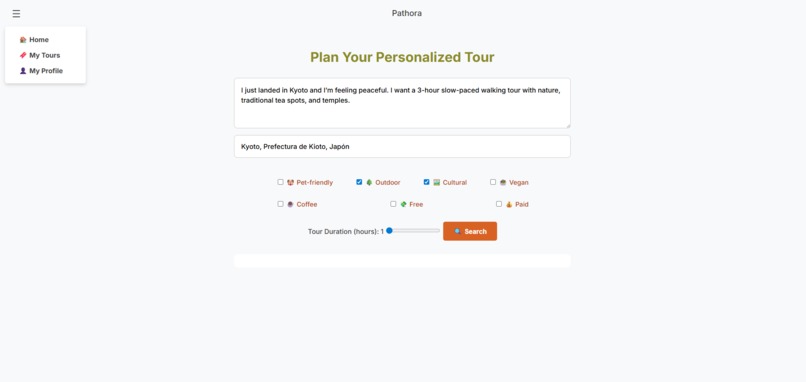
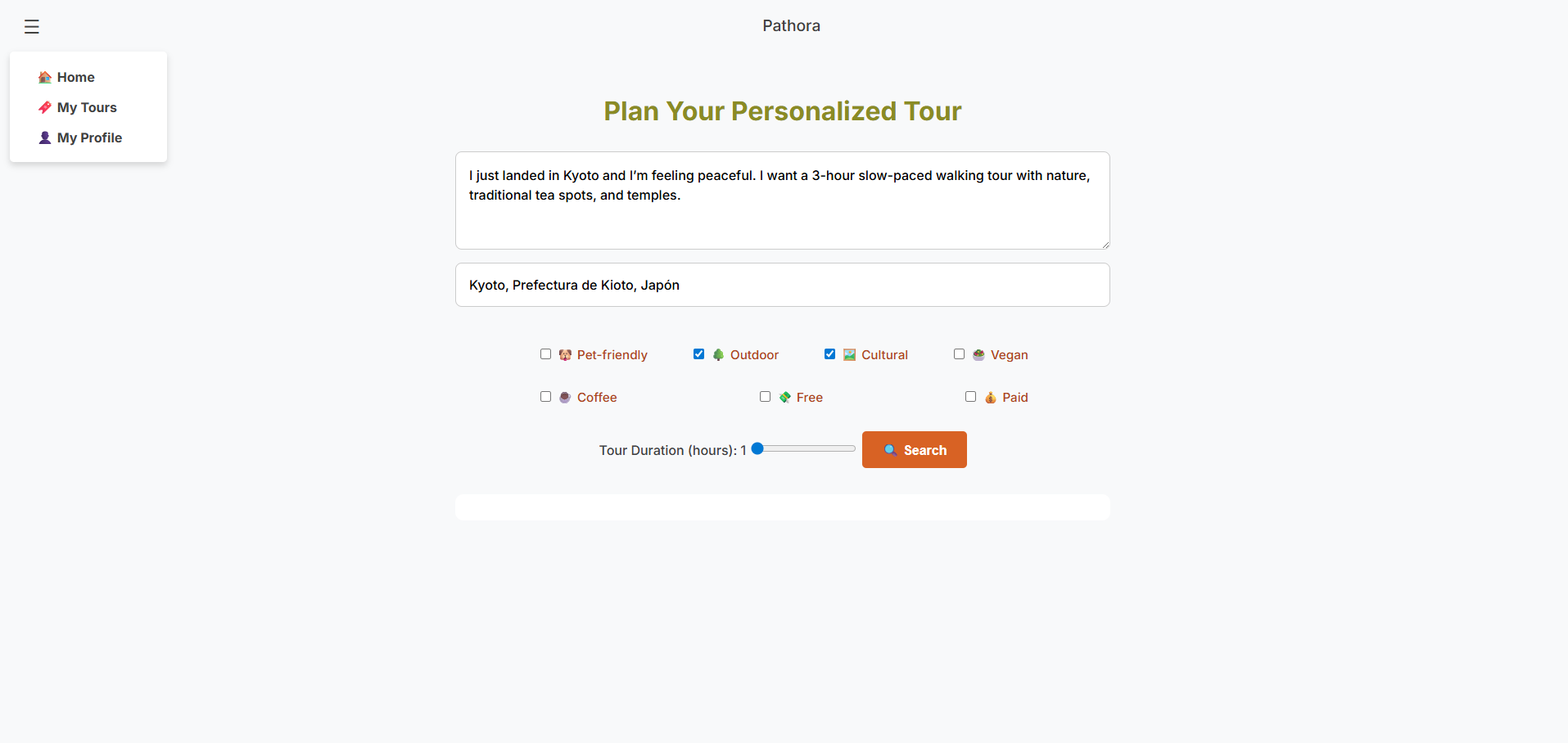
prompt example

Inspiration
Travel planning can be overwhelming — especially when time is limited and your energy or mood changes day to day. We dreamed of a tool that understands your vibe and your constraints, and instantly maps the perfect route for you. That’s how Pathora was born — an AI-powered tour planner that personalizes short urban explorations, in seconds.
What it does
Pathora generates customized walking tours based on:
- Your current mood, energy level, interests
- Your available time and city
- Filters like cost, accessibility, or type of experience It returns a markdown itinerary with real Google Maps places, estimated visit durations, transitions between stops, and direct links. You can save and revisit your favorite tours on the web platform. 🎯 Future users could say: “I’m in Kyoto, I love indie bookstores and only have 2 hours” — and Pathora will do the rest.
How I built it
- Frontend: HTML/CSS + Vanilla JS, hosted on Firebase
- Backend: FastAPI (Python), hosted on Render
- AI: OpenAI’s GPT-3.5-turbo for itinerary generation
- Maps: Google Maps Platform (Places API, geolocation, search)
- Storage: Firebase Firestore for saved tours The backend fetches real data from Google Maps, structures it, and prompts OpenAI to write a human-like tour with times and links.
Challenges I ran into
Prompt engineering was key. I iterated to:
- Ensure OpenAI used only real Google Places data
- Avoid invented locations or unrealistic time blocks
- Balance personalization with tour structure (timing, cost, accessibility) I also debugged CORS issues, cross-platform deployment, and formatting the output for markdown + front-end compatibility.
Accomplishments that I'm proud of
- Built and deployed the full AI-driven stack in under 24 hours
- Delivered a functional, emotionally-aware travel planner with real-time data
- Created an architecture ready for scale, and UX-ready for mainstream use
What I learned
- Integrating Google Maps data into natural language tasks is a powerful pattern
- Accessibility, personalization, and real-world grounding can coexist
- With the right prompt design, AI can assist in emotionally meaningful tasks like trip planning
What's next for Pathora
📍Embed as a plugin or layer inside Google Maps: an assistant that lives inside the map UI ♿ Add accessibility modes, such as: - Wheelchair-friendly routing - Sign-language integrated UI (for guided instructions or museum-style tour reading) 🧳 Expand tour modes: slow travel, museum-only paths, café hopping 🌐 Add support for more languages and international cities
Built With
- cors
- css3
- dotenv
- fastapi
- firebase
- google-maps
- google-places
- html5
- javascript
- markdown
- openai
- python
- render


Log in or sign up for Devpost to join the conversation.