-
-
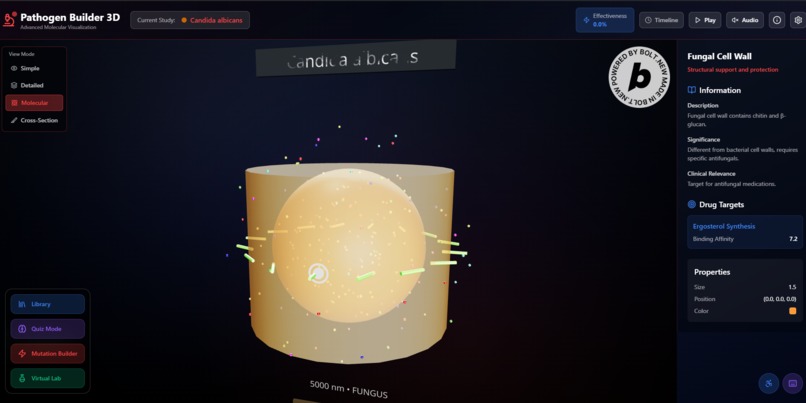
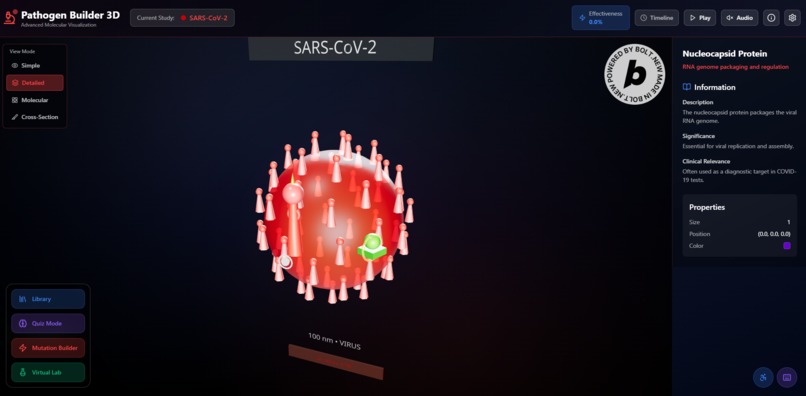
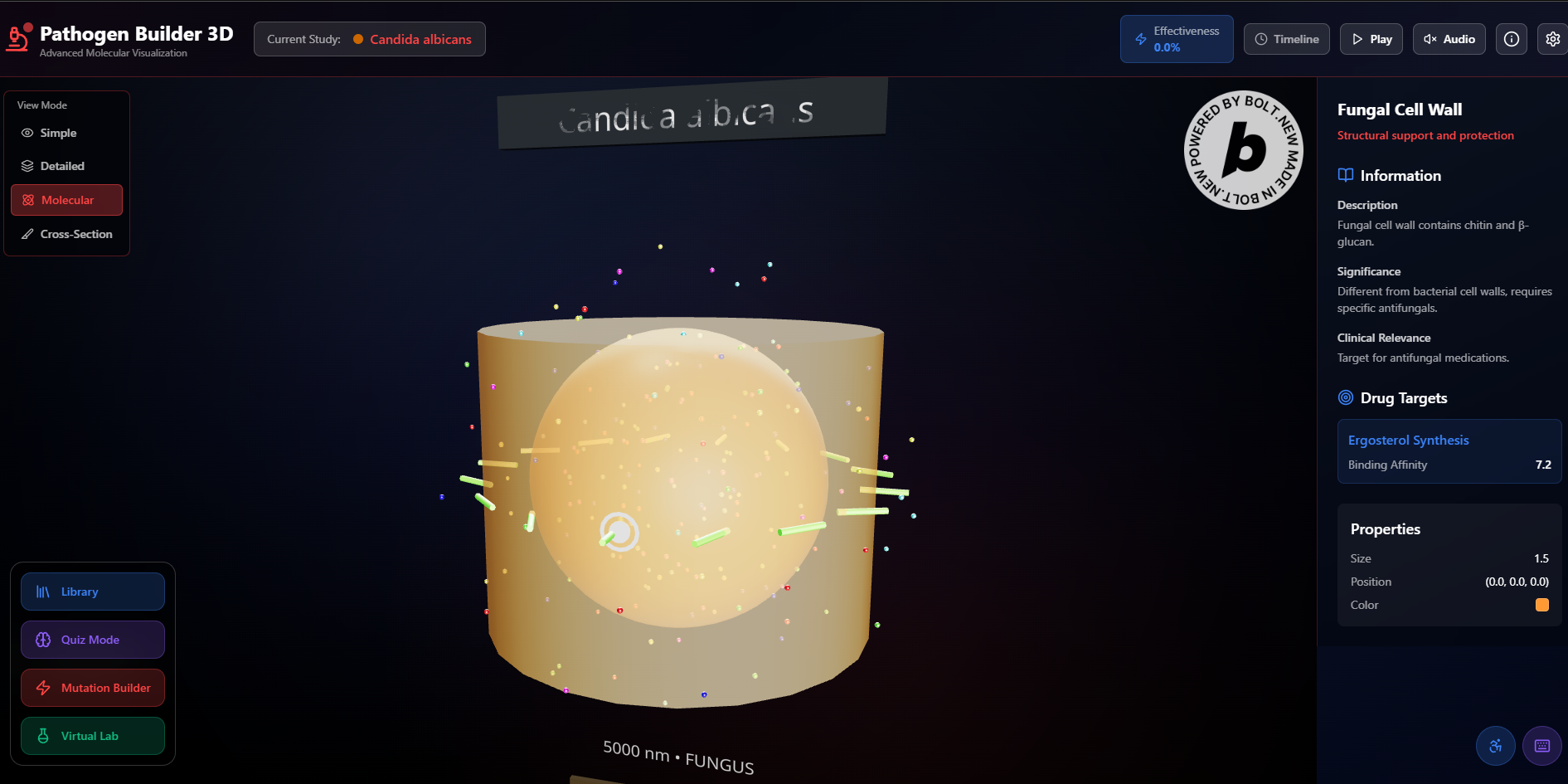
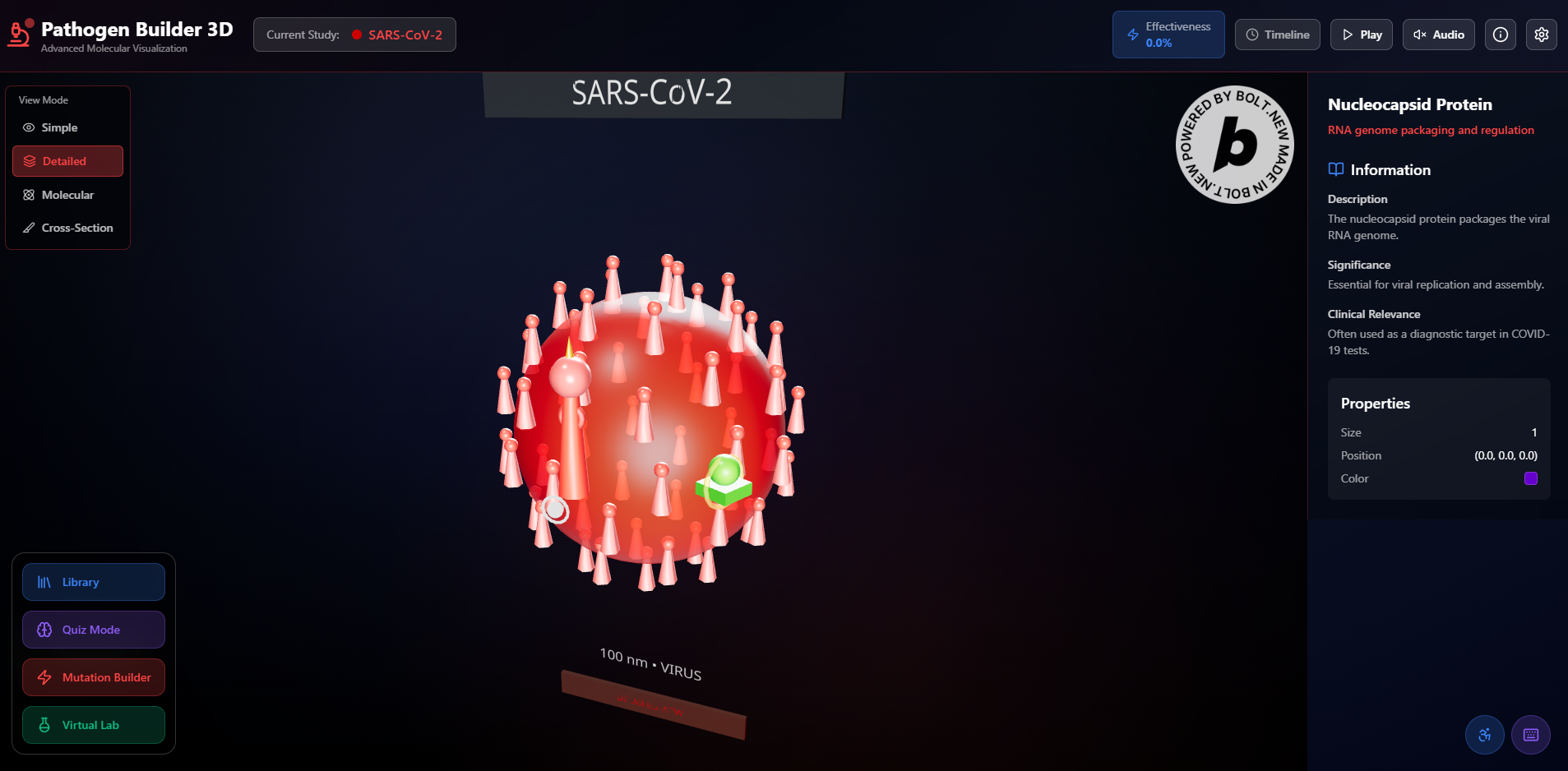
Explore 3D viruses, click to inspect proteins
-
Mutation simulation with treatment resistance
Inspiration
We’ve always seen biology taught using flat images and long explanations. It’s hard to fully understand how viruses or bacteria work when you can’t interact with them. We wanted to build something where you could actually explore pathogens visually — click, rotate, test mutations — and make that learning process more hands-on.
bolt.new gave us a way to build that without needing to set up a complex stack or worry about deployment. That simplicity made the idea feel doable within the hackathon timeframe.
What it does
Pathogen Builder 3D lets users explore different pathogens in real-time 3D, right in the browser. You can:
- Load and rotate pathogens like viruses and bacteria
- Click on components to learn about their function
- Simulate mutations and see how structure and behavior change
- Test treatments by adjusting resistance and seeing outcomes
- Take quizzes that reinforce learning
- Receive AI-powered suggestions for what to try next
It’s entirely web-based — no login, no installs, just open and explore.
How we built it
The entire project was built using bolt.new. We used Bolt's built-in 3D template and logic structure, and adapted it for science education.
- No external assets were uploaded
- No custom shaders or 3D engines were added
- Supabase integration and deployment were handled directly through Bolt
We focused our time on repurposing Bolt's default features into a working educational simulation — adding quiz logic, UI flow, treatment sliders, and adjusting the interaction design.
Challenges we ran into
- Figuring out how to visualize mutation and resistance changes clearly
- Balancing between scientific accuracy and simplicity
- Making the interaction intuitive for both students and casual users
- Staying within time constraints while making it look and feel complete
We leaned on the existing Bolt structure and kept things minimal by design.
Accomplishments we’re proud of
- Repurposed a default Bolt template into a fully interactive learning experience
- Got 3D rendering, quizzes, and simulations running in-browser without a single manual deployment step
- Created a project that can actually help people understand complex topics faster
- Kept it lightweight and responsive on both desktop and mobile
What we learned
Bolt let us skip all the boilerplate and go straight to feature building. That made the process faster, more focused, and fun.
We also learned that even basic interactivity — like clicking components or adjusting sliders — can completely change how people engage with scientific content. Small changes in experience make a big difference in learning.
What’s next for Pathogen Builder 3D
We'd love to explore:
- More pathogen models with detailed real-world data
- A mobile-first layout and better touch support
- VR/AR mode for immersive learning
- Teacher tools for classroom integration
- Collaboration features — imagine two users exploring the same virus together
- Offline version for schools with limited connectivity
Open Source
The project is fully open source and available here:
https://github.com/Gaeto95/PathogenBuilder3D-Complete
Anyone is welcome to fork it, expand it, or adapt it for their own learning platform, classroom, or research tool. We’d love to see where others take it.
Built entirely with bolt.new in just a few days.
Built With
- bolt.new
- framer
- netlify
- openai
- react
- react-three-fiber
- supabase
- tailwind-css
- three.js
- typescript
- vite
- zustand


Log in or sign up for Devpost to join the conversation.