Inspiration
Every year, millions of ambitious students around the globe miss out on life-changing opportunities—such as prestigious international scholarships, research grants, and high-impact hackathons. The tragedy isn't a lack of talent; it is the sheer volume of information overload, language barriers, and complex requirements.
Many students spend weeks drafting documents for programs where their GPA or skill profile doesn't pass the initial screening threshold. Meanwhile, they completely miss rolling-admissions grants that align perfectly with their backgrounds.
We asked ourselves: What if every student had a personal "Board of Advisors" to scout opportunities, debate their realistic chances, calculate document preparation effort, and write their initial drafts? This vision inspired PathFinder — a Multi-Agent Opportunity Navigator.
What it does
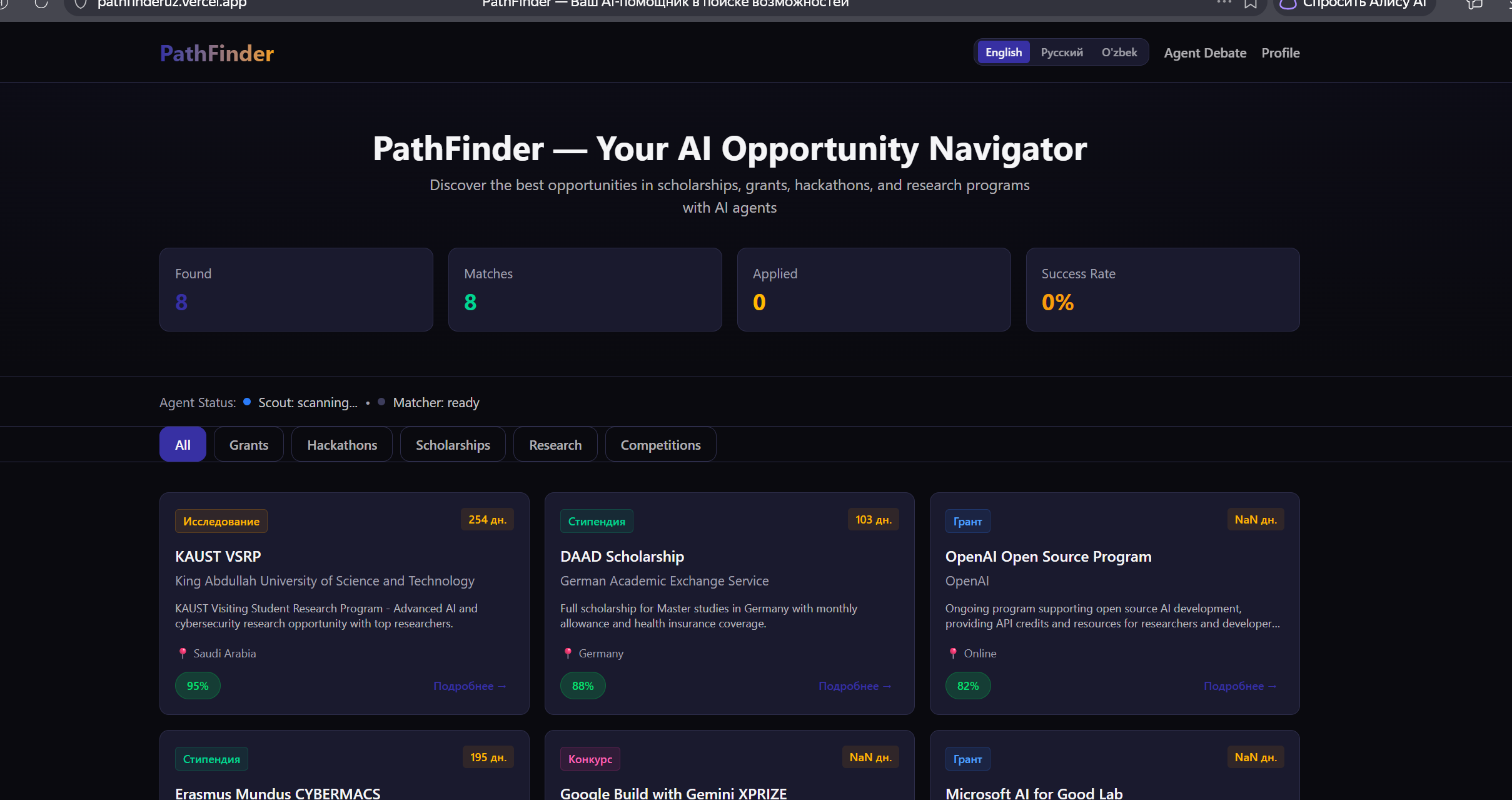
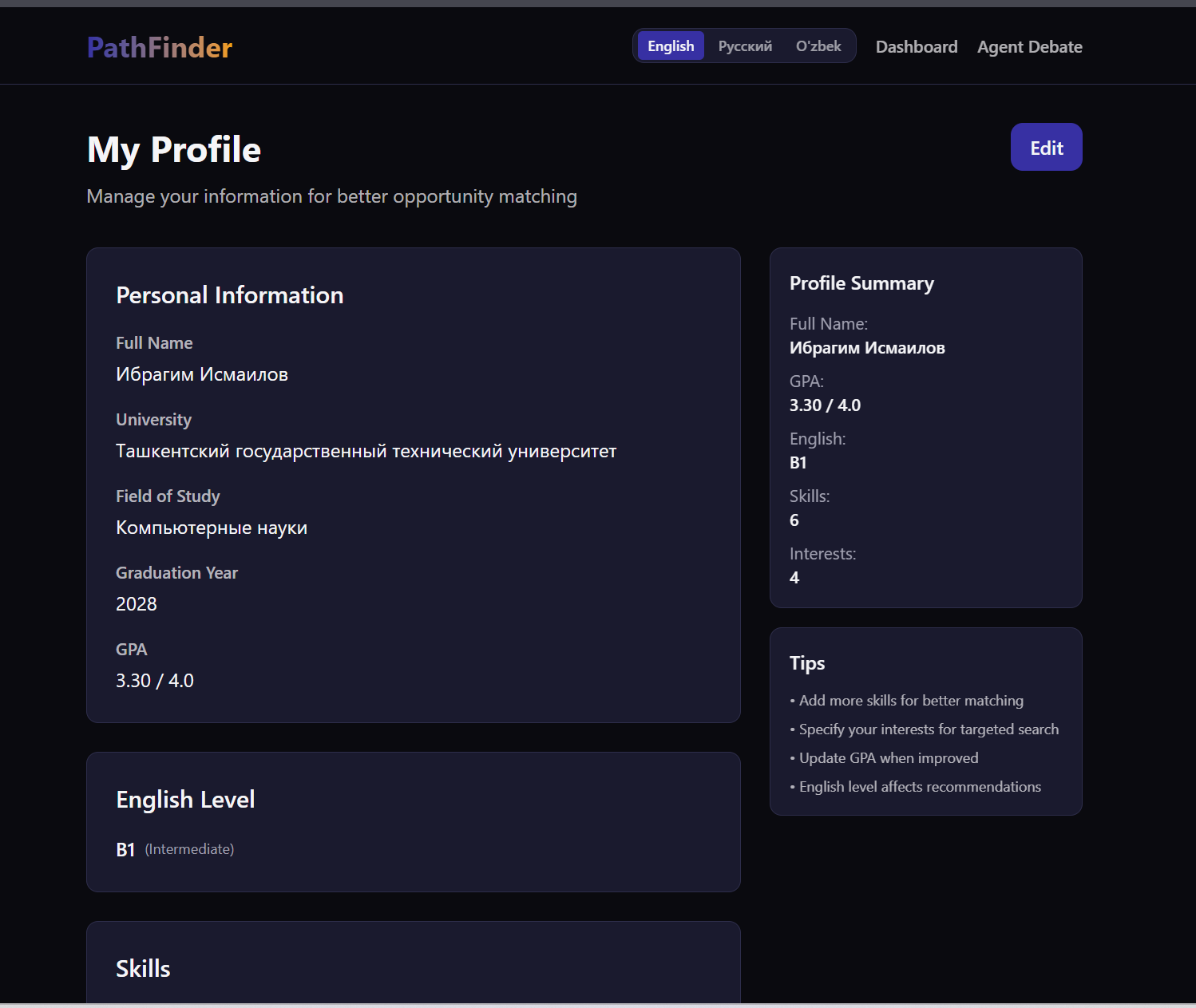
PathFinder is an intelligent portal that matches students with academic and career opportunities. Rather than presenting a static list of links, it runs a student's profile (GPA, skills, interests, language level) through an autonomous AI Agent Society.
The platform:
- Scouts live updates using web search to check for deadline shifts or updated rules.
- Conducts an interactive, multi-agent debate (Scout, Matcher, Writer, and Negotiator) right on the screen, showing the user how different models evaluate their fit.
- Outputs a final verdict (
Apply,Maybe, orSkip) with comprehensive justification. - Simplifies complex, long English requirements into a clear summary and automatically drafts a customizable starter application cover letter.
- Provides a fully localized interface in English, Russian, and Uzbek.
How we built it
PathFinder is built using a modern, scalable web stack integrated with state-of-the-art language models:
- Frontend & API: Next.js 15 (App Router), TypeScript, and Tailwind CSS.
- Agent Society Orchestration: We deployed specialized models from the Qwen series via the DashScope API:
- Scout Agent (
qwen3.6-flash+ Web Search) collects real-time context. - **Matcher Agent
(qwen3.6-plus`) evaluates academic compatibility. - Writer Agent (
qwen3.6-flash) evaluates document complexity. - Negotiator Agent (
qwen3.7-max) arbitrates disagreements.
- Scout Agent (
- Serverless Backend: The Negotiator Agent logic is decoupled into a standalone microservice hosted on Alibaba Cloud Function Compute (FC) in a Node.js Custom Runtime.
The Mathematical Evaluation Model
To evaluate an opportunity $O$, we model the student's profile as a feature vector $\mathbf{x} \in \mathbb{R}^n$ (containing GPA, language levels, and technical skill flags) and the opportunity criteria as a vector $\mathbf{y} \in \mathbb{R}^n$.
The Matcher Agent calculates a compatibility score:
$$S(\mathbf{x}, \mathbf{y}) = \sum_{i=1}^{n} w_i \cdot \text{sim}(x_i, y_i)$$
The Writer Agent evaluates documentation complexity $E \in [0, 100]$. The Negotiator Agent resolves conflicts by maximizing a utility function:
$$U(\text{apply}) = S(\mathbf{x}, \mathbf{y}) - \lambda \cdot E$$
where $\lambda$ represents the student's tolerance for complexity. The agent outputs a final verdict: $\text{Verdict} \in {\text{Apply}, \text{Maybe}, \text{Skip}}$.
Challenges we ran into
- Agent Sycophancy & Deadlocks: Early prototypes suffered from agents agreeing too quickly or getting stuck in infinite loops of disagreement. We resolved this by defining a strict 5-round debate protocol (Propose $\rightarrow$ Challenge $\rightarrow$ Revise $\rightarrow$ Vote $\rightarrow$ Arbitrate) which forces adversarial criticism before the Negotiator arbitrates.
- Parsing Structured Outputs: Standard LLMs return conversational fluff. To ensure the agents could pass parameters to each other, we had to enforce strict JSON and Markdown block schemas.
- Serverless Security: Deploying the Negotiator microservice on Alibaba Cloud Function Compute required hidden credential storage. We secured the endpoint by masking the
QWEN_API_KEYon the cloud, enforcing custom CORS restrictions (rejecting*wildcards), and creating a client-side Next.js Rate Limiter allowing a maximum of $10$ requests per minute per IP.
Accomplishments that we're proud of
- Autonomous Debate Engine: We built a functional, live-streaming agent interface where users see agents challenge each other's opinions in real time.
- Alibaba Cloud FC Integration: A lightweight, highly scalable microservice architecture running Negotiator decisions with sub-second response times.
- Robust Localization: A complete i18n translation system that dynamically changes language translations (EN/RU/UZ) for both the UI and AI-generated outputs.
What we learned
- Model Tier Optimization: We learned that using a frontier model for every task is highly inefficient. Offloading search and text analysis to smaller models (
qwen3.6-flash) and using the flagship model (qwen3.7-max) strictly as a Negotiator reduces cost and latency dramatically while maintaining top-tier reasoning. - Adversarial Debating Reduces Hallucinations: Prompting agents to actively search for flaws in another agent's arguments forces self-correction, resulting in highly reliable recommendations.
What's next for Pathfinderuz
- Direct Academic Integrations: Integrating with school and university transcript APIs to automatically sync GPA and coursework data.
- Advanced Document Generator: Expanding the Writer Agent to automatically generate drafts of custom motivation letters and recommendation emails.
- New Agent Roles: Adding a Visa Advisor Agent and a Cost-of-Living Financial Agent to provide a holistic relocation assessment.
Built With
- agent-society
- alibaba-cloud
- alibaba-cloud-function-compute
- artificial-intelligence
- css3
- dashscope
- html5
- i18n
- javascript
- llm
- multi-agent-systems
- next.js
- node.js
- prompt-engineering
- qwen
- qwen-3.6-flash
- qwen-3.6-plus
- qwen-3.7-max
- react
- rest-api
- serverless
- tailwind-css
- typescript
- web-development


Log in or sign up for Devpost to join the conversation.