Inspiration
Most of us have a problem we genuinely care about. Microplastics in the water. People going missing. Communities that are not even on a map yet. And most of us do nothing about it, not because we do not care, but because we have no idea where to start.
I noticed that AI made this worse, not better. Ask any AI tool about a big problem and it gives you a beautiful, thoughtful summary, and then it leaves you exactly where you began. Informed, but with no doorway. Diagnosis without a doorway does not create action. I wanted to build the opposite: something that takes you from caring about a problem to actually taking your first real step, this week. That idea also became the front door to Innovators of Tomorrow, a community I run for people who want to solve real problems together.
What it does
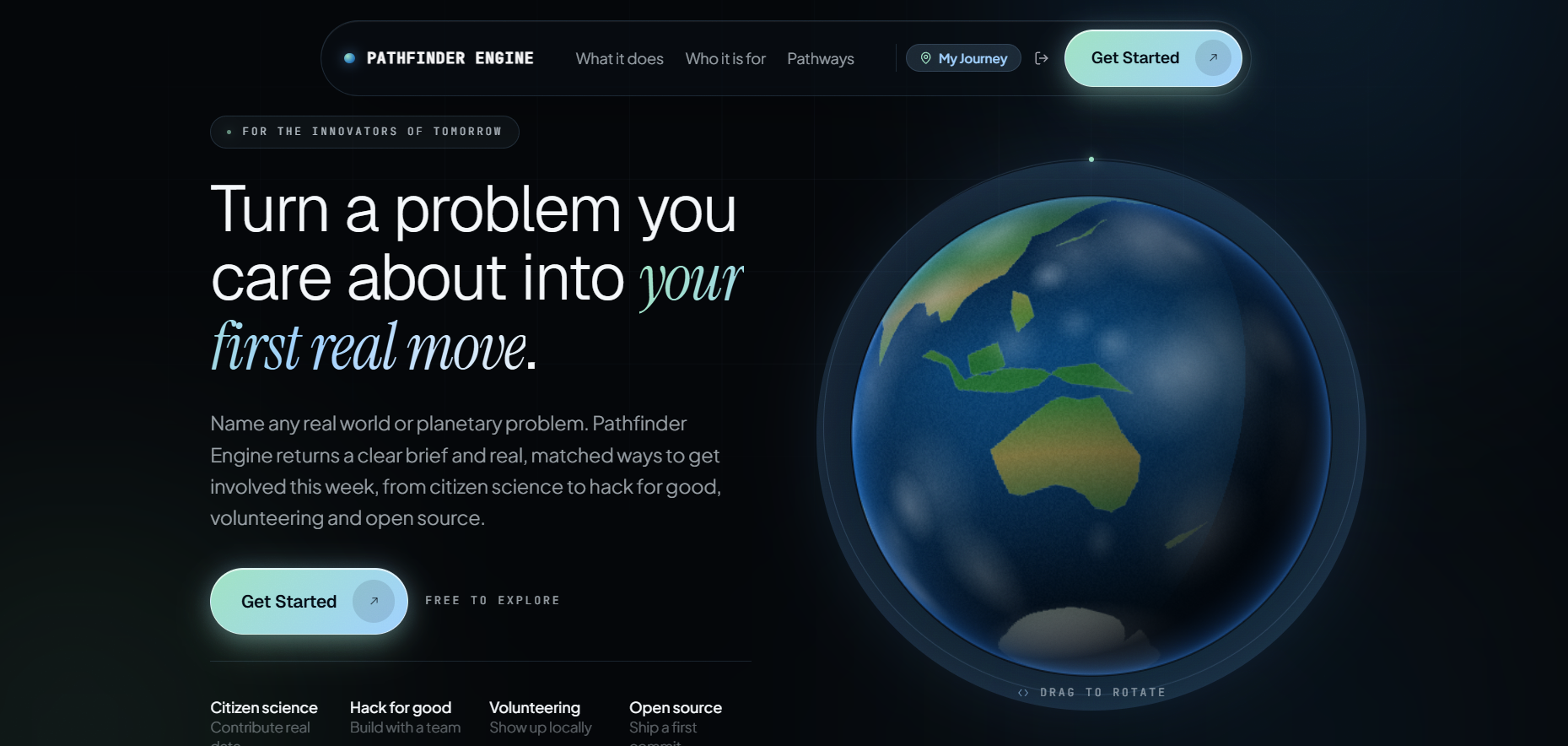
Pathfinder Engine turns any real-world or planetary problem into two things: a clear brief, and real, live ways to get involved.
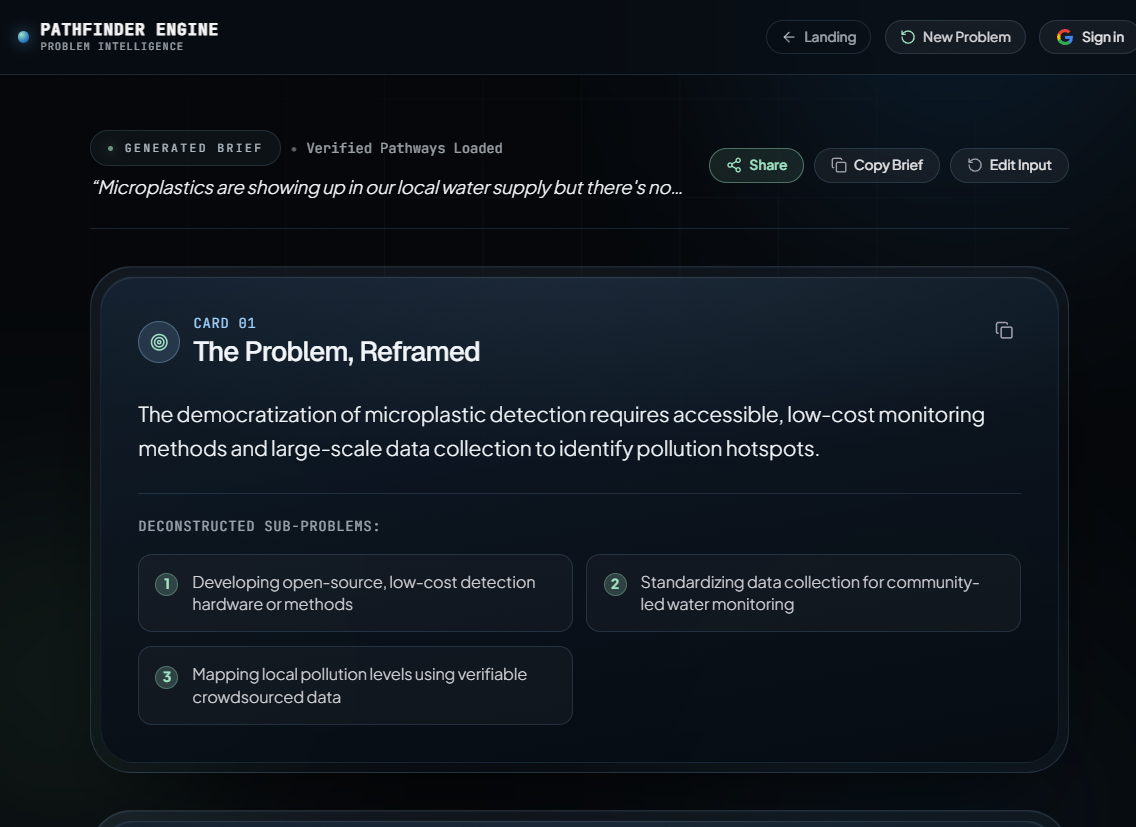
You describe a problem in plain language, even a messy half-formed one. The app returns a six-part brief: the problem reframed into its real sub-problems, the landscape of who is already working on it, the real gaps where a newcomer can matter, your pathways in, your single highest-leverage first move, and an invitation into the community.
The heart of it is the Pathways In. Instead of generic advice, the app runs live searches to find real, currently existing projects, investigations, and listings, and links you straight to them. The matches span citizen science, hack-for-good, OSINT and investigation, skilled volunteering, civic and open data, and humanitarian mapping. After the brief, you can open an AI assistant that already knows your problem and helps you start building toward a solution.
How we built it
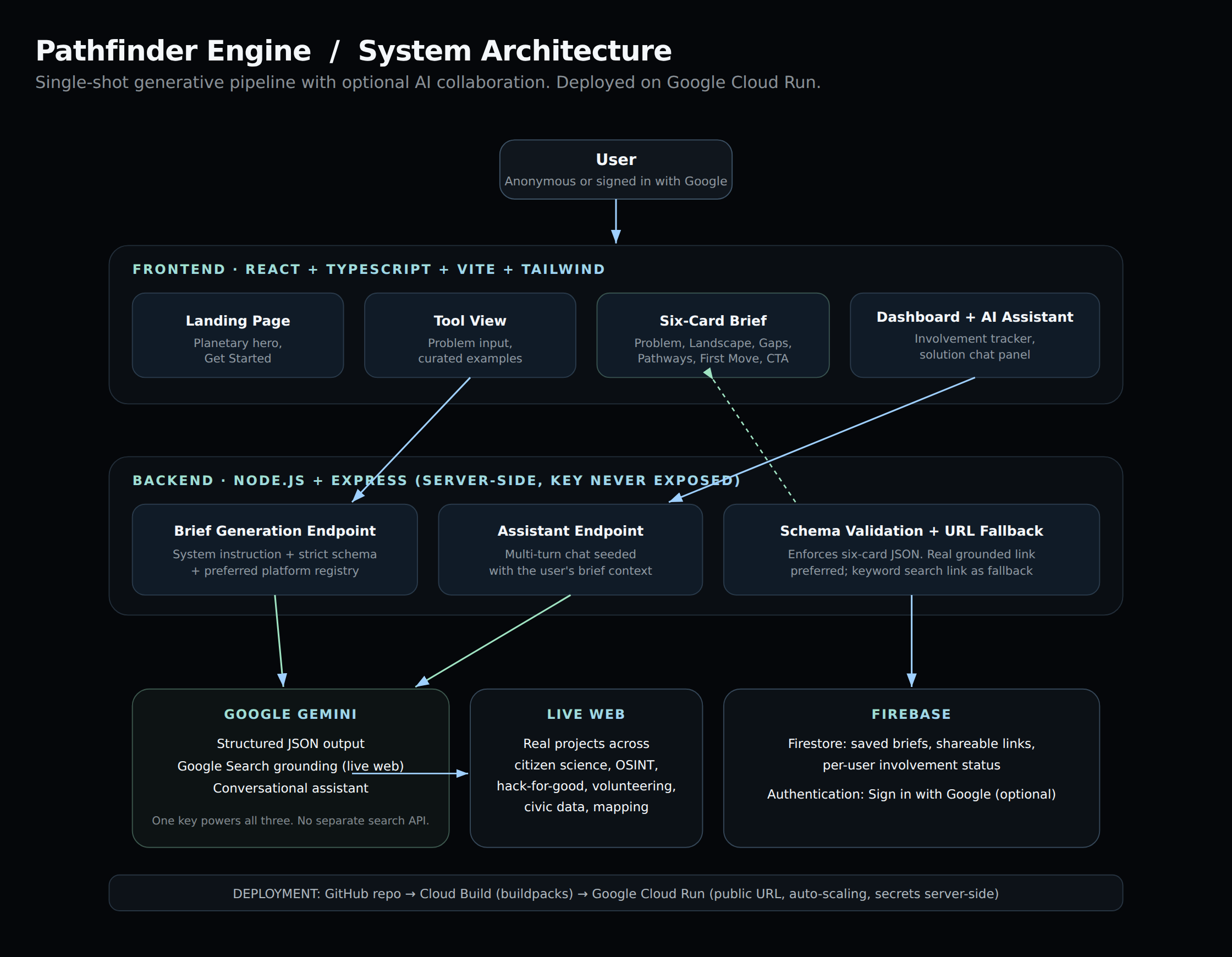
Pathfinder Engine is a full-stack app built and deployed entirely on Google infrastructure. The frontend is React with TypeScript and Tailwind, built with Vite, wrapped in a dark planetary theme. The backend is Node.js and Express, serving both the API and the built frontend from one service.
The intelligence is Google Gemini, called server-side. It uses structured JSON output against a strict schema so every brief renders reliably into the six cards, and Google Search grounding so the model runs live web searches during generation and returns real current sources instead of guesses. A separate Gemini conversation, seeded with the full context of the brief, powers the solution assistant. Firestore stores saved briefs and involvement status, and Firebase Authentication handles optional Google sign-in. The whole thing deploys to Cloud Run through Cloud Build, from a GitHub repo, with the API key held server-side.
Challenges we ran into
The honest answer is that most of the fight was not the AI, it was the plumbing. Getting the app from a working preview to a live public URL took real work: a container that would not pass its health check because it was listening on the wrong port, a production environment variable that had to be set exactly right, and a GitHub integration that broke and forced a manual deploy path.
The biggest lesson came from the search feature. I first tried to add real search through Google's Programmable Search API, and spent a long time fighting credential and project-permission errors before realizing Gemini's built-in Google Search grounding could do the same job using the key I already had. Even then, getting grounding to return real project links while still producing valid structured JSON took several iterations, because the app kept overwriting the real URLs with template-based search links. I also had to correct my own definition of one category from open-source software to open-source intelligence partway through.
Accomplishments that we're proud of
I am proud that it is genuinely live, deployed, and working, not a demo held together with tape. As a solo builder I took it from an idea to a full-stack app with a real theme, live AI-grounded results, persistent data, authentication, and an AI collaborator, all deployed on Cloud Run.
Most of all, I am proud that it actually does the hard thing it set out to do. When you click a pathway, it takes you to a real project where real people are doing the work right now. That single moment, where "verified pathways" is literally true and not marketing, is the thing I most wanted to build.
What we learned
I learned that shipping is a discipline separate from building. The gap between "it works on my screen" and "a stranger can open a URL and use it" is where most of the real work lives, and I learned to protect that by getting a live version deployed first and adding features on top of a working foundation, rather than polishing something that was not yet live.
I also learned to reach for the simplest capability that solves the problem. I nearly built an entire second search integration before discovering the model I was already using could do it natively. And I learned that a clear structure, a strict schema and a curated set of real destinations, is what lets an AI product feel trustworthy instead of vague.
What's next for Pathfinder Engine
Next is deepening the AI assistant into a real solution workspace, where each problem keeps its own ongoing thread. I want to grow the involvement tracker so people can move each pathway from Interested to Started to Active and watch their contribution history build over time. I plan to expand the registry with more regional and niche platforms, and to add community features that connect people working on the same problem. The long-term goal is for Pathfinder Engine to be the front door that turns anyone who cares into someone who contributes, and feeds a growing community of people solving real problems together.
Built With
- css
- express.js
- firebase
- firestore
- gemini
- git
- github
- google-ai-studio
- google-cloud-buildpacks
- google-cloud-run
- html
- javascript
- node.js
- react
- typescript
- vite

Log in or sign up for Devpost to join the conversation.