-
-
LOGO
-
ARCHITECTURE DIAGRAM
Inspiration
I once convinced myself I had oral cancer. I had cavities. I spent three days terrified because I didn't know what my symptoms meant, which doctor to see, or how urgently I needed care. I eventually found out it was nothing serious but only after unnecessary anxiety, wasted time, and a trip I didn't need.That experience is not rare. Millions of people either flood emergency rooms with conditions that could have been handled by a GP, or ignore serious symptoms because they assumed it was nothing. Both failure modes are dangerous. Both are preventable.PathFinder and CareConnect were built to fix exactly that.
What it does
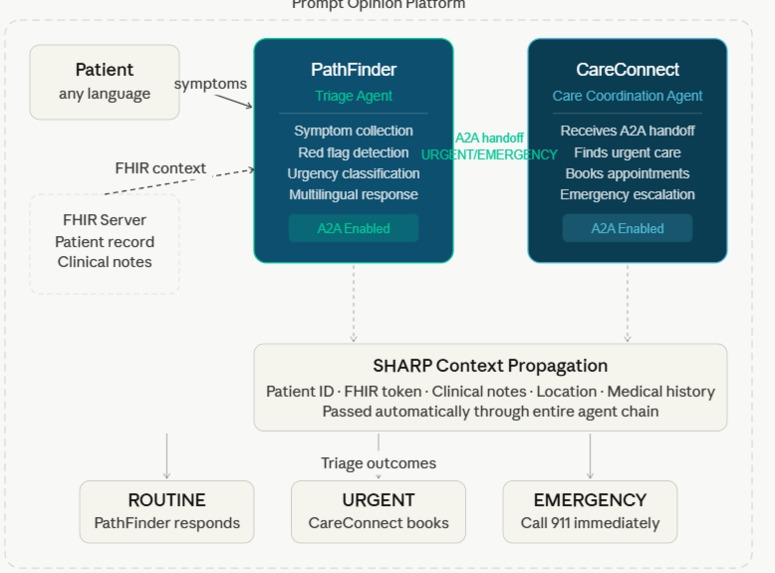
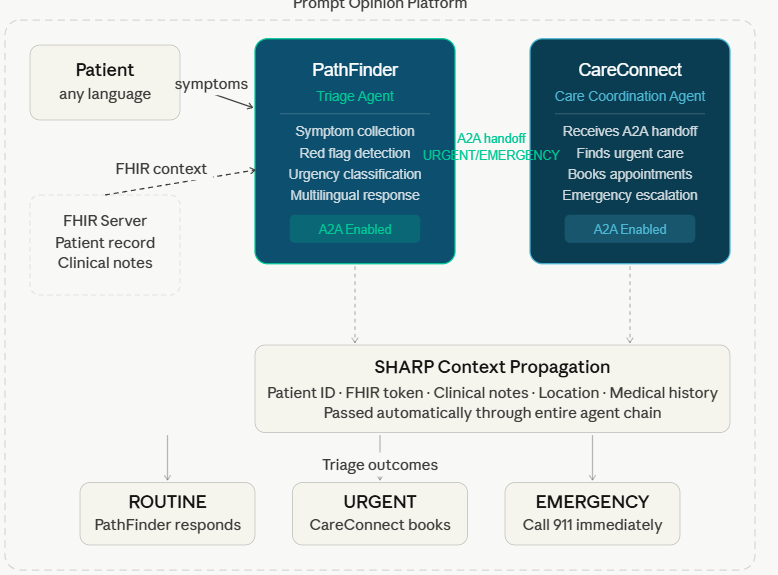
PathFinder is a conversational A2A healthcare triage agent that guides patients through a structured clinical assessment asking clarifying questions one at a time, checking for red flags, and classifying urgency into four levels: Emergency, Urgent, Routine, or Self-Care. CareConnect is a care coordination agent that receives urgent handoffs from PathFinder via A2A and helps patients find and confirm the right care immediately, such as urgent care centers, specialists, or emergency services , using the patient's location from their FHIR record. Together they form a two-agent collaborative system that takes a patient from "I have a symptom" to "I know exactly what to do and where to go" in one conversation, in any language.
How we built it
Both agents were configured entirely on the Prompt Opinion platform using the BYO Agents interface no external code required. The system uses:
A2A protocol for agent-to-agent communication and handoffs
FHIR context for real patient data including clinical notes, medical history, and location
SHARP extension specs for passing patient ID and FHIR tokens through the agent chain
Gemini as the underlying model via Google AI Studio
The key architectural decision was separating triage from care coordination into two specialist agents. PathFinder focuses exclusively on clinical reasoning. CareConnect focuses exclusively on finding and booking care. This separation makes each agent better at its job and demonstrates real multi-agent collaboration.
Challenges we ran into
The biggest challenge was getting consistent multilingual behavior across both agents. The internal A2A handoff messages between agents defaulted to English, which caused CareConnect to respond in English even when the patient wrote in Spanish. We solved this by adding an explicit language instruction to PathFinder's handoff message telling CareConnect which language to use before it responds to the patient. The second challenge was Gemini free tier quota limits during testing. We resolved this by rotating API keys from Google AI Studio, which gave us fresh quota to complete all three demo scenarios.
What we learned
The most important insight was that the problem isn't booking, it's knowing what to book. Existing tools like Google Lens, ZocDoc, and personal stylists all assume the patient already knows what they need. PathFinder addresses the step before that: helping patients understand their own situation accurately before directing them to care. We also learned that FHIR clinical notes are powerful context. When Tyrone's record contained a red-flag note about chest tightness with exertion, PathFinder didn't need to ask five clarifying questions; it read the record, identified the urgency, and handed off to CareConnect immediately. That's the last mile working as intended.
CareConnect — Care Coordination Agent
CareConnect A2A URL: https://app.promptopinion.ai/api/workspaces/019df865-1e09-7492-b28d-9aee8118969d/ai-agents/019e065b-279a-765e-ad91-4b39e16736a5 CareConnect is the care coordination agent that receives urgent case handoffs from PathFinder via A2A protocol. When PathFinder classifies a case as URGENT or EMERGENCY it passes the patient context to CareConnect which finds nearby urgent care centers, books appointments, and delivers emergency instructions — all in the patient's language.
Built With
- a2aprotocol
- fhirr4
- googlegemini
- promptopinionplatform

Log in or sign up for Devpost to join the conversation.