-
-
PathFinder AI
Inspiration
As Computer Science educators, we witness a recurring dilemma every semester: ambitious undergraduates master core theoretical algorithms and computer science fundamentals, yet struggle to pass entry-level technical interviews. Academic syllabi simply cannot update at the velocity of fast-evolving industry tech stacks.
We asked ourselves: What if an autonomous AI system could continuously analyze real-time job market requirements and automatically construct scaffolded, hands-on software engineering projects to bridge each student's specific skill gap? This challenge inspired us to build PathFinder AI.
What it does
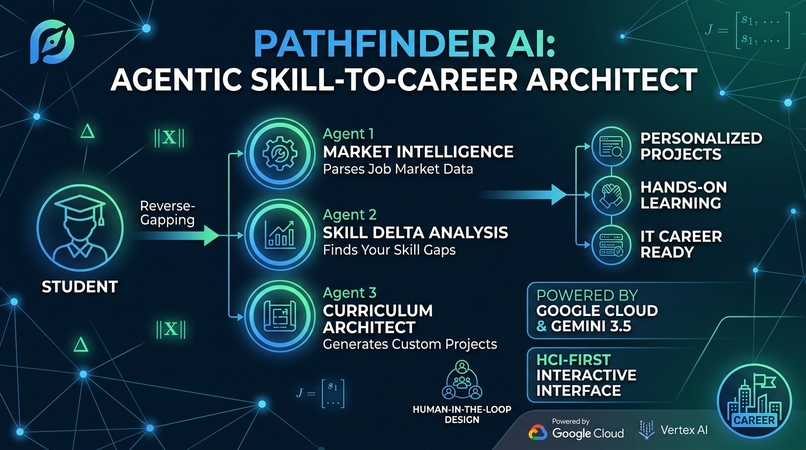
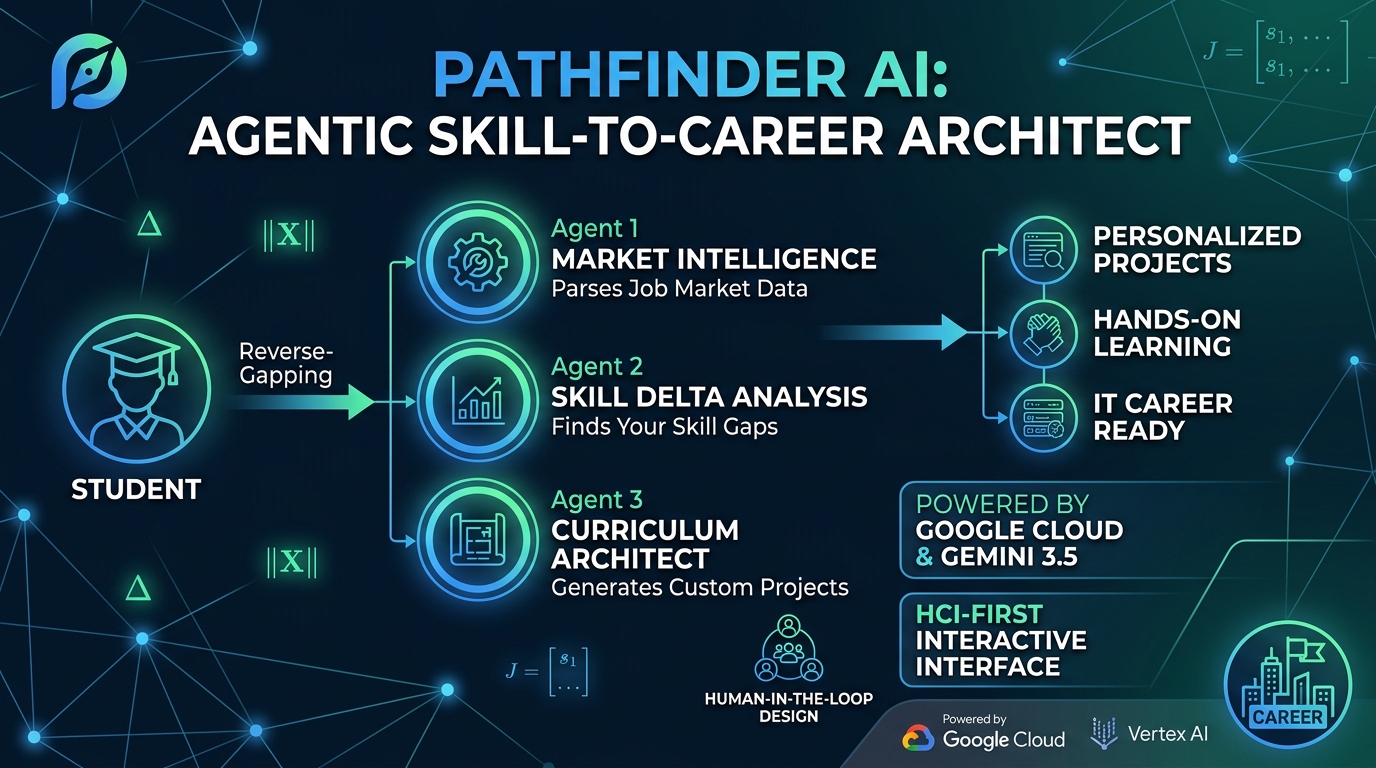
PathFinder AI is an autonomous, multi-agent platform that reverse-engineers real-time job market requirements into personalized, project-based learning journeys for entry-level CS undergraduates.
Scrapes & Parses Job Data: Extracts in-demand technical skills, tool stacks, and architecture concepts directly from entry-level tech job listings.
Calculates Skill Gaps: Compares a student’s current profile against live market demands using a mathematical vector similarity model.
Generates Experiential Curricula: Synthesizes custom, step-by-step software engineering projects designed to bridge the missing skill delta.
Provides a Steerable Interface: Offers an interactive canvas where students track milestones, inspect agent reasoning, and receive guided feedback without "black-box" opacity.
How we built it
PathFinder AI is powered by Google Cloud, Google Agent Development Kit (ADK), and Gemini 3.5, paired with a modern React canvas frontend built for optimal Human-Computer Interaction (HCI).
The system runs on three primary agentic layers:
Market Intelligence Agent: Analyzes raw job postings to build structured skill vector representations.
Skill Matrix & Gap Analysis Agent: Evaluates candidate profiles against target job vectors.
Curriculum & Project Architect Agent: Generates scaffolded software engineering projects tailored to student needs.
Mathematical Formulation & Skill Analytics
PathFinder models career readiness using vector projections in skill space. Let the target industry job requirements vector be defined as:
J = [ j₁, j₂, ..., jₙ ]ᵀ
where each jᵢ ∈ [0, 1] represents the required competency level for skill i. The student's validated proficiency vector is:
S = [ s₁, s₂, ..., sₙ ]ᵀ, where sᵢ ∈ [0, 1]
The agent calculates the Skill Delta Vector (Δ):
Δ = max(0, J − S)
To evaluate overall career compatibility, PathFinder computes an adjusted cosine readiness score:
Readiness Score = ( (S · J) / (||S||₂ ||J||₂) ) × ( 1 − ||Δ||₁ / ||J||₁ )
The Curriculum Architect Agent optimizes project generation by minimizing the remaining distance ||Δ||₁ across candidate projects P = {p₁, p₂, ..., pₖ} subject to student time constraints:
min || Δ − ∑ₖ pₖ ||₁ subject to ∑ₖ Cost(pₖ) ≤ Tₘₐₓ
Challenges we ran into
Challenges we ran into Agent Output Schema Rigor: Ensuring multi-agent loops reliably emitted valid JSON schemas for dynamic project tasks required building strict validation fallback routines within Google ADK.
Avoiding the "Black Box" UX: Autonomous agent execution can feel overwhelming. We designed custom UI state inspectors using React Flow to make intermediate agent decisions legible and steerable for students.
Token & Context Bloat: Processing dozens of raw job descriptions simultaneously overloaded LLM context windows. We resolved this by implementing structured pre-summarization pipelines prior to matrix mapping.
Accomplishments that we're proud of
Accomplishments that we're proud of End-to-End Autonomous Orchestration: Built a cohesive multi-agent pipeline using Google ADK that seamlessly bridges raw web data to actionable learning plans.
HCI-First Agent Design: Created a transparent user interface that shifts AI away from passive chat prompts toward active, visual workflow navigation.
Bridge for Academic-to-Industry Transition: Developed a high-impact application that directly addresses graduate employability with concrete software engineering tasks.
What we learned
Human-in-the-Loop is Essential: Autonomous agents perform best when students and educators retain control nodes to adjust project scopes and challenge levels.
Gemini 3.5 Multimodal Synergy: Leveraging Gemini's strong reasoning allowed us to effortlessly extract structured insights from non-standard job posts and visual system diagrams.
Project-Based Learning Drives Retention: Active system construction consistently outperforms static text tutorials for entry-level engineering preparation.
What's next for PathFinder AI: Agentic Skill-to-Career Architec
Agentic Skill-to-Career ArchitectGitHub Repository Integration: Autonomous analysis of student code repositories to automatically populate and update their initial proficiency vector.
Code Evaluation Agent: An embedded agentic code reviewer that grades submitted project milestones and provides real-time execution feedback.Educator & Institution Dashboard: Cohort-level analytics tools enabling university lecturers to identify widespread curriculum gaps and adjust department syllabi dynamically.
Built With
- actions
- agentic
- fastapi
- figma
- framer-motion
- gemini
- google-cloud-sql
- html5
- javascript
- json-mode-extraction
- next.js-(app-router)
- node.js
- python
- react
- stich
- syllabus-templates
- tailwind-css
- validated-skill-matrices

Log in or sign up for Devpost to join the conversation.