-
-
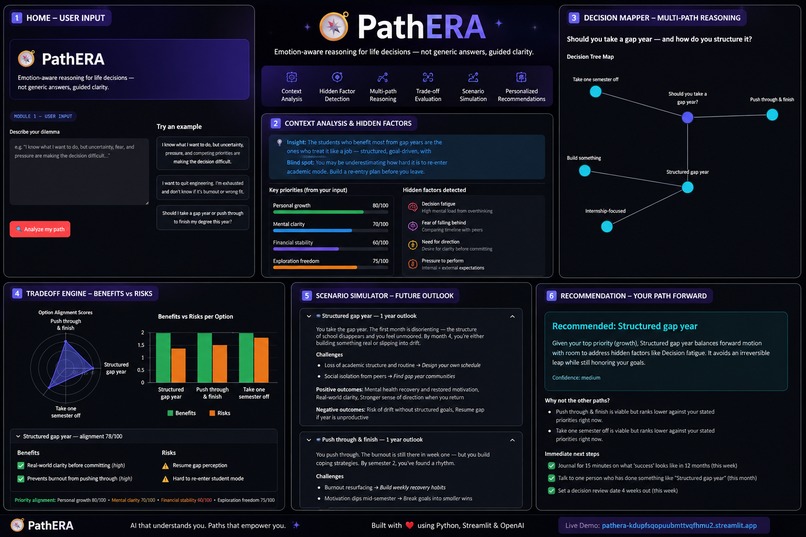
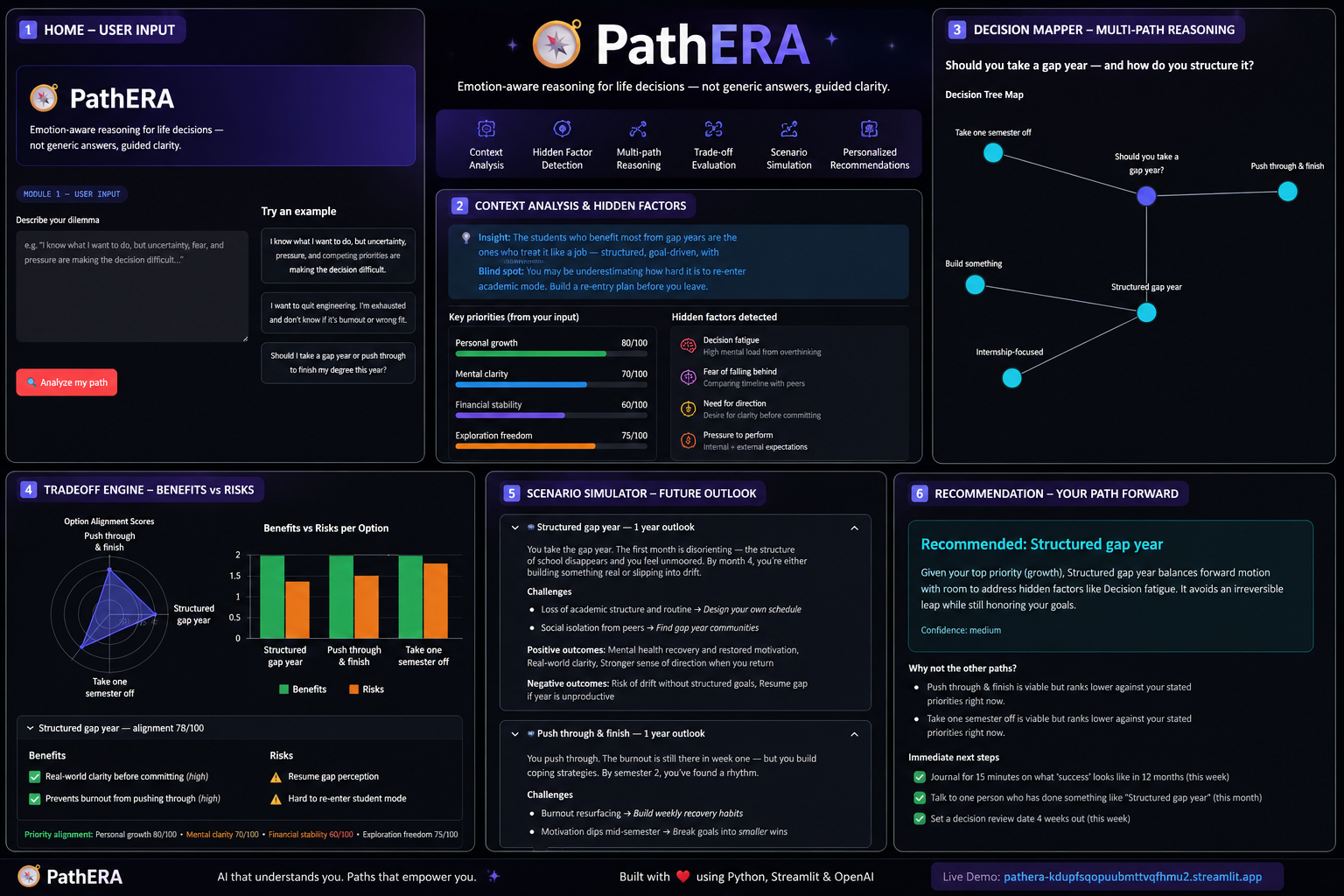
PathERA transforms uncertainty into clarity with emotion-aware reasoning, tradeoff analysis, and future simulations.
Inspiration
Students and young adults face some of the most important decisions of their lives with very little guidance. Whether it's choosing a career path, studying abroad, taking a gap year, or deciding whether to continue a degree, these choices often come with uncertainty, family pressure, financial concerns, and self-doubt.
Most AI tools provide direct answers, but they rarely consider the emotions, priorities, and hidden factors behind a decision.
We wanted to build something different.
PathERA was created to help people think through difficult life decisions with greater clarity, confidence, and self-awareness. Instead of telling users what to do, PathERA helps them understand why a particular path may be right for them.
What it does
PathERA is an Emotion-Aware Reasoning Assistant that guides users through a structured six-module decision pipeline.
Module 1 — User Input
The user describes a real-life dilemma in natural language.
Module 2 — Context Analyzer
PathERA identifies goals, constraints, emotions, stakeholders, and hidden factors influencing the decision.
Module 3 — Decision Mapper
Multiple possible paths are generated instead of a single generic answer.
Module 4 — Tradeoff Engine
Each path is evaluated through benefits, risks, and priority-alignment scores.
Module 5 — Scenario Simulator
Users can explore realistic future outcomes and challenges for each option.
Module 6 — Recommendation Engine
A personalized recommendation is generated based on the user's own priorities and circumstances.
How we built it
PathERA was built using Python and Streamlit with a modular architecture where each reasoning module feeds into the next.
The application supports:
- Demo Mode for offline hackathon demonstrations
- Live AI Mode using OpenAI APIs
- Structured JSON reasoning pipelines
- Interactive visualizations and decision analysis
Tech Stack
- Python
- Streamlit
- OpenAI API
- Plotly
- NetworkX
Challenges we ran into
One of our biggest challenges was making the system feel genuinely personalized rather than generating repetitive advice.
We spent significant time designing prompts and reasoning structures that could distinguish between different dilemmas. For example, "I want to study abroad" should produce very different reasoning than "I want to quit engineering."
Another challenge was identifying hidden emotional drivers such as burnout, fear of failure, social pressure, or uncertainty without explicitly being told about them.
We also worked on handling vague or unusual inputs gracefully while keeping the experience simple and understandable.
Accomplishments that we're proud of
- Hidden factor detection that surfaces underlying emotional influences
- Explainable reasoning instead of black-box recommendations
- Personalized tradeoff analysis based on user priorities
- Scenario simulation for future outcomes
- A fully working live web application deployed with Streamlit
What we learned
Building PathERA taught us that explainability is just as important as intelligence.
Users are more likely to trust AI systems when they can understand the reasoning process behind recommendations.
We also learned that prompt engineering, structured outputs, and user experience design play a critical role in creating AI systems that feel useful and trustworthy.
What's next for PathERA
Our future plans include:
- Expanded support for more life and career decisions
- User accounts and decision tracking
- More advanced AI reasoning capabilities
- Improved visualizations and interactive simulations
- Mobile-friendly experiences
PathERA is our step toward creating AI systems that don't simply answer questions—but help people navigate life's most important decisions with clarity and confidence.


Log in or sign up for Devpost to join the conversation.