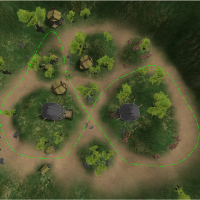
One of the main uses of artificial intelligence in games is to perform path planning, the search for a sequence of movements through the virtual environment that gets an agent from one location to another without running into any obstacles. In order for an agent to engage in path planning, there must be a topography for the agent to traverse that is represented in a form that can be efficiently reasoned about.
The simplest topography is a grid. Grid topologies discretize the environment and assumes an agent can be in one discrete cell or another. However, for many games such as 1st-person shooters, a more continuous model of space is beneficial. Depending on the granularity of the grid, a lot of space around obstacles becomes inaccessible in grid-based approaches. Finally, grids result in unnecessarily large number of cell transitions.
A path network is a set of path nodes and edges that facilitates obstacle avoidance. The path network discretizes a continuous space into a small number of points and edges that allow transitions between points. However, unlike a grid topology, a path network does not require the agent to be at one of the path nodes at all times. The agent can be at any point in the terrain. When the agent needs to move to a different location and an obstacle is in the way, the agent can move to the nearest path node accessible by straight-line movement and then find a path through the edges of the path network to another path node near to the desired destination.
In this project, I am provided with different terrains with obstacles and hard-coded path nodes. I must write the code to generate the path network, as a set of edges between path nodes. An edge between path nodes exists when (a) there is no obstacle between the two path nodes, and (b) there is sufficient space on either side of the edge so that an agent can follow the line without colliding with any obstacles.

Log in or sign up for Devpost to join the conversation.