-
Sample Map
Inspiration
Drawing inspiration from real-world emergency response protocols—especially those developed by the Navy—PathHero blends mapping technologies with AI to revolutionize training scenarios. The project recognizes that real-time decision-making is incredibly difficult for first responders—including firefighters—who often must navigate unfamiliar environments under stress and limited visibility. By providing automated route planning and dynamic scenario analysis, PathHero aims to alleviate the cognitive load of emergency personnel, ensuring they can focus on critical tasks rather than manually plotting escape or firefighting routes.
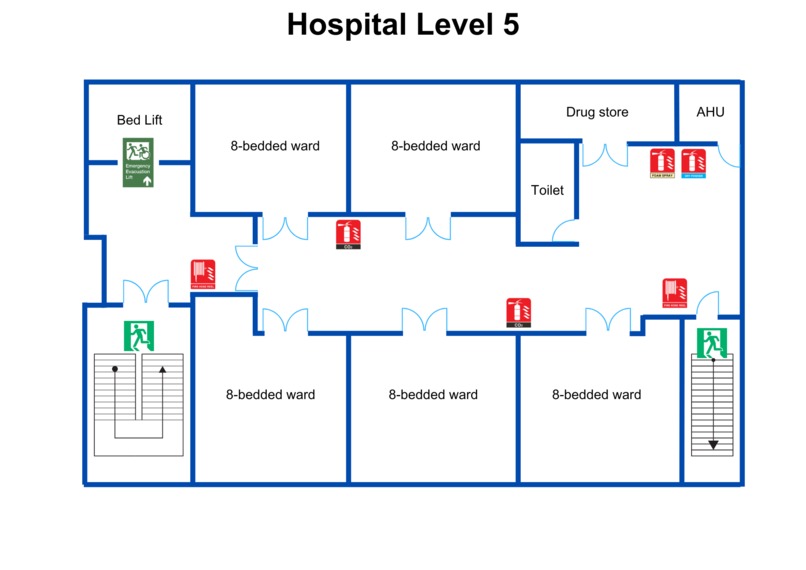
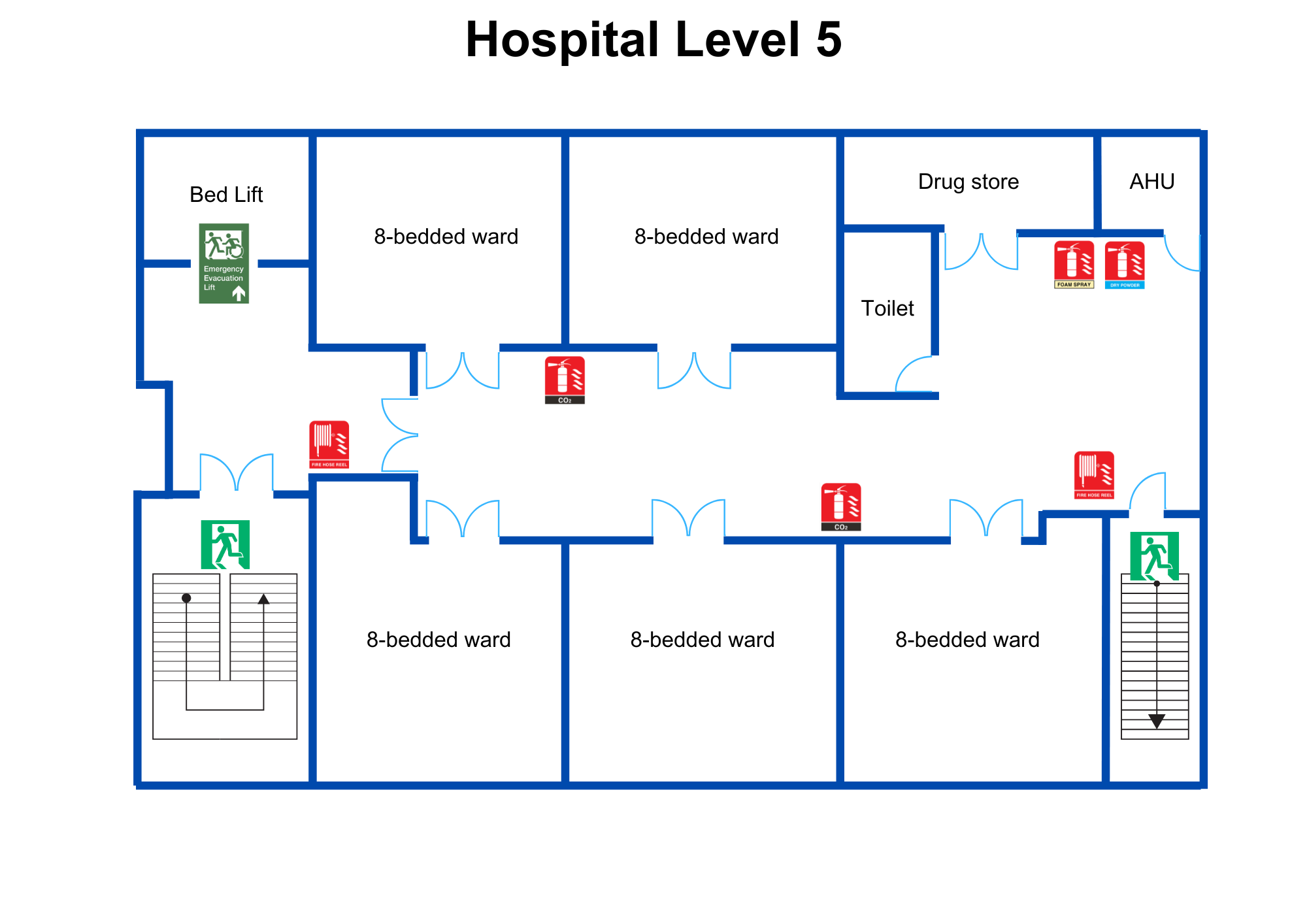
Detailed floor plan analysis: Similar to military-style readiness, the system dissects floor layouts to highlight critical areas such as escape routes, key safety assets (e.g., extinguishers), and hazardous zones.
Dynamic scenario injection: Inspired by how military training injects situational challenges, the platform leverages LLMs and ML to simulate various crisis scenarios in real time.
Practical risk mitigation: Emphasizing realistic emergency response tactics—from containment strategies like boundary cooling to full-scale extinguishment—the project mirrors the rigor and adaptability required in real-life operations.
What it does
Floor Plan Input:
- Users choose a floor plan uploading a digital file.
Automated Map Processing:
- Preprocesses the map to detect key objects such as extinguishers, staircases, and rooms. It extracts symbols, locations, and contextual descriptions.
Evacuation and Risk Analysis:
- The system computes evacuation routes from each room and identifies high-risk zones. Each route consists of a sequence of coordinates that guide safe exits.
Dynamic Crisis Simulation:
- A dedicated frontend form allows users to initiate fires by selecting fire types. The application then estimates the fire class, suggests appropriate extinguishing agents (e.g., water for solid fires, foam for liquid fires), and generates both evacuation and firefighting routes using a mix of advanced pathfinding and LLM response templating.
Live Scenario Injection:
- Leveraging LLMs and an interactive frontend interface, the system can inject live scenarios via text cues, marking hazards on the map and outputting instructions and paths specific to the updated scenario. This feature reduces risks during evacuation planning.
How we built it
- Planning which features needed to be built
- Standardizing data and UI
- Building, testing and re-prototyping on the fly
Challenges we ran into
- We had to pick up leaflet JS in less than six hours due to unfamiliarity with shape rendering in HTML.
- Mapping frontend and backend requirements and splitting tasks evenly
Accomplishments that we're proud of
- Implementing generic OpenCV and image/edge detection models to parse input floor maps into HTML shapes that worked on various maps
- Picking up leaflet JS in such a short amount of time
What we learned
Integration Complexity: Merging classical AI methods (like A* and Dijkstra’s algorithms) with modern reinforcement learning and LLMs is challenging but feasible, providing a robust foundation for real-time decision-making.
User-Centric Design is Crucial: While automation in map processing is powerful, enabling manual editing ensures that inaccuracies (e.g., in floor plans) can be corrected, enhancing overall reliability and usability.
Real-time Data Enhances Simulation: Incorporating live inputs (such as CCTV imagery) adds valuable context, allowing the system to dynamically update hazard assessments and casualty counts for more realistic simulations.
Scalable Architecture: The division between frontend and backend tasks—from form submissions and map editing to ML-based preprocessing—has highlighted the importance of scalable, decoupled system design for rapid prototyping and deployment.
What's next for Path Hero
Enhanced ML Integration: Experiment with more advanced reinforcement learning models and integrate additional sensor data, making hazard detection and route optimization even more accurate.
Live Scenario Enhancements: Develop more interactive scenario injection features, potentially including audio prompts via LLMs for a fully immersive training experience.
Broaden Application Domains: Extend the platform’s use cases beyond traditional buildings to specialized environments such as hospitals, shopping complexes, and multi-use venues, addressing unique challenges in each setting.
Advanced Visualization Tools: Enhance the frontend with richer, more dynamic mapping capabilities using libraries like Leaflet, to offer real-time updates and finer control over the simulation environment.
Built With
- astar
- fastapi
- gemini
- javascript
- leaflet.js
- ocr
- opencv
- pathfinding
- python
- svelte
- tesseract
- typescript
- vite


Log in or sign up for Devpost to join the conversation.