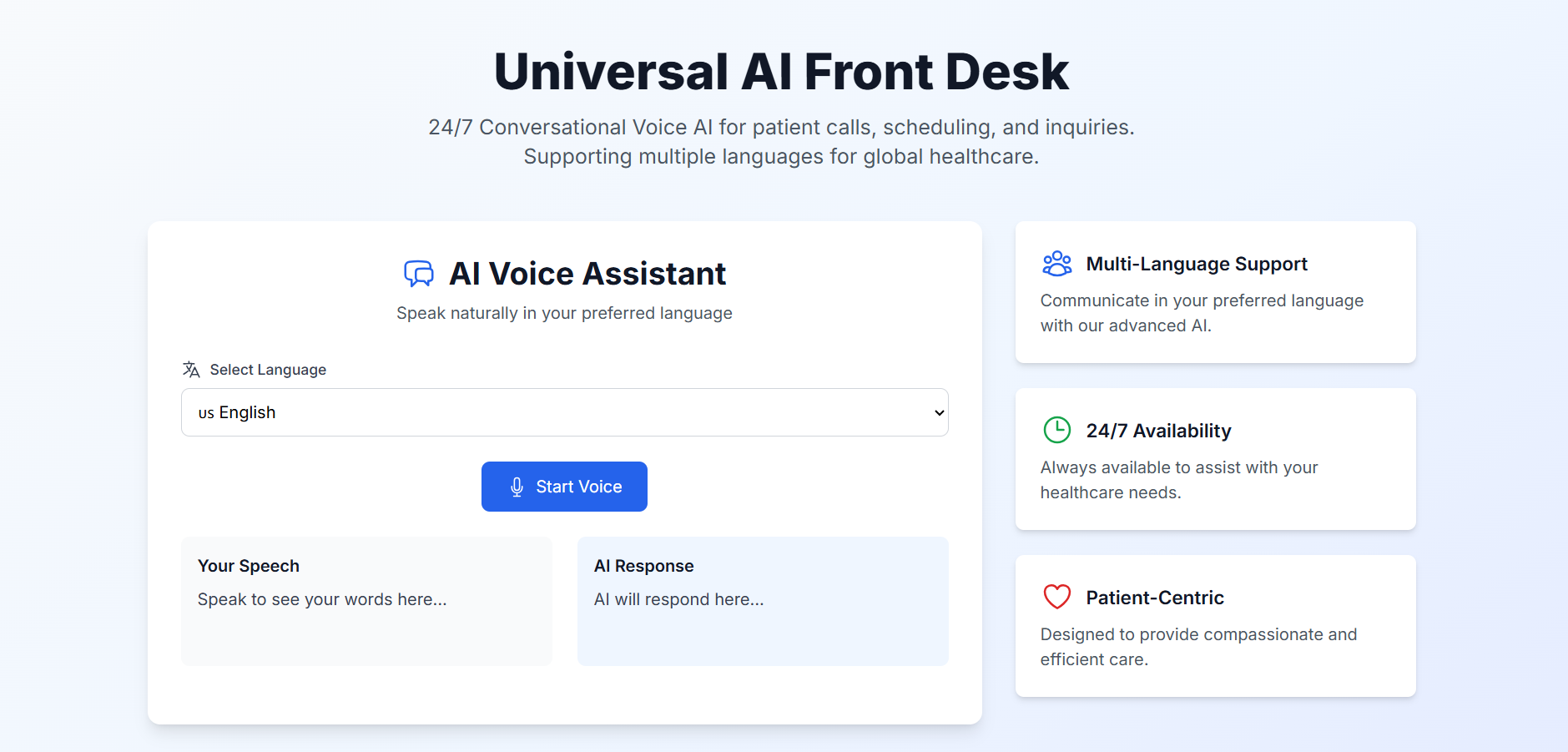
🏥 PatientDesk.ai – Conversational Voice AI Front Desk
🚀 Inspiration
The idea for PatientDesk.ai came from observing real-world inefficiencies in healthcare communication systems. Many clinics and hospitals still rely heavily on manual front-desk operations, where staff handle appointment scheduling, patient queries, and intake processes over phone calls.
This often leads to:
Long waiting times 📞 Miscommunication due to language barriers 🌍 Overburdened staff 😓
We envisioned a “universal AI front desk” that could:
Handle patient interactions automatically Work across multiple languages Provide accurate, real-time responses
The goal was simple:
Make healthcare communication faster, smarter, and accessible to everyone.
📚 What We Learned
While building this project, we explored multiple domains:
🧠 Artificial Intelligence Concepts Natural Language Processing (NLP) for understanding patient queries Speech Recognition to convert voice → text Text-to-Speech (TTS) for human-like responses Intent Classification using machine learning 🌐 System Design Designing real-time conversational systems Handling multi-language inputs Managing scalable backend workflows 📊 Mathematical Insight
We used probability-based intent detection:
P(Intent∣Input)= P(Input) P(Input∣Intent)⋅P(Intent)
This helped us predict the most likely user intent from spoken input.
🛠️ How We Built the Project
- 🎙️ Voice Input Processing Integrated Speech-to-Text APIs to capture patient speech Supported multiple languages for accessibility
- 🧠 Intent Detection Engine Built a model to classify intents such as: Appointment booking Rescheduling General inquiry Used NLP pipelines: Tokenization Named Entity Recognition (NER) Intent classification
- ⚙️ Backend Workflow Automation Designed logic to: Check doctor availability Schedule appointments Store patient data securely
- 🔊 Response Generation Generated natural responses using: Predefined templates + AI-generated text Converted responses into voice using TTS
- ☁️ Deployment Architecture Cloud-based system for scalability Real-time processing using APIs Modular structure: Voice Module AI Engine Database ⚡ Challenges We Faced
- 🌍 Multi-language Understanding Handling different accents and dialects was difficult Solution: trained models with diverse datasets
- 🎯 Accurate Intent Detection Similar phrases led to confusion Example: “book appointment” vs “check appointment” Solution: improved training data + contextual analysis
- ⏱️ Real-Time Processing Ensuring low latency during live calls Solution: optimized API calls and lightweight models
- 🔐 Data Privacy Healthcare data is sensitive Implemented: Secure storage Encrypted communication
- 🗣️ Natural Conversation Flow Early responses felt robotic Solution: Added conversational tone Context-aware replies 🌟 Conclusion
PatientDesk.ai demonstrates how AI can transform healthcare communication by acting as a smart, multilingual voice assistant.
It:
Reduces workload on staff Improves patient experience Ensures accessibility across languages
This project taught us not just technical skills, but how technology can create real-world impac Inspiration

Log in or sign up for Devpost to join the conversation.