-
-
1-overview
-
2-real-world-results
-
3-how-it-works
Inspiration
AI coding tools write a plausible fix and leave you to check it. A wrong fix that looks right costs more than no fix. We wanted to move the trust from the model to code: the model proposes, plain code judges. And because the biggest model is expensive, we wanted to measure exactly where it is worth paying for.
What it does
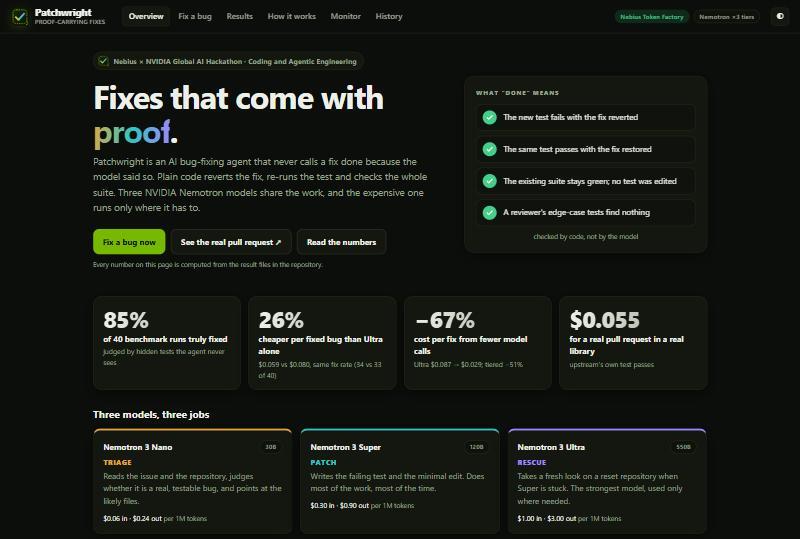
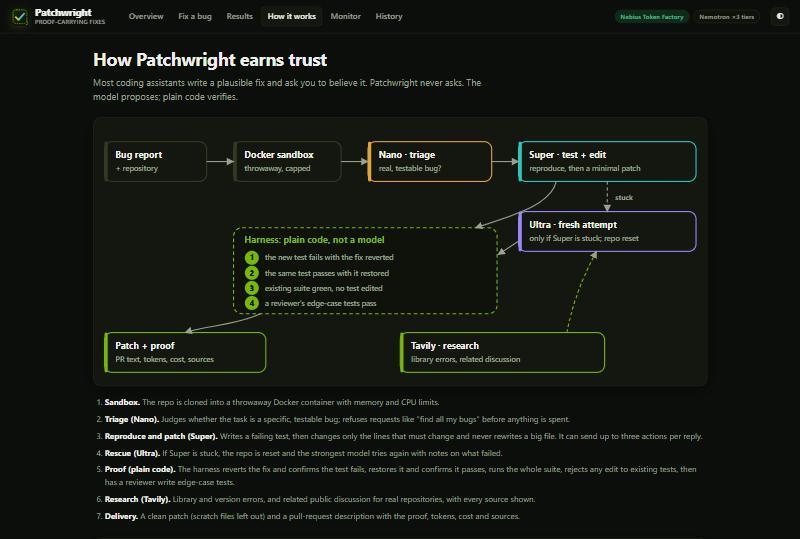
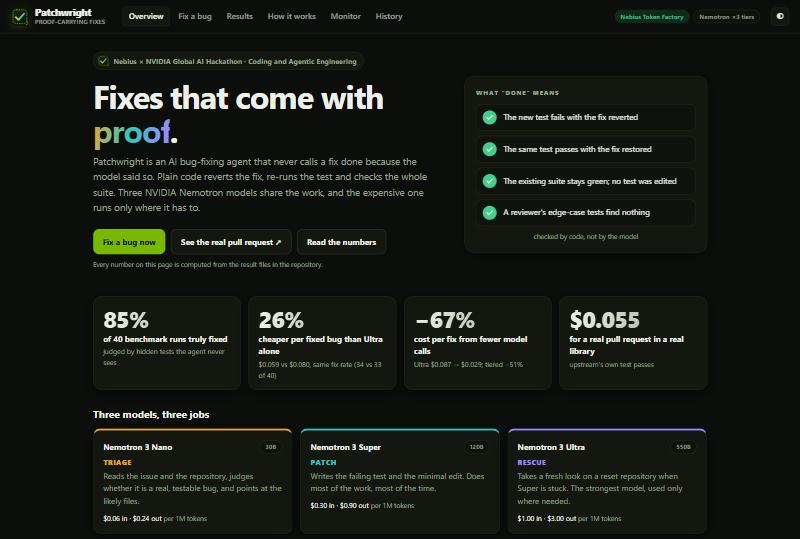
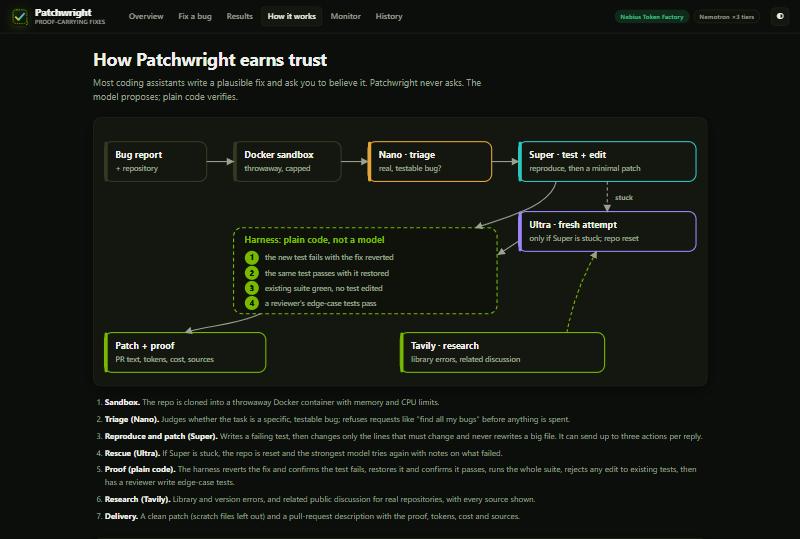
Patchwright takes a bug report and a repository, reproduces the bug in a Docker sandbox, writes a failing test, fixes the code, and only reports success when an independent harness confirms all of this:
- the new test fails with the fix reverted,
- the same test passes with the fix restored,
- the project's existing suite still passes and no existing test was edited,
- a reviewer's edge-case tests find nothing.
It delivers a clean patch (scratch files left out) and a pull-request description with the proof, tokens, cost and sources. It never merges anything.
Three NVIDIA Nemotron 3 models on Nebius Token Factory share the work: Nano (30B) triages and judges whether the task is a real, testable bug; Super (120B) writes the failing test and the minimal edit; Ultra (550B) takes a fresh attempt on a reset repository only when Super is stuck.
A real bug in a real library
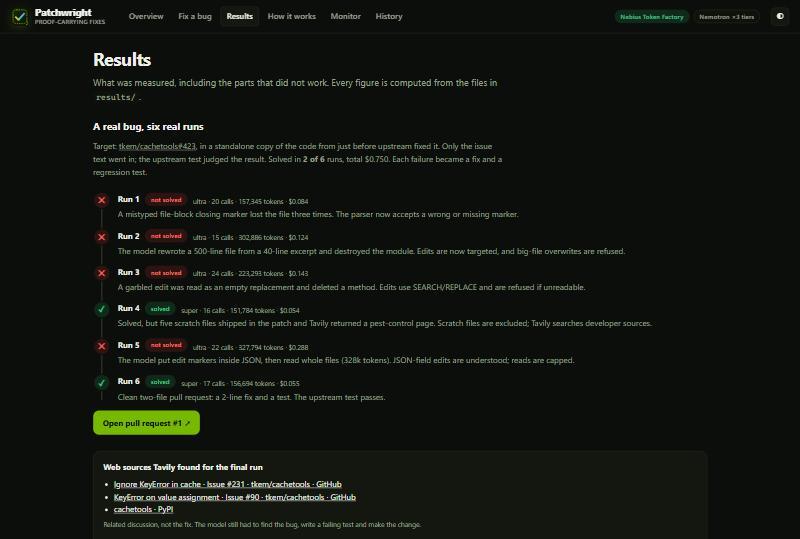
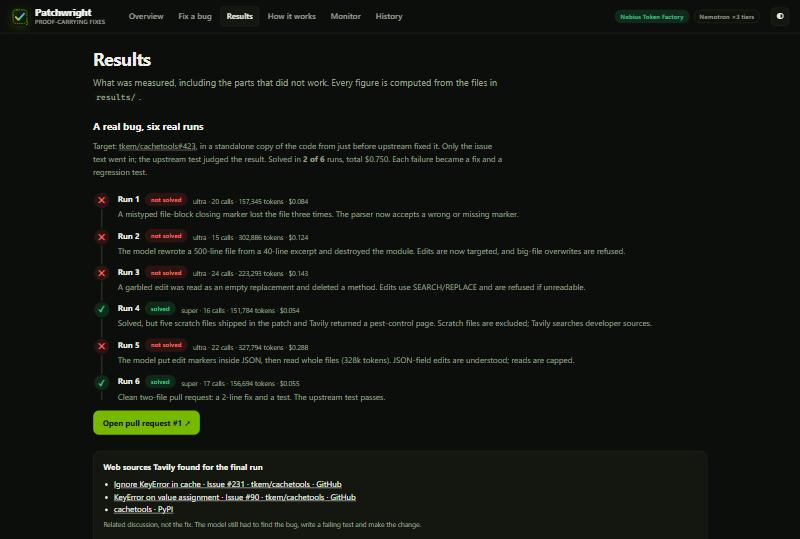
We ran it on a real, closed upstream issue (tkem/cachetools#423) using only the issue text, and judged the result with the upstream project's own test, which the agent never saw. Result: a real pull request with a 2-line fix and a test, written by Nemotron 3 Super in 14 steps for about $0.055. It took seven runs; two solved it. Each of the five failures exposed a real flaw in Patchwright (a destructive whole-file rewrite, a garbled edit that deleted a method, scratch files in the patch, wandering through huge files). We fixed each with a regression test and published all seven runs.
What we measured (real Nebius billing prices)
On 20 bugs with hidden tests, 40 runs per strategy, compared on the same runs:
- Super alone fixes 50% of the bugs, Ultra alone 82.5%, tiered (Super then Ultra) 85%. Tiered matches Ultra's fix rate at about 26% lower cost per fixed bug ($0.059 vs $0.080), because Ultra costs about 3.3x Super per token.
- The biggest lever was not the router, it was fewer model calls: the whole conversation is re-sent on every call, so about 75% of tokens are prompt tokens. Letting the model send up to three actions per reply cut cost per fixed bug by 51% (tiered, $0.048 to $0.024) and 67% (Ultra-only, $0.087 to $0.029) on the same 20 bugs, with no loss in fix rate (19 of 20 each).
- A negative result, reported honestly: asking Nano to rate difficulty did not predict which bugs a larger model would fail, so difficulty routing added nothing. Nano was reliable at refusing non-bug requests (10 of 10 in a small check) and wrongly refused 1 of 5 real bugs, so the app offers "Run anyway".
How we built it
Python, FastAPI and a no-build single-page front end; a Docker sandbox per run; an OpenAI-compatible client for Token Factory; a harness that reverts and restores the fix itself; a 20-bug benchmark with hidden tests and reference-fix validation; spend limits and loop protections tested with a scripted fake model so they cost nothing; 132 tests and CI.
Tavily is used by the harness itself, not just offered to the model: when a command fails with a library or version style error it searches for it, and for a real repository it looks up related discussion and official docs before the model starts. Every query and source is shown in the live view and in the pull request. Measured: on the synthetic benchmark the docs lookup cost 26% more tokens for no gain, so it is real-repo only; on cachetools it found related issues and docs, not the fix.
Challenges
Our first real-world batch fixed 0 of 7, mostly our own fault: Nemotron 3 reasons by default and used the whole reply budget in an agent loop (turned off: 37 tokens and 1 s instead of 3,000 tokens and 28 s with no answer); models invented action names, so we moved to native tool calling; they read whole files instead of editing, so we improved code localization; old test suites already failed, so a fix is judged on the failures it adds.
What we learned
Measure the cost of a fix, not a call; publish the failures.
Honest limits
The 20-bug benchmark is synthetic: the final code fixes 18/20 for about $0.01 per fixed bug. On real issues (Patchwright-RW: boltons, tabulate, toolz, judged by upstream tests) 3 of 14 runs were fixed, and the cachetools PR task 2 of 7. Small samples; Python projects with tests only.
What's next
More languages, a larger real-world set, PRs from the UI. Built from 2026-10-20. Code: https://github.com/rohith95-p/patchwright (MIT).
Built With
- docker
- fastapi
- github-actions
- javascript
- nebius-token-factory
- nvidia-nemotron
- pytest
- python
- tavily


Log in or sign up for Devpost to join the conversation.