Inspiration
Teams set up automations to keep important business data up to date. Then a source system changes its website, someone renames a field, or the structure of incoming data shifts. Suddenly, records stop arriving, and someone has to figure out what broke, fix the mapping, and track down everything that came in while it was broken.
We built Patchwork around a question: What if setting up an integration meant showing it a few examples, and fixing it meant approving a change?
What it does
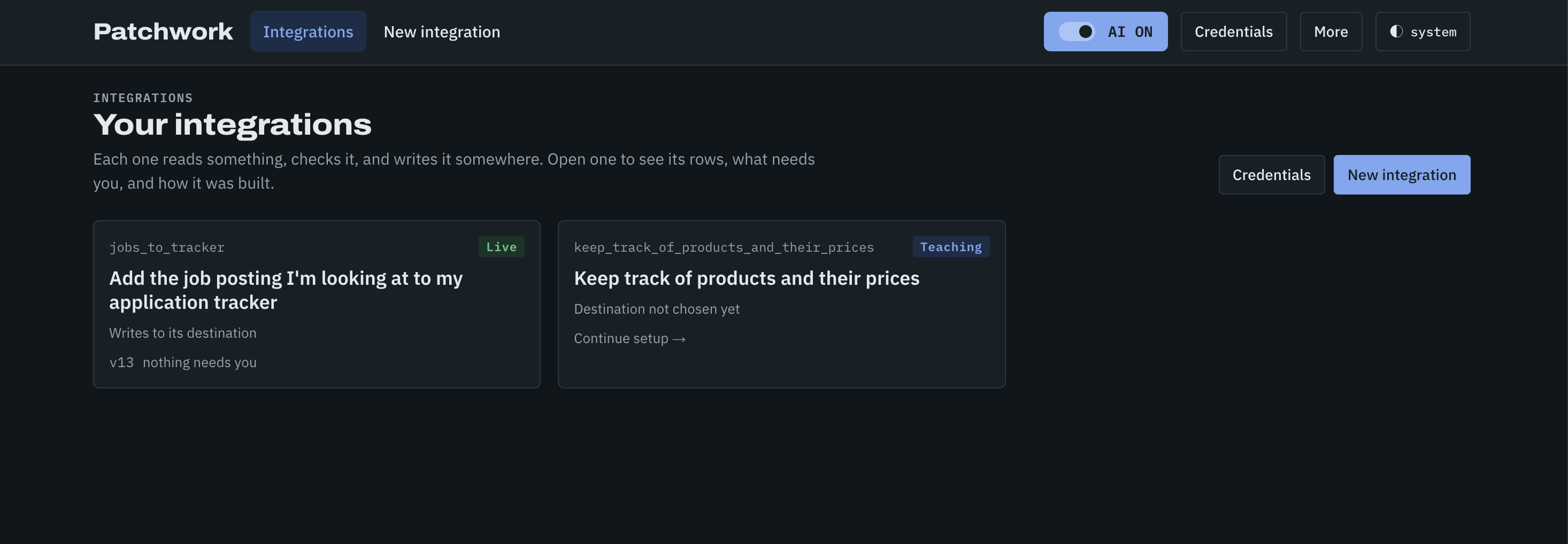
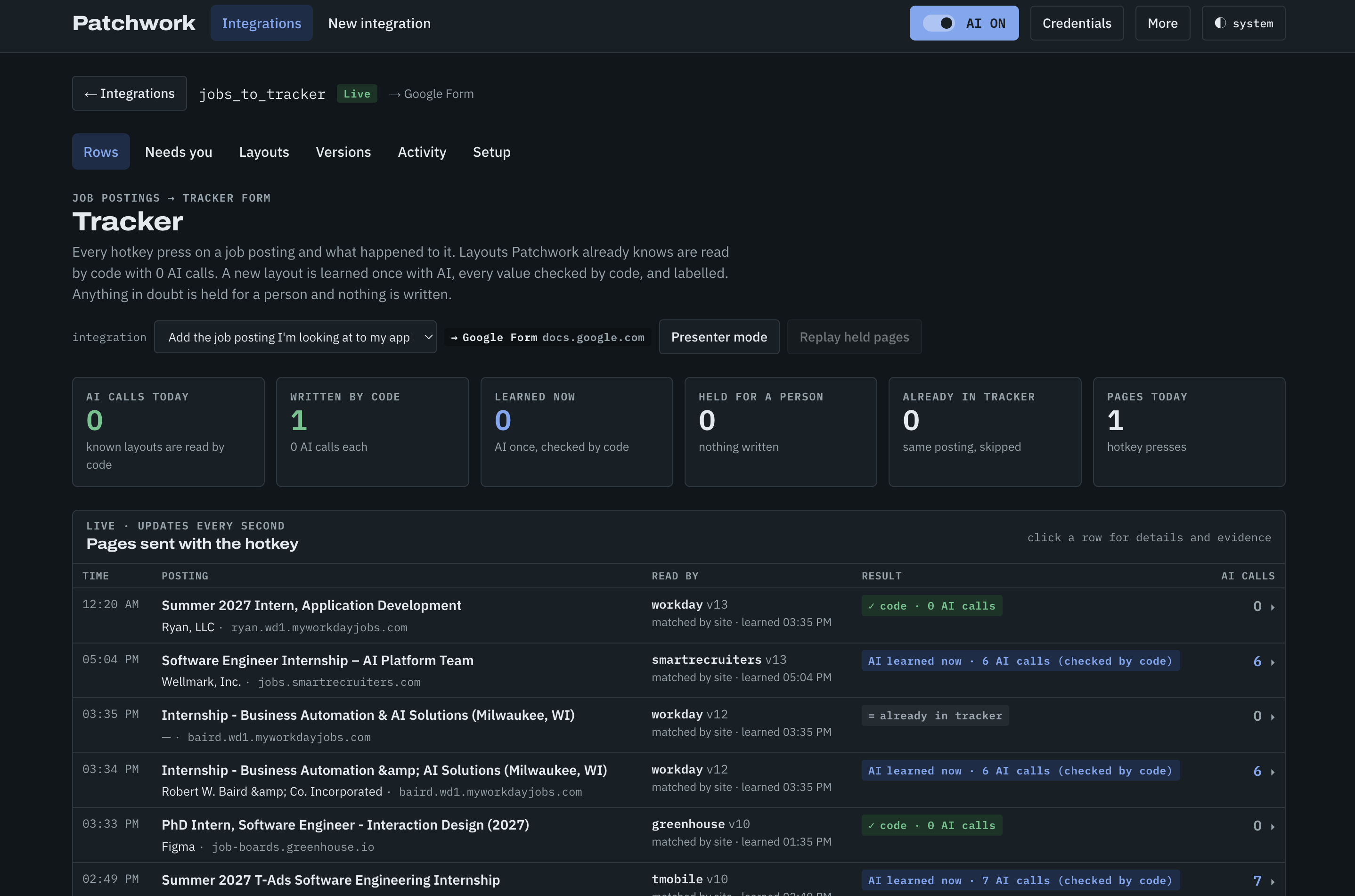
Patchwork moves data from websites and APIs into tools teams already use, including Airtable, forms, and databases. You choose a destination and show Patchwork example records. It proposes where each value should go, shows the values it found, and asks for help when it needs a decision. Once approved, the integration runs without calling an AI model for each record.
When a destination changes, Patchwork can hold the affected record, propose a repair, and replay the original after approval. In our purchasing tracker demo, a teammate can rename Price to Unit Price in Airtable and watch the next product get held, reviewed, and delivered to the renamed field.
How we built it
We built a browser extension to capture source pages, a React interface for setup and review, and a FastAPI backend. A single AI agent uses tools to inspect examples and propose field mappings and repairs. Those tools check the proposed changes and update a YAML integration spec.
A Jinja compiler turns the approved spec into Python code. That code runs in a separate process without model credentials. It extracts and validates values, checks for duplicates, sends the record, and verifies the result.
Challenges we ran into
A field can pass a type check and still be wrong. Unit Price and Total Price are both valid numbers, but swapping them can throw off a purchasing tracker. We built the review around concrete example values so a person can see what a mapping would actually write.
Recovery was another challenge. Fixing a mapping also had to account for the records that arrived before the fix. We kept the original input available for replay and made runs for the same integration execute one at a time to guard against duplicate writes.
Accomplishments that we're proud of
We got the full loop working: teach an integration from examples, approve the mapping, and send a fresh record through the compiled runner. We also built an end-to-end test that changes a destination field, checks that the affected record is held, and verifies that the same record lands after the repair is approved.
What we learned
Examples made setup easier, and they made review faster. Seeing the actual value next to a destination field gave people something concrete to check. We also learned to design for the second run: somewhere to see why a record was held, a way to fix the mapping, and a way to replay the original.
What's next for Patchwork
We want to bring the same workflow to finance documents that arrive by email. Our next goal is to build an end-to-end accounts payable system that automatically monitors shared inboxes, classifies incoming documents, extracts vendors, purchase orders, line items, tax details, payment terms, and banking information, validates invoices against purchase orders and receiving records, detects duplicates and fraud risks, routes exceptions to the right reviewers, updates the ERP, schedules approved payments, and preserves a complete audit trail with the original documents and every decision made.
Built With
- airtable
- anthropic-claude
- chrome
- deep-agents
- fastapi
- google-docs
- jinja
- langchain
- langgraph
- openapi
- openrouter
- playwright
- pydantic
- python
- react
- sqlite
- tailwind-css
- typescript
- vite
- yaml
