-
-
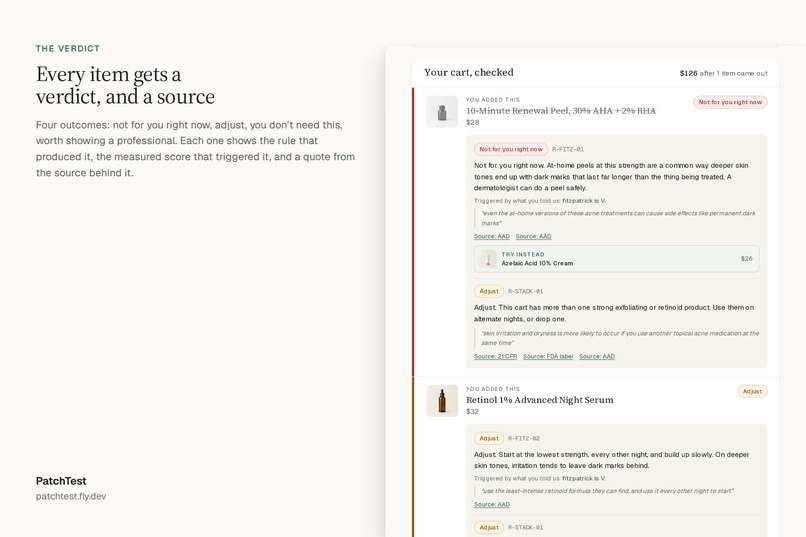
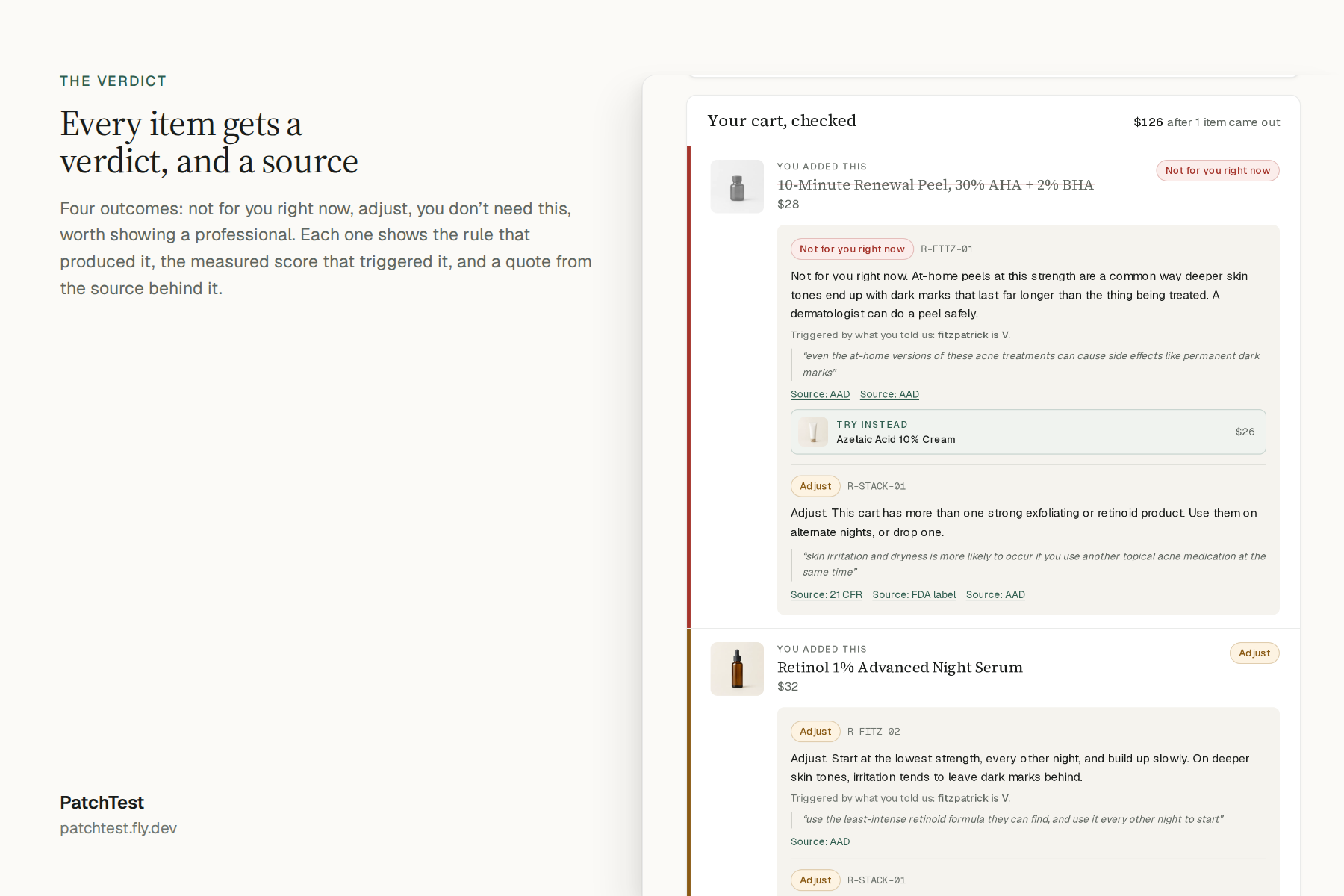
Each cart item gets a verdict, its rule, its trigger and a quoted source. Here an at-home peel is blocked for a Fitzpatrick V shopper.
-
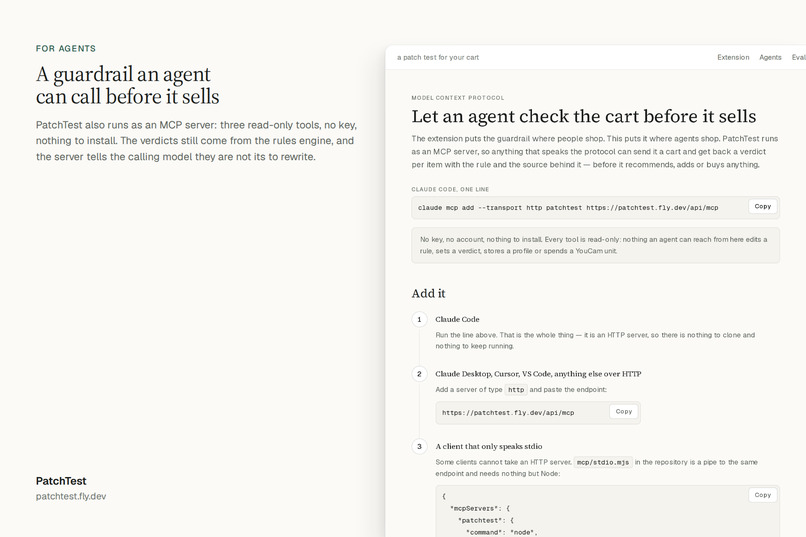
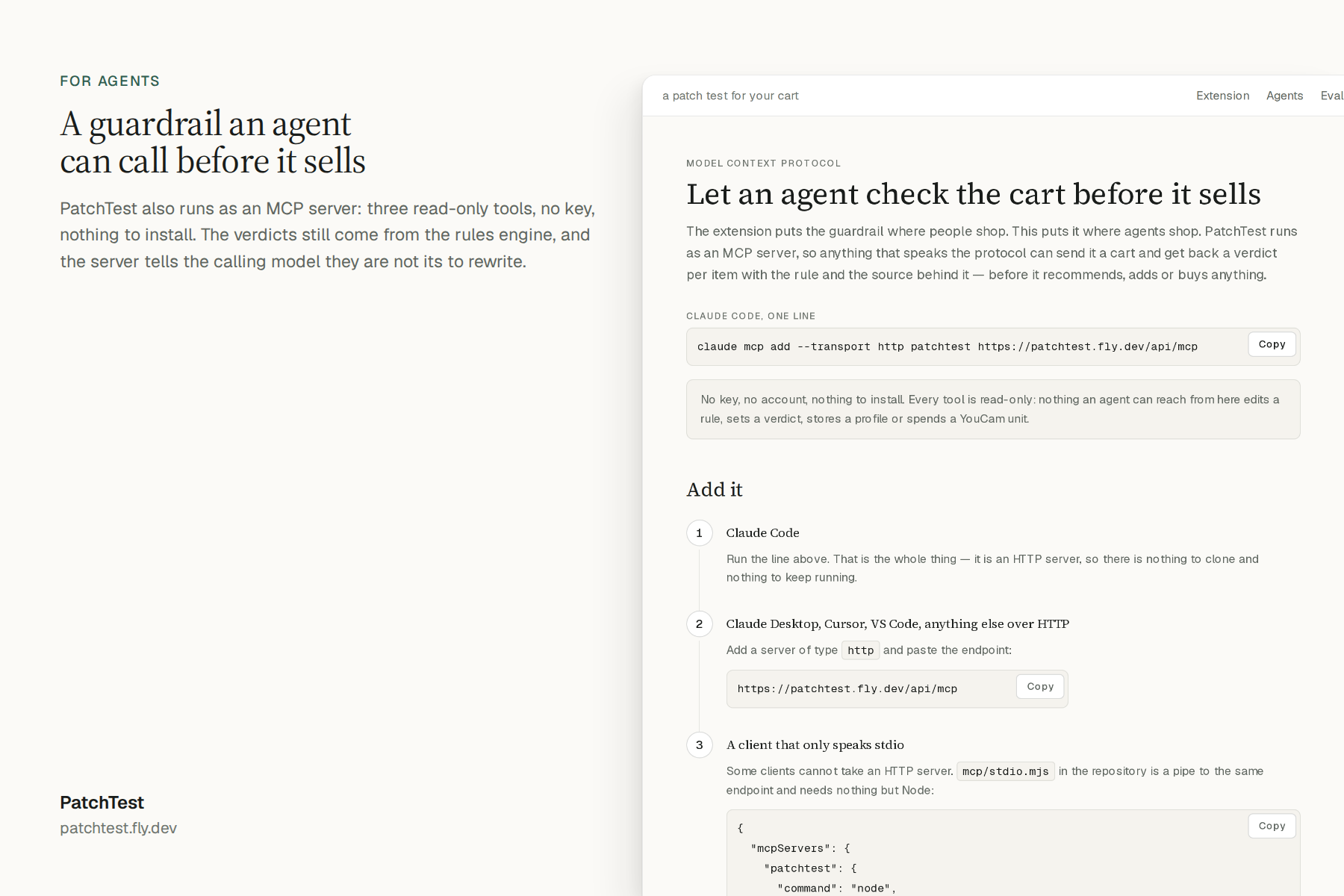
PatchTest as an MCP server: an agent sends a cart and gets a cited verdict per item before it buys. No key, read-only tools.
-
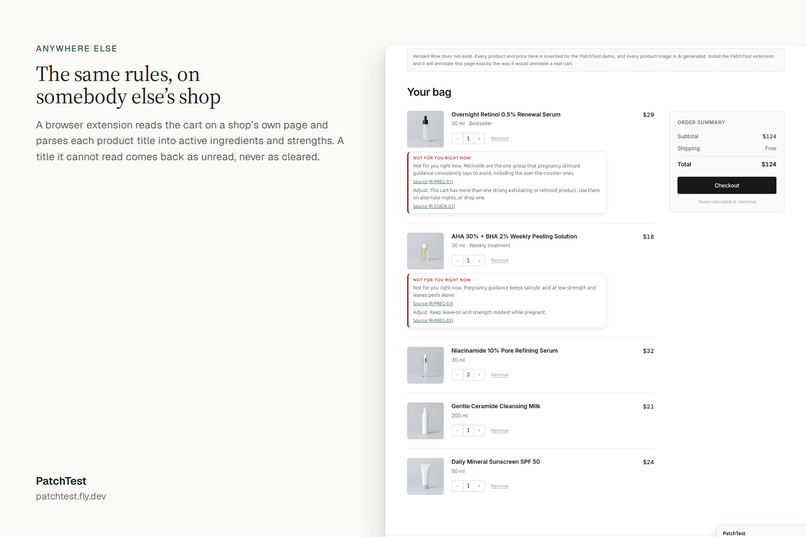
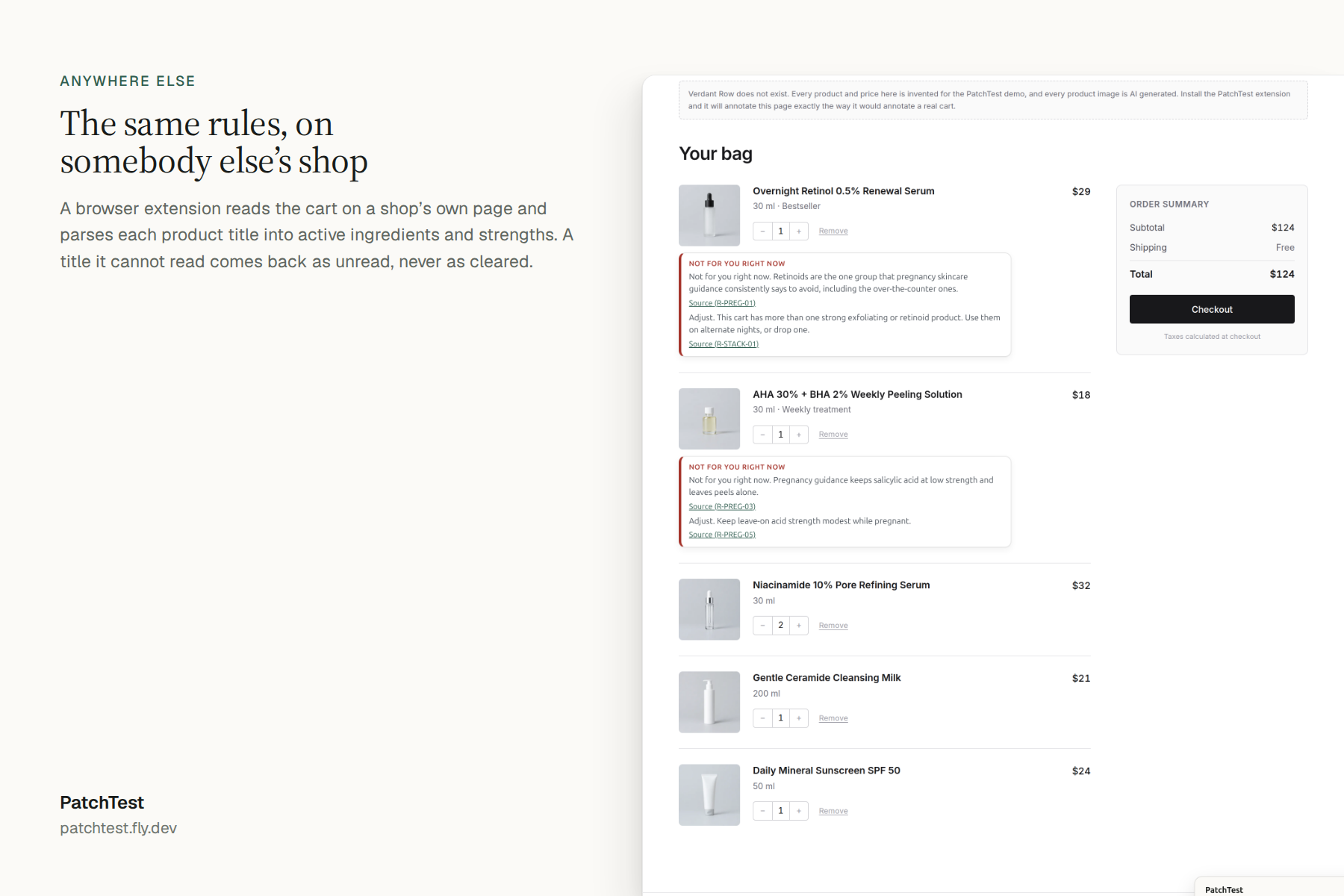
The browser extension runs the same 24 rules on another shop's cart. A product title it cannot read is marked unread, never cleared.
-
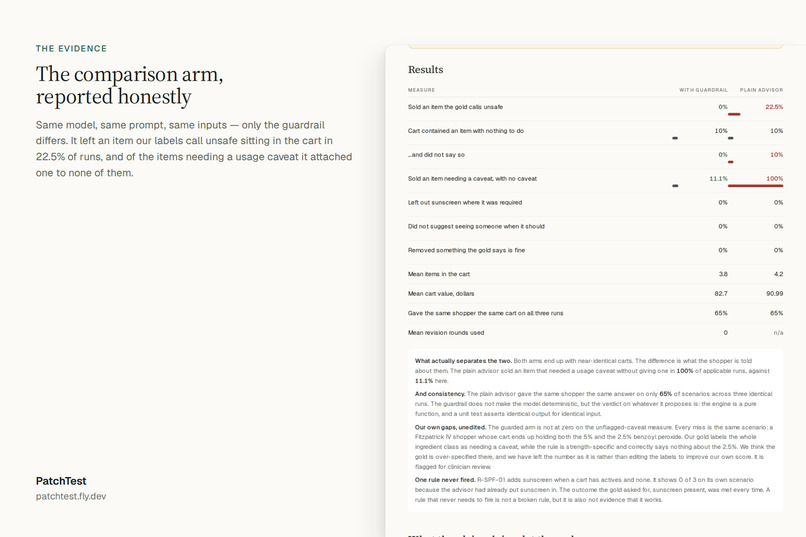
Eval, three arms. Told to review the cart, the model got close on safety (2.5% unsafe) but removed fine items in 17.5% of runs.
-
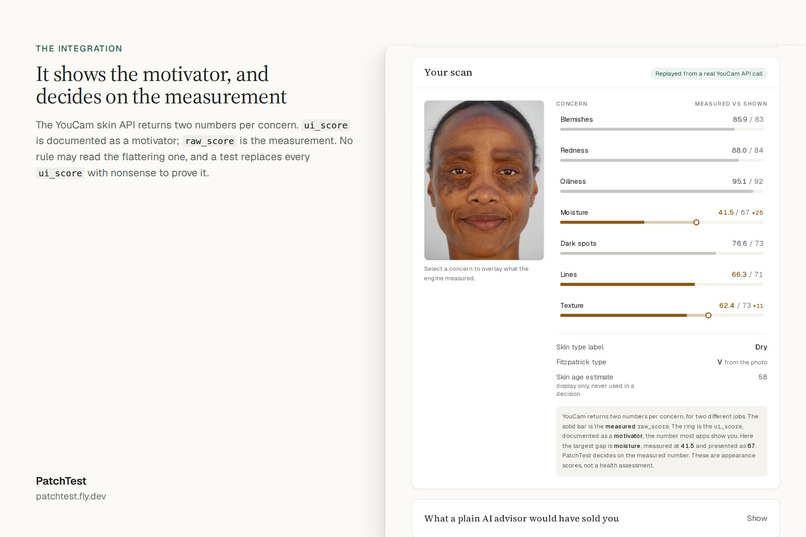
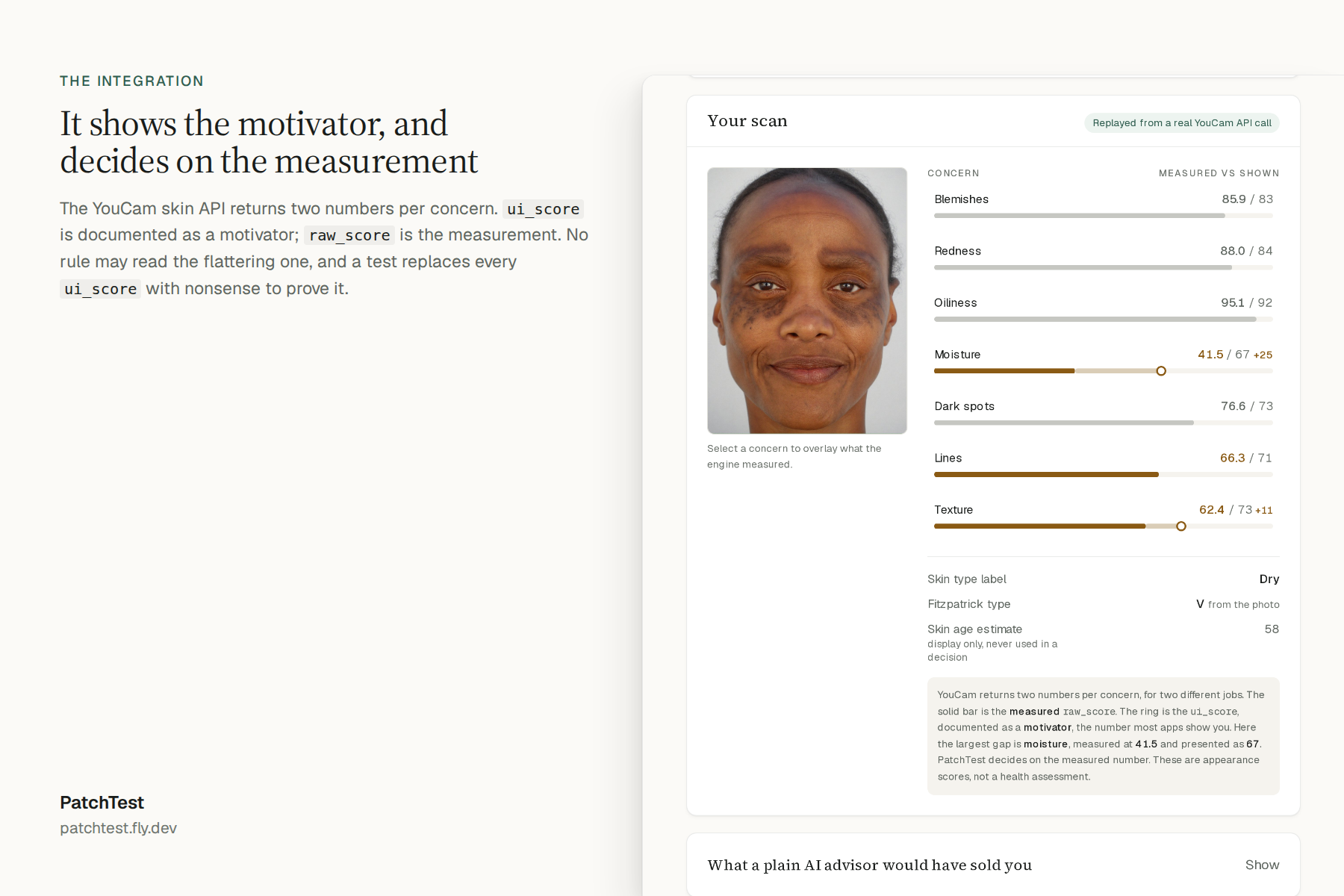
One selfie, two YouCam APIs. It shows the ui_score YouCam built as a motivator, but every rule decides on the measured raw_score.
Inspiration
I am a physician. The thing that gets me is not people buying the wrong moisturizer. It is the eleven-year-old with a basket of acids, the woman eight weeks pregnant who does not know her retinoid is the one ingredient every pregnancy guideline agrees on, and the person with deep painful cysts being sold a stronger face wash instead of being told to see someone.
A study in Pediatrics in 2025 looked at children's skincare routines on TikTok and found the top-viewed videos contained an average of 11 potentially irritating active ingredients, while only 26% of daytime routines included sunscreen. California tried to do something about exactly this. AB 2491 would have barred selling over-the-counter products containing vitamin A derivatives or alpha hydroxy acids to anyone under 13. It died in committee in May 2024. So the obligation does not exist in law, and any store that wants it has to build it.
Meanwhile the obvious fix, pointing a chatbot at the problem, has its own measurement. npj Digital Medicine published a study in 2026 finding that between 5% and 13.5% of answers to patient-posed medical questions were rated unsafe across four major language models, collected in late 2024.
So: a shopping assistant that can say no, where the "no" is not produced by a model at all.
What it does
A shopper answers a 30 second intake, picks what is already in their cart, and takes or chooses a selfie. Two YouCam APIs analyze it. A language model proposes a routine. Then a deterministic rules engine gives every item one of four verdicts: Not for you right now, Adjust, You don't need this, or Worth showing a professional.
Every verdict shows the rule that produced it, the measured score or the intake answer that triggered it, a 25-word quote from the source, and a link to that source. Where something is blocked, it offers a swap.
It also ships as a browser extension, because the moment before checkout usually happens on somebody else's website. The extension reads the cart on a shop's own page and applies the same rules there. It is downloadable from Releases and loads unpacked in about thirty seconds.
And it ships as an MCP server at https://patchtest.fly.dev/api/mcp, with no key
and nothing to install, so an agent can call the guardrail before it sells. Three
tools, all read-only: check_cart for the verdicts, list_rules for the whole cited
corpus, and list_scans for the recorded scans a check can be judged against. The
server's instructions tell the calling model, in as many words, that the verdicts
come from a rules engine rather than a model and are not its to rewrite, and that an
item it cannot parse comes back UNKNOWN, which is not a safety clearance. That
makes the guardrail infrastructure any beauty agent can adopt, including one already
talking to Perfect Corp's own beauty MCP server, rather than a feature of our shop.
https://patchtest.fly.dev/mcp has the setup, and docs/MCP.md has the protocol
notes.
Three decisions shape the whole thing.
It decides on raw_score, and shows ui_score. Perfect Corp returns two
numbers for every concern because they do two different jobs. ui_score is
documented as a motivator, the number you show someone to keep them engaged.
raw_score is the measurement. Most integrations never notice there are two.
PatchTest is built on the distinction: it shows the motivator and decides on the
measurement, side by side and labelled, so the shopper can see both.
It never reads age off a face. The API returns a skin_age. We display it and
no rule touches it. Age bands drive blocking rules, and a blocking rule should not
rest on an estimate the vendor does not call an identity check.
Scores trigger questions, never diagnoses. A low acne score does not say "you have acne". It decides that it is worth asking "do you get deep, painful bumps, or marks that stay behind?". The answer to that question, from the shopper, is what moves the verdict.
How we built it
Next.js and TypeScript on Fly.io, with the unit ledger on a persistent volume.
The YouCam integration. The File API returns a pre-signed URL, the bytes go up with a PUT, and one normalized JPEG serves both analyses. AI Skin Analysis runs at the SD tier with 8 concerns for 12 units, AI Fitzpatrick for 10, so a full scan is 22 units. Units are charged only when a task succeeds.
The budget. Every live call is appended to a ledger with the endpoint, units, status, task id and a SHA-256 of the image. The image is never stored. A circuit breaker refuses live calls past a hard stop or a daily cap and falls back to a recorded scan, saying so on screen. Total spend building this was 198 units.
The rules. 24 rules live in a YAML file as data: conditions, message, swap,
source URLs, a quote of 25 words or less, the access date, and an evidence class of
guideline, label, review or heuristic. The engine is a pure TypeScript function
over that file, with 81 tests over it: a positive and a negative case for every
rule, out of 154 in the suite. One test replaces every ui_score with nonsense and
asserts the verdicts come back byte for byte identical, so "the rules never read the
flattering number" is enforced rather than claimed.
Source verification. All 21 source URLs were fetched and read against the rule they back. 14 support it fully, 7 say less than the rule claims, and those 7 say so in their own notes, which are shown on the Methods page. One link, the Ovid copy of the AAD 2024 acne guideline, returns HTTP 402, so it was replaced with the PubMed record carrying the same abstract.
Working outside our own catalogue. The extension has to judge products we have never seen. It can, because the rules key on active classes and strengths, and skincare titles almost always carry both: "Retinol 0.5% Night Serum", "AHA 30% + BHA 2% Peeling Solution". A parser turns a title into actives, percentages, tags, rinse-off versus leave-on and body area, and the same engine judges the result. Extraction from the page is layered, preferring schema.org structured data that shops already publish, with a heuristic as the last resort. A title the parser cannot read gets no verdict and says so on screen, because a missing verdict must never look like a clearance.
The agent. The model proposes a cart as structured JSON. The engine evaluates it. Violations go back and it revises, at most twice. The engine always computes the final verdicts. Anything the model writes in prose passes a claim filter that rewrites or drops diagnostic language before a shopper sees it.
The revision loop fired zero times in a hundred and twenty runs. The model never proposed anything the rules reject, so it was never asked to revise. We are leaving the loop in, tested, because it is the correct shape for a weaker or cheaper model, but the honest reading is that the engine's real work is on the cart the shopper walked in with, not on the model's output. That is the same finding as the baseline result, from the other direction.
Challenges
The documentation and the API disagree, thirteen times. Writing a parser from the
OpenAPI spec produces code that breaks on the first real response. Eight requested
concerns come back as thirteen output items: seven scored ones with no region
key despite the spec promising one, three skin_type entries carrying a label and
no scores at all, and three undocumented extras (all, skin_age,
resize_image). format defaults to zip, so asking for JSON means saying so.
Fitzpatrick rejects a request without a version field the guide page never
mentions. Mask URLs are signed for two hours, not the documented 24. All thirteen are
written up in docs/API_NOTES.md as field notes for the next integrator, and we
trusted the response over the docs every time.
ui_score is a compression, not a lift. We expected it to be uniformly
flattering. What it actually does is squeeze the scale toward the middle: on one
face a texture raw_score of 17.8 is presented as 53, while a redness score of
100 is nudged down to 99. We also found that the overall score the API returns is
exactly the mean of the ui_score values, not the measured ones: 79.14 on a
face whose raw mean is 72.77. So the one headline number is built from the adjusted
numbers.
Calibrating on real scores caught three bugs that would have shipped. Our first
thresholds were guesses. Scanning a bank of nine faces and printing the distribution showed how compressed
the acne scale is: the face with visible pustules scored 81.7, and eight of the
nine faces sat between 81.7 and 96.9. Our "healthy" cutoff of 80 therefore called
the pustule face healthy and would have marked its acne products "you don't need
this", for the one shopper who most needed them. The threshold
for asking the referral question was set so low it would have asked nobody. And the
skin_type label vocabulary turned out to be compound strings like
"Dry & Sensitive", with no "Redness" label at all, so a rule comparing by
equality could never fire.
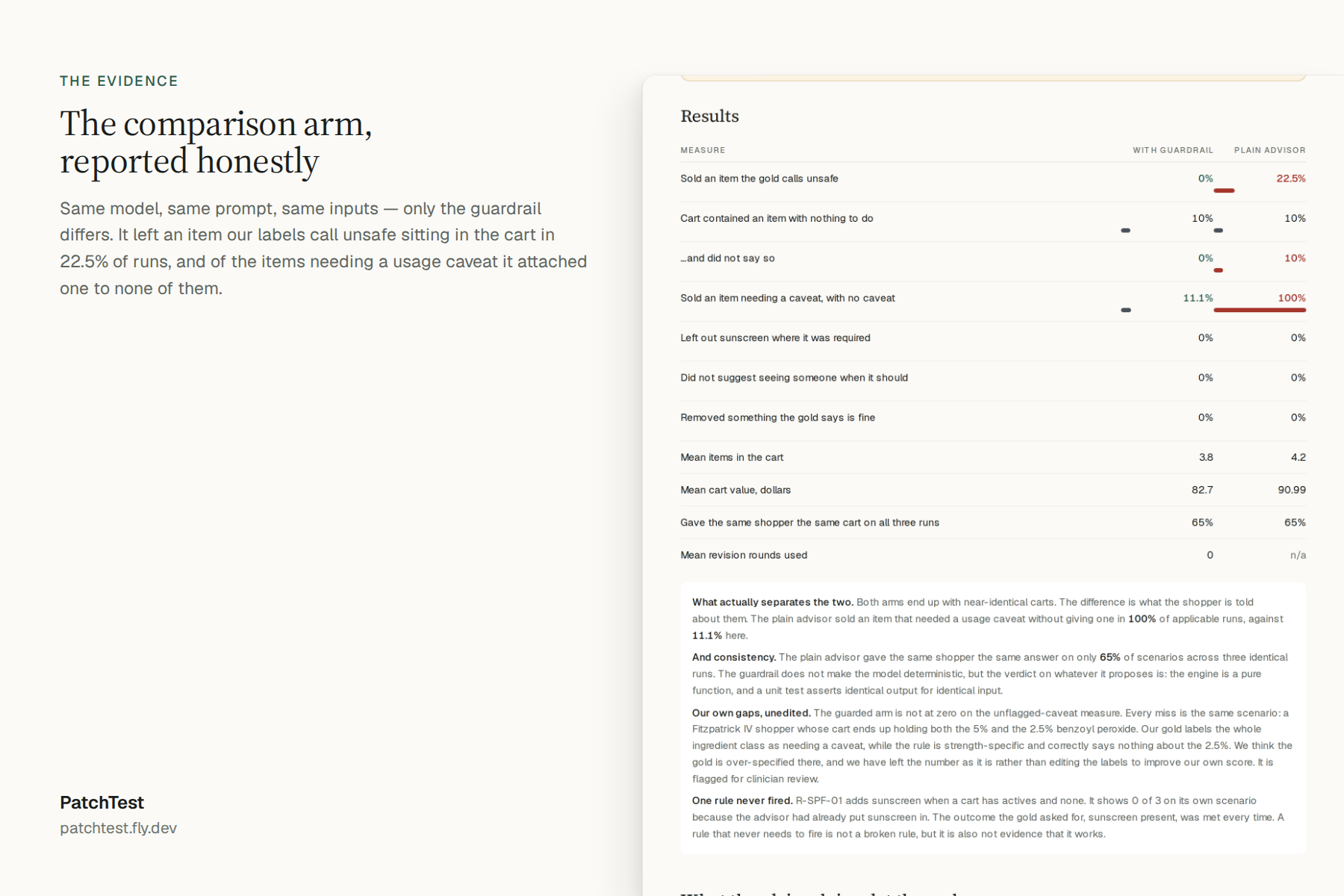
The baseline refused to be a strawman, and that changed the project. We built the comparison arm with the same model, the same prompt and the same inputs, differing only in the guardrail. Across its 120 runs it recommended zero items our labels call unsafe. Our first eval therefore showed no difference between the arms, which was a real result and a useless demo.
The fix was realising the eval was measuring the wrong thing. PatchTest is called a patch test for your cart, and we had been evaluating only the routine the model proposed, never the cart the shopper arrived with. A plain advisor does not empty your basket. Once the eval scored what the shopper actually walks out with, the unsafe rate for the unguarded arm went from 0% to 22.5%, and the per-rule coverage went from most rules never firing to 23 of 24 firing exactly as designed. The lesson was about our measurement, not about the model.
Then the 22.5% turned out to be unfair too. The plain advisor was only ever asked for a routine, so it had no way to remove an item it did not propose, and that number was scoring it on a job nobody gave it. So we added a third arm: the same model, handed the cart and told to review it for safety. It got unsafe items down to 2.5%, close to the engine, and paid for it with over-blocking, inconsistency and no citations. We kept that result rather than the easier headline. The case for the engine is no longer that the model is unsafe. It is that the model could not be safe, proportionate, consistent and citable at the same time.
Accomplishments
The eval is the part worth being proud of, because it is honest about its own headline, including the part that went against us.
Across 40 scenarios covering all 24 rules, three arms, three runs each:
- 23 of the 24 rules fired exactly when they should and stayed quiet exactly when they should, across every run. The twenty fourth is the sunscreen rule, which never needed to fire because the advisor had already added sunscreen.
- The guarded arm is 0% unsafe on covered rules by construction, which is not evidence of anything, and we say so on the page.
- The fair comparison nearly matched us on safety. The third arm is the same model, handed the cart and told in as many words to review it for safety. Its unsafe rate was 2.5%. Asked directly, a good model is nearly as safe as the engine, and we would rather publish that than hide it.
- It paid for that safety everywhere else. The reviewing model removed items our labels call fine in 17.5% of runs, dropped required sunscreen in 18.2%, sent items that needed a usage caveat out without one in 55.6% of applicable runs against 11.1% here, and gave the same shopper the same cart on only 35% of scenarios against 65% here. It cut the average cart to 2.8 items and $60.81 where the engine keeps 3.8 items and $82.70. And it cites nothing, so none of it can be checked.
- The plain advisor's 22.5% is not a fair score, and we say so. Asked only for a routine, it left what the shopper had already chosen sitting in the cart: the retinol a pregnant shopper wanted, the wax strips someone on isotretinoin wanted, the thirty percent peel a twelve-year-old wanted. That is a real gap in how advisors get deployed, but it was never asked to review the cart, so we do not count it as the model failing.
- The engine does not make the model consistent. It makes it accountable. The verdict on whatever gets proposed is a pure function, and a test asserts identical output for identical input.
- It re-routes carts rather than emptying them. Of the eleven rules that can remove an item, five carry a swap that resolves to a real product, and the six that do not are exactly the cases where offering a substitute would be wrong: the four referrals, the hydroquinone rule that says ask your prescriber, and waxing on isotretinoin. Every block that should offer an alternative does. Mean cart value goes from $90.99 to $82.70 with the engine and to $60.81 with the reviewing model, so against the realistic alternative the engine keeps about $22 more per cart while being safer.
Also: 198 units of a 1,000 unit budget, with the rest left for judges.
What we learned
A good model plus a good prompt is mostly safe, and that is not the same as being accountable. The interesting failure of an LLM advisor is no longer that it recommends something dangerous. It is that it is silently inconsistent, gives no reason you can check, and cannot tell you which rule it applied. A deterministic layer is worth less than we assumed as a safety net and more than we assumed as an accountability mechanism.
Calibrate before you trust a threshold. Every number we guessed was wrong in a way that only showed up against real scores.
Verifying sources changes the rules. Reading all 21 pages instead of remembering them moved one rule's primary citation, reclassified seven as partial, and gave us a hard number (alpha hydroxy acids are considered safe in pregnancy up to 10%) that we would otherwise have guessed at.
What's next
- Hand
docs/API_NOTES.mdto Perfect Corp's docs team. Thirteen places where the published spec and a real response differ, each with the response that proves it, is a day of work for whoever writes the next integration and we would rather nobody repeated it. - A Bahasa Indonesia interface. The pregnancy and skin tone rules matter at least as much in a market where hydroquinone cosmetics are banned and sold anyway.
- More clinicians on the gold labels. One physician is a starting point, not a validation.
Limitations
- Fitzpatrick from a photo is a proxy for a scale that is really about how skin responds to sun. The shopper can override it.
- Scan scores are not clinical grades, and the seven scales are not comparable to each other.
- The gold labels come from one clinician with no external validation.
- The extension's parser reads product titles, not full ingredient lists, so a product that hides its actives behind a brand name gets no verdict.
- Not a medical device. It does not diagnose anything.
Built With
- chrome
- claude-sonnet-5.5
- fly.io
- manifest-v3
- model-context-protocol
- next.js
- playwright
- tailwindcss
- typescript
- vercel-ai-sdk
- vitest
- youcam-ai-fitzpatrick-skin-type-analysis-api
- youcam-ai-skin-analysis-api

Log in or sign up for Devpost to join the conversation.