Inspiration
Debugging rarely starts with a difficult piece of code. It starts with a simple sentence:
“Something is broken.”
From there, developers often have to jump between issue trackers, source code, logs, documentation, test runners, and pull requests just to answer a few questions:
Where is the problem? Why is it happening? Did we fix the right thing? And does the fix actually work?
AI tools can already help developers write code, explain errors, and generate fixes. But I wanted to explore a different idea:
What if AI could help connect the entire debugging lifecycle instead of solving only one step at a time?
That idea became PatchPilot — a structured workflow that takes developers from a bug report all the way to a verified fix while keeping the reasoning, changes, tests, and verification traceable in one place.
What it does
PatchPilot guides a debugging session through a structured workflow:
BUG REPORT → REPRODUCE → ANALYZE → ROOT CAUSE → FIX → TEST → VERIFY
🔎 Report & Reproduce
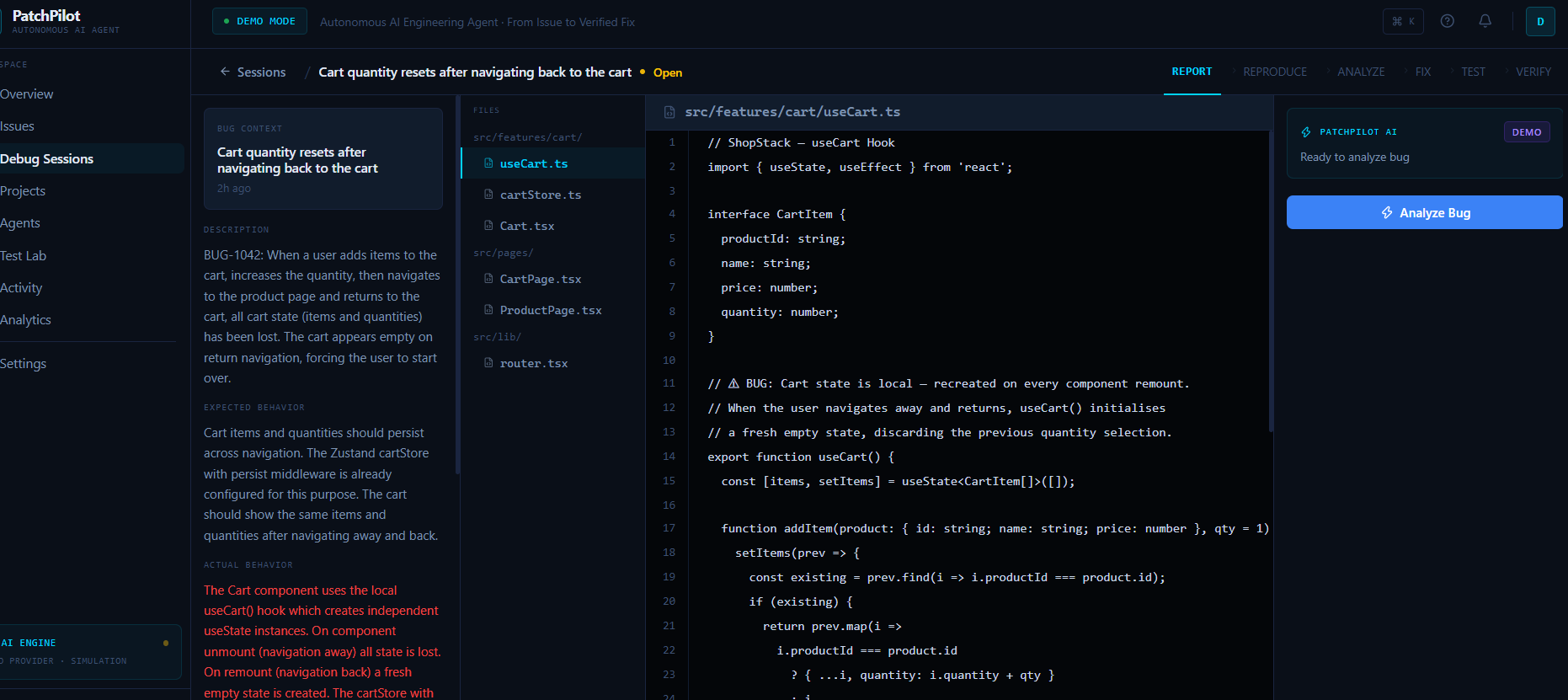
Developers start with a structured issue containing the problem, reproduction steps, expected behavior, and actual behavior.
🧠 Analyze
PatchPilot organizes the debugging context and produces a structured root-cause analysis with affected files, suspicious code locations, supporting evidence, and a confidence score.
⚡ Fix
A proposed fix is presented through a before/after code diff so the developer can understand exactly what is changing before approving it.
🧪 Test
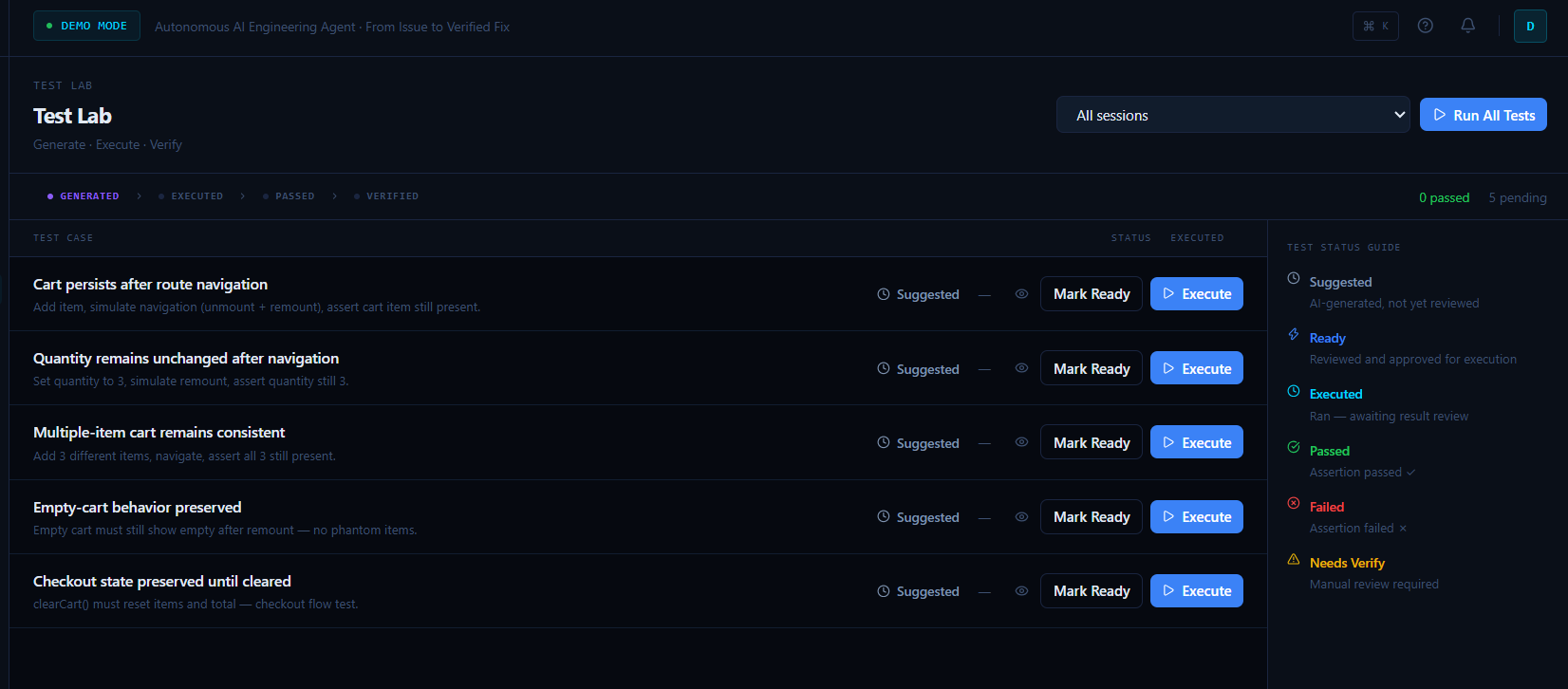
PatchPilot generates regression and edge-case test scenarios based on the identified problem and proposed solution.
✅ Verify
The final stage tracks the verification process and produces a structured summary of what was investigated, changed, tested, and verified.
The platform also includes:
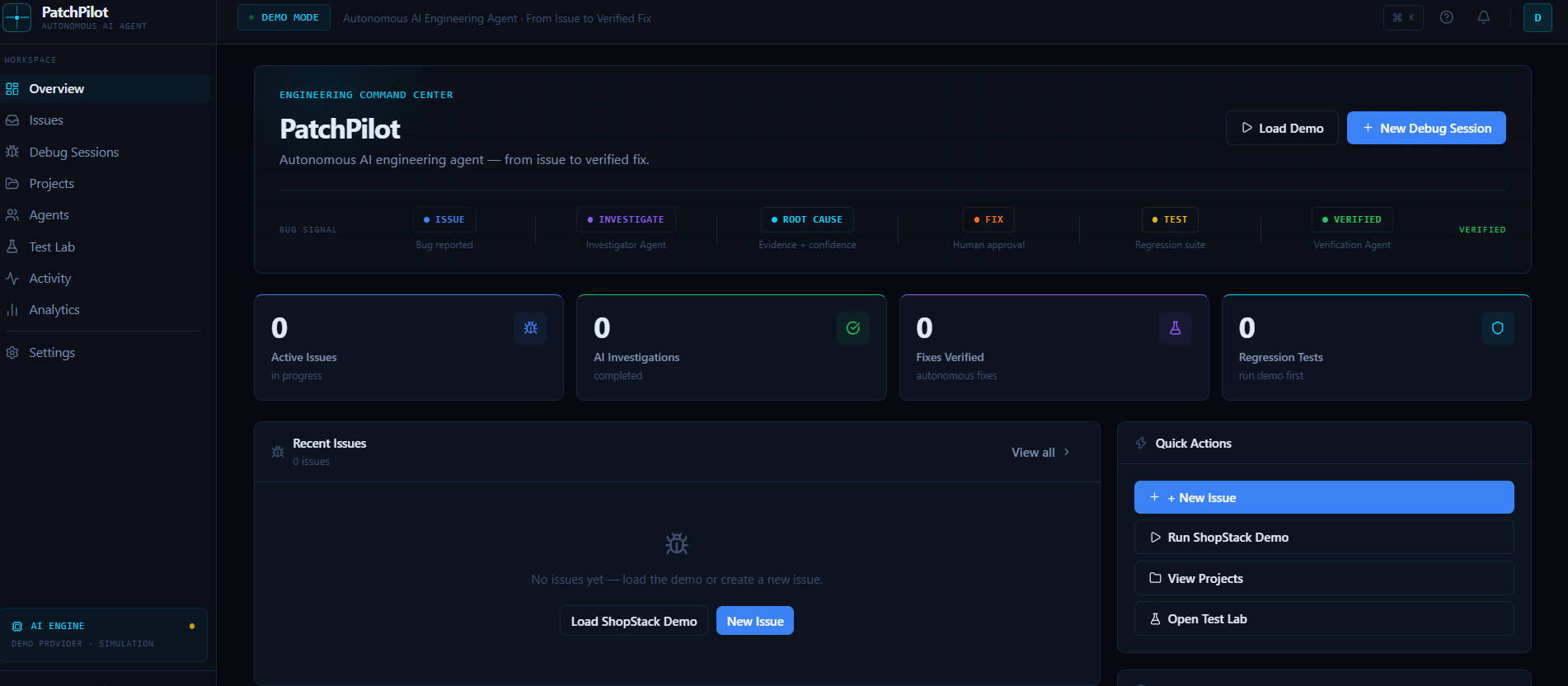
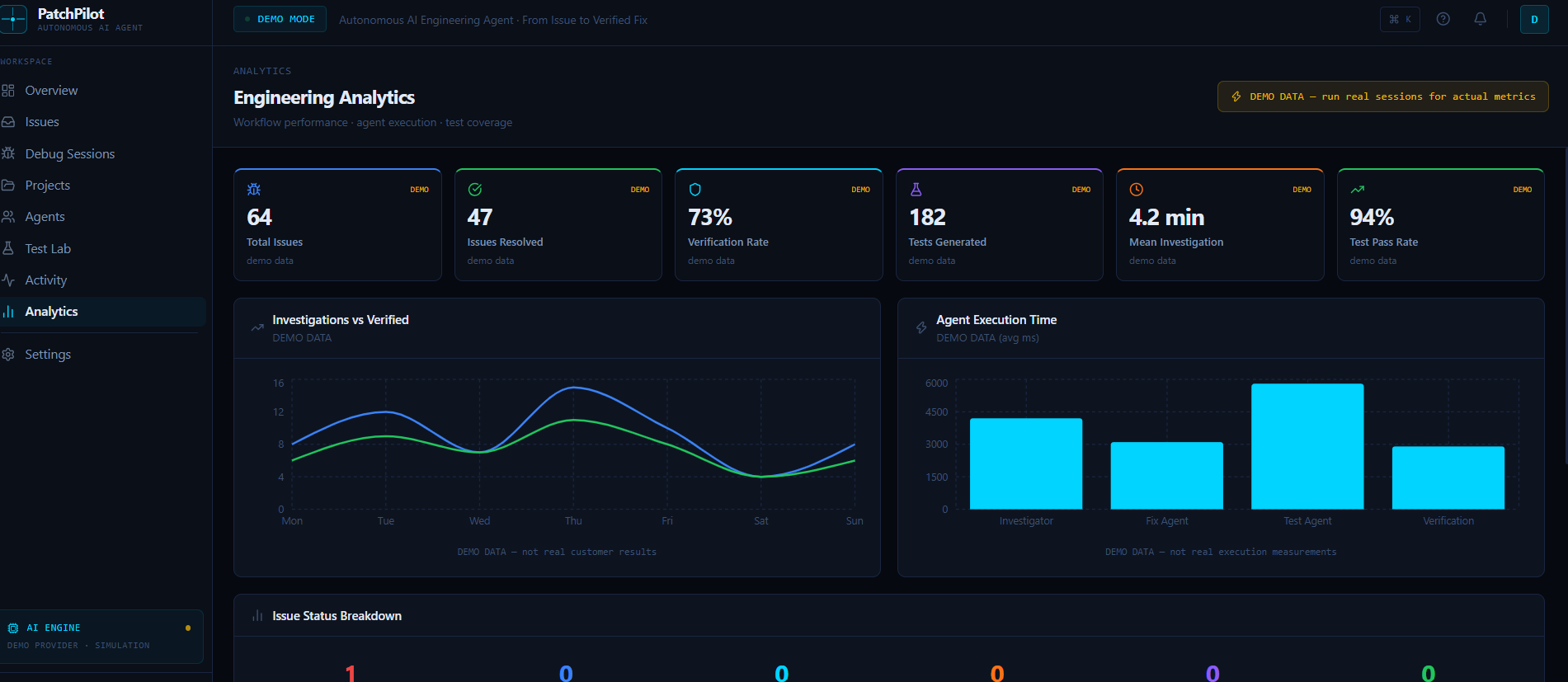
- Engineering dashboard
- Three-column Debug Session Workspace
- Code Diff Viewer
- Test Lab
- Verification Timeline
- Activity Timeline
- Workflow Impact metrics
- PR Summary generation
- ShopStack demonstration project
A key principle throughout the workflow is:
AI assists. Developers review and approve.
How I built it
PatchPilot was built as a modular developer workflow application using:
- Next.js 16 App Router
- TypeScript
- Tailwind CSS v4
- Lucide React
- Browser localStorage
- Provider-based AI architecture
- ShopStack as the demonstration application
The application is organized around reusable components and core workflow data models.
PatchPilot
│
├── app/
├── components/
├── lib/
│   ├── types.ts
│   ├── store.ts
│   ├── demo-data.ts
│   ├── ai-provider.ts
│   └── run-demo.ts
│
└── shopstack-demo/
    ├── src/
    └── tests/
I also created an AI provider abstraction so the workflow is not tightly coupled to a single AI backend.
For the current demonstration, PatchPilot uses a deterministic DemoProvider for the ShopStack scenario. This allows us to demonstrate the complete workflow without requiring external credentials while keeping the architecture ready for future AI-provider integrations.
The interface was designed as a developer command center rather than a traditional chatbot, keeping the issue, code, analysis, changes, tests, and activity visible throughout the debugging session.
IBM Bob IDE was used as the primary development environment during the project.
Challenges I ran into
One of the biggest challenges was deciding what an AI debugging workflow should actually be responsible for.
It was easy to make a simple interface that generates a code suggestion. The harder problem was creating a workflow where every step connects to the previous one.
I had to think about:
- How an issue should be structured
- How debugging evidence should be represented
- How root-cause analysis connects to affected files
- How a proposed fix should be reviewed
- How generated tests should relate to the original bug
- How verification should be represented without making unsupported claims
Another challenge was building a convincing end-to-end demonstration without depending on external services or credentials.
I solved this by creating ShopStack, a small e-commerce application with a deliberately reproducible cart-state bug, and building a deterministic DemoProvider around that scenario.
I also deliberately avoided presenting simulated actions as real Git operations or real AI inference. This helped us keep the prototype transparent about what is implemented today and what belongs in the next stage.
Accomplishments that I'm proud of
I'm proud that PatchPilot is more than a collection of AI-generated code screens.
I built a complete, traceable debugging workflow that connects:
Issue → Investigation → Root Cause → Fix → Tests → Verification
Some of the things I'm particularly proud of:
- 🧩 A complete debugging lifecycle in one workspace
- 🔎 Structured root-cause analysis with evidence
- 📝 Side-by-side code diff review
- 🧪 Dedicated Test Lab workflow
- ✅ Verification timeline
- 📋 Automatically structured PR summaries
- 🕒 Full activity timeline for the debugging session
- 🛒 A reproducible ShopStack bug for the live demonstration
- 🧠 Provider abstraction for future AI integrations
- 👨💻 Human approval before applying proposed fixes
- 📚 Dedicated architecture, API, demo, and development documentation
Most importantly, I built the product around traceability rather than simply generating an answer and moving on.
What I learned
Building PatchPilot taught us that AI-assisted development is not only about generating better code.
The workflow around the generated code matters just as much.
I learned the importance of:
1. Context
A useful debugging assistant needs access to the right issue and code context instead of treating every request as an isolated prompt.
2. Traceability
Developers need to understand why a fix was suggested, what changed, and how the change relates to the original problem.
3. Human-in-the-loop design
Automation becomes more useful when developers can inspect and approve important actions rather than losing control of the workflow.
4. Verification
Generating a fix is only one part of the problem.
A debugging system should also ask:
“How do we know this actually solved the issue?”
5. Honest AI integration
I also learned to clearly separate implemented functionality from future integrations. A convincing prototype should demonstrate what it actually does instead of pretending simulated results are production execution.
What's next for PatchPilot
The current version establishes the foundation for a much more autonomous engineering workflow.
My next steps include:
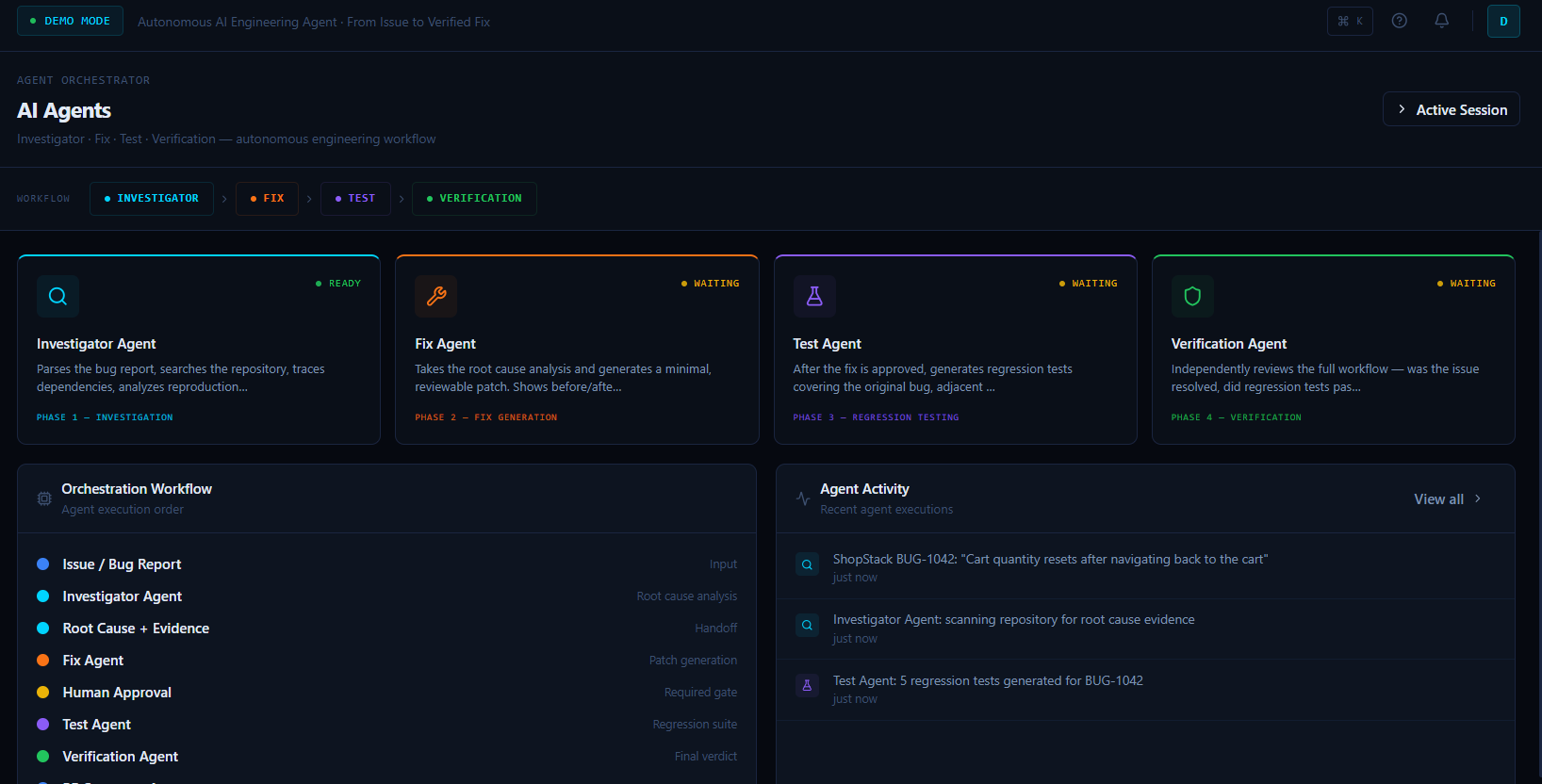
🤖 Multi-Agent Debugging
Introduce specialized agents for:
- Investigation
- Root-cause analysis
- Fix generation
- Test generation
- Independent verification
These agents could collaborate through a central orchestration layer.
🔗 Repository & Git Integration
Connect PatchPilot directly with GitHub and GitLab so developers can:
- Import repositories
- Create branches
- Apply approved fixes
- Commit changes
- Open pull requests
🧪 Real Test Execution
Move beyond test generation and connect the Test Lab to real test runners such as Jest, Vitest, and pytest.
🧠 Production AI Integration
Connect the provider abstraction to production AI infrastructure and use stronger repository-level reasoning for larger codebases.
👥 Team Workspaces
Add collaborative debugging sessions, shared projects, permissions, and historical engineering analytics.
📊 Engineering Intelligence
Build long-term insights around recurring bugs, debugging patterns, verification rates, and engineering workflow bottlenecks.
My long-term vision is simple:
PatchPilot should not just help developers fix bugs. It should help them move from an issue to a verified engineering outcome with less context switching and more confidence.
PatchPilot — From Bug Report to Verified Fix.
Built With
- ai
- aiagents
- approuter
- debugging
- developertools
- generativeai
- ibmbob
- jest
- localstorage
- next.js
- react
- tailwindcss
- testing
- turbopack
- typescript


Log in or sign up for Devpost to join the conversation.