-
-
PatchPilot
PatchPilot — Autonomous Security Patching via GitLab Orbit
The Problem: The 84-Day Vulnerability Gap
Every security scanner can tell you what's vulnerable. None of them tell you what breaks when you fix it.
Here's the daily reality: the Security Dashboard flags a Critical CVE in lodash.
You know you need to patch it. But the real question is never "should I upgrade?"
It's "what happens to my codebase when I do?"
- Which files import this package?
- Which functions call the vulnerable symbol?
- What modules call those functions?
- Does the new version change the API contract?
Without those answers, developers do what humans do with uncertainty: they wait. The industry mean time to remediate Critical CVEs is 84 days — not negligence, but invisible blast radius.
The Solution: PatchPilot
PatchPilot is a GitLab Duo Agent that closes the remediation gap using the GitLab Orbit Knowledge Graph to map the exact blast radius of any vulnerability before writing a single line of a fix.
Triggers
- Automatic: GitLab Security Dashboard webhook on new Critical/High CVE
- Manual:
/.patchpilot CVE-2021-23337in any MR comment
What it does
- Queries Orbit for
VulnerabilityOccurrencenodes matching the CVE - Traverses
ImportedSymbolnodes to find exact vulnerable symbol usage - Follows
DEFINESandCALLSedges to map function-level blast radius - Extends traversal to second-order callers (hop 2)
- Checks package registry for API signature changes
- Classifies: SAFE / BREAKING / UNKNOWN / CRITICAL_BLAST
- Acts: opens a patch MR, a shim MR, or an escalation issue — automatically
How It Uses GitLab Orbit
This is the core differentiator. A plain LLM can only see the file you paste into it. GitLab Orbit sees the entire live codebase dependency graph.
PatchPilot chains 8 real Orbit graph queries per run:
| Query | Type | Purpose |
|---|---|---|
VulnerabilityOccurrence → IN_PROJECT |
traversal | Find CVE in project |
Project → HAS_FILE → File |
traversal | Enumerate affected files |
File → IMPORTS → ImportedSymbol |
traversal | Find vulnerable symbol usage |
File → DEFINES → Definition |
traversal | Map function-level blast radius |
Definition → CALLS → Definition |
traversal | Second-order callers (hop 2) |
count(caller) group_by(definition) |
aggregation | Coupling density score |
User → AUTHORED → MergeRequest |
traversal | Code owner resolution |
Project → HAS_FILE (manifest) |
traversal | Package manager detection |
None of this is possible with a plain LLM. Every decision PatchPilot makes is grounded in the live graph — not hallucinated from training data.
The Safety-First Design (Enterprise-Grade)
PatchPilot knows when to stop — as important as knowing what to do:
| Classification | Trigger | Action |
|---|---|---|
| SAFE | No API changes, blast radius ≤ 4 hops | Auto version-bump MR |
| BREAKING | Exported signatures changed | MR + auto-generated compatibility shims |
| UNKNOWN | Empty Orbit graph, dynamic imports | Escalation issue → human |
| CRITICAL_BLAST | >4 hops or >50 definitions affected | High-priority escalation |
This "degraded mode" design means PatchPilot never blindly patches code it cannot reason about. In the context of the GitLab Transcend Hackathon's focus on "agentic speed with enterprise control" — showing the agent knows when to stop is as impressive as showing what it can do.
Live Demo
Escalation Path (real output — live Orbit query)
 >> Step 0 | Checking Orbit cluster health...
 >>         Orbit is healthy (version 0.74.0)
 >> Step 1 | Querying Orbit for vulnerability occurrences...
 !!         No vulnerability occurrences found for CVE-2021-23337.
 >>         Falling back to package import scan...
 >> Step 7  | Classifying patch type... -> UNKNOWN
 >> Step 9  | Creating escalation issue (UNKNOWN)...
 >>         Issue created: https://gitlab.com/ekpenyongasuquo/patchpilot/-/work_items/1
  Result   : UNKNOWN | Artifact: issue
Safe Patch Path (full Orbit graph — MR auto-created)
 >> Step 1 | Found 3 directly affected file(s).
 >> Step 4 | Blast radius -- 5 file(s) | 4 definition(s) | depth=2
 >> Step 7  | Classifying... -> SAFE (no breaking API changes)
 >> Step 8  | $ npm install [email protected] --save
 >> Step 9  | MR created: https://gitlab.com/yourorg/repo/-/merge_requests/42
  Result   : SAFE | Artifact: merge_request
What Changes for Developers
Before PatchPilot:
Scanner: "lodash 4.17.20 has a Critical CVE." Developer: parks it in the backlog for 84 days
After PatchPilot:
Scanner detects CVE → PatchPilot runs → patch MR open in 45 seconds Developer reviews a well-reasoned MR with full blast-radius report Merge. Done.
Time saved per patch:
- Blast-radius analysis: ~2 hours manual → 45 seconds automated
- MR creation + reviewer assignment: ~30 minutes → zero
- BREAKING changes: shim scaffolding ready for review, not discovered in CI at 2am
Technical Implementation
Stack: Python 3.12, GitLab Orbit REST API, python-gitlab, Jinja2
Architecture highlights:
- Orbit client isolated in
agent/orbit/client.py— all query DSL builders are pure functions, fully unit-testable without HTTP - Business logic never imports python-gitlab — clean separation of concerns
- Four-classification decision matrix with auditable reasons for every decision
- Graceful degradation: Orbit health gate, empty-graph fallback, branch conflict retry, missing code owner fallback to maintainers
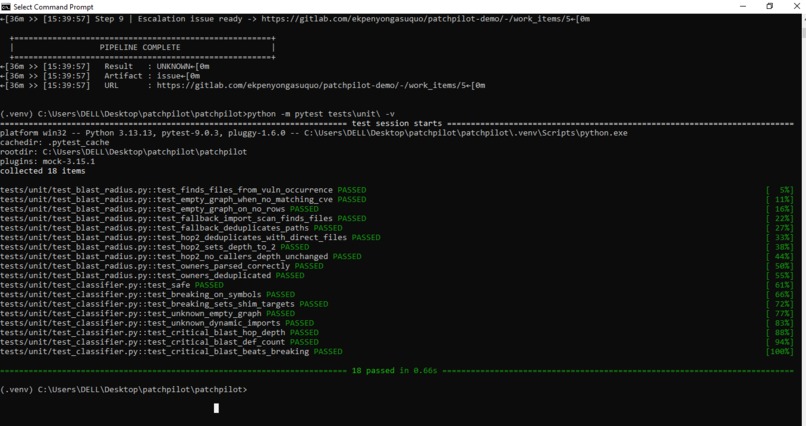
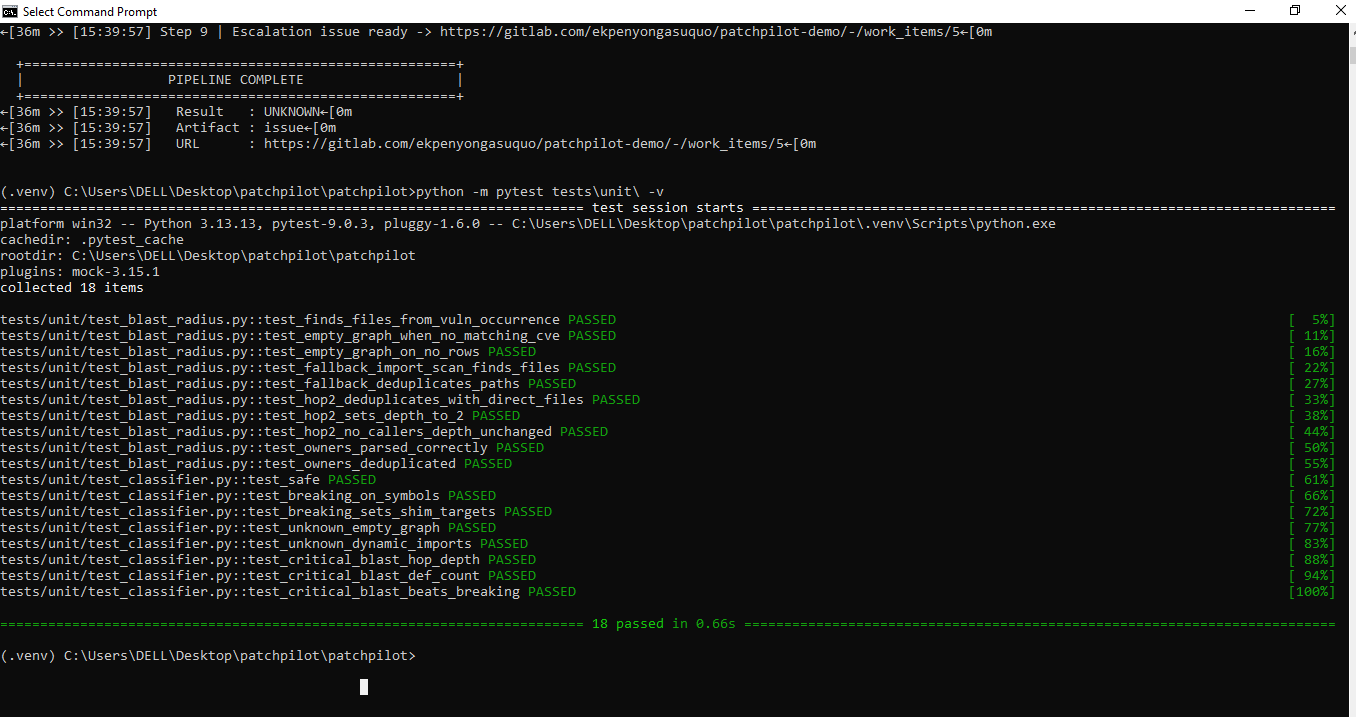
- 18 unit tests — all passing on Python 3.13 / Windows and Linux
Published artifacts:
- MIT-licensed GitLab project:
gitlab.com/ekpenyongasuquo/patchpilot - GitLab AI Catalog skill:
patchpilot(skill.yml included)
Impact
| Metric | Before | After |
|---|---|---|
| Mean time to remediate Critical CVE | 84 days | < 5 minutes (SAFE path) |
| Blast-radius analysis | 2+ hours manual | 45 seconds |
| Broken CI from blind bumps | Common | Eliminated (BREAKING path) |
| Over-coupled packages | Silent risk | CRITICAL_BLAST escalation |
Roadmap
- v1.1 — Orbit path-finding: visual coupling chains in MR descriptions
- v1.2 — Auto-generated test stubs for shim functions
- v1.3 — Weekly security graph health wiki reports
- v2.0 — Multi-CVE batch mode with blast-radius deduplication
PatchPilot v1.0 · MIT License · GitLab Transcend Hackathon 2026 by Ekpenyong Asuquo — Statistician & Developer, UCTH Calabar / Ensign College

Log in or sign up for Devpost to join the conversation.