-
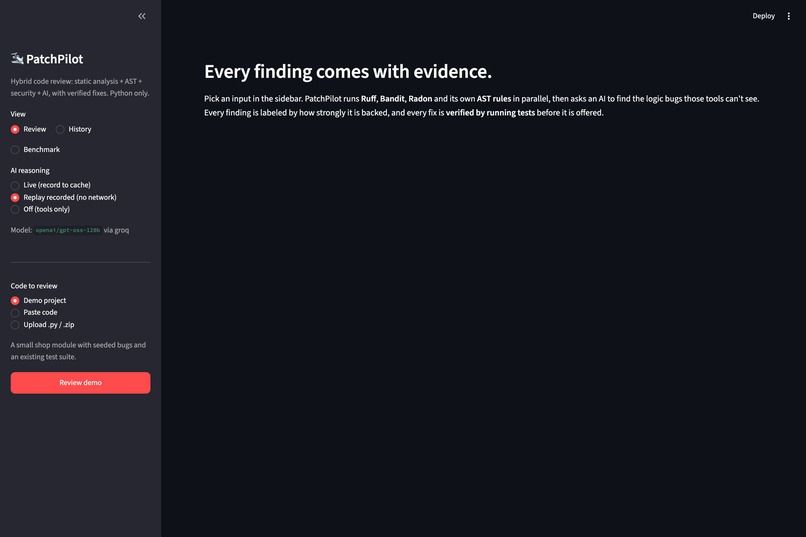
home
-
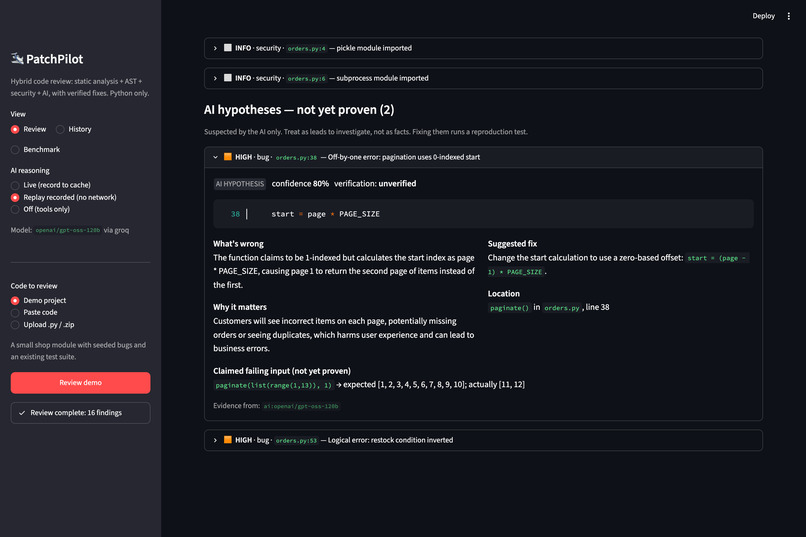
ai-hypotheses
-
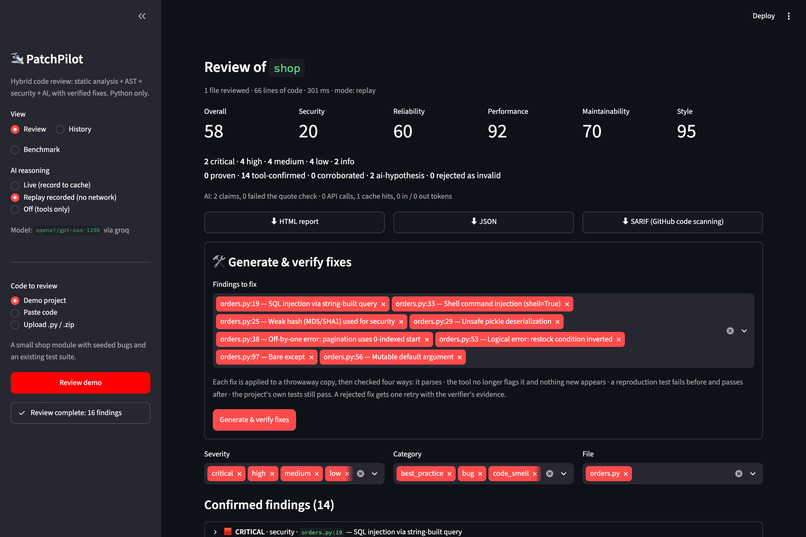
review-summary
-
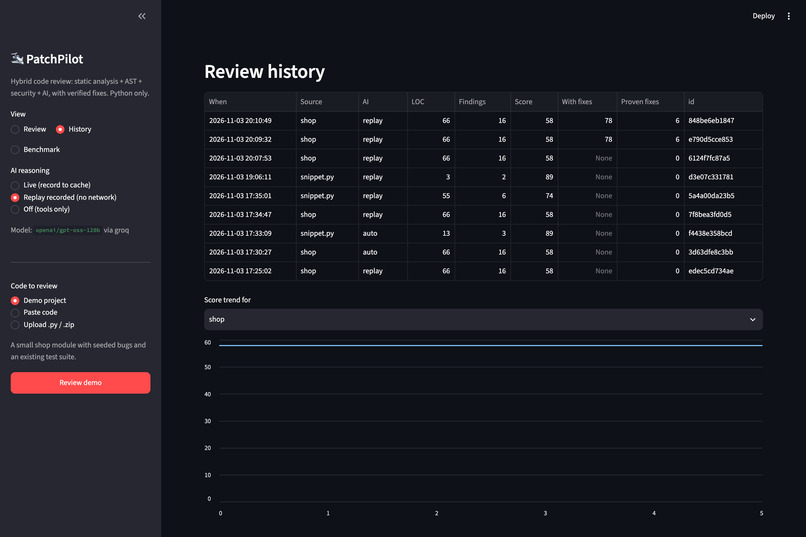
history
-
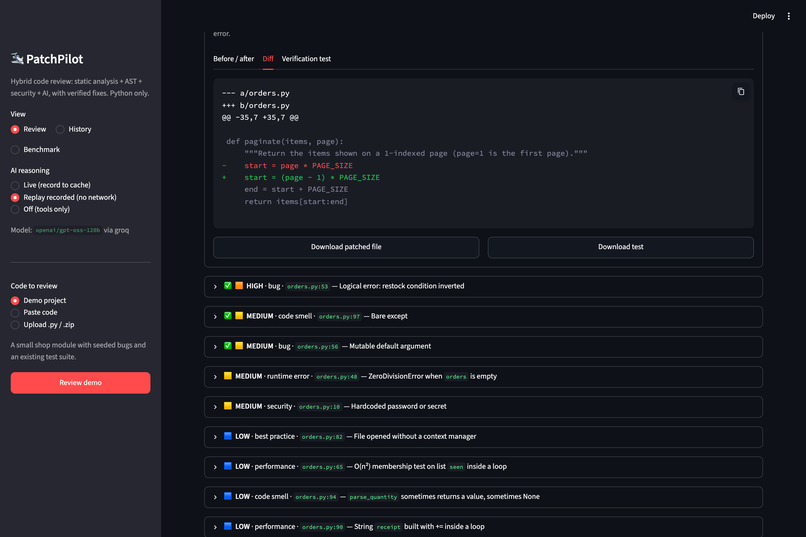
fix-diff
-
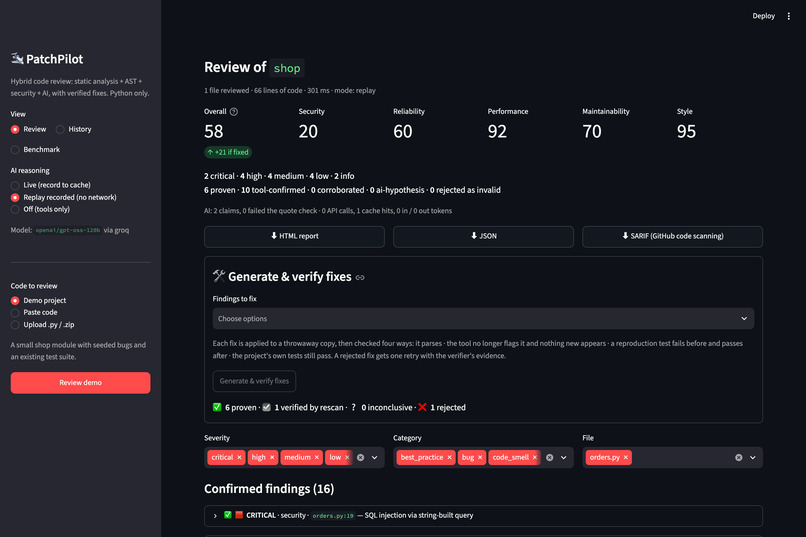
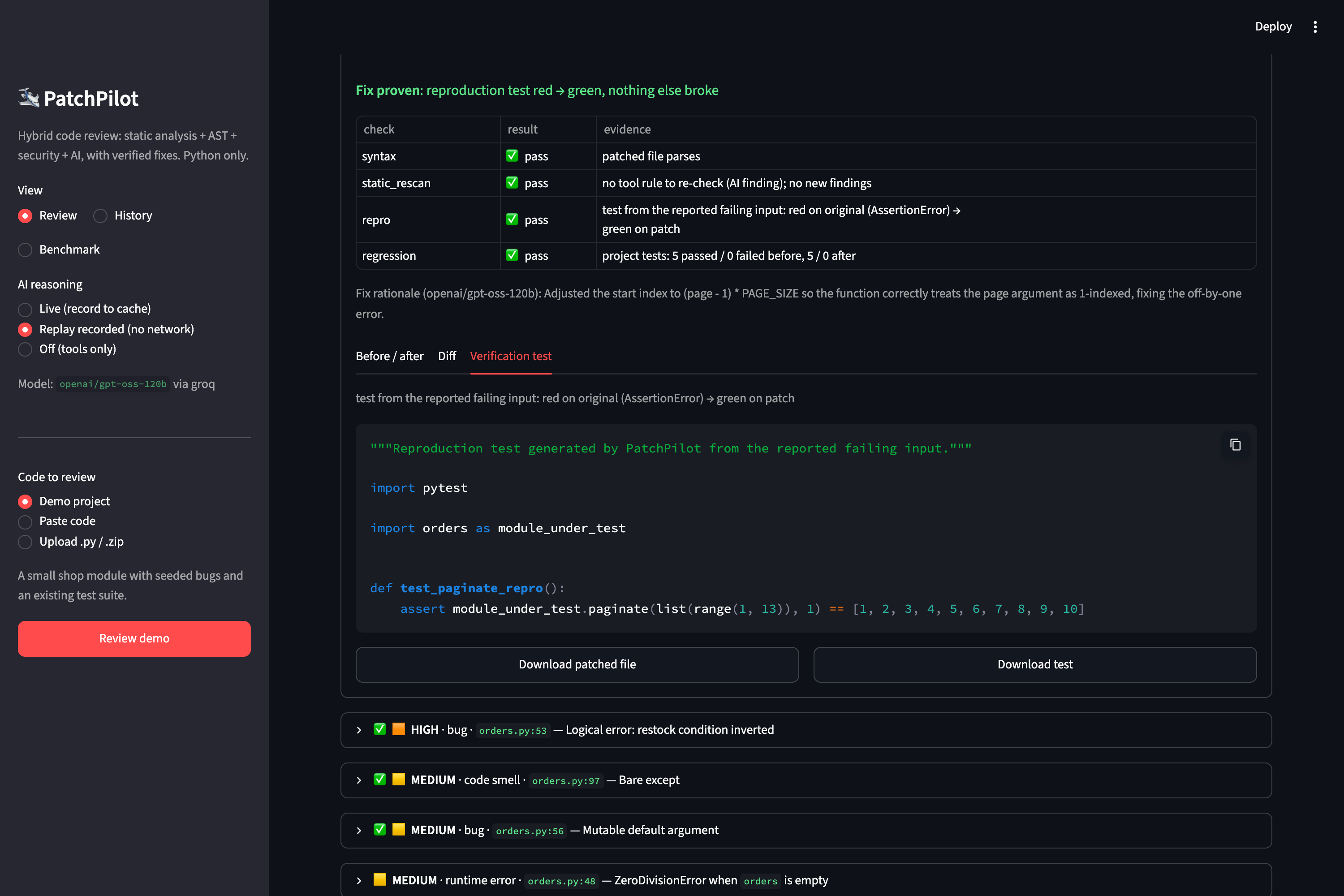
fixes and protection score
-
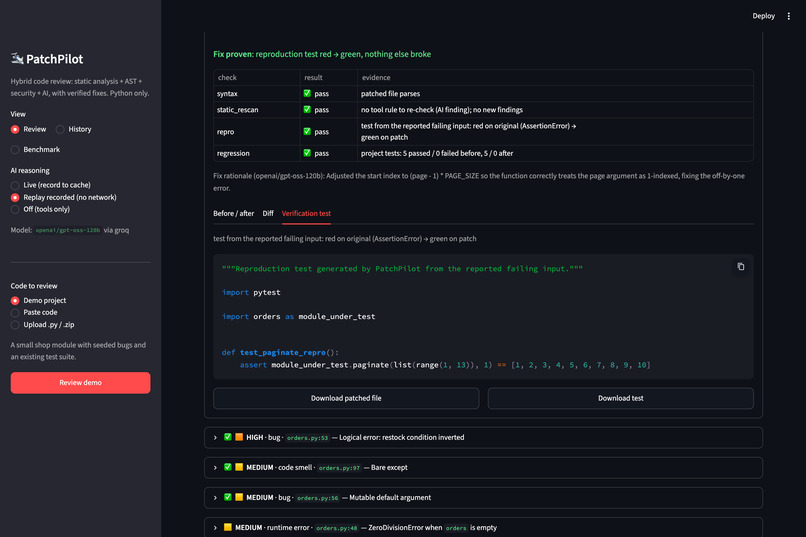
proven fix repro test
-
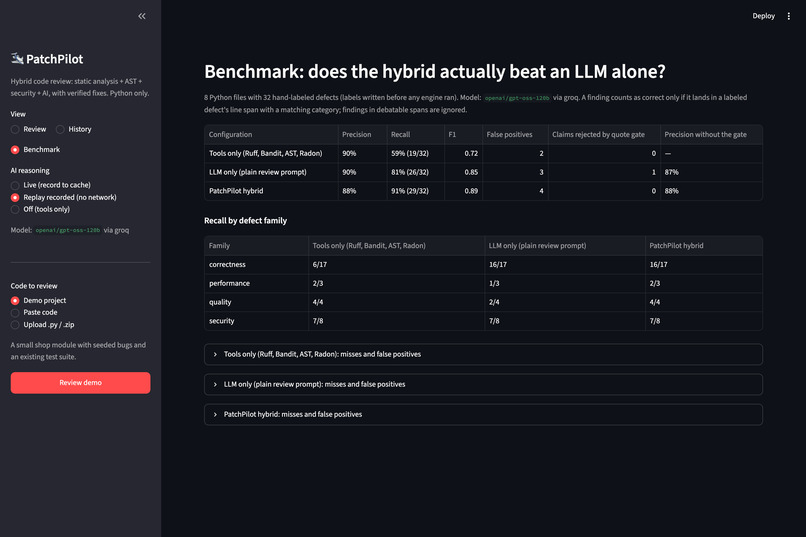
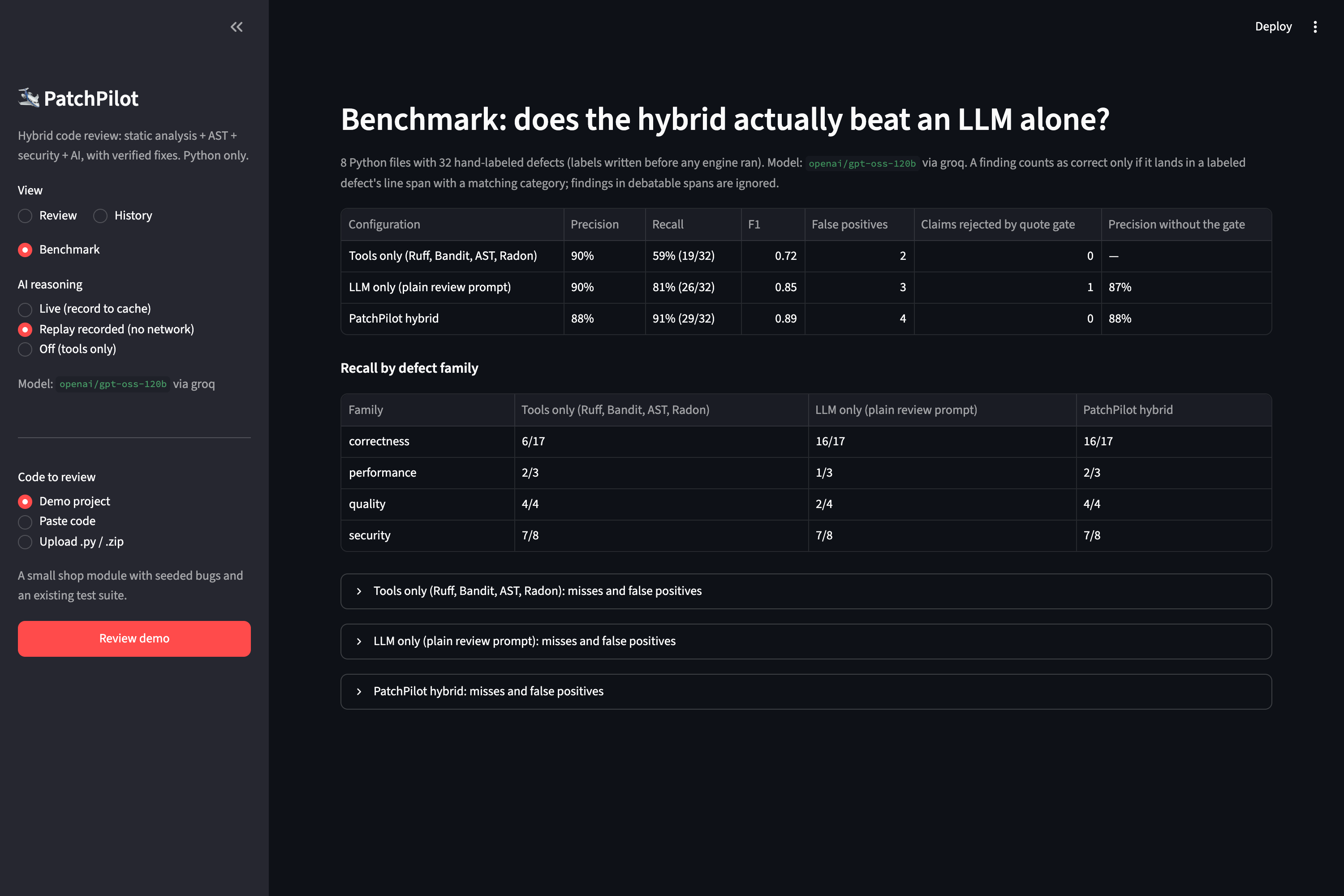
benchmark
-
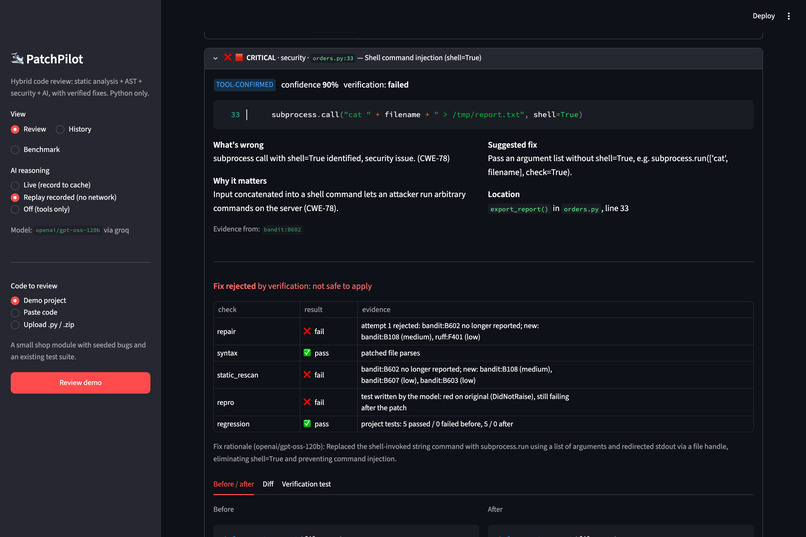
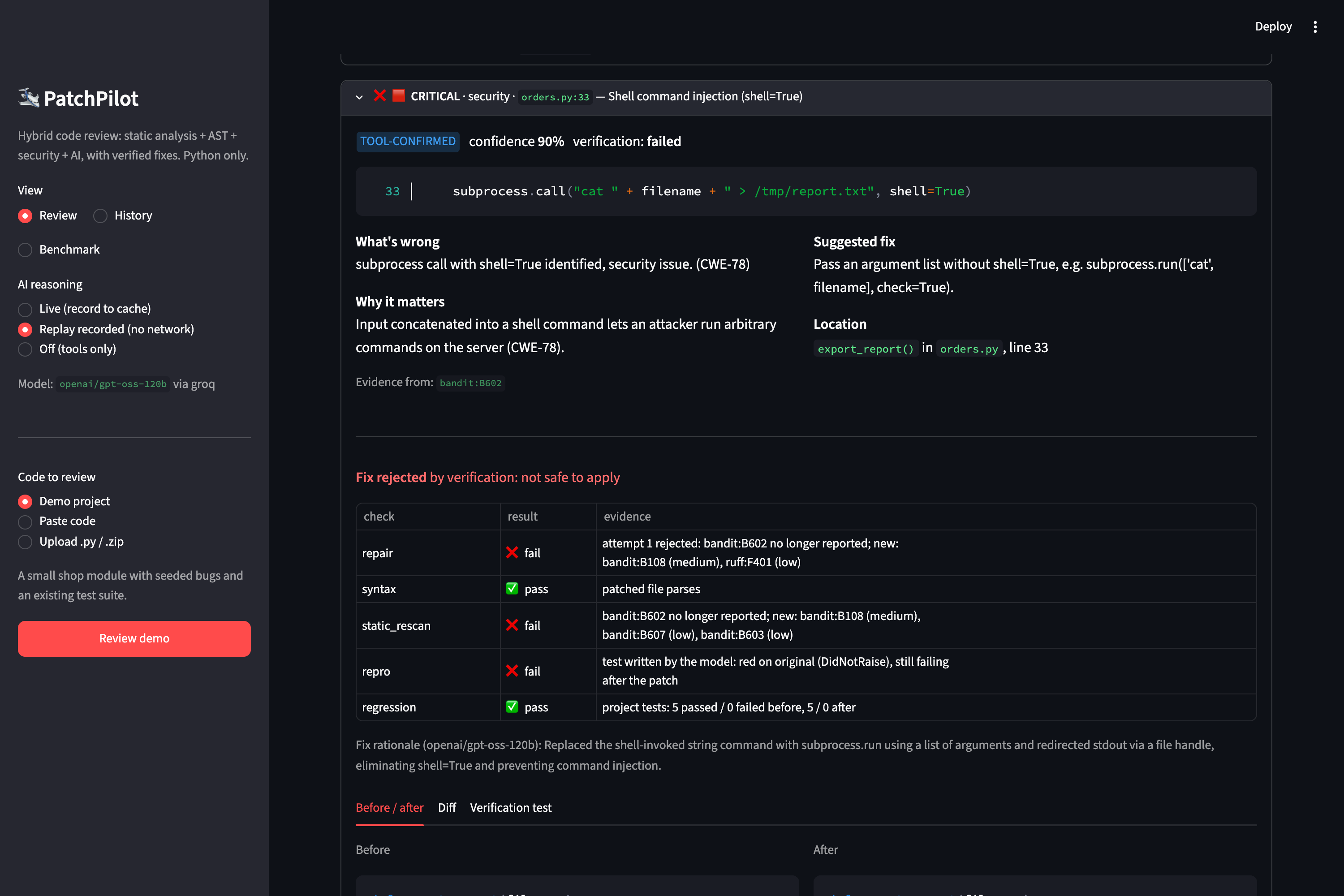
rejected-fix
-
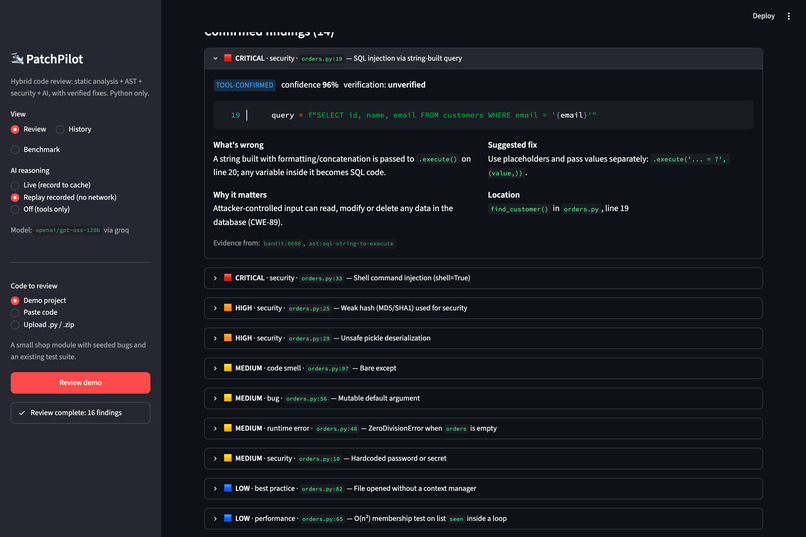
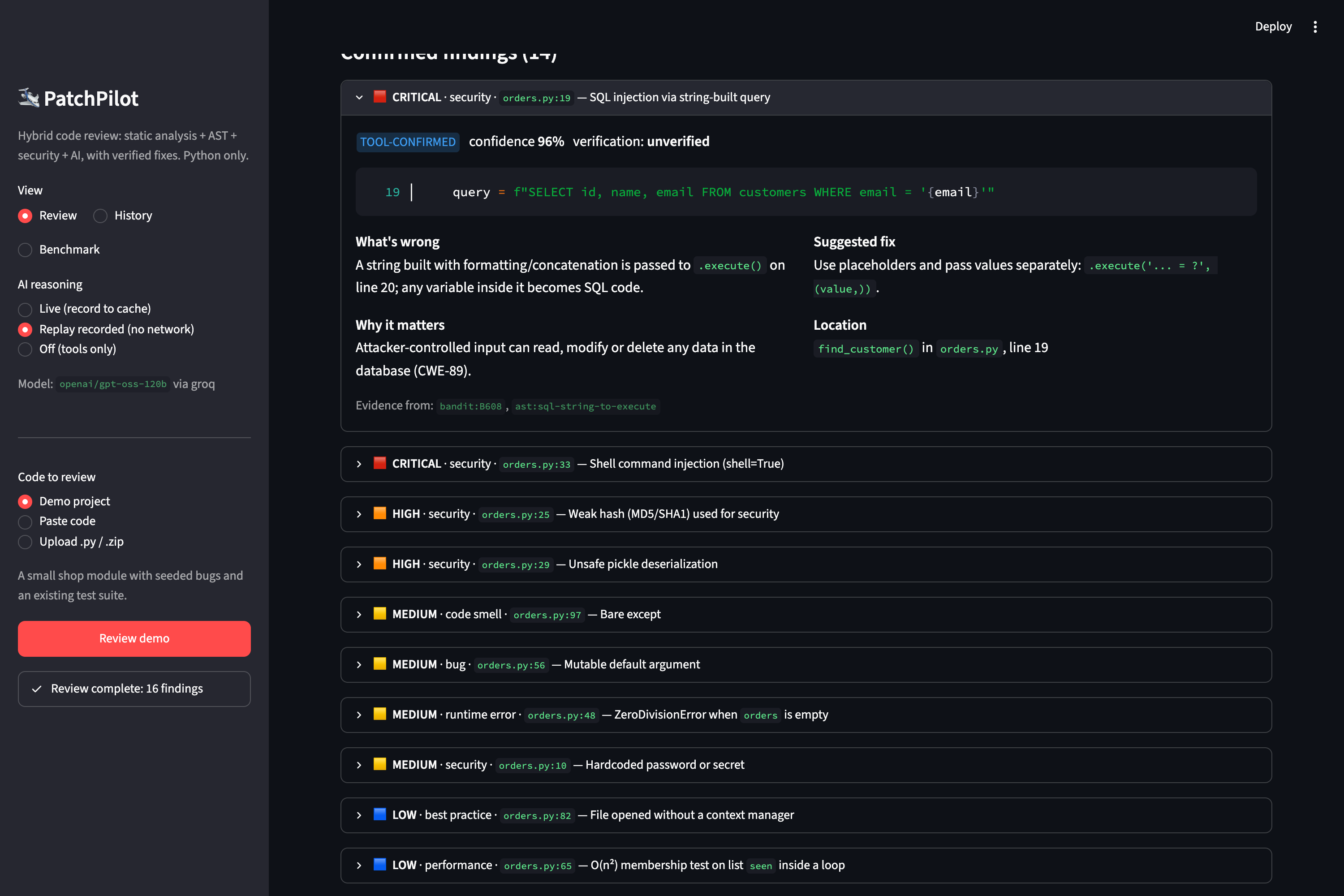
sql-injection-finding
Inspiration
Code review is an essential part of software development, but identifying security vulnerabilities, logical bugs, performance issues, and code quality problems can be time-consuming.
Traditional static analysis tools are excellent at detecting predefined patterns, but they may not understand the broader context behind certain programming mistakes.
We wanted to explore how Artificial Intelligence could complement traditional code analysis to make code reviews more intelligent, understandable, and actionable.
That idea led us to build PatchPilot AI.
What it does
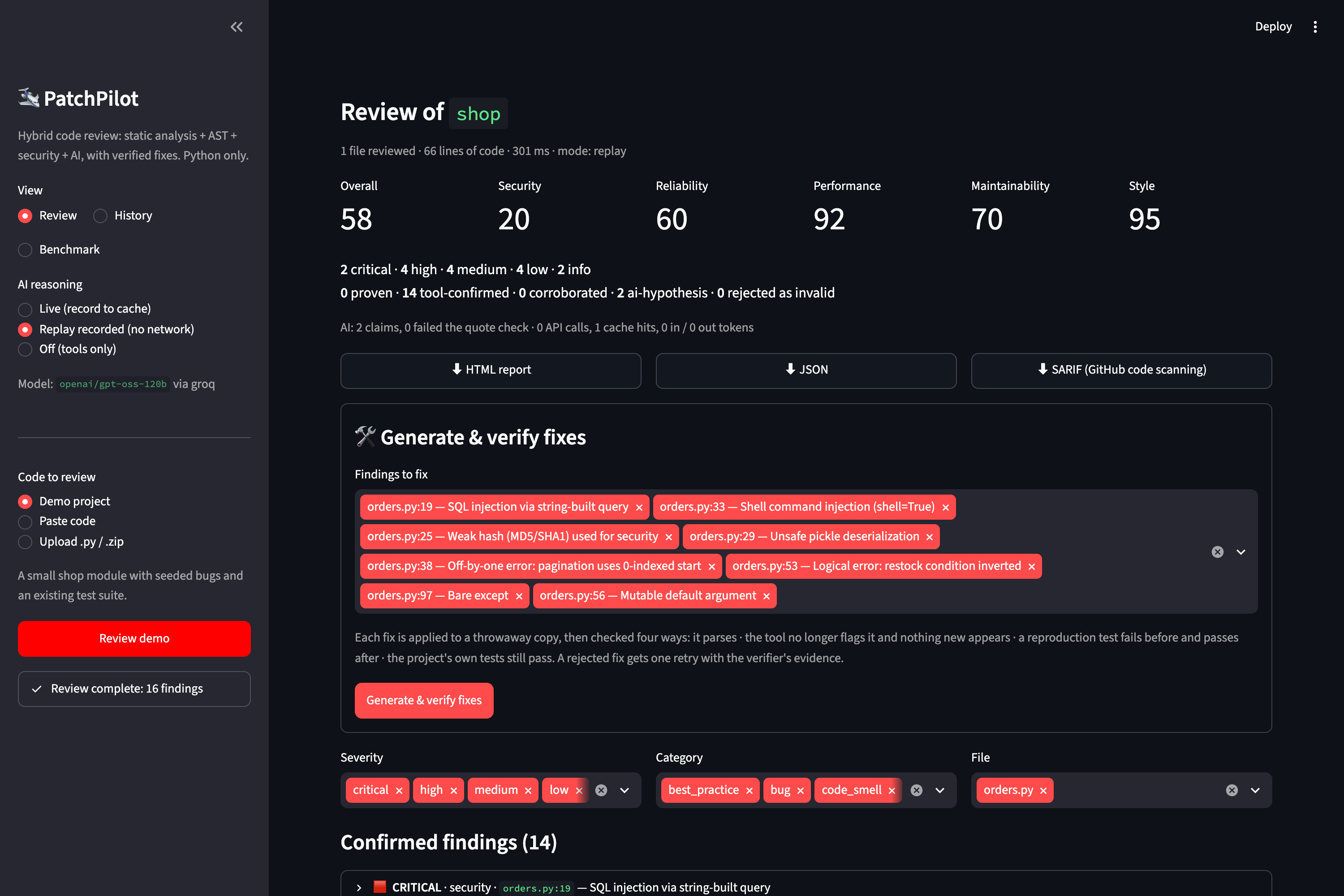
PatchPilot AI is an AI-powered automated code review platform designed to help developers identify and understand potential problems in their source code.
It combines multiple analysis approaches to provide a more comprehensive review.
Key capabilities include:
- Static Code Analysis: Uses established tools to identify coding errors and problematic patterns.
- Security Vulnerability Detection: Identifies potentially dangerous coding practices, including SQL injection vulnerabilities.
- AST-Based Analysis: Examines Python code structure to identify potential logical and runtime issues.
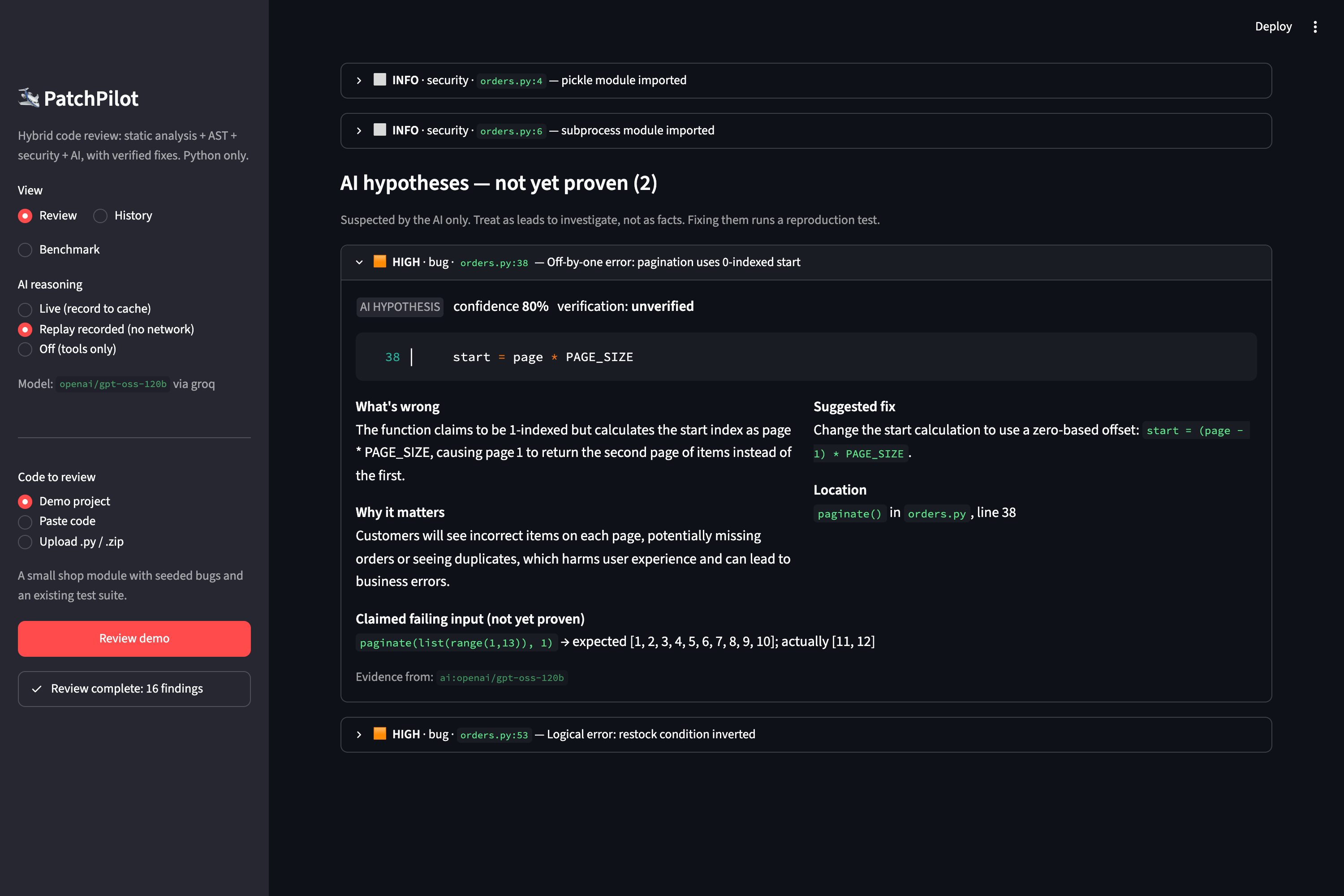
- AI-Powered Code Review: Uses AI reasoning to identify potential bugs and explain their impact.
- Severity Classification: Categorizes findings based on their potential impact.
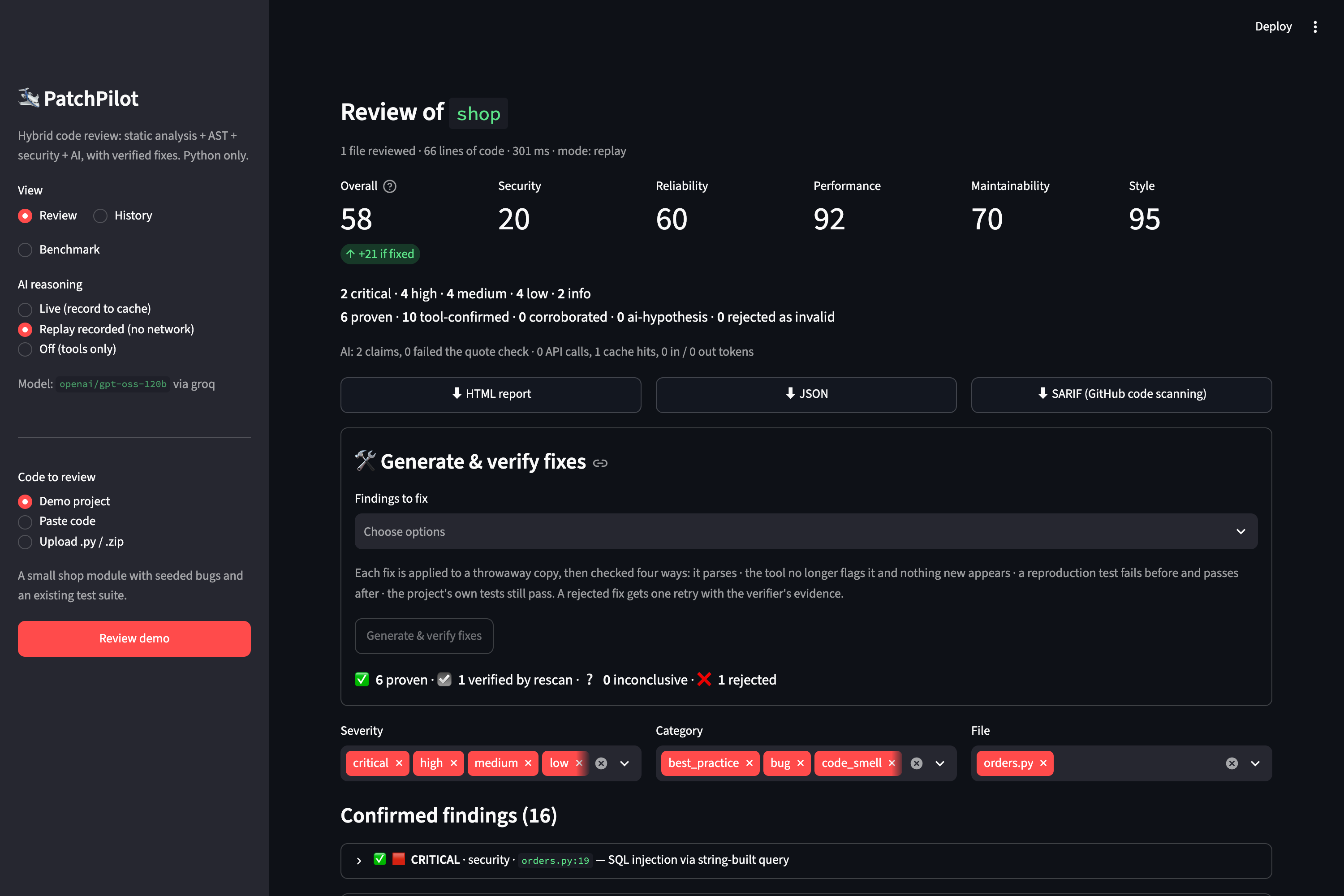
- Code Quality Scoring: Provides separate scores for security, reliability, performance, maintainability, and style.
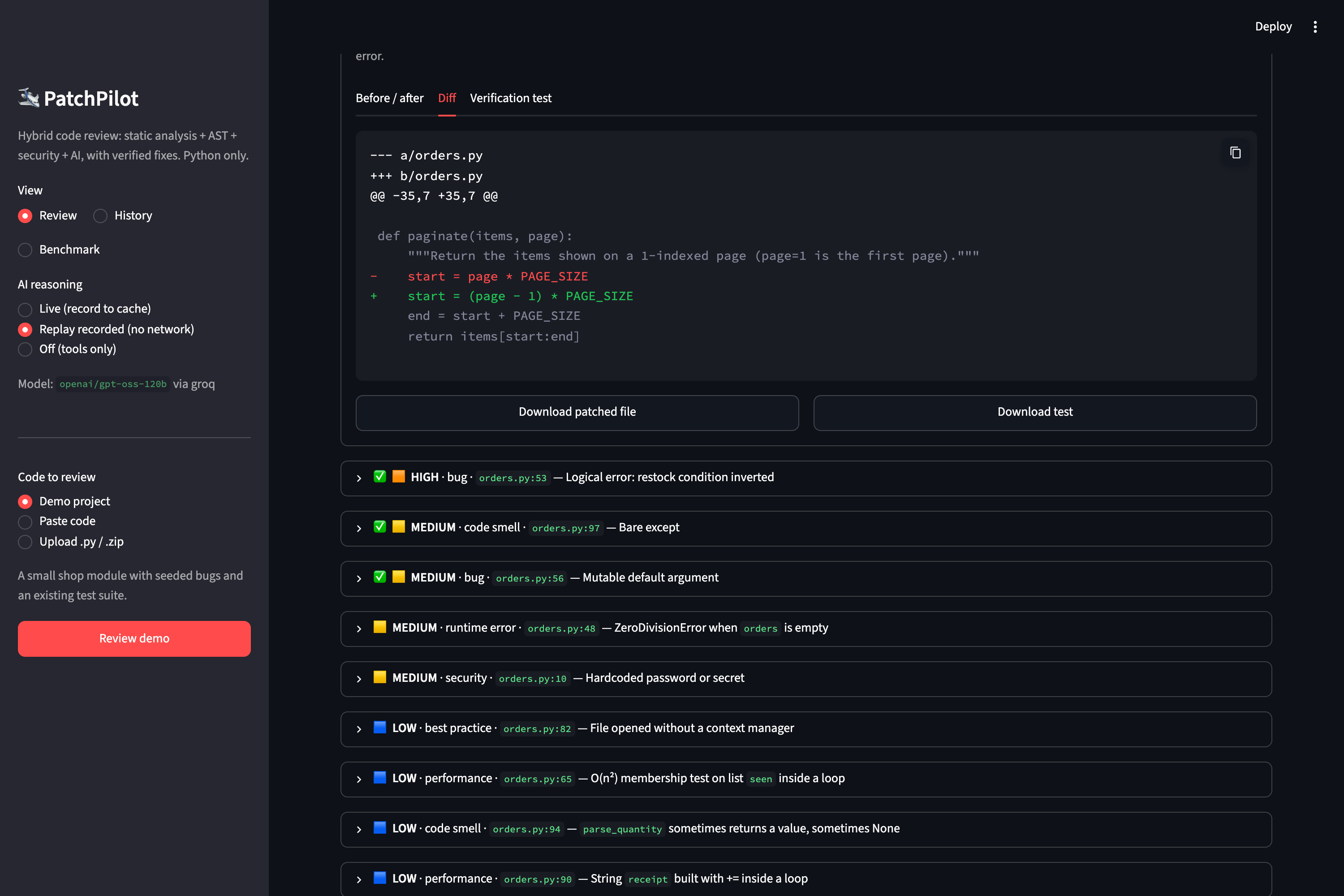
- Actionable Recommendations: Provides explanations and suggested improvements for detected issues.
- HTML Reports: Generates structured reports containing findings, source locations, severity levels, and recommendations.
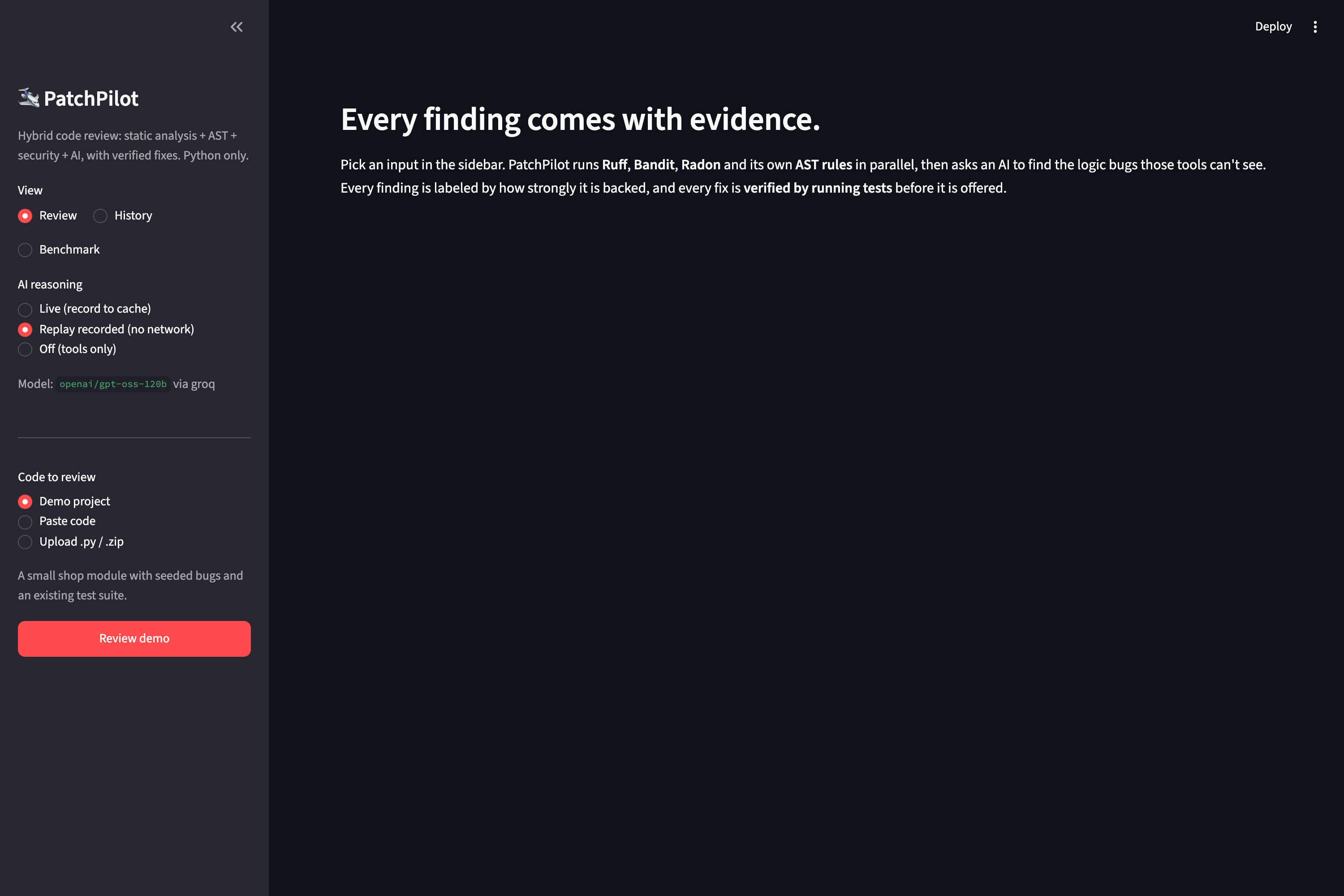
An important design principle is distinguishing tool-confirmed findings from AI-generated hypotheses instead of presenting every AI suggestion as a proven vulnerability.
How we built it
We built PatchPilot AI using Python as the primary language for its analysis engine.
The system follows a modular architecture in which multiple analysis components examine source code and contribute findings to a centralized review report.
Our technical approach combines:
- Python AST: For examining source-code structure and identifying potential programming issues.
- Ruff: For detecting code quality problems, unused imports, and style violations.
- Bandit: For identifying common security vulnerabilities in Python applications.
- AI Integration: For analyzing code and generating contextual explanations and recommendations.
- HTML and CSS: For presenting findings through structured, readable review reports.
The analysis results are organized by severity, category, source location, and confidence.
By combining deterministic analysis with AI-assisted reasoning, PatchPilot aims to provide more useful feedback than relying on a language model alone.
Challenges we ran into
One of our biggest challenges was combining different analysis engines into a consistent review system.
Different tools report findings in different formats, so we needed a common structure to organize and present them.
We also encountered several technical challenges:
- Reducing duplicate findings when multiple engines identify the same vulnerability.
- Maintaining accurate source-code line references.
- Distinguishing confirmed vulnerabilities from AI-generated suggestions.
- Handling AI engine failures without incorrectly reporting successful analysis.
- Designing meaningful code quality scores across different dimensions.
- Ensuring that suggested fixes are not presented as verified without supporting tests.
These challenges helped us understand that building a reliable AI-powered developer tool requires more than simply integrating an LLM.
Accomplishments that we're proud of
We are proud of building a working code review prototype that combines multiple analysis approaches.
Some of our key accomplishments include:
- Successfully integrating static analysis using Ruff and Bandit.
- Detecting SQL injection patterns across multiple locations in a Python application.
- Implementing AST-based detection for potential runtime issues.
- Creating a structured finding system with severity and confidence information.
- Separating deterministic findings from AI-generated hypotheses.
- Generating detailed HTML reports with code snippets and suggested improvements.
Most importantly, we established an architecture that can be extended with additional analysis and verification capabilities.
What we learned
Building PatchPilot AI helped us understand how different technologies can work together to solve real software engineering problems.
We learned about Python AST, static analysis, security vulnerability detection, AI integration, finding aggregation, and the importance of reliable testing.
We also learned an important lesson: AI-generated recommendations should not automatically be trusted. They need evidence, validation, and appropriate testing before being considered reliable.
What's next for PatchPilot AI
We envision evolving PatchPilot AI into a more comprehensive intelligent code review platform.
Our future improvements include:
- Automated patch generation and application.
- Isolated execution of generated code.
- Automated regression testing of suggested fixes.
- Better false-positive detection and finding deduplication.
- Support for additional programming languages.
- GitHub repository and pull request integration.
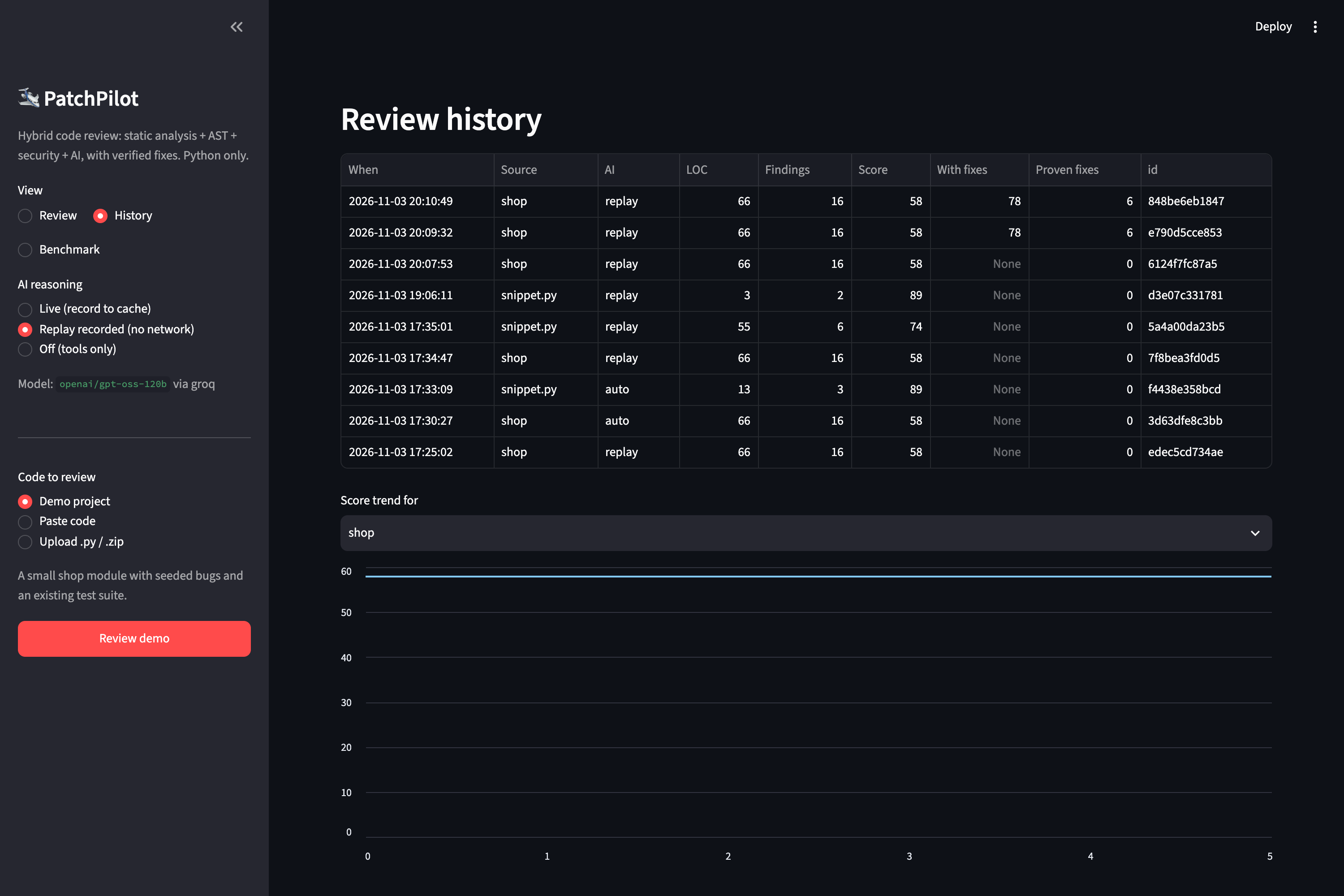
- Historical code quality tracking.
- More comprehensive security analysis.
Our long-term vision is to make PatchPilot AI a developer companion that does more than identify problems: it helps developers understand, resolve, and confidently validate them.
