Inspiration
Beginners often know that their code changed but struggle to explain what they learned. A generic assistant can produce a polished explanation that the author does not understand. PatchNotes for Learning takes a smaller approach: expose the concrete change and ask the author to connect it to their own words.
What it does
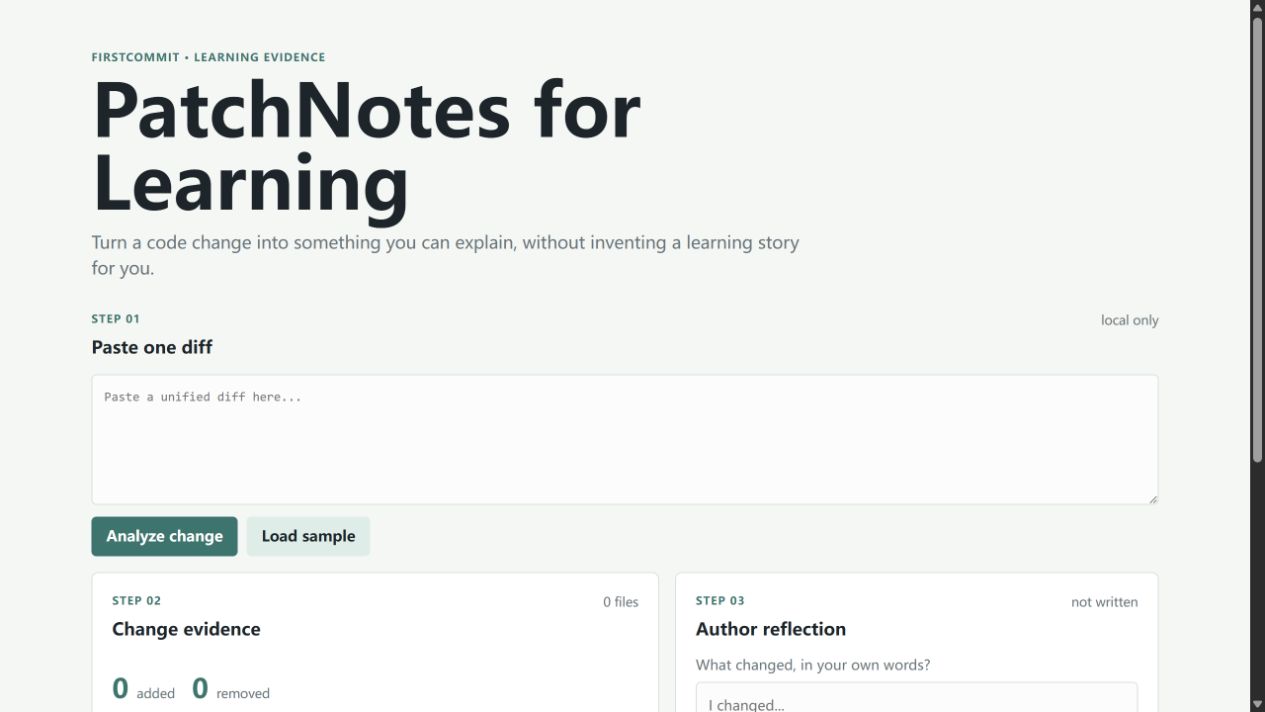
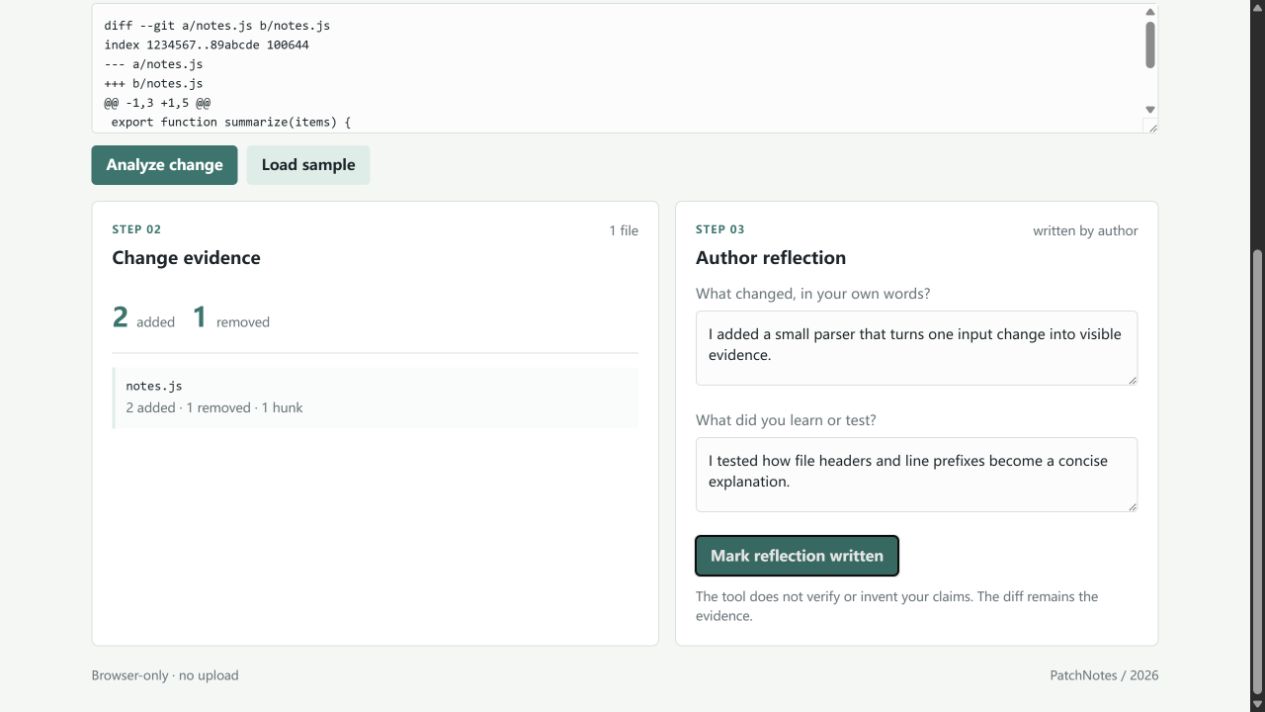
PatchNotes for Learning turns a pasted unified diff into traceable evidence for a beginner's own reflection. It extracts changed files, additions, deletions, and hunk counts, then places that evidence beside two author-written prompts: what changed, and what was learned or tested. The tool deliberately does not generate a learning story, grade the author, or act as an AI tutor.
How we built it
It is a browser-only prototype built with HTML, CSS, and vanilla JavaScript. The parser runs locally in the page. A guided demo mode stages a real sample diff and the reflection controls for a repeatable review. It uses no repository access, upload, API call, or retained pasted code.
Challenges we ran into
The main challenge was keeping the evidence useful without taking ownership of the learner's explanation. We learned to separate observable change facts from the author's interpretation, and to make that boundary visible in both the interface and the documentation.
Accomplishments that we're proud of
PatchNotes makes the learning evidence inspectable without pretending to know what the author learned. It keeps the changed lines visible, makes the counts concrete, and preserves the author's responsibility for the reflection.
What we learned
A smaller tool can be more trustworthy when it makes its boundary explicit. Showing evidence and asking the author to interpret it is more honest than generating a polished story on their behalf.
What's next
The next step is to test the reflection flow with more kinds of diffs while keeping the privacy boundary: no repository access, upload, API call, or retained pasted code.
AI-use disclosure
AI coding assistance was used while drafting the HTML, CSS, JavaScript, and documentation. The project owner reviewed the implementation and remains responsible for understanding and explaining the submitted work.
Built With
- developer-tools
- education
- javascript
- productivity
- web

Log in or sign up for Devpost to join the conversation.