Inspiration
A future smart bandage might observe a wound between appointments. But a changing reading is not the same thing as an infection, and a failing sensor can make an apparently confident system dangerous. I wanted to explore the harder part of autonomy: can the control loop show its evidence and stop when that evidence is weak?
Patchline is an interactive software prototype of that decision architecture. The long-term concept includes a wearable patch and possible ultrasound and violet-light modules. This submission does not test a physical device or a therapy.
What it does
Patchline generates reproducible 24-sample traces for four proposed wound-environment channels: local patch temperature, dressing wetness, fluid pH, and experimental wound-fluid glucose. Visitors can switch among stable, changing, and sensor-fault scenes, then adjust the final synthetic reading themselves.
A quality gate checks for missing, implausible, or isolated noisy values. For usable traces, a small classifier trained on separate synthetic examples scores resemblance to the generated stable or changing pattern. A bounded orchestrator records the trace or prepares a human-review handoff. In the fault scene, an out-of-range pH value and missing glucose reading withhold the score, request a sensor recheck, and set both hypothetical output indicators to zero.
Ultrasound and violet light appear only as disconnected 0–3 abstract simulation tokens. They are not doses, exposure times, device settings, or treatment recommendations. No physical output exists. The printable handoff links numeric claims to their underlying synthetic samples.
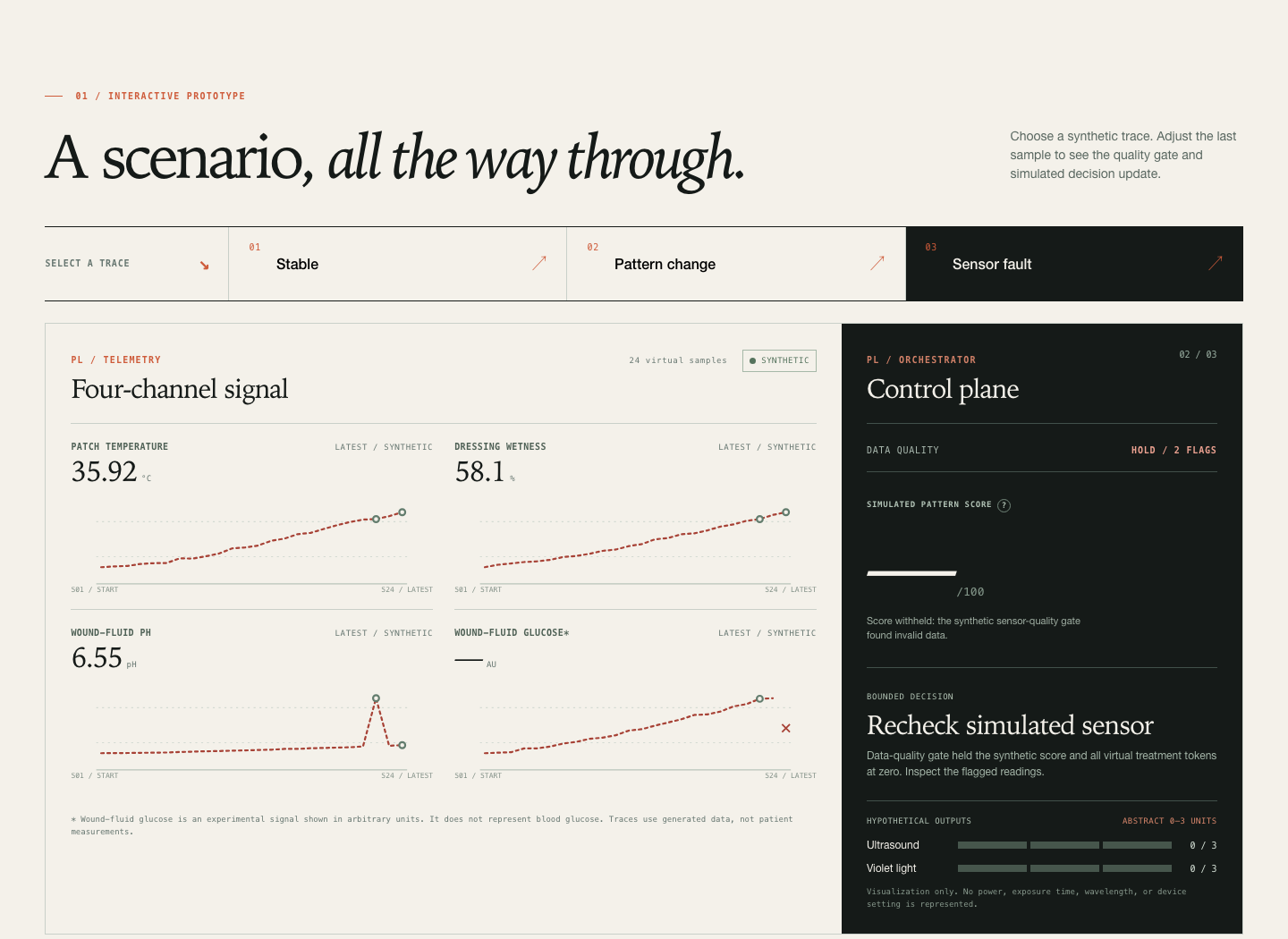
The fault scene: a broken reading stops the virtual control proposal.
How I built it
I built a dependency-free browser app in HTML, CSS, and JavaScript. A seeded generator produces the virtual four-channel traces. The app trains an inspectable logistic classifier on 320 generated examples and evaluates it on 128 separately generated examples. The labels come from the simulator, not clinicians, so the result measures this software experiment only.
The pipeline is explicit: synthetic samples → sensor-quality gate → trained pattern classifier → bounded policy → evidence-linked handoff. There is no backend, patient account, connected sensor, actuator interface, or runtime AI API key. AI-assisted development helped implement the prototype; the running app does not call a generative model to interpret a patient's wound.
Challenges
The central challenge was preventing a polished simulation from sounding like clinical validation. A classifier can learn a synthetic generator's assumptions extremely well while teaching us nothing about real wounds. I separated pattern score from infection risk, made poor-quality data block the score, and kept the hypothetical therapy display in arbitrary tokens with no path to hardware.
The sensor labels matter too: dressing wetness is not an infection measurement, and wound-fluid glucose is not blood glucose. Every trace is marked synthetic.
What I learned
The most useful output of an autonomous health system may be a clear account of why it did not act. A reviewable data-quality halt is more informative than a confident number built on a broken reading. Wound-environment signals, synthetic labels, clinical infection signs, and treatment evidence must remain distinct in both product language and code.
What's next
The next research step is an inert benchtop sensing study with documented calibration and independent reference measurements. Human studies would require clinician-defined questions, external validation, false-negative analysis, and appropriate oversight. Therapeutic hardware would need its own evidence of benefit and safety before any human treatment policy could be proposed.
Try the prototype and inspect the work
Use boundary: Patchline is a technical demonstration, not a medical device. It cannot diagnose infection, choose care, or treat a wound. IWGDF/IDSA guidance bases diabetes-related foot infection diagnosis on clinical assessment; these synthetic traces are not patient evidence. Built by Rishik Rontala.

Log in or sign up for Devpost to join the conversation.