The problem
The most important text in people's lives arrives as a wall: benefits letters, clinic instructions, school forms, government pages. It is written at a college reading level, full of jargon, with the deadline, the amount, and the phone number buried in the middle. For people with low literacy, cognitive or visual disabilities, dyslexia, or English as a second language, that wall is a barrier to benefits, care, and school — access denied by formatting.
People share this text the way they share everything: they copy it and paste it. Ctrl+V is how help travels. PasteBridge is what happens after the paste.
How it works
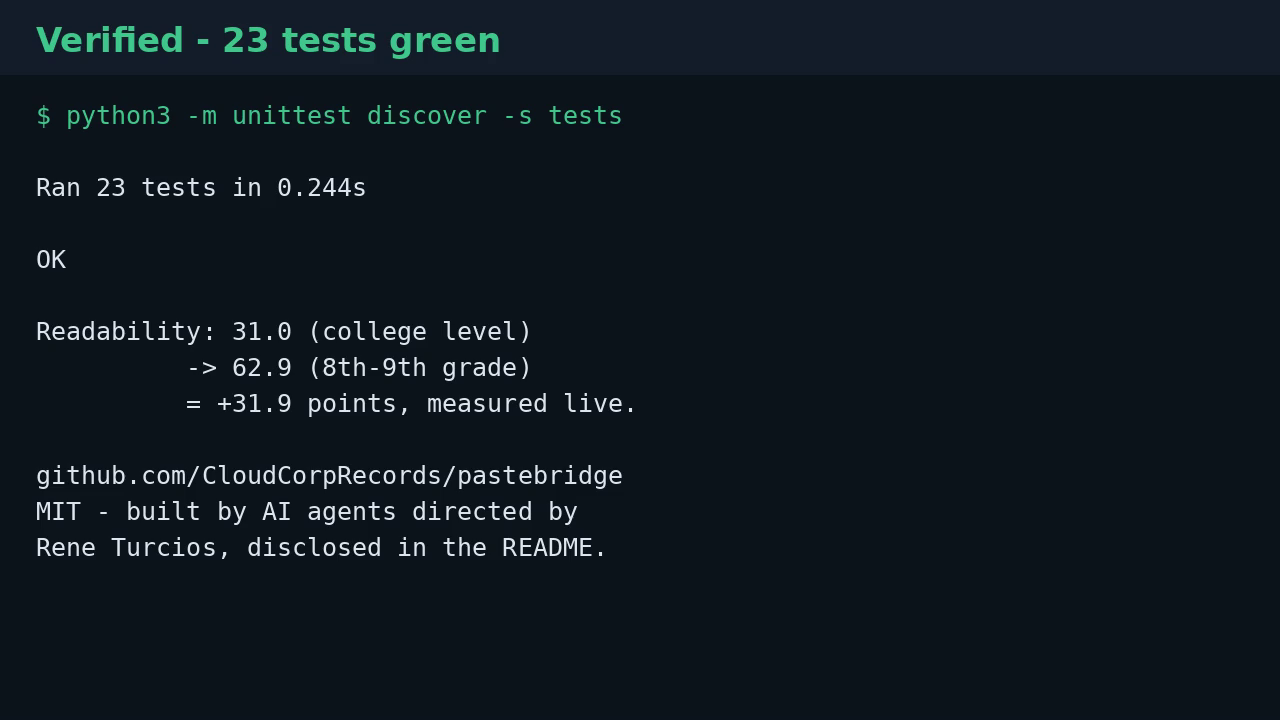
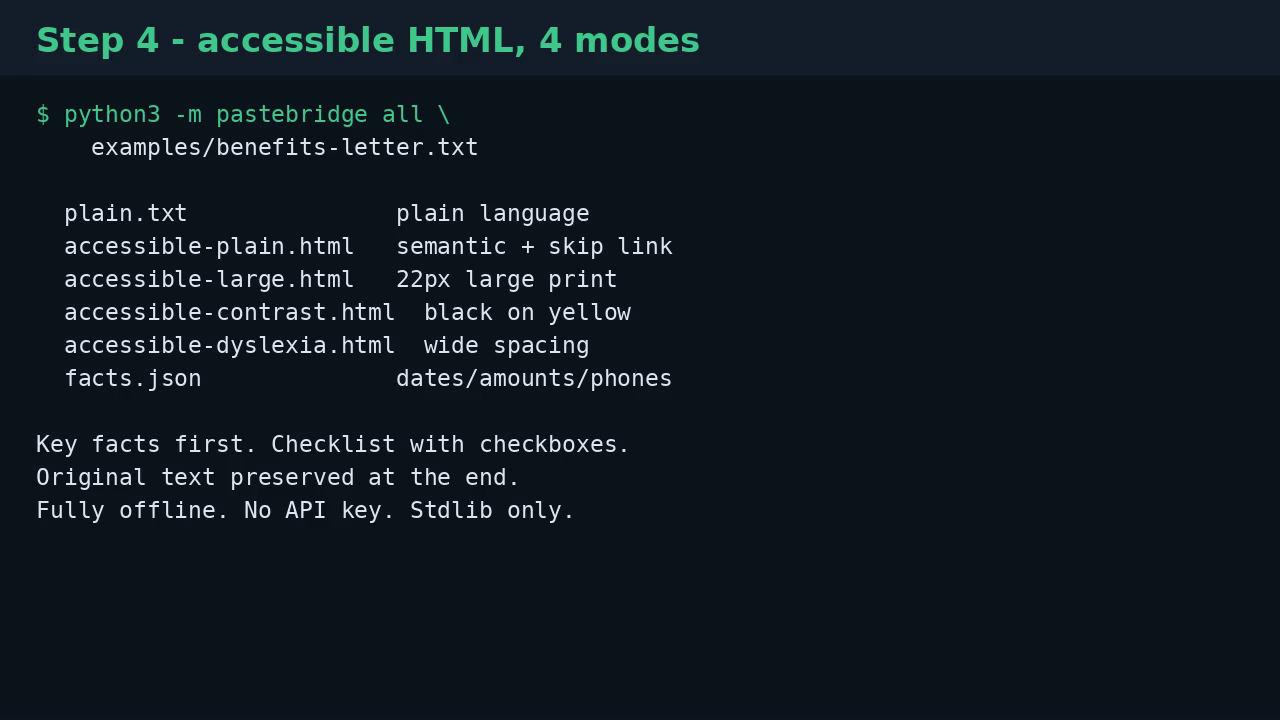
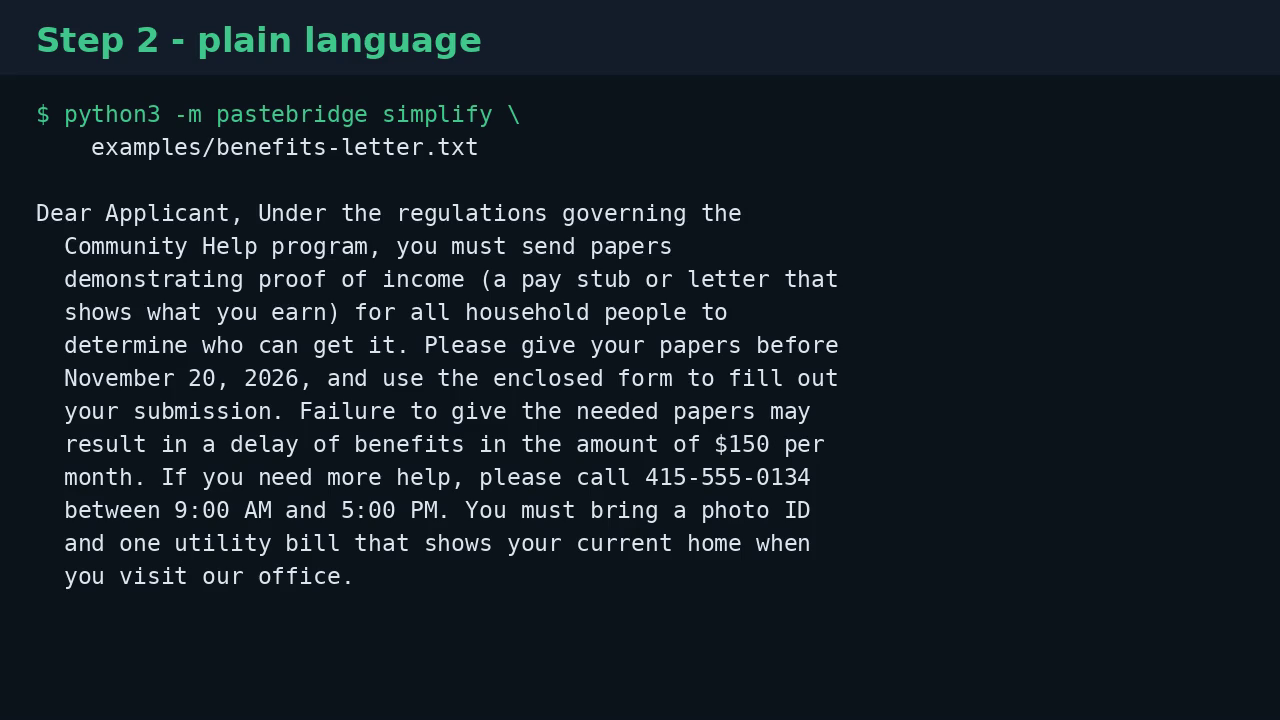
Paste any hard-to-read text and get back: (1) A plain-language version — deterministic glossary swaps ("utilize" becomes "use", "prior to" becomes "before", "proof of income" explained in plain words) and long-sentence splits. Every change comes from an auditable rule list — no model, no invented deadlines, works fully offline. (2) Key facts first — dates and deadlines, times, dollar amounts, and phone numbers pulled out of the prose into one box. (3) An action checklist — the sentences that ask you to do something ("bring a photo ID", "call to reschedule") turned into checkboxes. (4) Accessible HTML in four modes — plain (semantic, skip link), large print (22px), high contrast (black on yellow), and dyslexia-friendly (wide spacing, left-aligned) — each a standalone file, with the original text preserved at the end. (5) A readability receipt — Flesch Reading Ease before and after. The sample benefits letter goes from 31.0 (difficult, college level) to 62.9 (standard, 8th-9th grade): +31.9 points, measured by the tool itself in the demo video.
What we built during the hackathon
A Python 3 package (standard library only) with a CLI (check / simplify / actions / html / all), a zero-dependency browser demo (web/index.html in the repo), 23 passing tests, and three sample letters. The demo video shows real terminal runs of the shipped code — no mocked output.
Honest limits
The simplifier is rules, not magic: it swaps known jargon and splits long sentences, but does not rewrite arguments. That is deliberate — for benefits and medical text, an auditable rule list is safer than a model that might invent a deadline.
Build Disclosure
Build Disclosure: AI-built. This project was built by AI agents (Tree / Muse fleet) directed by Rene Turcios. Rene set the problem, theme fit, and acceptance review; agents designed, coded, tested, and documented the project during the hackathon period. AI tools used are credited in the Built With list. Open source under MIT.
