-
-
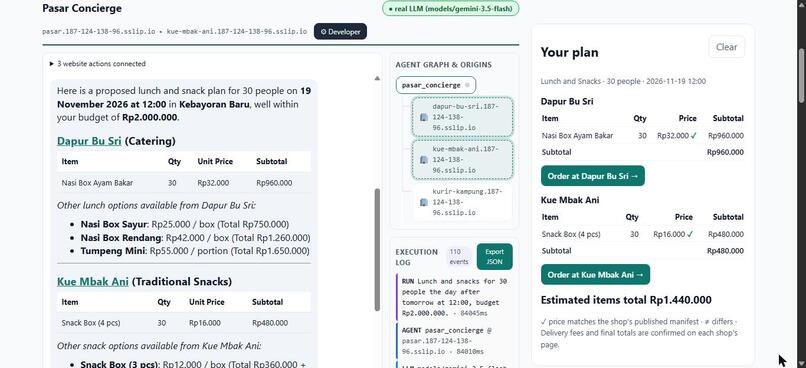
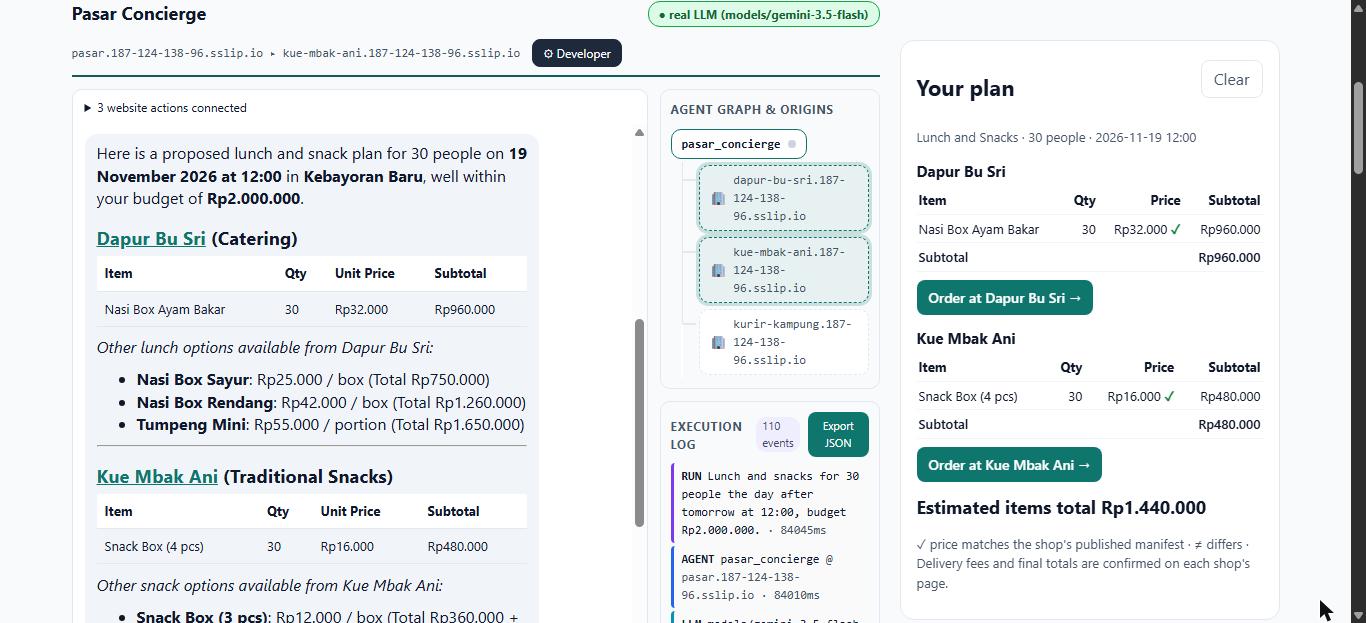
Live run: the concierge plan, every price verified (✓) against the shops' manifests
-
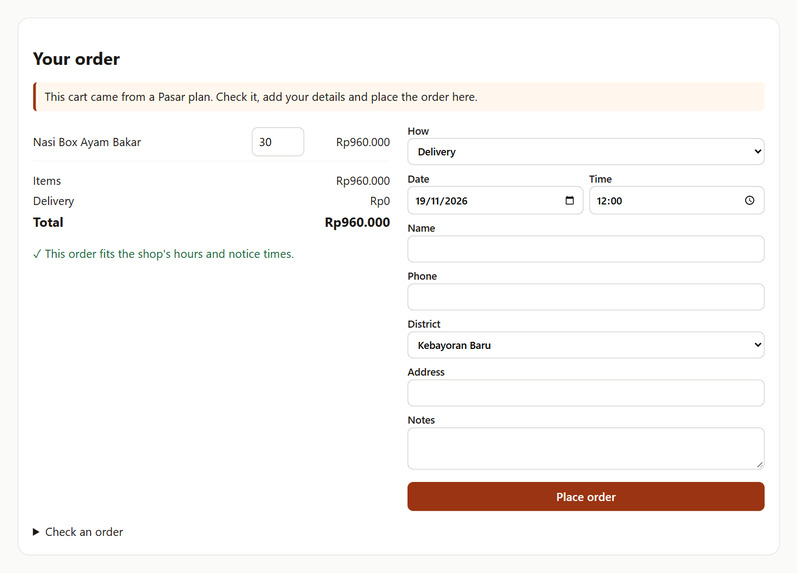
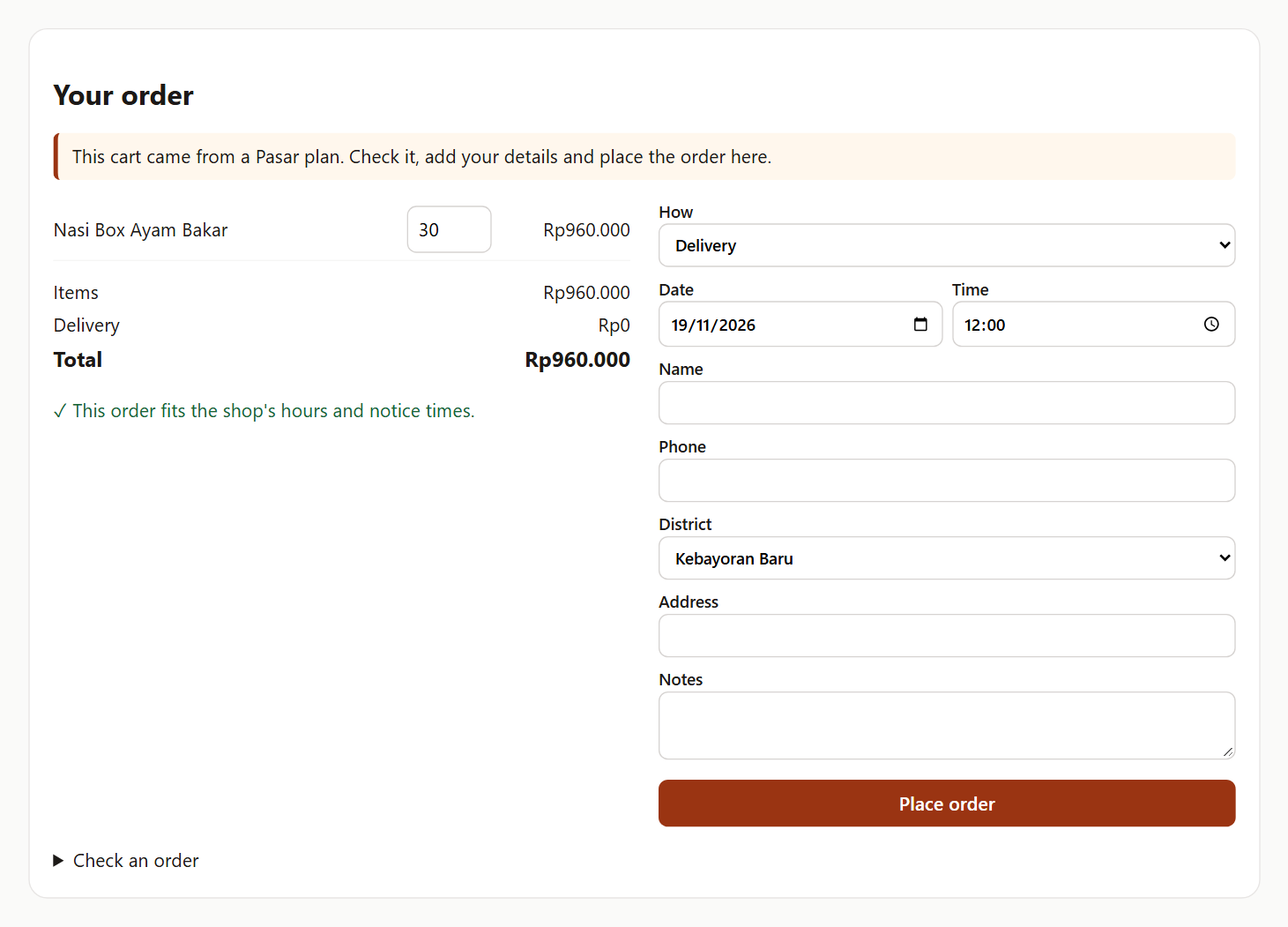
The "Order at" link opens the shop with the cart, date and time filled
-
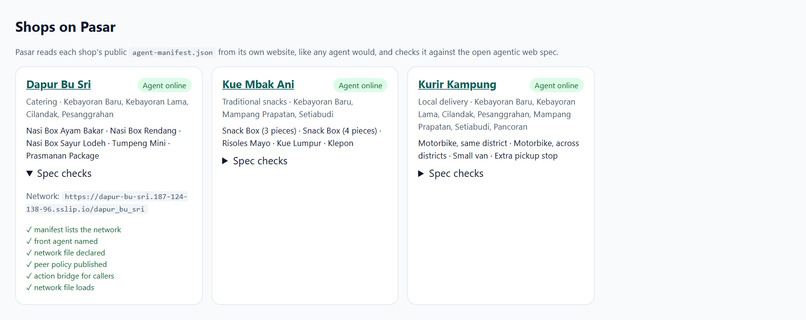
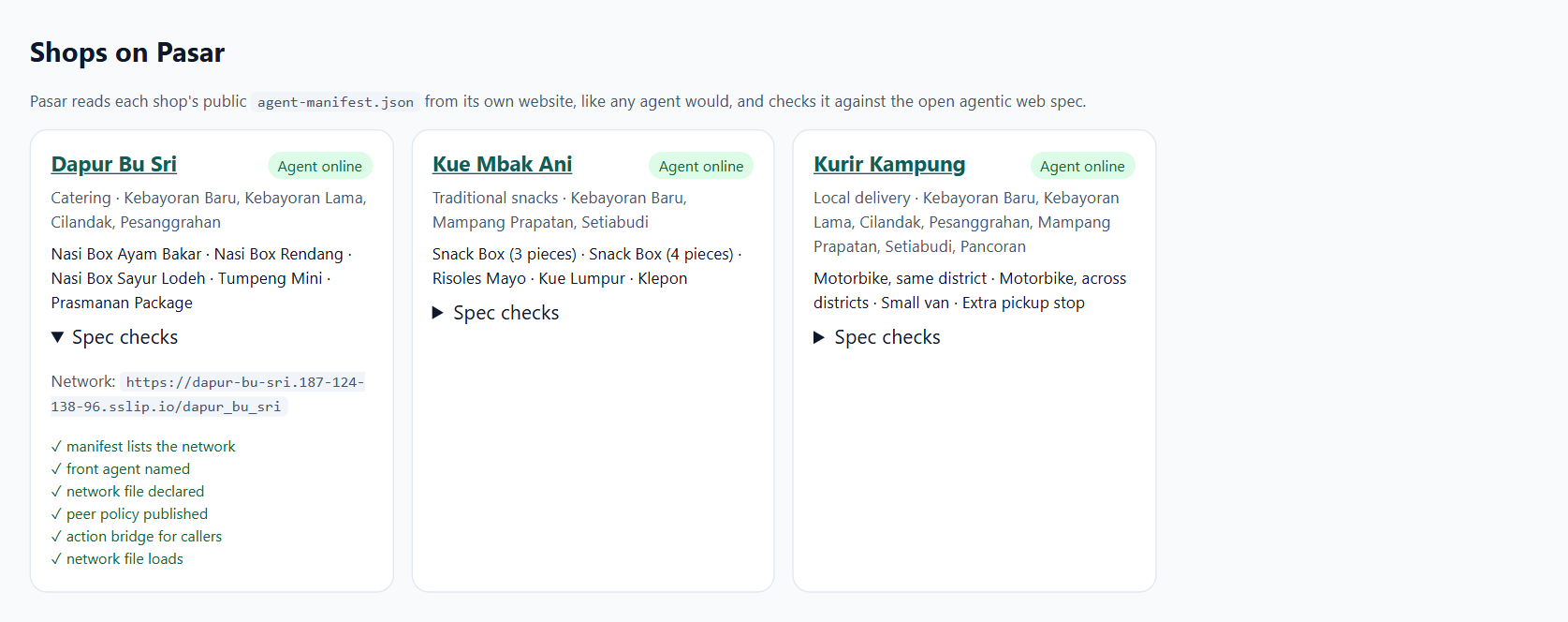
Pasar checks each shop's agent-manifest.json live against the spec
-
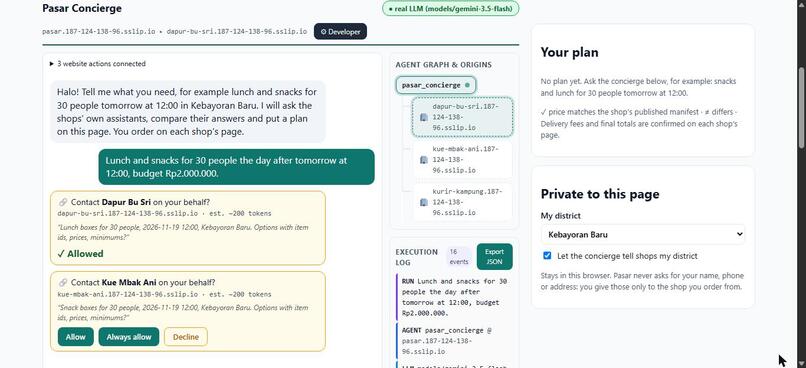
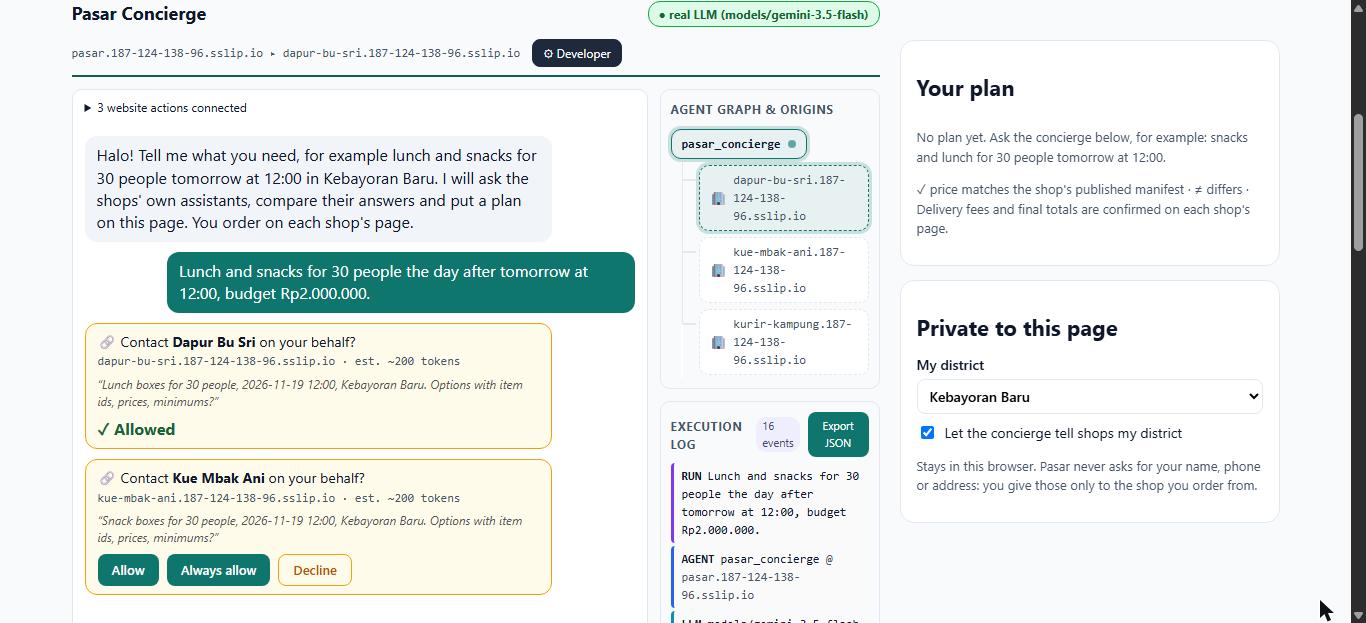
Consent card before each shop is contacted, with the exact request
-
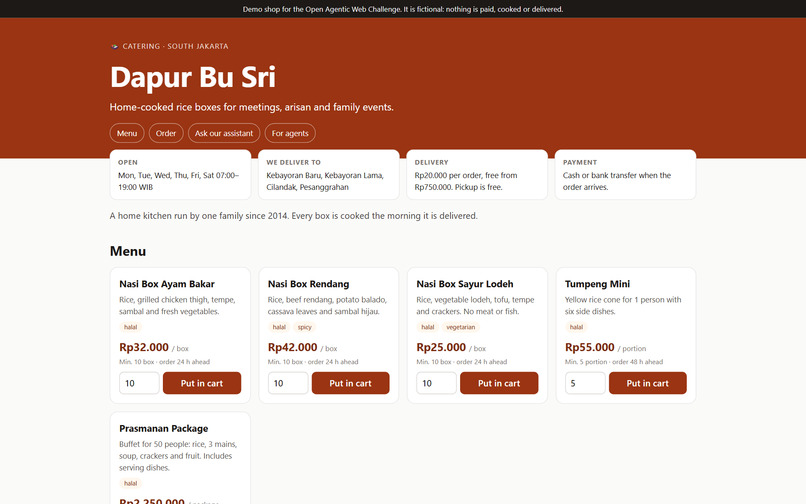
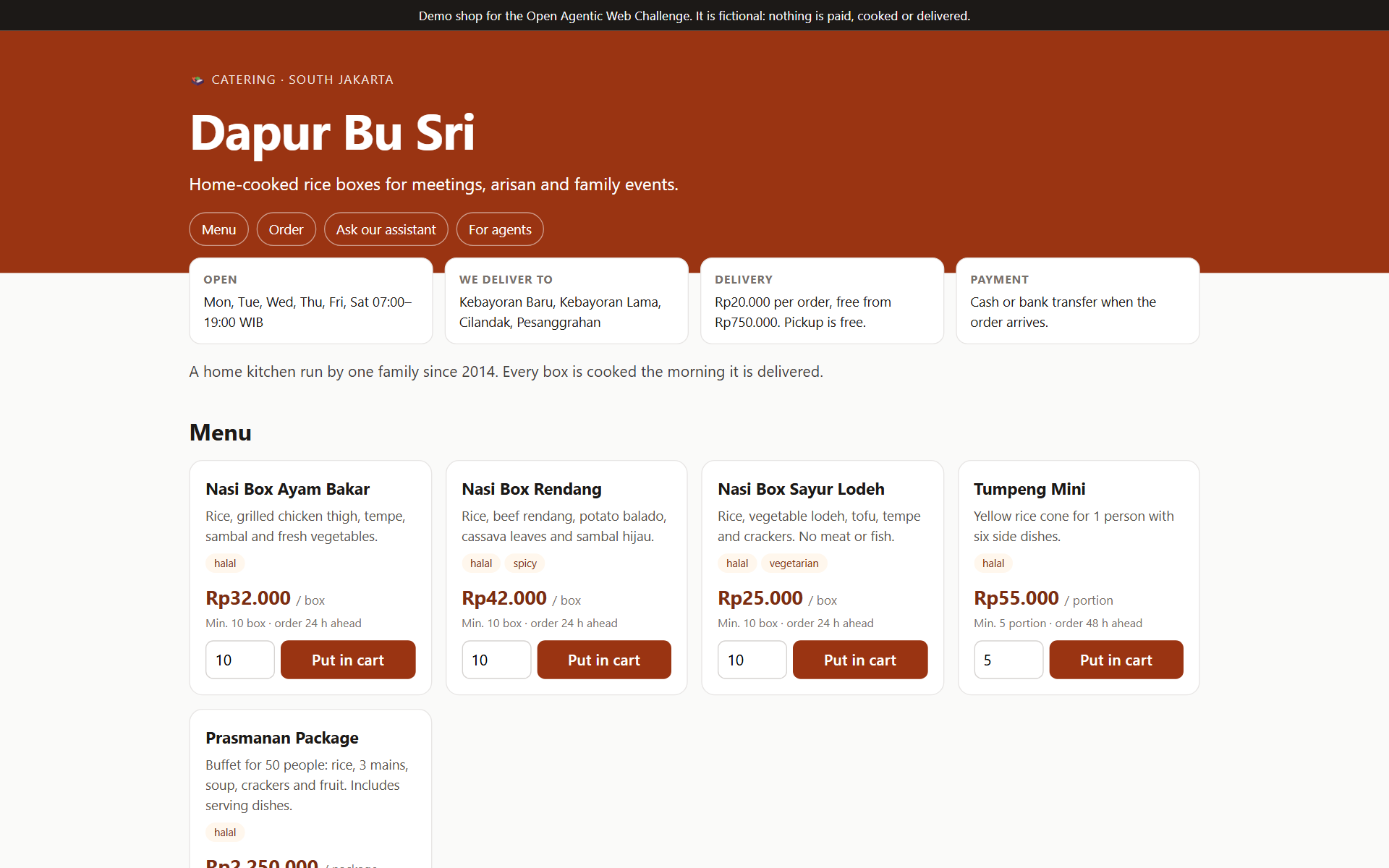
A generated demo shop: Dapur Bu Sri (catering)
Inspiration
Indonesia has about 64 million micro, small and medium businesses (UMKM): the catering kitchen down the street, the snack seller on her porch, the neighbourhood courier. Today they reach customers through a few large platforms that set the fees, the ranking and the rules. When personal AI agents start shopping for people, the same thing could happen again, only faster: whoever owns the agent owns the market.
The open agentic web offers a different path. A shop can publish its own agent as plain data on its own website, and any visitor's agent can run it. We wanted to show what that path looks like for the smallest businesses, and what a buyer gets from it.
What it does
PasarAgen has three parts. Every site is a separate origin and follows the Worldwide Agentic Web MVP spec.
- Agentify UMKM (generator). A shop writes its catalog as one JSON file: items, prices,
minimum order, notice time, opening hours, delivery districts and policies. One command
generates a complete open agentic website:
- a normal shop page with menu, cart, order form and order lookup, which works without AI;
- an agent network (HOCON and JSON),
agent-manifest.json,links.json, the action bridge and the browser runtime; - the shop's own functions as
website_*tools: read the shop, quote, set the cart, look up an order, and place an order, which always opens a confirmation dialog.
The same catalog is also compiled into the network's published price list. Another site's agent, which never gets the shop's tools, can therefore still answer with real prices.
- Three demo shops, all fictional: Dapur Bu Sri (catering), Kue Mbak Ani (traditional snacks) and Kurir Kampung (local delivery). Each one is generated from its catalog.
- Pasar, the buyer concierge. You ask once, for example "lunch and snacks for 30
people the day after tomorrow at 12:00, budget Rp2.000.000". The concierge:
- reads Pasar's directory and picks the shops that fit;
- shows a consent card for each shop with the exact request, before anything is fetched;
- runs each shop's own network in your browser, on your model and key, so the shop never sees your key, your chat or your details;
- builds a shopping plan and checks every price against the shop's own published manifest. A ✓ means it matches; ≠ flags a number the model got wrong;
- gives you an "Order at …" link that opens the shop's page with the cart, date and time filled in. No name, phone or address travels in the link. You finish the order on the shop's site, where its own assistant can help and you confirm.
Your district is private to Pasar. The concierge may read it, and tell shops, only when you tick a box. Pasar also checks each listed shop's manifest live against the spec and shows the result on the shop's card ("Agent online" and "Spec checks").
How we built it
- We built on the agentic-web reference runtime and agentify-website skill from the challenge repository, vendored unchanged except for the fixes below. Networks are data, execution happens in the browser, and inference is bring-your-own-key.
- The generator is a dependency-free Node script. It validates the catalog, renders the
shop page from a template, writes the HOCON network with the published price list in its
peer rules, writes the manifest with a small
umkmextension block (items and prices that a buyer can verify), then runs the officialbuild_network.mjschecks. - Pasar's concierge network declares each shop's network URL as a partner tool. It lists
the shops' origins in
allowed_peerswith a closed peer policy, and its instructions keep each request under 140 characters with no personal data. - Each site is hosted as static files with nginx on our own VPS, under its own HTTPS subdomain (Let's Encrypt). nginx sends CORS headers on the public agent files and the sandbox-worker CSP the spec asks for.
- The official
check_partner.mjspasses for all four live sites. Node tests cover the shop rules, the price checks, the privacy toggle, the generated price lists and the runtime fixes.
Challenges we ran into
- Gemini 3 and tool calls. Through Google's OpenAI-compatible endpoint, Gemini 3
failed in the reference runtime in two ways:
- Each tool call carries a
thought_signaturethat must be sent back, and the stream parser dropped it (HTTP 400). - Parallel tool calls arrive at the same stream index with different ids, and the parser
merged them into one call named
dapur_bu_srikue_mbak_ani.
- Each tool call carries a
We fixed both in runtime/llm.js with regression tests, so free-tier Gemini keys now
work end to end.
- Grounding partners without their tools. A partner network runs without the shop's
website_*tools, so it cannot read live data. We compile the published price list into the network, and Pasar verifies every price against the manifest instead of trusting the model. - Separate origins on a budget. Consent cards only appear across origins, so each shop needs its own HTTPS host. We used IP-based hostnames with Let's Encrypt on one small VPS, with no DNS changes.
Accomplishments that we're proud of
- A live, end-to-end run on the hosted sites. One request produced two consent cards, two shop networks running in the visitor's browser, and a plan of Rp1.440.000 with every price verified against the shops' manifests.
- A small shop can go from a JSON catalog to a spec-conformant agentic website with one command.
- Two runtime fixes that any agentic website using Gemini can reuse.
What we learned
Consent, key isolation and "the shop owns its agent" are not just policy; the runtime enforces them by design, and they make a better user experience too. The weak spot is trust in what a partner's model says. Publishing machine-readable facts next to the network, and verifying against them, closes much of that gap.
What's next for PasarAgen
- A browser-only "Agentify my shop" form, so shop owners don't need Node.
- Submit the runtime fixes upstream, and add Pasar's shops to the challenge's list of agentic websites.
- Signed catalogs and price hashes in the manifest, so a buyer agent can prove a quote.
- Real pilots with a few UMKM in Jakarta, with WhatsApp handoff for the final order.
