Inspiration
Partner Up came from two observations about how people form connections.
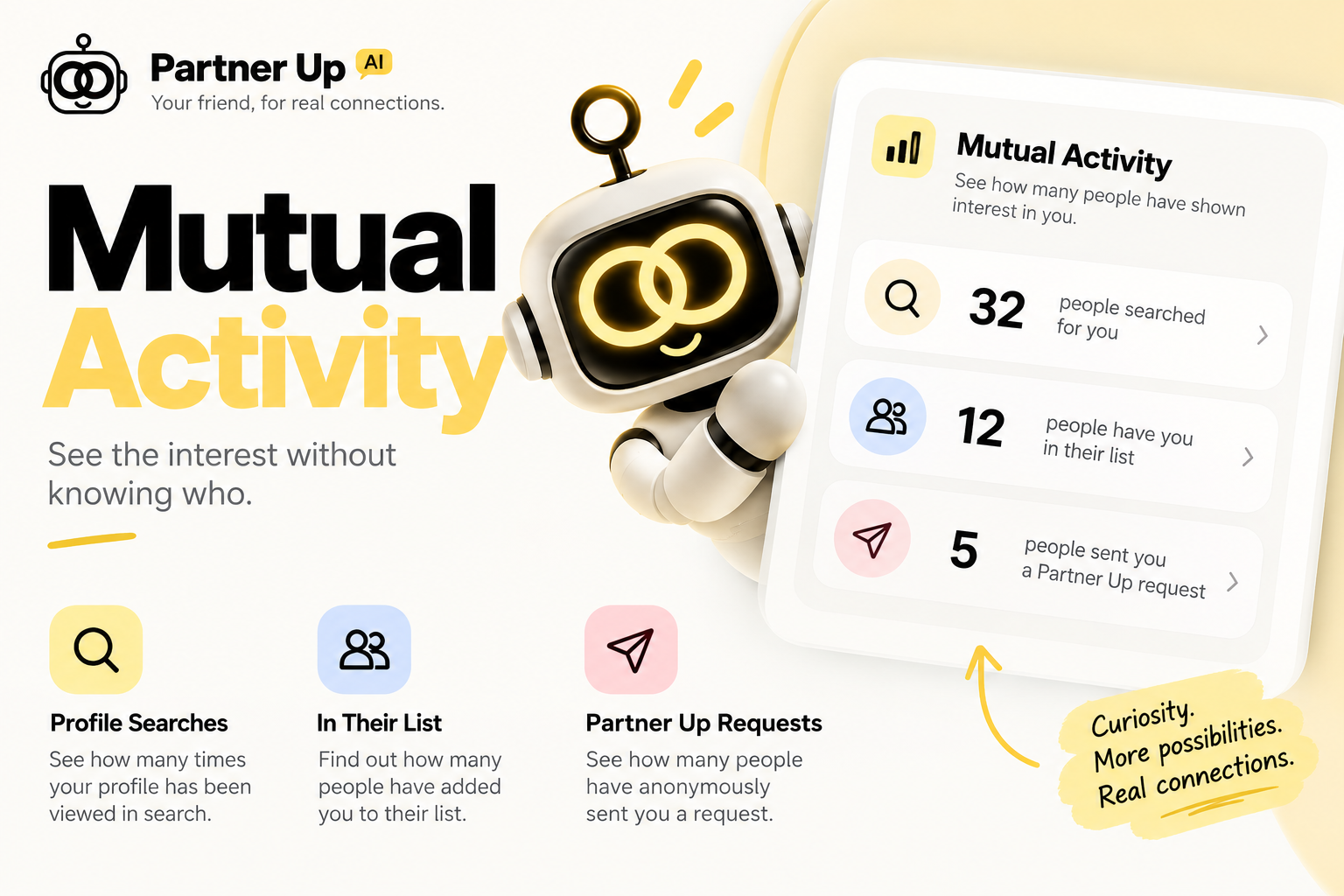
For Mutual, part of the inspiration came from LinkedIn’s profile-view feature. Seeing that someone had viewed your profile creates curiosity, even when you do not know exactly who it was. We wanted to bring that same feeling into a more personal setting: letting people know that others may be thinking about them without exposing anyone’s identity or creating an awkward one-sided situation.
For Scout, the inspiration came from HackGT’s own teammate-matching system. It helped organize hackers by skills and interests, but users still had to search through profiles, decide what criteria mattered, and manually figure out whether another person actually shared the same goals.
That reminded us of how the best connections often happen in real life: through a well-connected mutual friend who understands both people well enough to say, “You two should meet.”
We wanted to build that mutual friend at scale.
Rather than create another social network that competes for attention, Partner Up is designed to complement existing platforms by helping create the right connection in the first place.
What it does
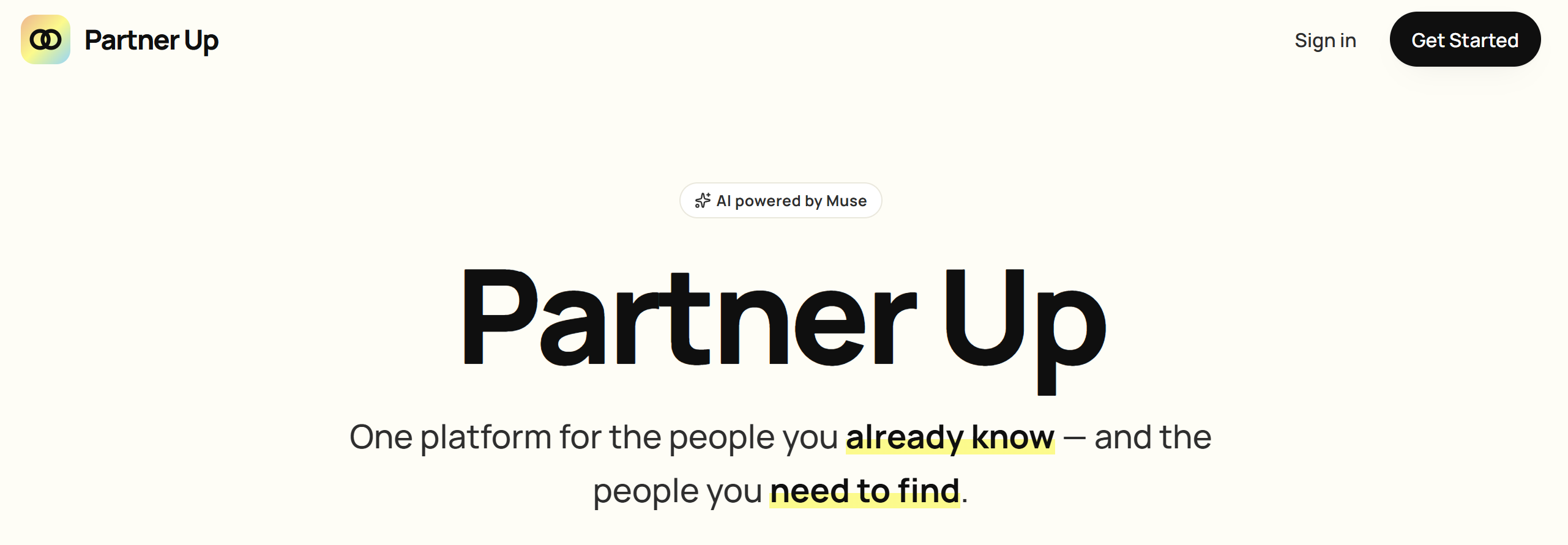
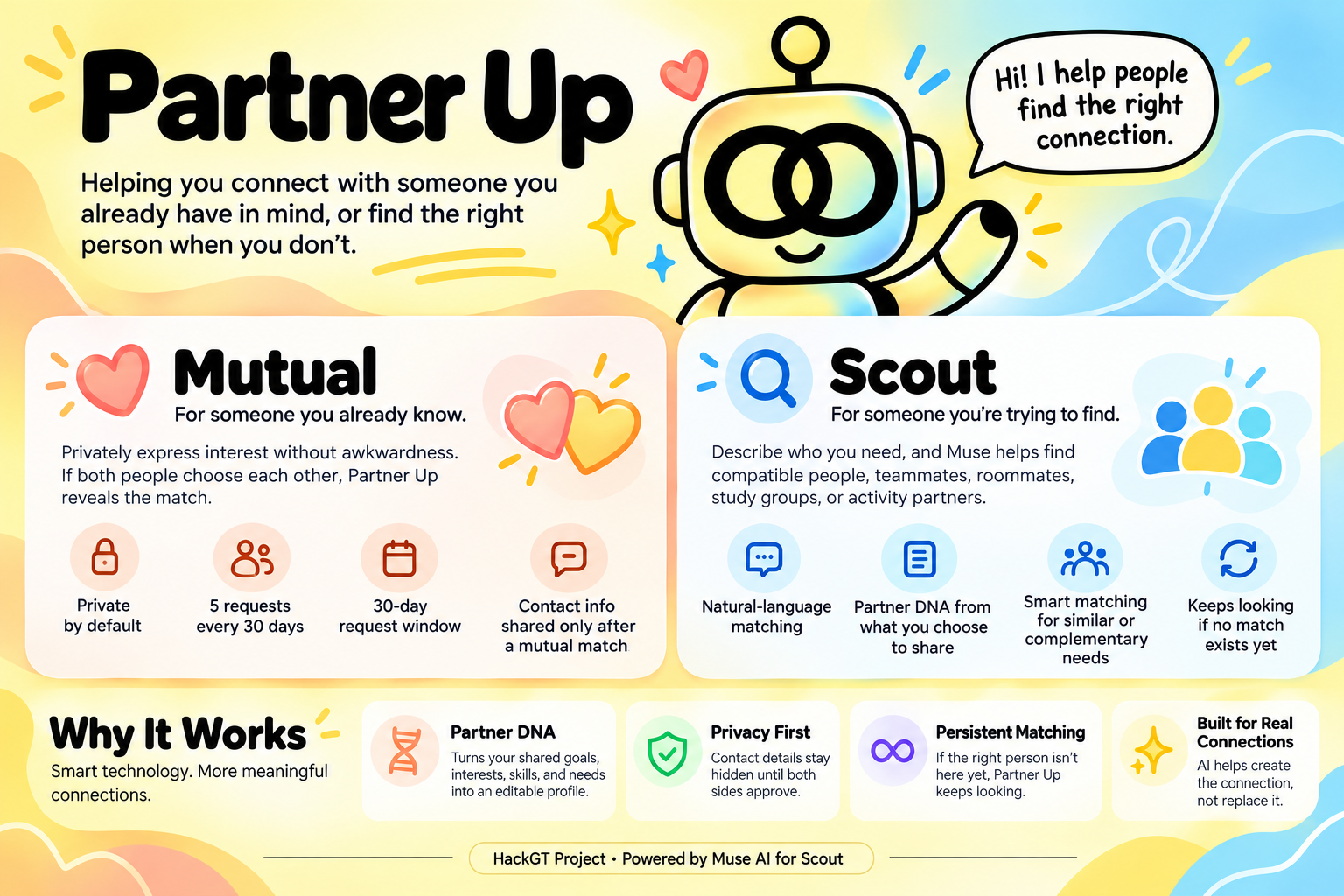
Partner Up is a privacy-first platform for helping people form the right connections.
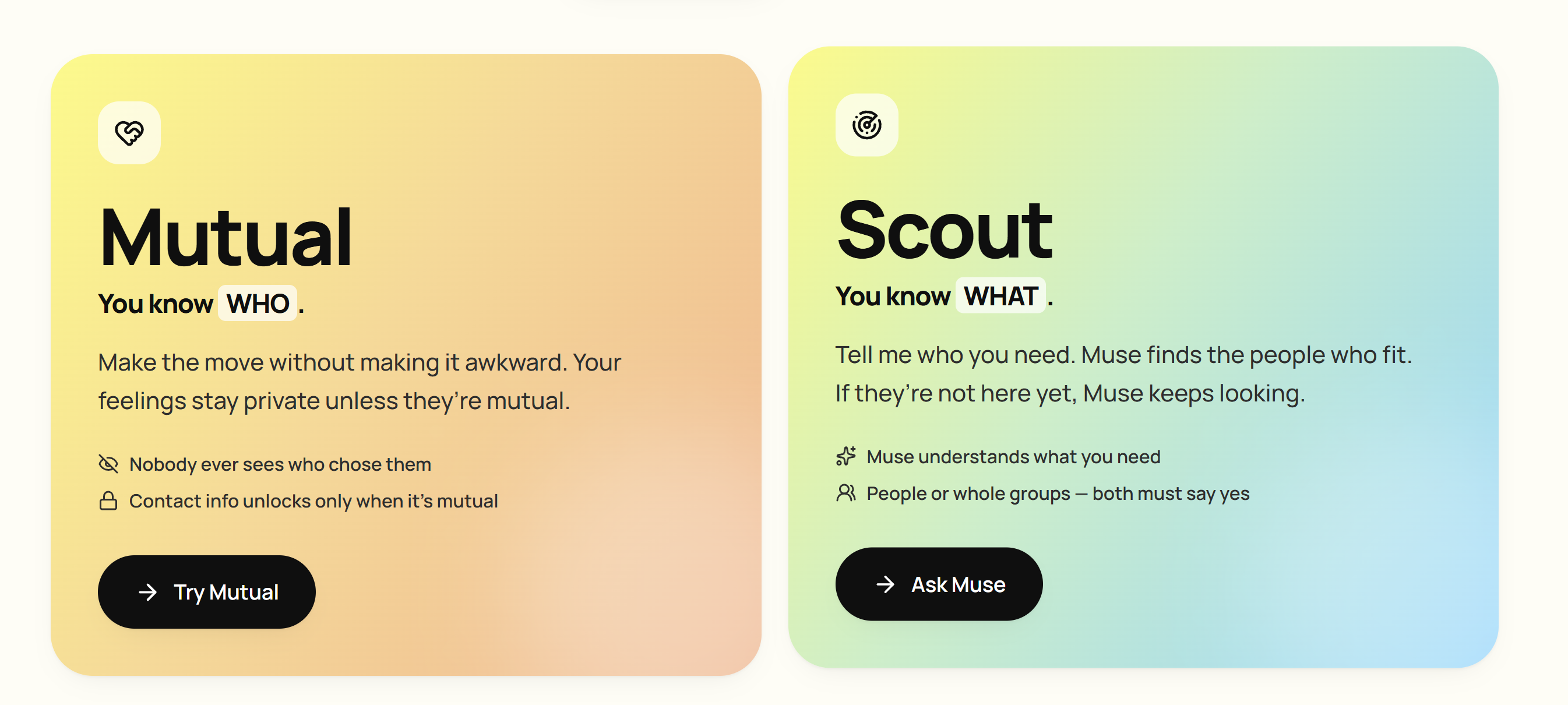
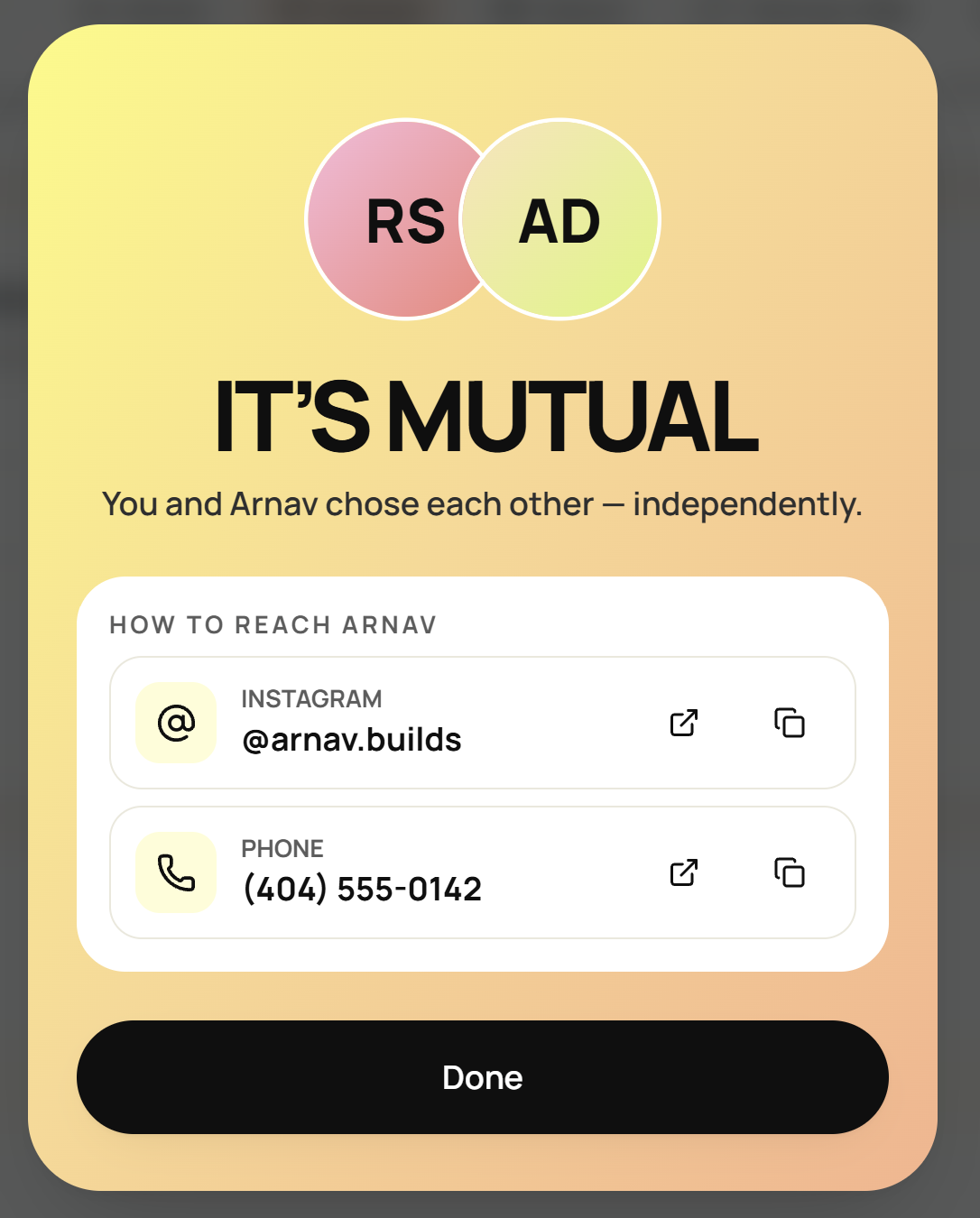
Mutual is for someone you already know and have feelings for. Users can send a private Partner Up request, and neither side is revealed unless both people independently choose each other. Partner Pulse also shows anonymous activity, such as how many times your name was searched, without exposing who searched for you.
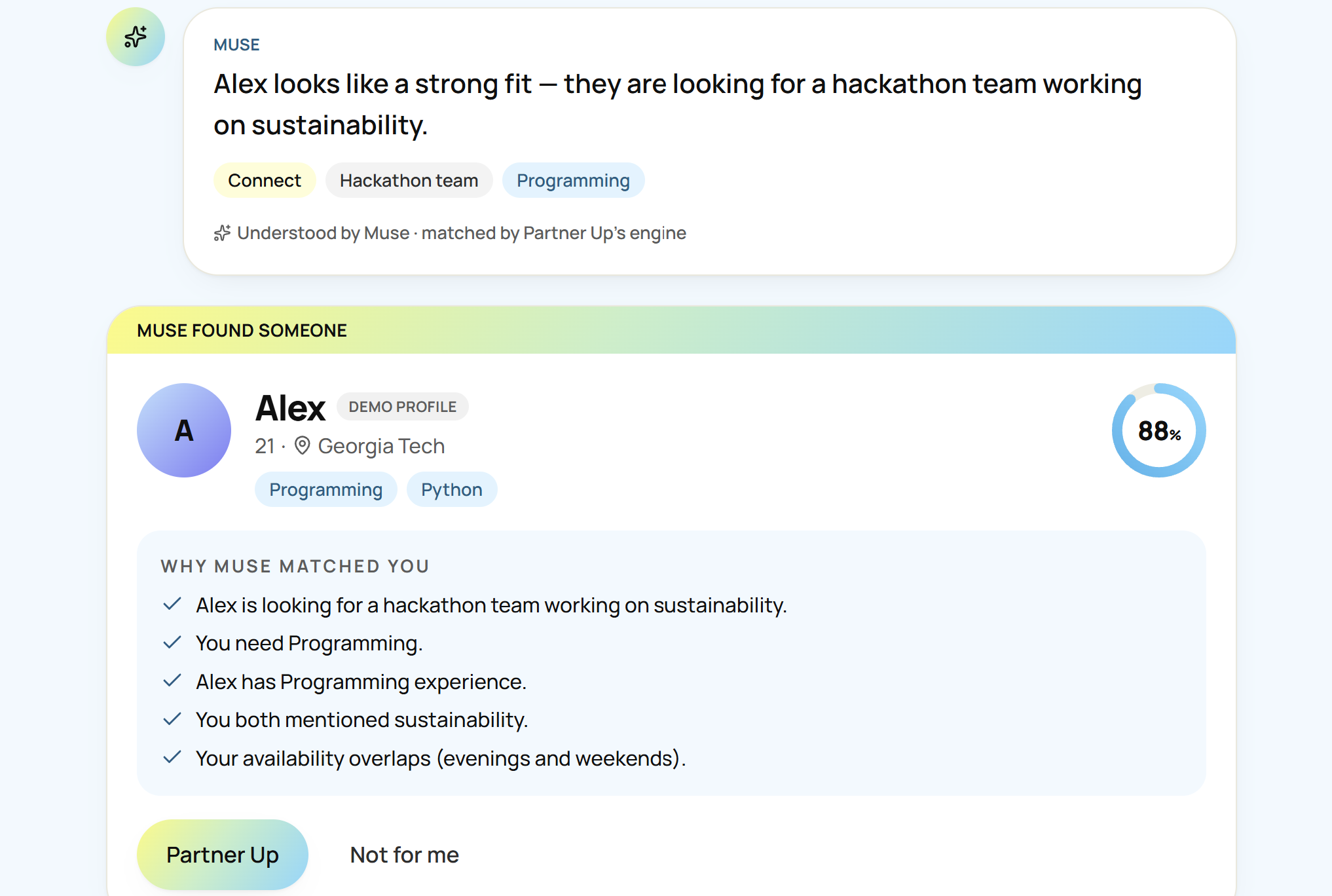
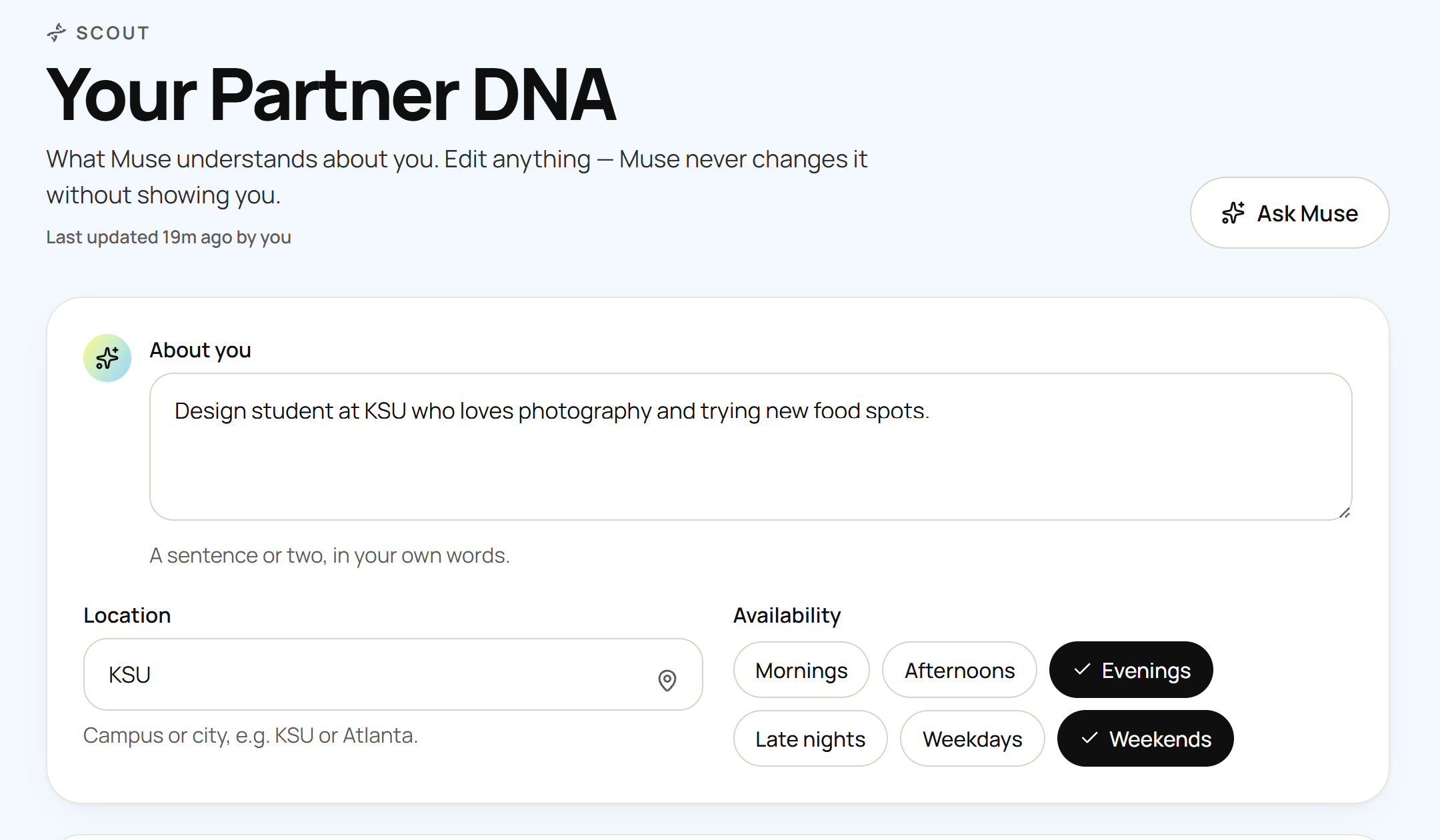
Scout is for when you know what kind of person you need, but not exactly who. Users describe what they are looking for in natural language, and Meta Muse helps turn that into an editable Partner DNA based on interests, skills, goals, needs, location, and availability. Our matching engine then finds compatible or complementary people, such as roommates, hackathon teammates, study partners, international friends, or groups.
If no strong match exists yet, Scout keeps the request active and can notify the user when a compatible person appears later.
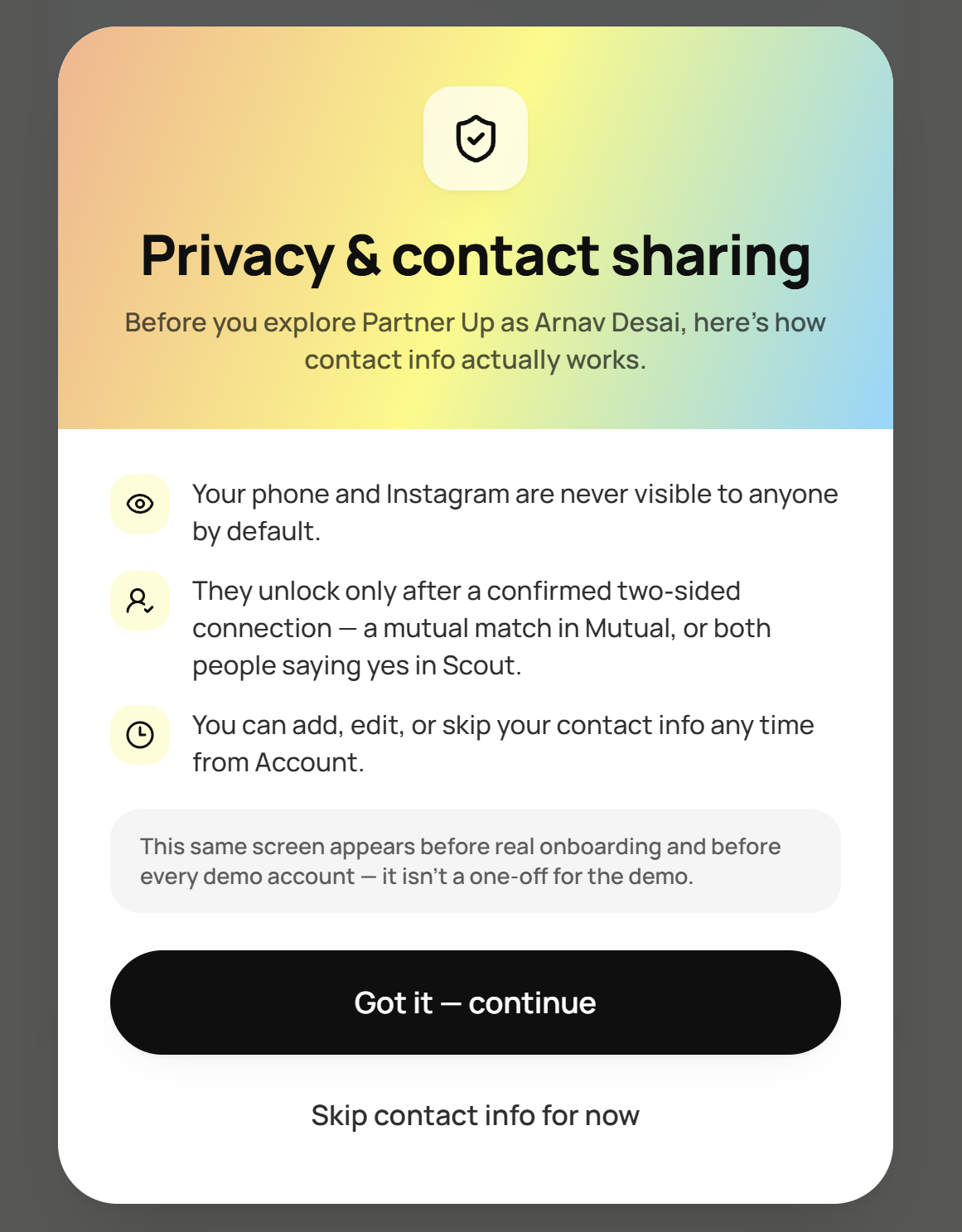
Private contact information stays hidden until both sides approve the connection, and phone numbers or Instagram handles are never sent to Muse.
How we built it
We built Partner Up with React, Vite, TypeScript, Tailwind CSS, Node.js, Prisma, and SQLite.
For Scout, we integrated Meta Muse server-side for natural-language understanding, Partner DNA extraction, request interpretation, semantic understanding, and match explanations.
We deliberately separated AI from the final matching decision. Muse interprets what users mean, while a deterministic scoring engine evaluates structured data such as interests, goals, skills, availability, and location.
We also built a concept ontology and location resolver so related terms and nearby locations can be interpreted more intelligently, such as understanding that KSU is associated with Kennesaw and the greater Atlanta area.
For group formation, we use gated scoring and group assembly logic that favors complementary skill sets instead of simply grouping people with identical profiles.
Every Muse-backed feature also has a deterministic fallback so the core experience remains functional even if the AI service becomes unavailable.
Privacy was designed into the architecture as well. Private contact information is never sent to Muse, and it is only revealed after both sides explicitly approve a connection.
Challenges we ran into
Our biggest challenge was defining what made Partner Up meaningfully different from existing social platforms.
At first, it was easy to drift toward building another profile-discovery app. We eventually realized that our opportunity was not to replace existing networks, but to solve the step that often happens before them: identifying when two people should connect.
A second challenge was deciding where AI actually belonged.
Because human connection is personal, we did not want AI to replace conversation, manufacture relationships, or make decisions for users. We had to identify the parts of the experience where AI created real value without taking control away from people.
That led to one of the main principles behind Partner Up:
AI should facilitate human connection, not replace it.
We also had to learn the Muse API, design reliable structured outputs, protect user privacy, create deterministic fallbacks, and deploy an application with both AI and database functionality under hackathon time constraints.
Accomplishments that we're proud of
We’re proud of building a product that addresses a problem we’ve experienced ourselves: finding the right person to connect with, whether for a project, shared interest, study group, or something more personal.
Partner Up acts like a trusted mutual friend—helping people discover connections that may otherwise never happen.
We’re especially proud that we made the platform private by design. Sensitive contact information stays hidden until both sides explicitly approve a connection, one-sided Mutual interest is never exposed, and private contact details are never sent to Muse.
We wanted privacy to be part of the product architecture, not an afterthought.
What we learned
This was our first hackathon, and we learned that building a strong product requires much more than writing code.
We had to learn how to prioritize aggressively, simplify ideas, divide work, debug under pressure, and distinguish between features that sounded impressive and features that actually strengthened the product.
We also learned an important lesson about AI product design: the most valuable AI systems are not always the ones that make decisions for users. Sometimes their greatest value is understanding human intent well enough to create opportunities that would otherwise be missed.
Conversations with sponsors also pushed us to think beyond the prototype and consider privacy, reliability, scalability, and how a product like this could operate responsibly with a much larger user base.
What's next for Partner Up
Our goal is to make Partner Up a universal connection layer for any situation where you need the right person—whether that means finding a hackathon teammate, college roommate, study partner, startup cofounder, travel buddy, international friend, language-exchange partner, or someone who shares a specific interest.
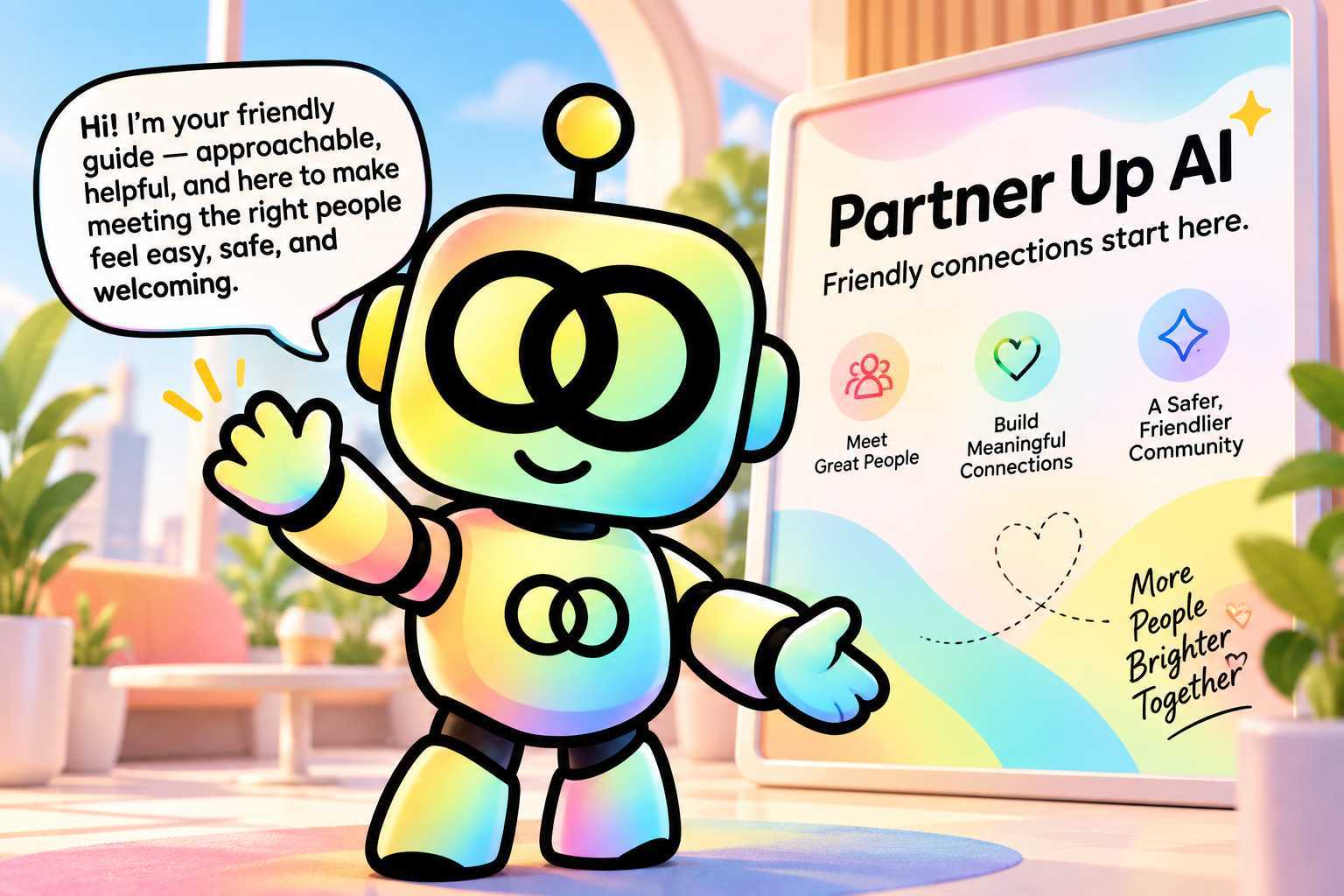
We also want Muse to evolve beyond matching into a more helpful friend-like advisor, offering suggestions on who may be a good fit, what kind of teammate could complement your skills, or how to strengthen a group before connecting.
Future versions would also add campus verification, group chats for matched teams, richer Partner DNA, and a broader ontology of skills, interests, cultures, locations, and goals so Partner Up can support more meaningful connections across campuses, cities, and countries.
Built With
- chatgpt
- claude
- github
- laptop
- muse
- terminal
- typescript
- vscode
- windows


Log in or sign up for Devpost to join the conversation.