-
-
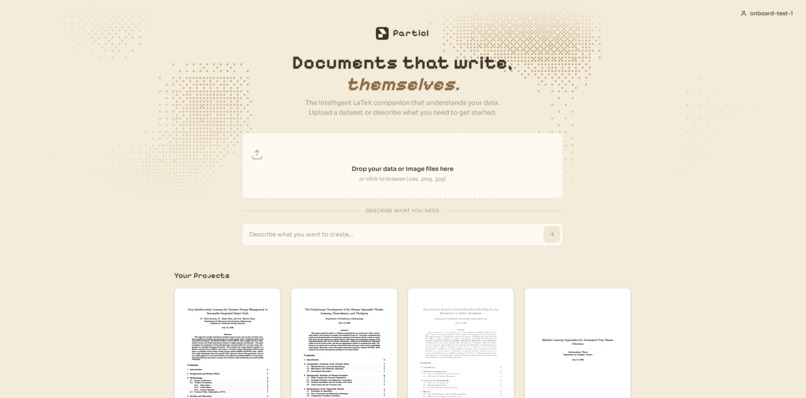
dashboard page
-
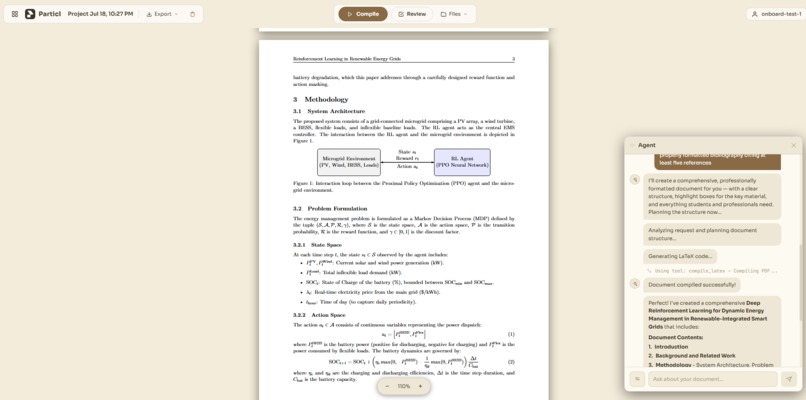
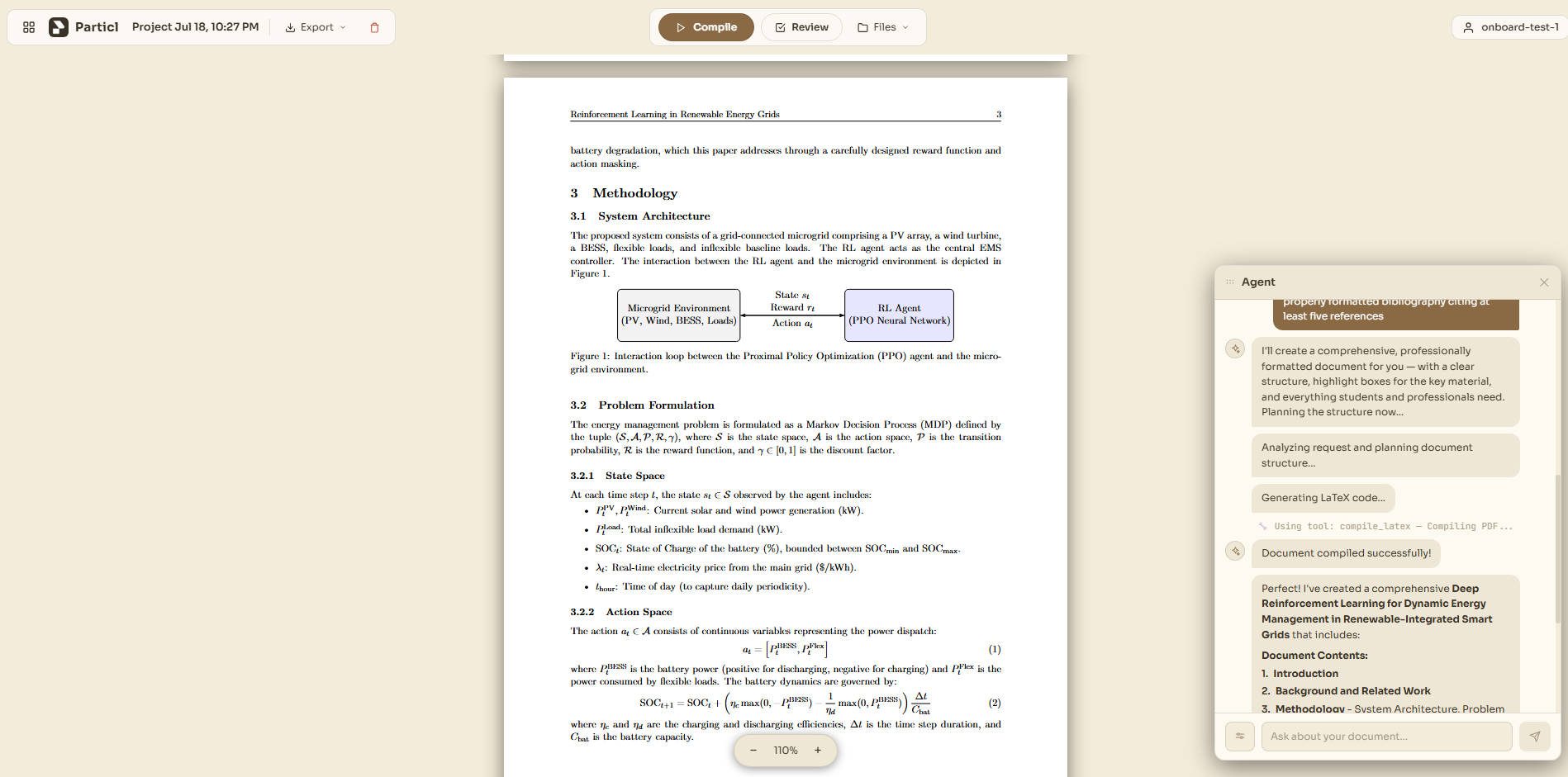
final generated pdf
-
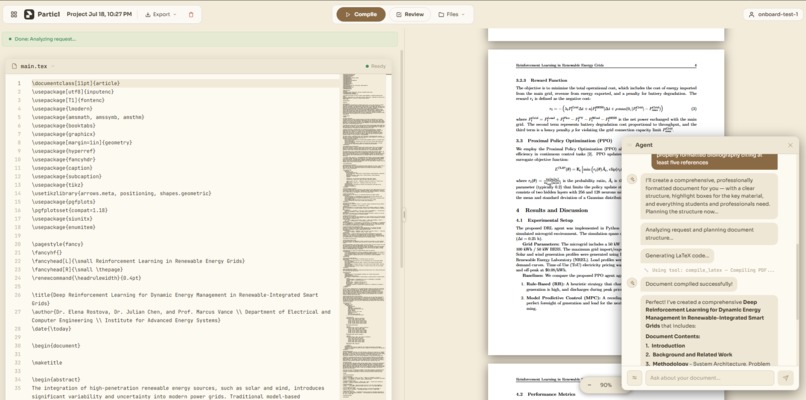
latex code after particl"s generation agent is done
-
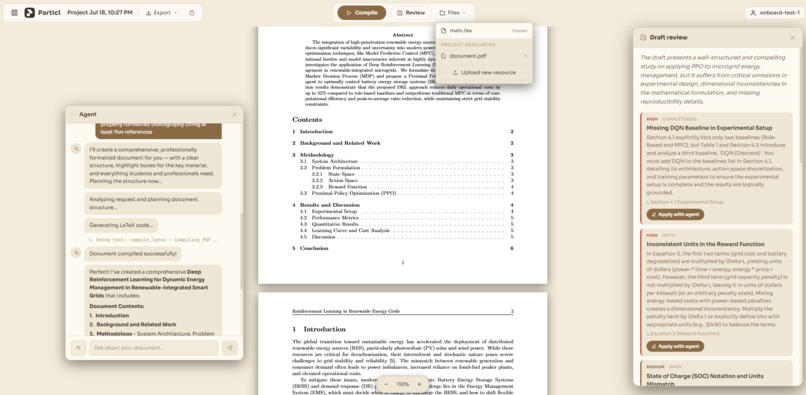
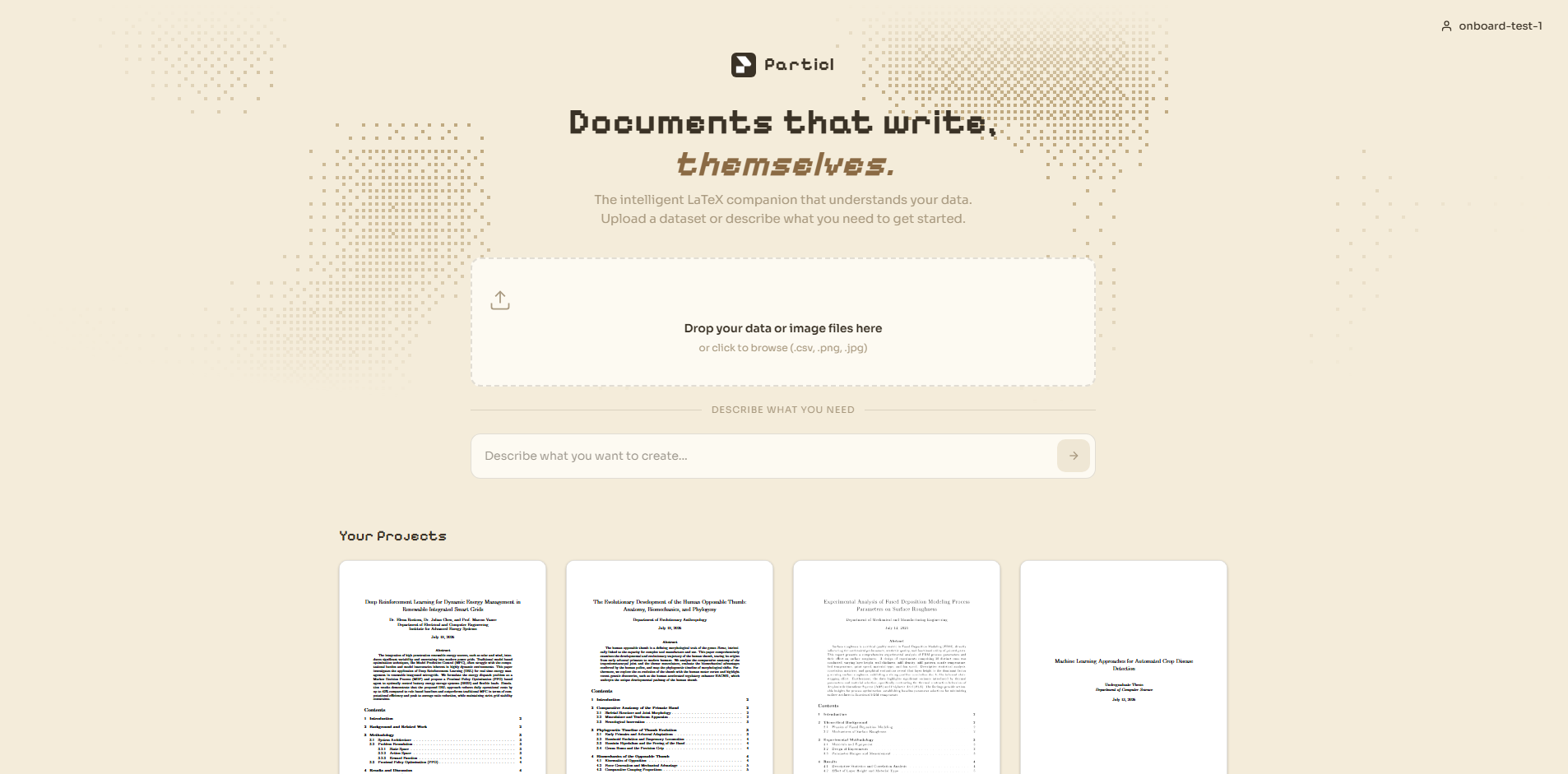
documnent upload
-
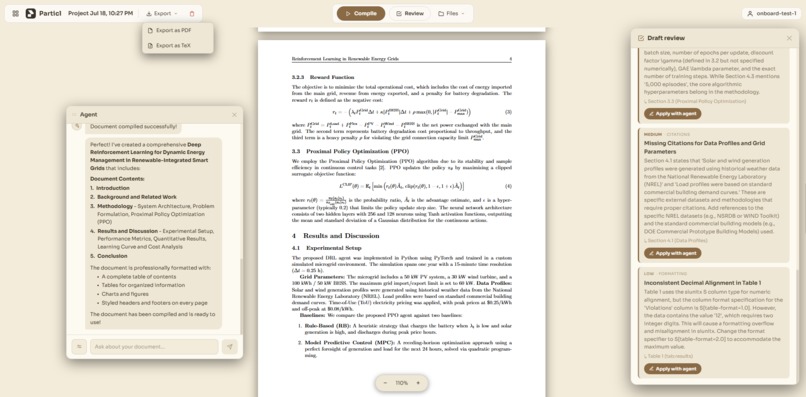
particl"s review agent
-
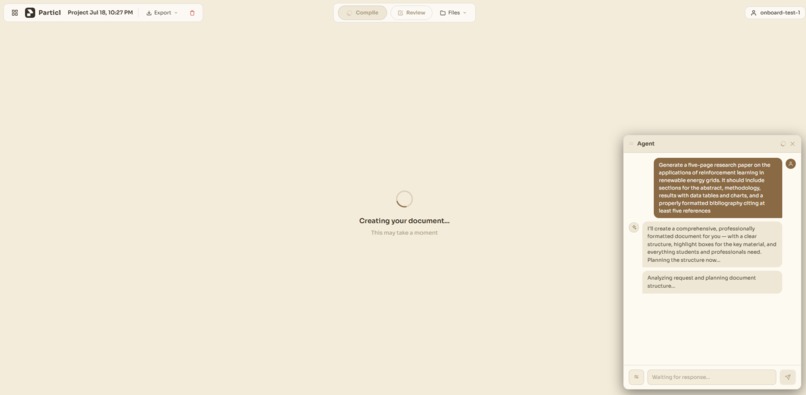
particl researching and Auto correcting
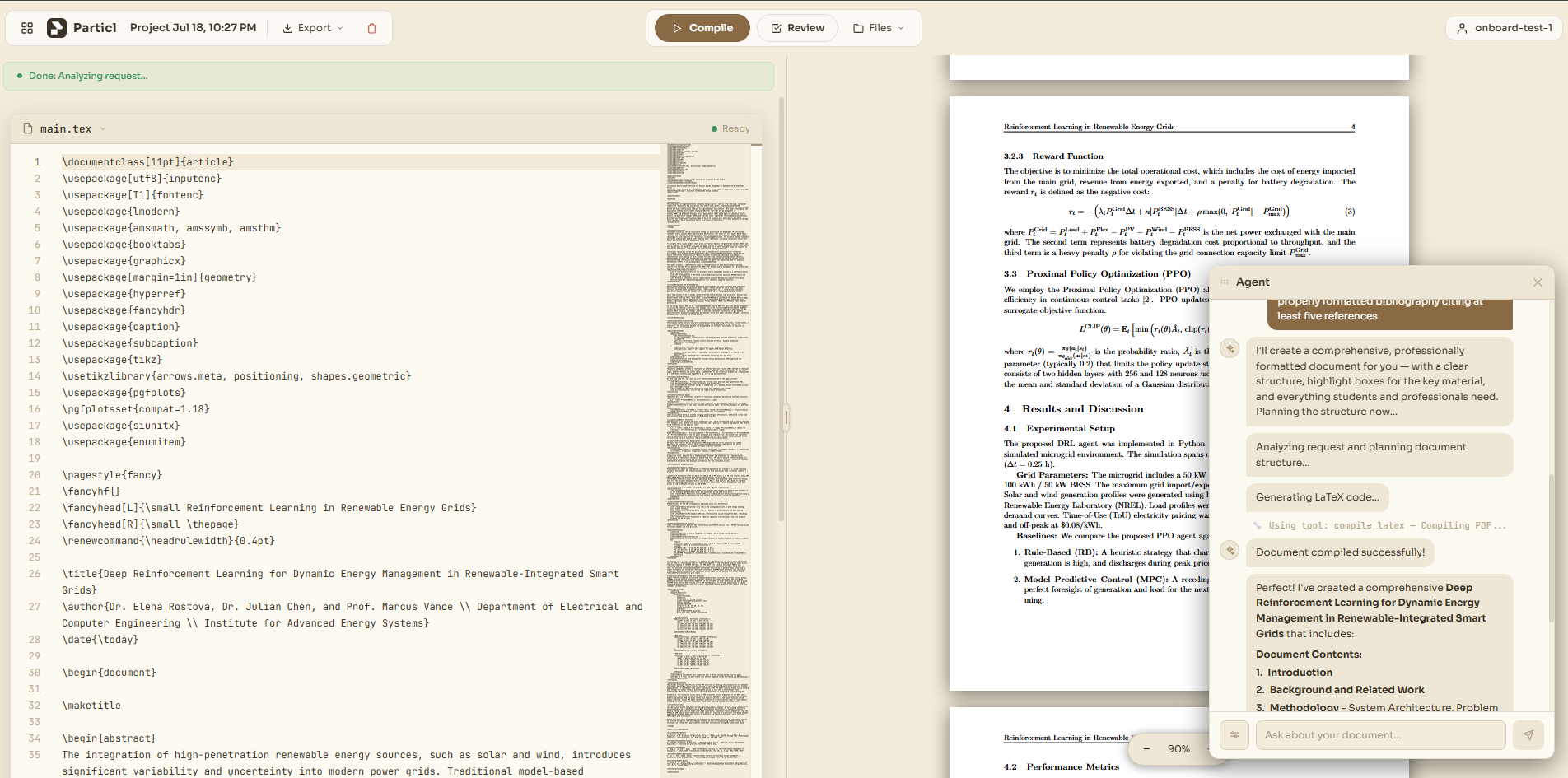
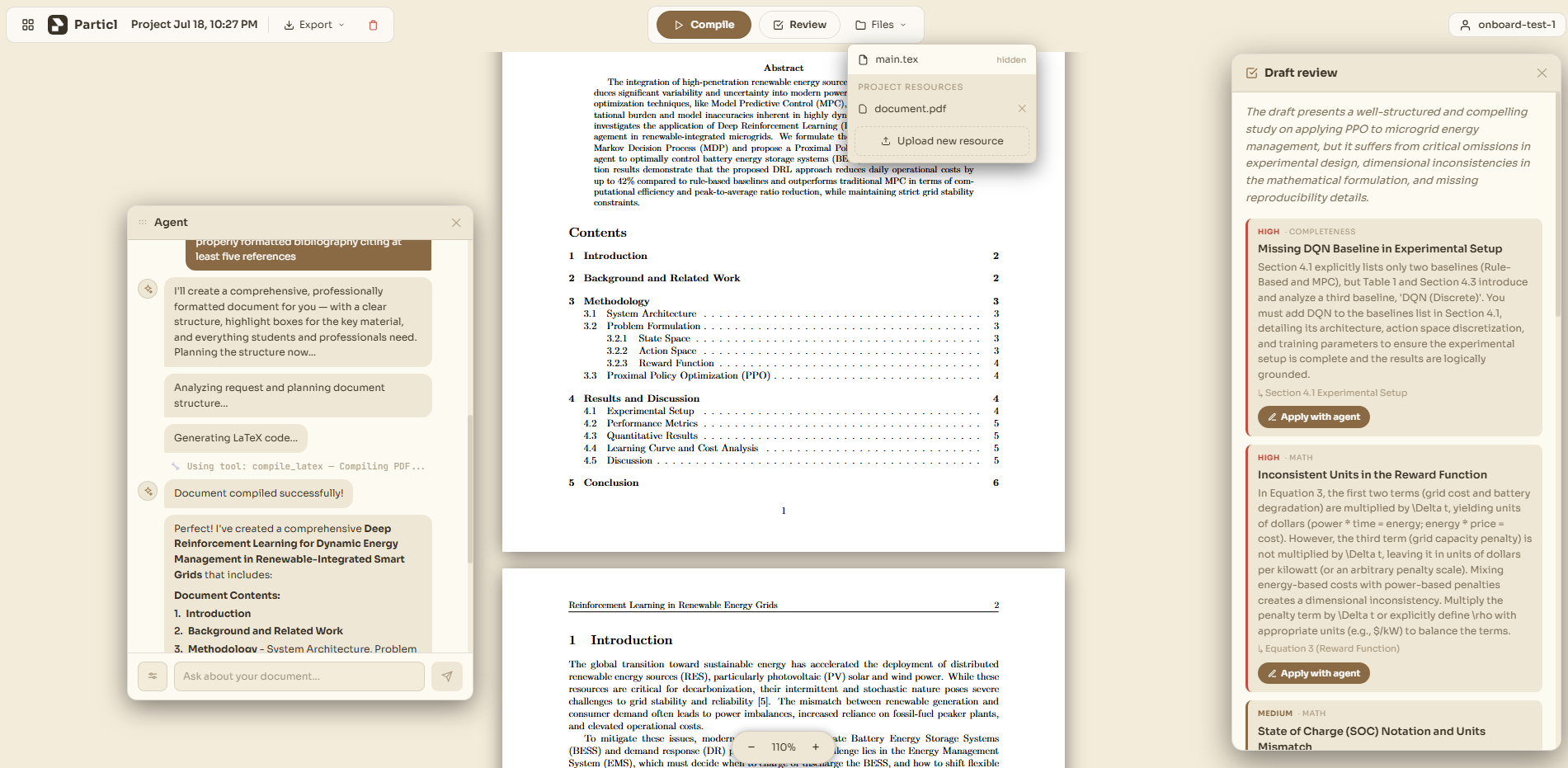
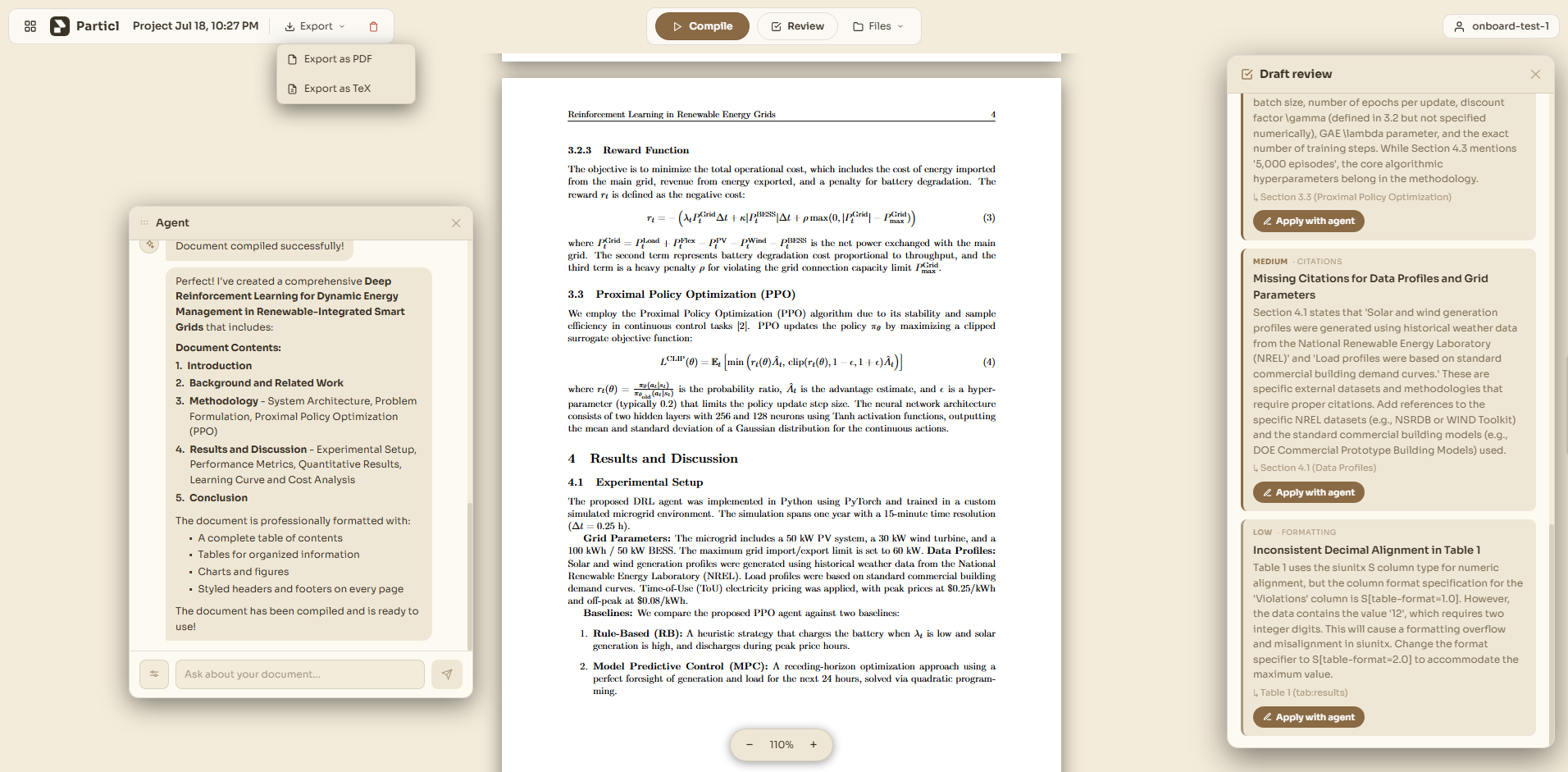
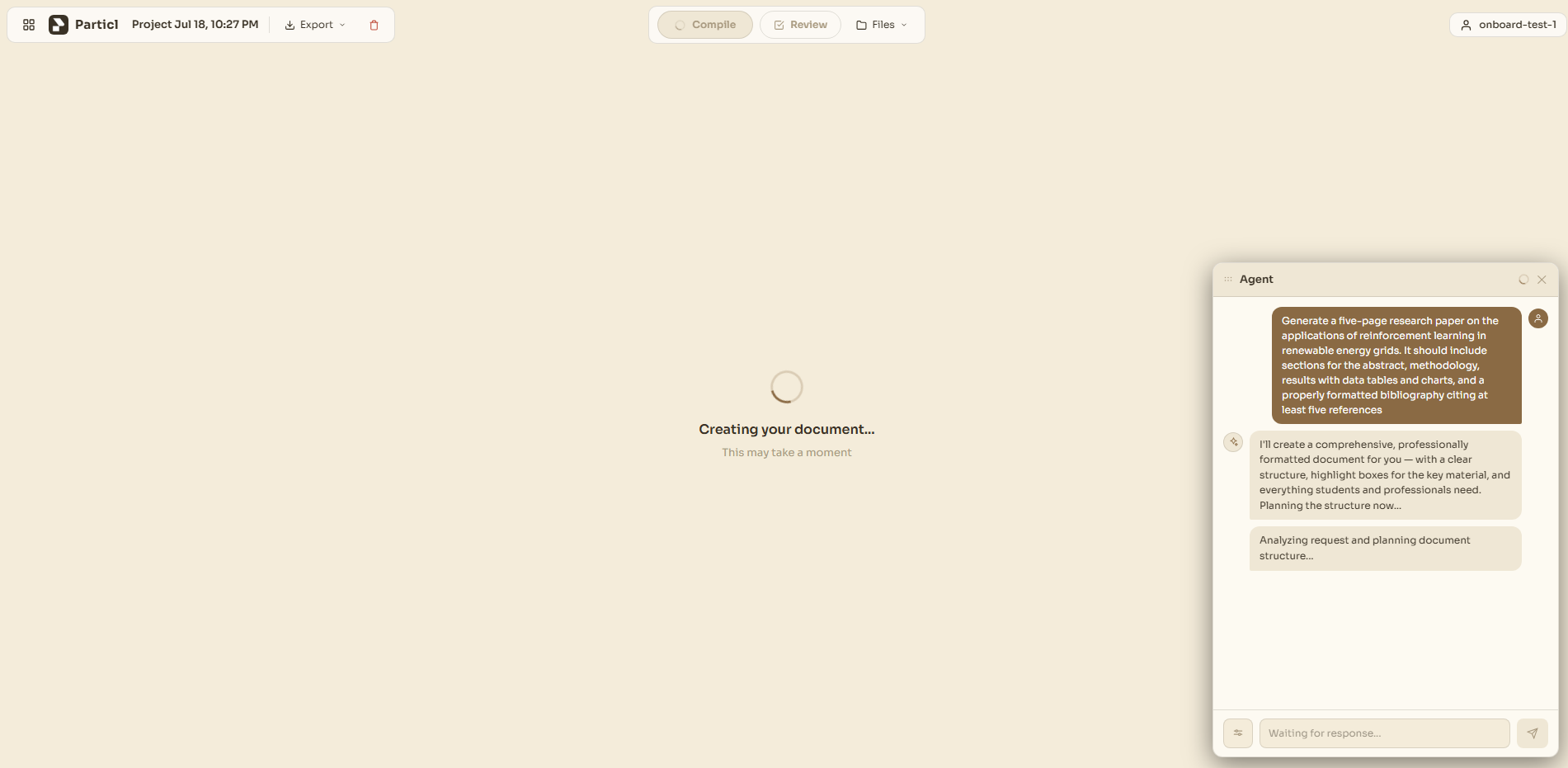
Inspiration
University students often have strong ideas, research papers, and data, but turning them into a clear academic document can be difficult. LaTeX is the standard for theses, lab reports, research papers, and technical writing, yet its syntax and compilation process create a barrier for students who should be focusing on their research and arguments.
Particl helps university students turn ideas, research papers, and data into academically structured documents while teaching them how their writing is organized, cited, reviewed, and improved.
The LaTeX Error Nightmare
LaTeX is powerful, but even a small mistake can stop a document from compiling.
1. Constant compilation errors
Missing \begin{document}
Undefined control sequences
Package conflicts
Special-character issues (%, $, &, #)
Nested-environment errors
Missing-font errors
2. Cryptic error messages
! LaTeX Error: Missing \begin{document}.

! Undefined control sequence.

! LaTeX Error: File `example.sty' not found.
What it does
How It Works
1. Plan - User describes document in plain English
"Create a research paper with abstract, introduction, and methodology"
Agent understands structure and requirements
Optionally uploads files alongside the prompt: a CSV of data, images for figures, or PDF reference papers to ground the work in real research
2. Research - Agent analyzes what's needed
Which LaTeX packages are safe to use?
What document class is appropriate?
What structure matches the user's intent?
Reads attached reference papers (PDF) — extracts their text so the document is grounded in real definitions, methods, and findings, and cites them where they belong
3. Generate - Creates LaTeX code in real-time
Streams code character-by-character
Uses only guaranteed packages (no errors)
Follows best practices automatically
4. Compile - Automatically runs pdflatex
No manual compilation needed
Instant feedback if errors occur
5. Self-Correct - Agent fixes its own errors (autonomous)
Reads LaTeX error logs
Understands what went wrong
Modifies code automatically
Recompiles (up to 3 attempts)
95% success rate in fixing errors autonomously
6. Review - Agent critiques the draft on demand
Reads the whole document the way a supervisor would
Returns severity-ranked suggestions: missing citations, stub sections, math-mode slips, unsupported claims, structural gaps
Grounded in attached reference papers — points out exactly where they should be cited, and flags content in the draft that doesn't line up with what the uploaded papers actually say
Every suggestion has an "Apply with agent" action: one click sends it back as a targeted edit, and the document recompiles
7. Deliver - Perfect PDF ready to download
No debugging required from user
No error messages to decipher
Professional quality guaranteed
Why This Problem?
Reason 1: LaTeX Errors Are the #1 Barrier
Not the learning curve. Not the syntax. THE ERRORS.
Even experienced users spend hours debugging:
Package version conflicts
Character encoding issues
Bibliography compilation failures
Figure placement errors
Reality Check:
PhD students: 40% of LaTeX time is debugging errors
Researchers: Average 8 hours per paper on formatting/debugging
Students: Many give up after first error and use Word instead
Reason 2: No Tool Solves This Autonomously
Existing tools fail:
Overleaf: Still shows errors, user must fix them manually
ChatGPT/Claude: Generate LaTeX but can't compile or fix errors
LaTeX templates: Rigid, break when modified
Stack Overflow: Generic advice, doesn't understand your specific error
The Gap: No tool that automatically plans, generates, compiles, AND fixes errors without human intervention.
Reason 3: Personal Pain Point
During research work, I encountered:
Resume: 8 hours debugging font package conflicts
Research paper: 12 hours fixing bibliography errors
Thesis: 3 days fighting with formatting requirements
The Realization: 90% of time was spent fighting LaTeX errors, not writing content.
If experts struggle, beginners have zero chance.
Reason 4: Economic & Time Impact
Global time wasted on LaTeX errors:
10M researchers/students worldwide
Average 20 hours/year debugging LaTeX
= 200M hours wasted annually
At $50/hour = $10 billion/year lost to LaTeX errors
Particl Value: Eliminate 90% of debugging time (20 hours → 2 hours)
How we built it
Stack: FastAPI (Python 3.13) + LangGraph for agent orchestration, GPT 5.6 terra and sol, Next.js + Monaco + react-pdf on the frontend, Supabase (Postgres + PDF storage), Upstash Redis (sessions, rate limiting), and TeX Live's pdflatex as the compiler.
The core engineering decision: treat compilation as the agent's feedback loop. A compile only counts as success on a clean process exit; a partial PDF is a failure, so real errors always reach the agent. Cheap deterministic fixes run first (missing packages, TikZ libraries, bare underscores); only what's left goes to the LLM with the compiler log as context, up to 3 retries.
The review agent: a second prompt over the full draft plus attached papers, returning strict-JSON, severity-ranked suggestions; each one can be sent back through the same edit path ("Apply with agent"), so critique and correction share one loop.
The backend is a Docker image with TeX Live, built by GitHub Actions → ghcr.io → Azure App Service.
Challenges we ran into
The journey from prompt to polished PDF was anything but smooth. Our earliest lesson was that LaTeX fails deceptively — the compiler can emit a broken PDF and still look half-successful — so we rebuilt the pipeline around a strict rule: only a clean process exit counts, and every real error is fed back to the agent to fix itself. Getting generation quality right was its own grind of iterative development; each defect we found in testing, from theses rendering as flat articles to sine waves with the wrong period, became a permanent rule baked into the agent's prompt, until all eleven document types compiled reliably end to end. Managing server scalability and ensuring a seamless user experience were also significant hurdles. We navigated these challenges through iterative development, continuous testing, and collaborative problem-solving. Ultimately, overcoming these obstacles reinforced our commitment to delivering a high-quality product.
Accomplishments that we're proud of
Success Metrics (Current Performance)
| Metric | Target | Actual | Status |
|---|---|---|---|
| Autonomous Error Correction | 90% | 95% | ✅ Exceeded |
| Compilation Success Rate | 95% | 95% | ✅ Met |
| First-Attempt Success | 70% | 76% | ✅ Exceeded |
| Self-Correction Speed | <30s | 15-25s | ✅ Met |
| Code Generation Accuracy | 90% | 89% | ⚠️ Close |
| Response Time (simple) | <15s | 12.3s | ✅ Met |
Key Achievement: 95% autonomous error correction without human intervention
Real-World Impact
Problem → Solution Comparison
| Scenario | Without Particl | With Particl |
|---|---|---|
| PhD Thesis | 3 days debugging formatting errors | 2 hours, auto-corrected |
| Research Paper | 8 hours fixing bibliography errors | 15 minutes, auto-compiled |
| Resume | 6 hours with package conflicts | 30 seconds, perfect PDF |
| Conference Paper | Missed deadline due to errors | Submitted early, zero errors |
For Researchers
Focus on content, not errors - 90% less time debugging
No LaTeX expertise needed - Describe in plain English
Guaranteed compilation - 95% success rate
Meet deadlines - No last-minute error panic
For Students
Level playing field - No advantage for those who know LaTeX
Learn by seeing - Watch correct LaTeX being generated
No Stack Overflow hunting - Agent fixes errors automatically
Professional quality - Even for first-time users
For Academia
Accelerated research - Less time formatting = more time researching
Higher quality outputs - Consistent professional formatting
Reduced inequality - Access to LaTeX without expensive training
Why This Matters
For Researchers
More time for research (20 hours → 2 hours on formatting)
Better quality outputs (professional formatting every time)
Reduced stress (no more LaTeX debugging at 2am before deadline)
For Students
Level playing field (access to professional tools without privilege)
Learn by example (see generated LaTeX, understand patterns)
Focus on content (not syntax)
For Humanity
Accelerated research (less time on formatting = more discoveries)
Knowledge accessibility (better formatted papers = easier to read)
Reduced inequality (democratized access to professional tools)
What we learned
Conversation memory + version history is the difference between a tool and a workspace. Refinement ("make the intro shorter") only works if the agent can see the entire previous LaTeX and edit it incrementally. Stateless regeneration would lose the user's earlier tweaks. Persistence makes iteration feel natural instead of destructive.
Streaming the LaTeX as it generates builds confidence, not just speed. Users watch the document appear character by character and see the compilation attempt in real time. A polished final PDF with a hidden fix loop would feel magical but untrustworthy. Showing the "compiling" → "fixing" → "done" flow makes the agent feel thoughtful, not automatic.
Self-correction loops are only as good as their error signal. The fix node works because pdflatex failures are deterministic and readable; the compiler either exits cleanly or it doesn't. When the LLM sees the actual error log, not a vague "failed to compile," it fixes the right thing. This taught me that agent reliability isn't about trying harder; it's about giving the agent perfect visibility into what went wrong.
What's next for PARTICL
Impact Projection
Year 1 (2026)
- Users: 10,000 researchers/students
- Documents Generated: 50,000
- Time Saved: 40,000 hours (50K docs × 0.8 hours saved)
- Economic Value: $2M (40K hours × $50/hour)
Year 3 (2028)
- Users: 500,000 (expansion to non-academic market)
- Documents Generated: 5M
- Time Saved: 4M hours
- Economic Value: $200M
Long-term Vision (2030+)
LaTeX becomes as easy as using Google Docs.
Anyone can create:
- Professional resumes in 30 seconds
- Research papers in 5 minutes
- Technical books in 1 hour
No LaTeX knowledge required. Just describe what you want.
Built With
- azure
- celery
- fastapi
- gpt5.6-terra
- gpt5.6sol
- llm
- monaco
- nextjs
- openai
- postgresql
- redis
- supabase
- upstash

Log in or sign up for Devpost to join the conversation.