Inspiration
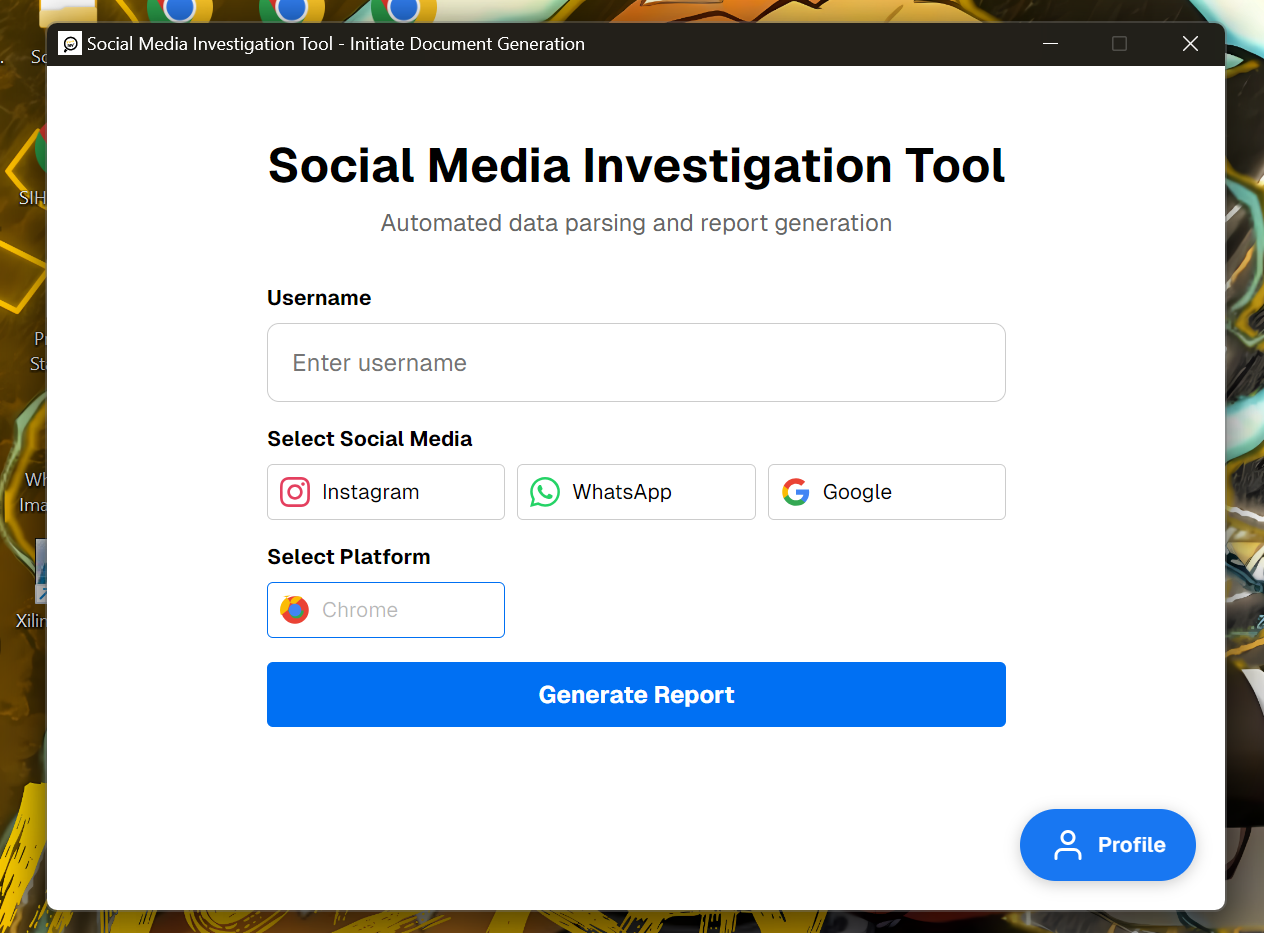
During investigation when the social media accounts of accused/suspect are opened for examination or creating Panchnamas, it would be better if some tool is designed which can automatically parse the data and provide the screenshot of the posts, messages, timeline, friend list, following, followers, account info, etc and provide screenshots in a documented form.
- This will omit any human error during the process and also help to thoroughly reviewing the data found for the said social media account. ## What it does The primary objectives of the Social Media Parsing Tool are to enhance the efficiency, accuracy, and security of social media data extraction and documentation processes for law enforcement agencies. These objectives can be further detailed as follows: Automation: Develop an automated tool to extract and document social media data, including posts, messages, timelines, and account information, from logged-in accounts on a Windows system. Security: Store extracted data and screenshots securely in Google Firestore to ensure data integrity and prevent unauthorized access. Efficiency: Optimize backend logic to perform tasks quickly while maintaining high accuracy. User Interface: Design a user-friendly interface that allows investigators to easily navigate, initiate tasks, and access reports, without requiring technical expertise. Scalability: While the initial focus is on a Windows application, the architecture will be designed to allow future expansion to other platforms such as Android and Web. ## How we built it The key phases of the project include: Requirement Analysis: a. Identify and analyze the specific needs of law enforcement agencies. b. Define the technical requirements for interacting with social media platforms and storing data securely. System Design: a. Design the system architecture with focus on code being modular, scalable, and secure. b. Create detailed specifications for the backend and frontend components, as well as the data storage strategy. Development: a. Backend Development: Implement the core logic for data extraction and processing using Node.js. b. Frontend Development: Develop the user interface using Electron.js, ensuring it is responsive and easy to use. c. Automation: Integrate Selenium WebDriver to automate the tasks to navigate to web pages and also to capture screenshots of pages that are relevant. Testing: a. Unit Testing: Test individual components to make sure that they function correctly as a separate file too. b. Integration Testing: Test the interaction between components to ensure they work correctly together as well. Deployment: a. Package the application for distribution and provide installation guidelines. b. Set up a secure server for the backend deployment and configure Google Firestore for storing data. Maintenance: Maintenance involves continual assistance for the tool, which includes addressing bugs, making updates, and implementing improvements based on user input.
Challenges we ran into
All major social media platforms, by default, block any web crawlers and automations on their websites. This involves blocking and permanently deactivating accounts that they suspect of being bots. Our several accounts were banned while testing our product. Additionally, social media platforms also have implemented several precautions to make their websites harder to automate which we overcome by rigorous tests and focus.
Accomplishments that we're proud of
We are now able to successfully extract important details of logged-in accounts and generate a PDF out of them. Our prototype and workflow are perfectly written and easy to understand.
What we learned
The most important new skills that we got to learn are the skill to develop softwares for Windows and MacOS as well as the skill to automate browser actions with the help of Selenium.
What's next for ParseSpy
Platform Expansion: We plan to extend the list of platforms where the tool can be run. This will ensure that it can be used across different devices. AI Integration: We also want to implement AI-based analysis to provide deeper insights for investigations. Support for Additional Social Media Platforms: We will also make the tool to be able to support more social media platforms for parsing. Cloud-Based Solution: We also wish to make a cloud-based tool version to allow collaboration between investigators and also to provide remote access to them. This would help them to work together on cases from different locations. Enhanced Reporting Features: We will also add more advanced reporting capabilities to our tool such as visual data analytics. Multilingual Support: We will implement support for various languages. This will allow the tool to parse and generate reports in various languages based on the needs of investigators. Advanced Security Features: We wish to incorporate additional security checks such as two-factor authentication (2FA) to restrict the access to the tool.


Log in or sign up for Devpost to join the conversation.