-
-
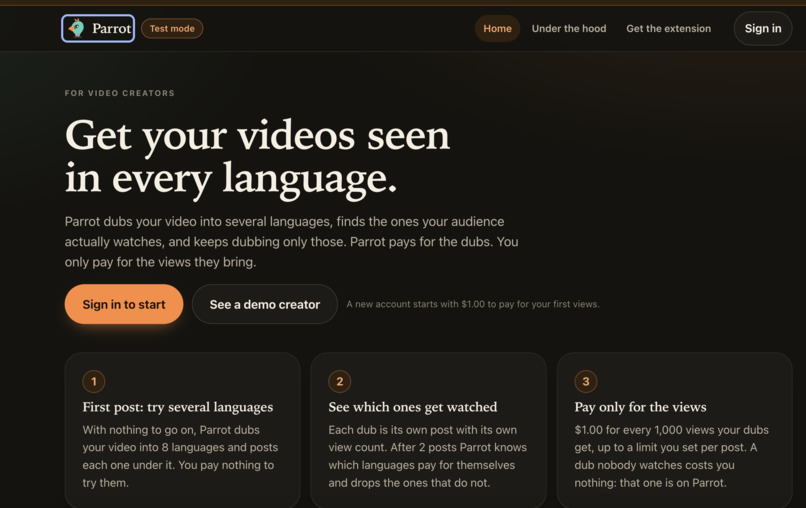
Parrot Intro!!
-
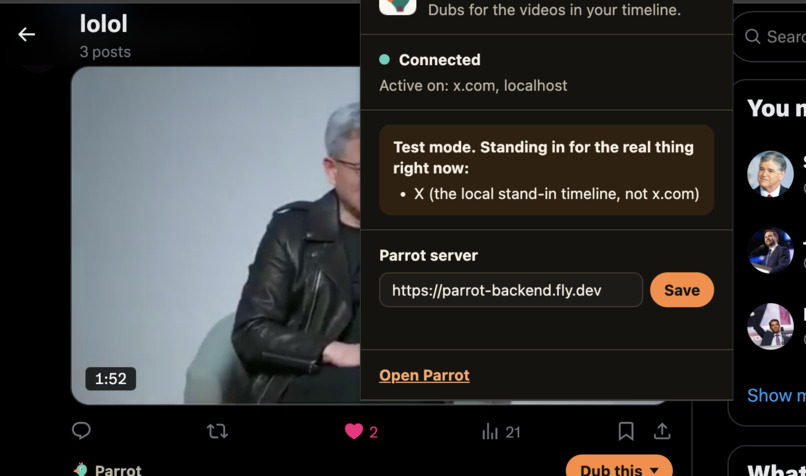
Parrot as an extension
-
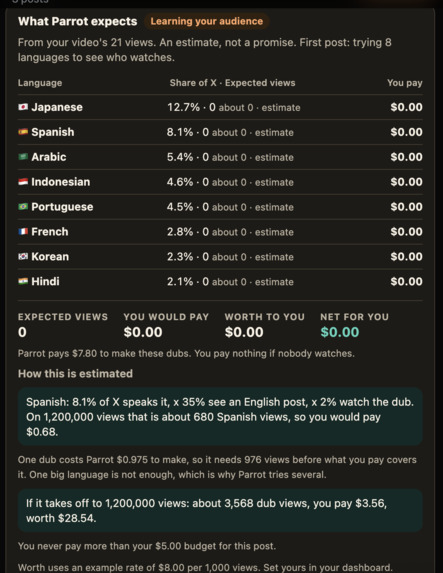
Parrots expectation values
-
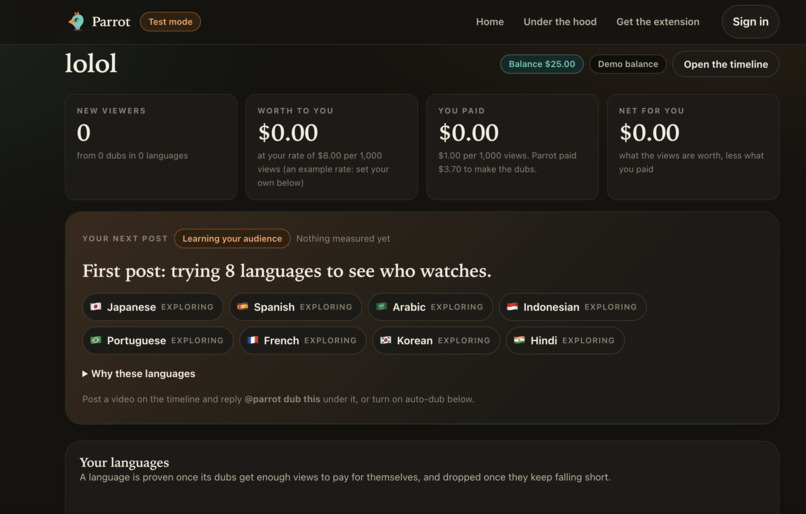
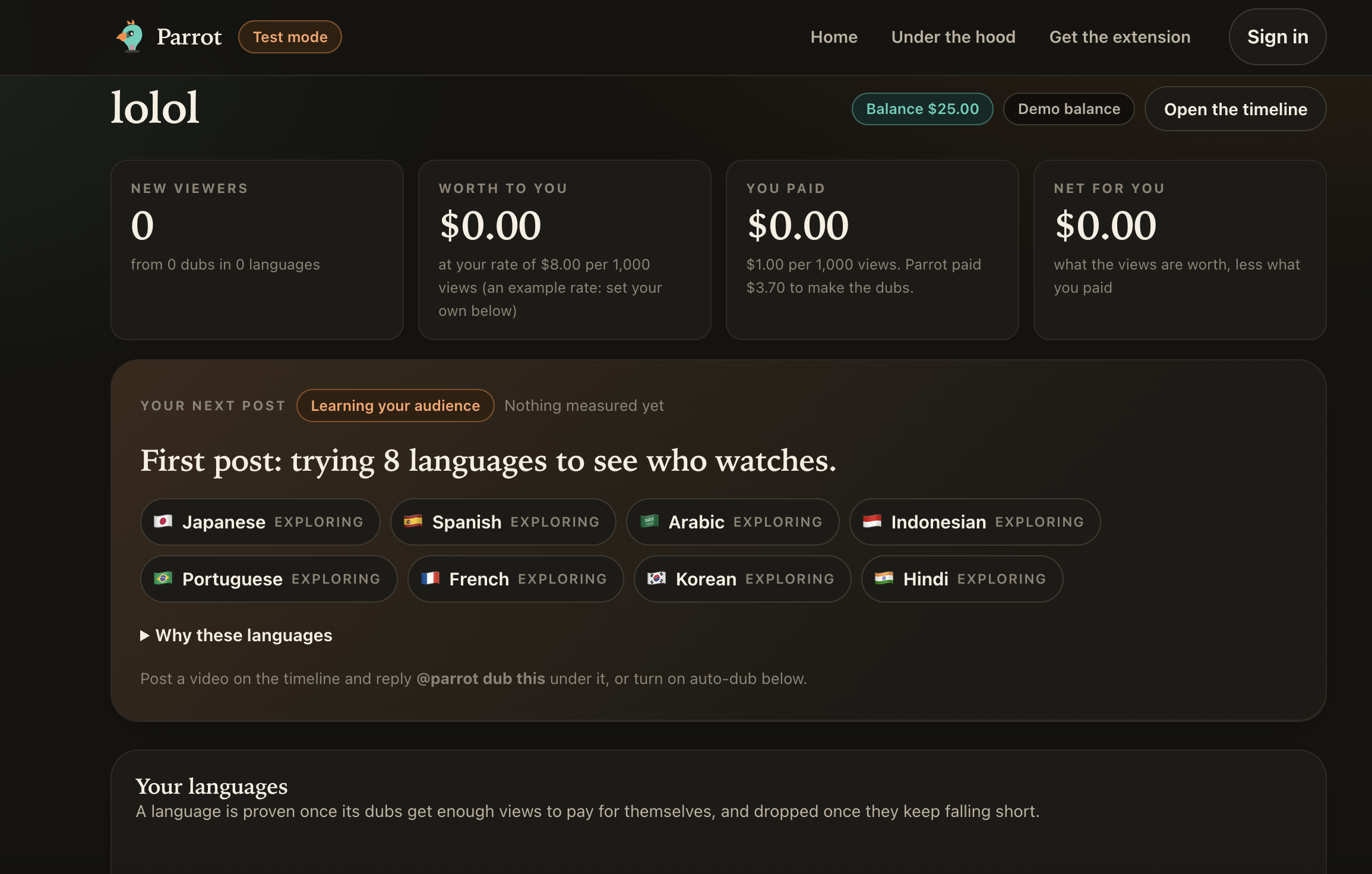
Dashboard to track transactions
Parrot: Get your videos seen in every language
Inspiration
A good video on X still dies at a language border. Roughly three in four people X reaches live outside English-speaking markets, and dubbing is the obvious way across. But dubbing is a gamble. A creator has to guess a language, pay up front, and hope someone watches. So most never try.
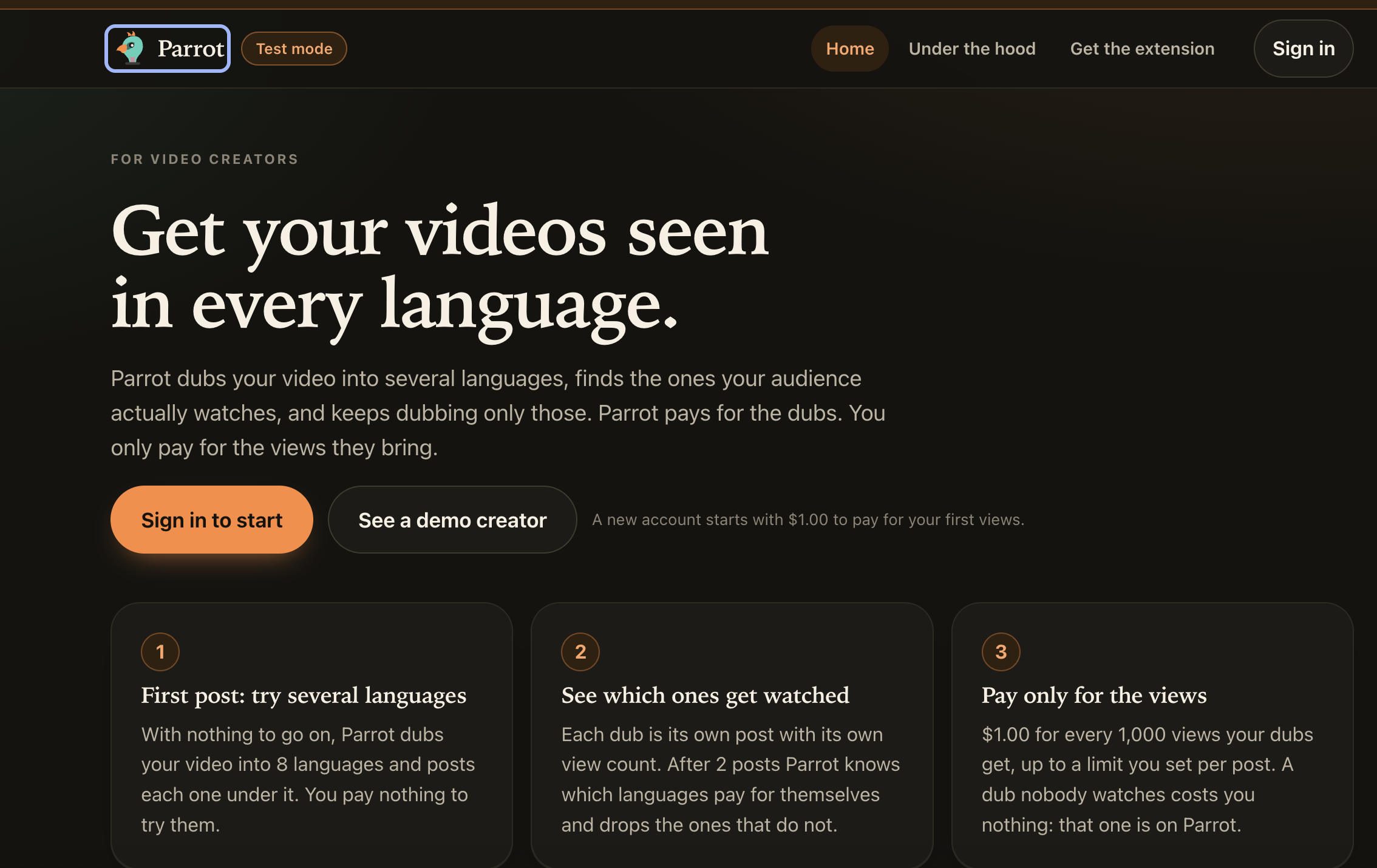
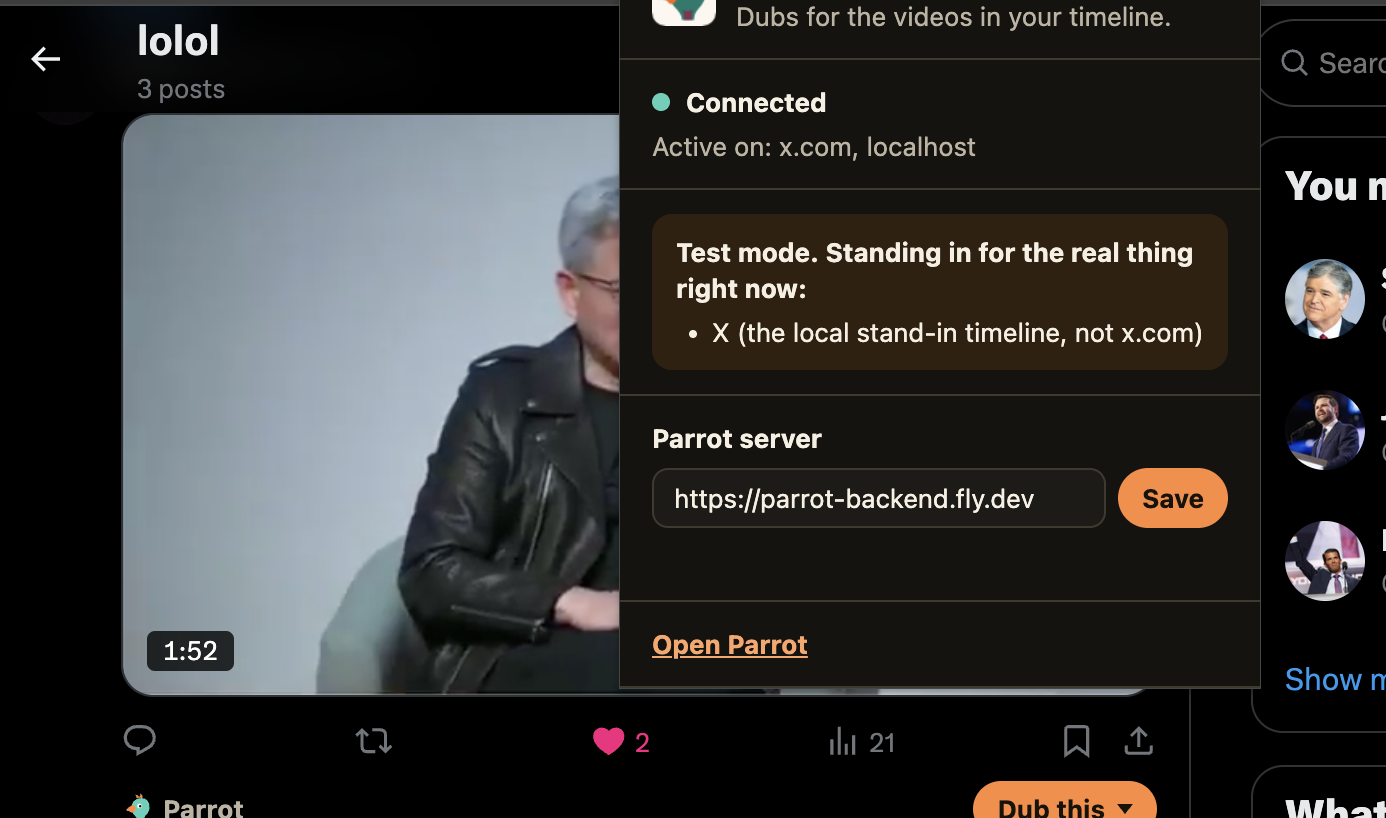
We set out to remove that gamble from the creator entirely. Parrot is a Chrome extension that lives on X. It dubs a creator's video into several languages at Parrot's expense, measures which languages the audience actually watches, and from then on dubs only those. The creator pays only for the views the dubs bring.
Our first design had AI agents bidding for dubbing jobs while viewers paid a small fee to unlock each dub. Reviewing it, we found its weakest point: viewers have no reason to pay for something YouTube and X already offer for free. We replaced it. Viewers watch free. The creator pays per view. Parrot carries the risk.
What it does
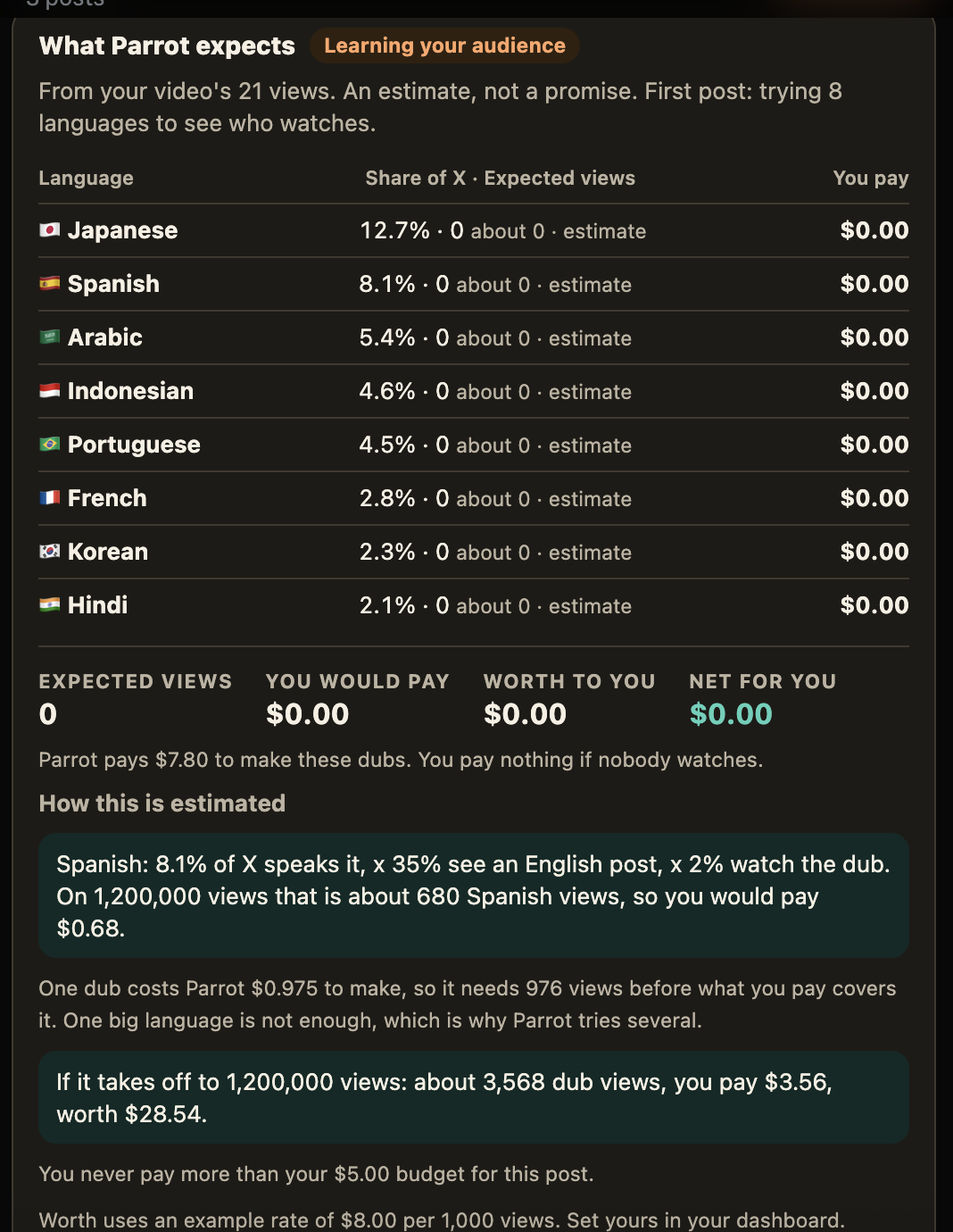
- Forecast. Under a creator's own video, the extension shows what to expect in each language and what it will cost, before anything is spent.
- Dub. Parrot dubs the video into 8 languages on the first post, using ElevenLabs.
- Check. Each dub passes an independent quality check before it goes live.
- Measure. Views are counted per language, with a progress bar toward the point where a dub pays for itself.
- Learn. Languages that pay off are proven, clear misses are dropped, and later posts are dubbed only into what works.
- Bill. The creator is charged for counted views only, and never beyond a per-post budget.
The fee structure
The creator pays \$1 per 1,000 views the dubs receive (0.1¢ a view), capped by a per-post budget (default \$5). Parrot pays ElevenLabs's list price, about \$0.50 per minute of video, per language, up front. A dub breaks even when the creator's payments cover its cost:
$$\text{break-even views} = \frac{\text{dub cost}}{\text{price per view}} = \frac{\$0.50 \times \text{minutes}}{\$0.001}$$
A 30-second dub costs \$0.25 and needs 250 views. A 1:57 dub costs \$0.975 and needs 975. Each side's result is:
$$\text{creator net} = \frac{\text{views}}{1000}\cdot \text{rate} - \text{paid} \qquad\qquad \text{Parrot net} = \text{paid} - \text{dub cost}$$
The "rate" is the creator's own value per 1,000 views (an example \$8 until they set their own). It is displayed as their number, never as income. A dub nobody watches costs the creator nothing and costs Parrot the price of the dub.
The forecast
For a creator Parrot has no history on, expected dub views in language $L$ are:
$$\hat V_L = V \times s_L \times r \times u$$
- $V$: views on the original video.
- $s_L$: the language's share of X's audience, from DataReportal's published country figures plus our estimates for markets outside the top ten. Spanish is about 8.1%.
- $r$: the share of that market that sees an English post. An assumption: 35% (range 20–50%).
- $u$: the share of those who watch the dub. An assumption: 2% (range 1–5%).
On a 1.2-million-view video, Spanish yields about 680 views, roughly 68¢, against about 97¢ to make a 1:57 dub. Even the best guess for the biggest language can fall short of break-even, which is why Parrot measures instead of assuming. A video with few views forecasts few views, so the strip also shows an "if it takes off to 1.2M views" scenario. Once a creator has measured posts, Parrot uses their own results in place of this estimate.
How it learns
For each language, define coverage $c = \text{views} / \text{break-even views}$.
- The first two posts explore, 8 languages each.
- A language is proven when its average $c \ge 1$.
- A clear miss ($c < 0.25$ on its first try) is dropped immediately, as is a language that falls short twice in a row.
- Anything in between is testing and gets another try.
- From the third post, Parrot dubs up to three proven languages plus one new language to test, and retries dropped languages every five posts.
Every decision carries a one-sentence reason shown to the creator.
Quality: no company grades its own work
ElevenLabs makes every dub, so it never judges one. ffmpeg measures the real file: length within 10% of the original, no long dead gaps, sane loudness. Grok (xAI) transcribes the dub, identifies its language, back-translates it to English, and scores from 0 to 100 how well it preserves the original's meaning. A score of 70 is required. The gate fails closed: a check that could not run is treated as a failure, and the dub is not published.
How we built it
A TypeScript monorepo, 322 automated tests:
packages/shared: money maths in integer micro-dollars (no floats), the forecast, the language planner, every user-facing string (enforced by a test that bans crypto vocabulary from creator screens), and the API contract.apps/backend(Express): dubbing workflow, quality gate, view counting, billing, sign-in with per-user wallets.apps/extension(Chrome, Manifest V3): reads posts from x.com's own markup and renders the strip in a shadow DOM. Everything it draws is built withoutinnerHTML, since post text comes from other people.apps/web(Next.js): the creator dashboard.apps/x-clone("Chirp"): a local stand-in for X that let us test the whole loop without paying for X's API.
Sponsor technology. ElevenLabs Dubbing API produces every dub. Arc carries payments: a signed-in creator gets an Arc wallet, and charges are batched into a single USDC transfer per billing run. Because Arc pays network fees in USDC, a creator holds one balance. A "Verify on Arc" link appears only for a confirmed transaction, never for a simulated one. xAI Grok judges dub quality and language, reads what language people reply in, and writes the plain-language summary on a creator's dashboard.
Challenges
- No X API access. X bills per API call, so Parrot cannot post replies or read view counts on x.com. The extension works from what the page shows, which is unverified, and we label it as such throughout. Dubs live on their own Parrot page, and views come from there.
- Honest measurement. Because real view data wasn't available, the demo uses a simulated audience. It is labelled everywhere it appears, and the results it produces illustrate the mechanism rather than prove an audience.
- Money correctness. Float-free arithmetic, idempotent billing batches that advance only after a payment confirms, and display bugs such as a \$0.975 dub rendering as \$0.97.
- Real-world bugs found by running it. Speech-to-text returns language codes like
spawhere our jobs usees, so every correct dub failed the language check until we normalised them. Eight simultaneous dubs of one post tried to download the original eight times. A slow model call stalled server start-up. - A pivot. Dropping a working auction system because the economics didn't hold up was the hardest and best decision we made.
What we learned
The bet is the product. Dubbing quality is increasingly a commodity; knowing which language is worth dubbing is not. Showing the maths, including the cases where it comes out negative, builds more trust than a confident promise.
What's next
Connect X's API for real view counts and in thread dub posts. Run the multi creator pilot we've designed: alternate dubbed and undubbed posts across 5–10 accounts for several weeks to actually measure whether dubbing genuinely lifts total views. Voice preserving options, and per-creator pricing extensions as well would be the immediate next steps. We're super excited about taking Parrot to the next level!
Built With
- arc
- chrome
- circle
- elevenlabs
- express.js
- grok
- nextjs
- react
- storage
- typescript
- usdc
- viem
- vitest
- xai
- zod


