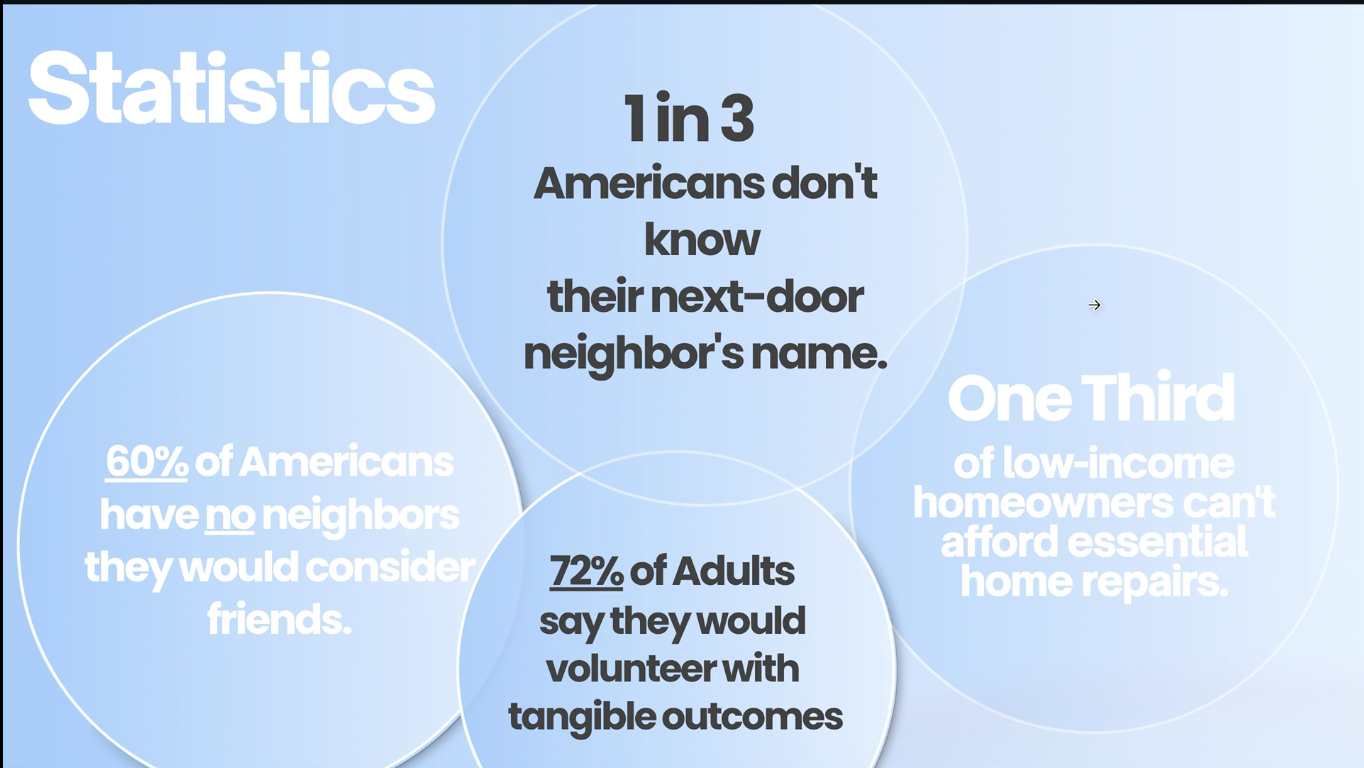
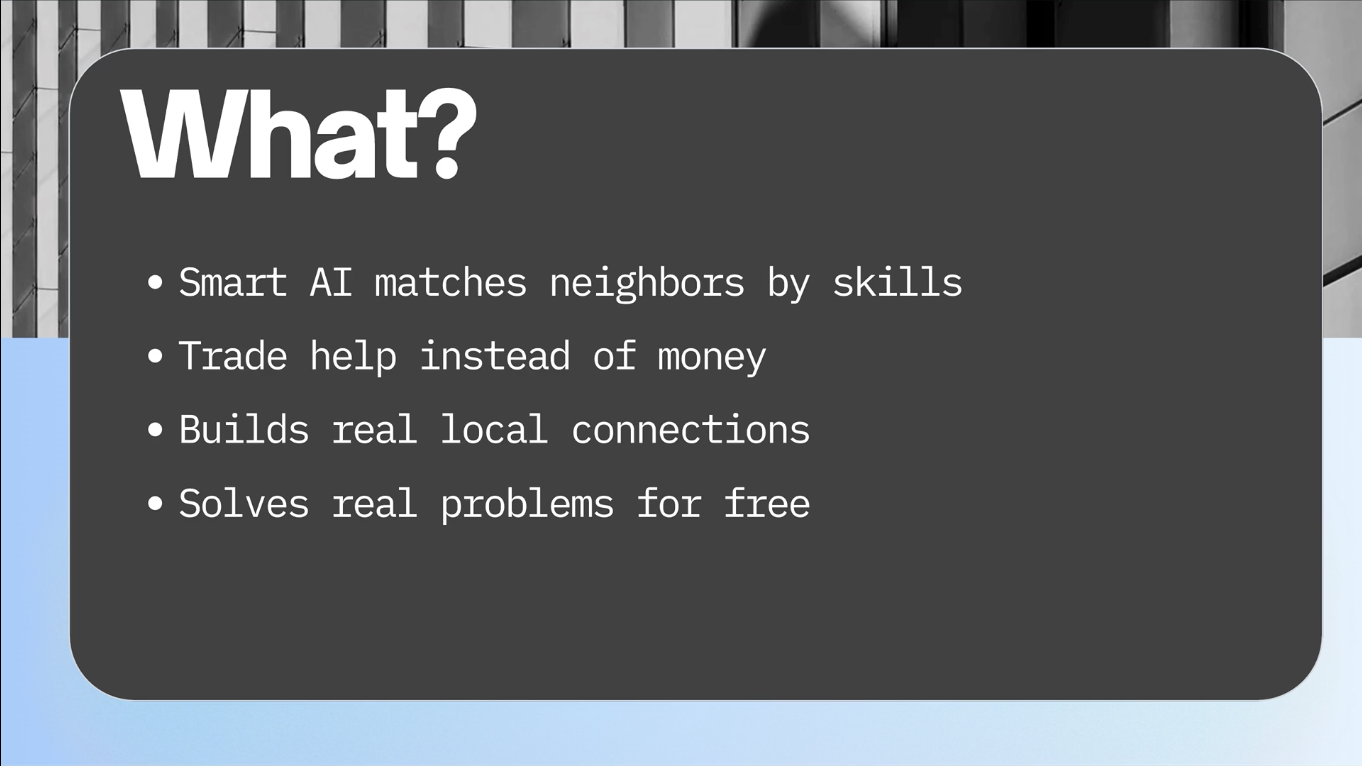
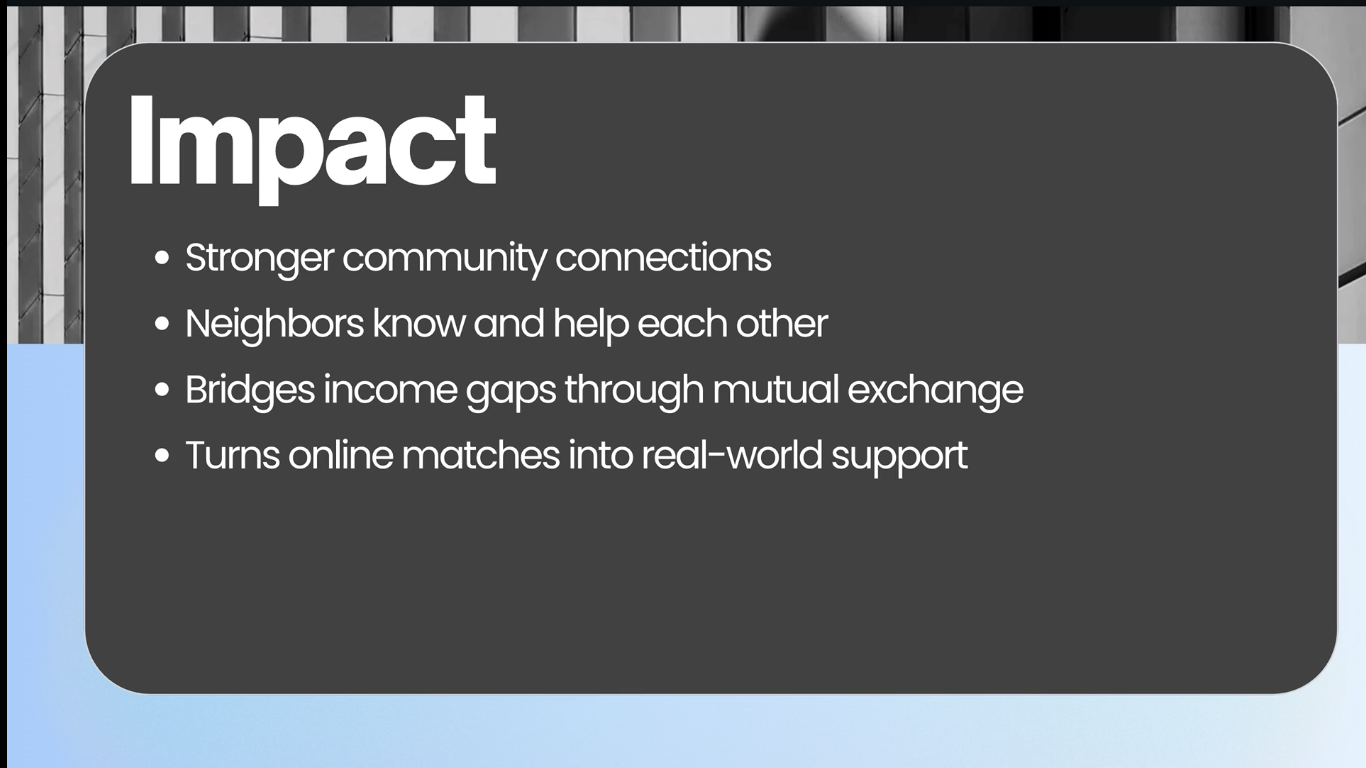

We live in a world where we can instantly connect with people across the globe, yet many of us barely know our neighbors. Through this realization, we saw that every neighborhood is an untapped skill economy—filled with people who have valuable knowledge and abilities but no easy way to share them. InterLink was inspired by the idea of turning learning into a mutual exchange rather than a one-sided transaction. Instead of paying with money, users barter skills. A retired piano teacher can trade lessons with a neighbor who knows home repair, or a student strong in math can exchange tutoring for language practice. Our goal was to reduce isolation, break language barriers, and make learning more accessible by allowing people to “pay” for knowledge with their own skills.
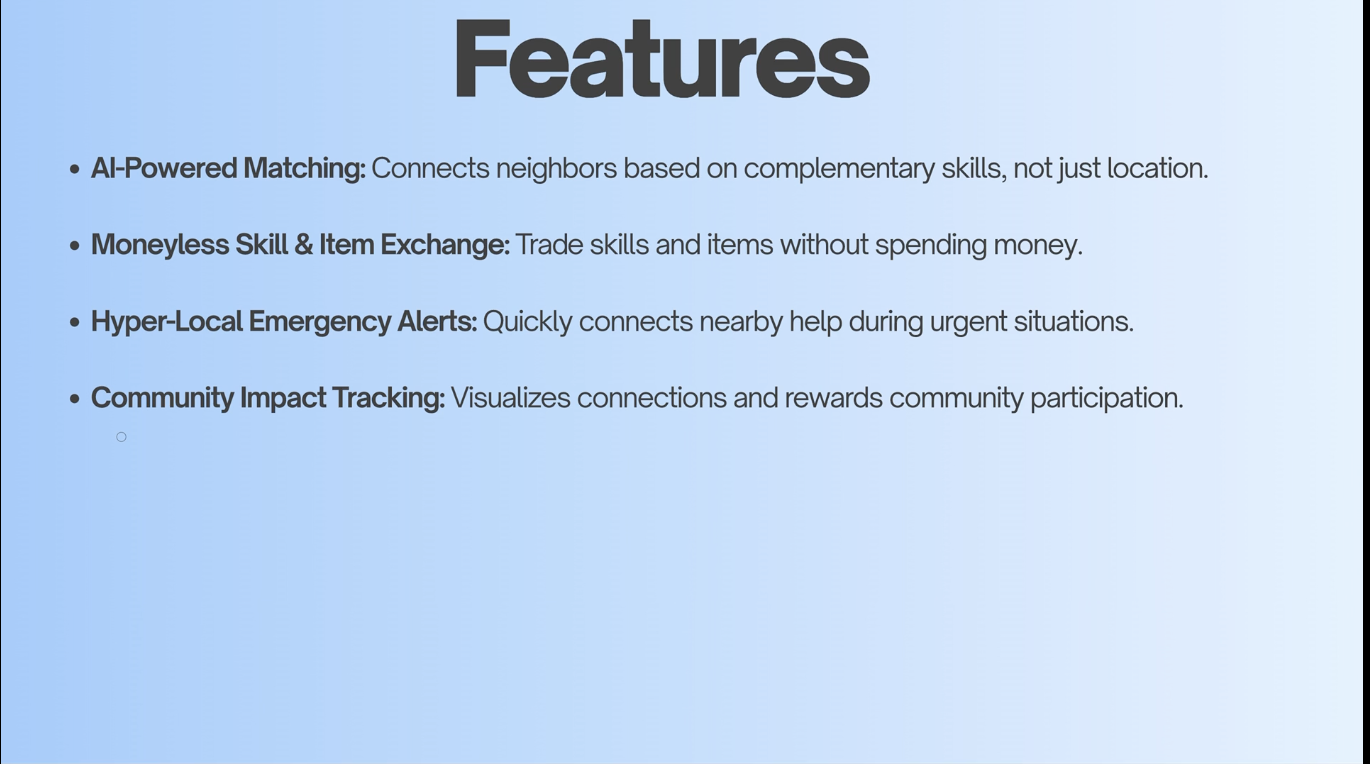
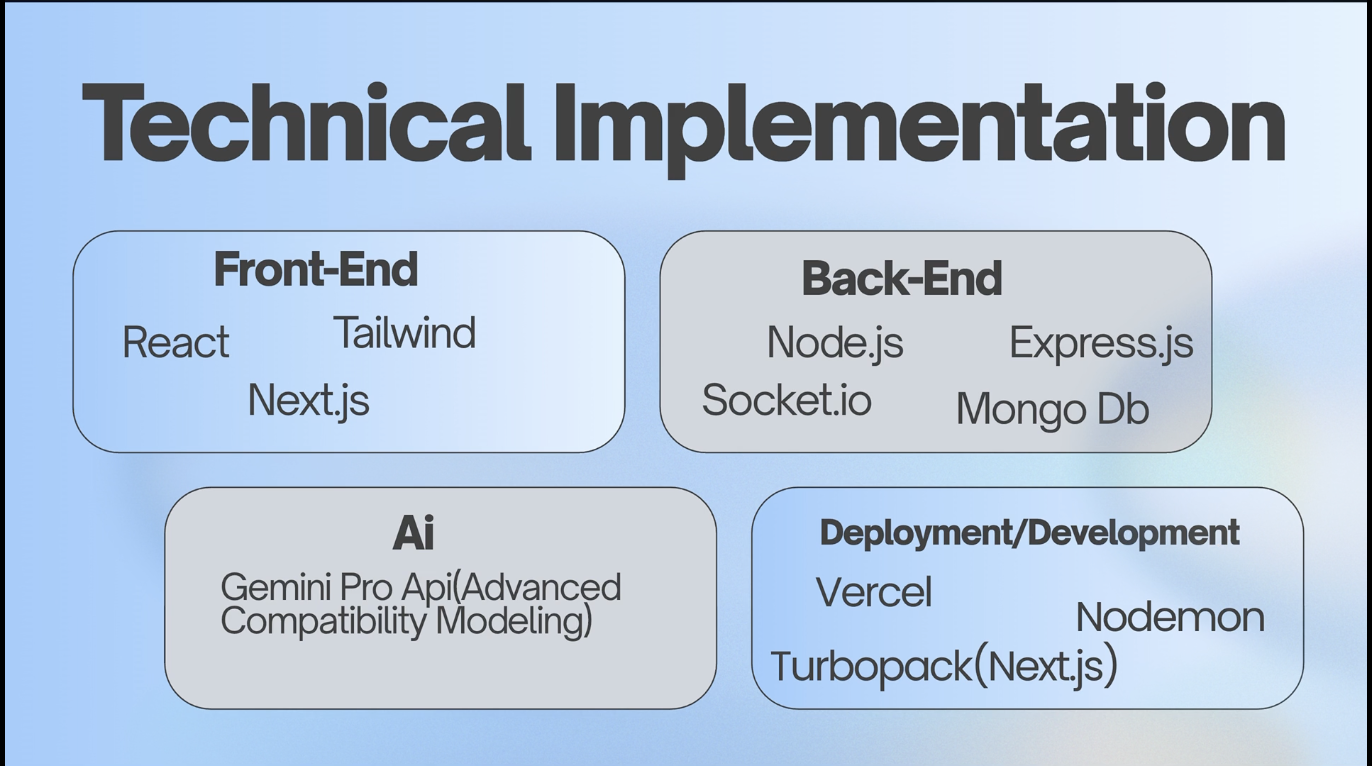
InterLink is a full-stack, real-time web application designed to be fast, inclusive, and reliable. We built the frontend using Next.js 16 and React 19 to create a modern, responsive user experience. The backend is powered by Node.js and Express, with MongoDB handling data storage and geospatial queries. For real-time interactions such as live negotiation and messaging, we integrated WebSockets using Socket.IO. At the core of the platform is AI-powered reciprocal matching. Instead of relying on simple keyword overlap, the system analyzes user profiles to identify mutually beneficial exchanges and generates clear, human-readable explanations for each match. This helps users understand why a connection makes sense and builds trust in the process.
To ensure accessibility, we added real-time translation that automatically detects and translates languages during conversations, allowing neighbors who speak different languages to communicate seamlessly. We also prioritized privacy by implementing geospatial matching with fuzzy location, enabling users to find help near general landmarks without revealing their exact address until they feel comfortable.
To encourage participation, we built a gamification system that rewards users for contributing to the community. Users earn points for making connections and completing exchanges, reinforcing the idea of shared value and active engagement.
One major challenge was managing AI API rate limits while keeping the application responsive. We addressed this by implementing a custom Least Recently Used (LRU) caching system that stores generated match explanations and translations, reducing redundant calls and improving performance. Another challenge was ensuring reliability in real-world conditions where external APIs can fail. To prevent disruptions, we designed intelligent fallback mechanisms that automatically switch to rule-based matching when AI services are unavailable, ensuring the platform remains stable.
Finally, coordinating real-time communication with asynchronous AI tasks required careful state management. Integrating WebSockets alongside REST APIs taught us how to manage complex data flows in a modern full-stack application.
Through this project, we learned that AI is most powerful as a user-experience tool, working behind the scenes to explain compatibility, translate conversations, and organize information rather than acting as a standalone chatbot. We also discovered the importance of reciprocity. People are more willing to ask for help when they know they can offer something in return, which strengthens trust and community bonds.
Most importantly, we learned that resilient full-stack design matters. Building systems that gracefully handle failure—through caching, fallbacks, and real-time safeguards—is essential for creating reliable, community-driven platforms.
InterLink transforms neighborhoods into living marketplaces of shared knowledge by combining reciprocity, accessibility, and resilient full-stack design.
Built With
- css
- express.js
- gemini
- javascript
- mongodb
- next.js
- node.js
- radix
- react
- socket.io
- tailwind
- typescript

Log in or sign up for Devpost to join the conversation.