
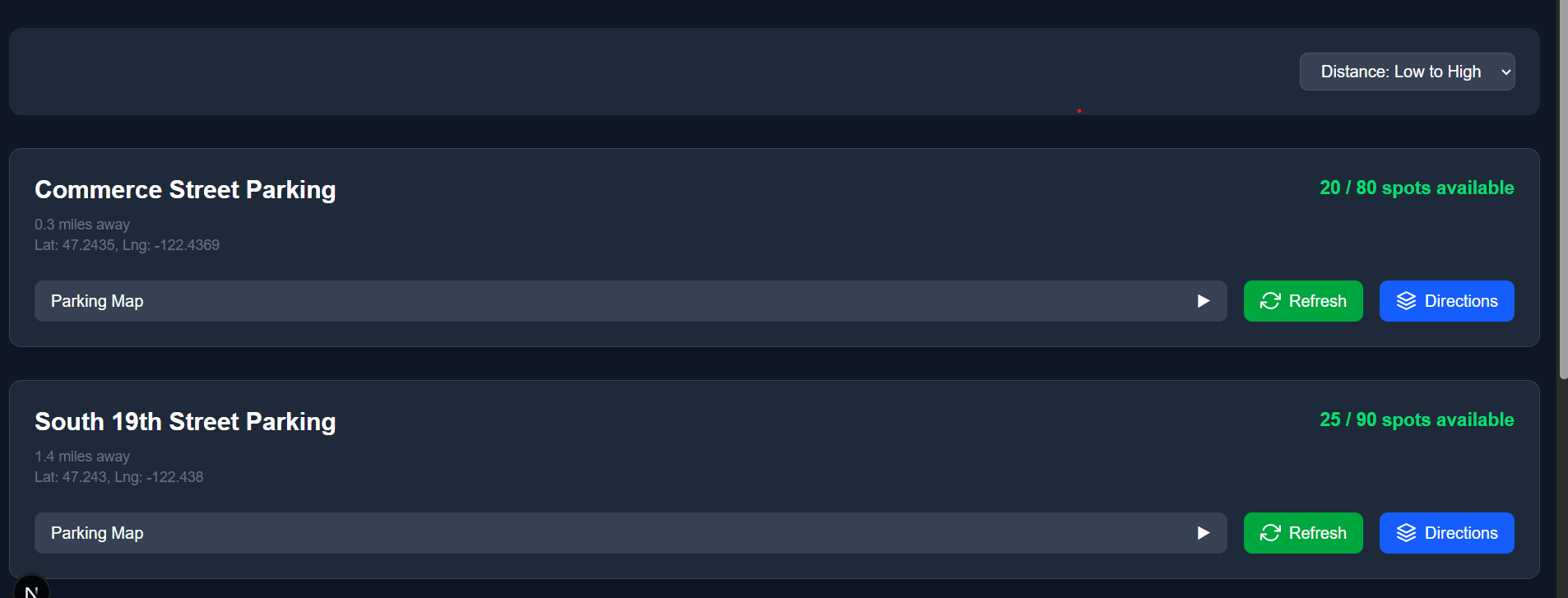
ParkWatch: Smarter Parking Through AI Inspiration In busy urban environments, drivers waste time and fuel searching for available parking. We wanted to create a solution that uses computer vision and AI to detect parking occupancy in real time and deliver that information to users in a clear, intuitive way. Inspired by smart city innovations and the frustration of circling blocks for a spot, we built ParkWatch — an AI-powered parking visualization system that brings real-time parking intelligence to life.
What it does ParkWatch uses a camera feed and OpenCV to detect whether parking spots are occupied. It then sends this data to a server, where it can be visualized on a live dashboard showing spot availability. Users (or city planners) can easily view which spots are taken or available, helping reduce traffic congestion and wasted time. Key Features: • Interactive parking lot UI with real-time occupancy visualization • Smart detection of cars in spots using OpenCV and adaptive thresholding • Responsive frontend with Tailwind-based UI simulating real parking layouts • Time-based occupancy simulation and predictions • Data sent to a backend endpoint in JSON format (designed for city integration)
How we built it • Computer Vision: OpenCV in Python to detect vehicle presence based on pixel changes and thresholding • Backend: Python script simulating JSON data pushes to an endpoint (can scale to Flask/Node) • Frontend: Static HTML/CSS UI styled with Tailwind to resemble real-world parking layouts • Simulation: Realistic UI renders occupied vs. free spots based on live data or mock time-based schedules • Collaboration: Divided roles into vision, backend, and UI/UX for quick iteration during a 6-hour sprint
Challenges we ran into • Calibrating OpenCV to reliably detect cars in varying light/angle situations • Structuring parking spot selection dynamically and saving/loading regions • Syncing the computer vision detection with real-time UI updates • Debugging video playback and frame analysis quickly in OpenCV
Accomplishments we’re proud of • Successfully simulated a real-world parking lot with dynamic UI feedback • Built a working OpenCV car detection system with a customizable detection threshold • Designed an interface that looks and feels like a polished commercial dashboard • Created a foundation for cities, malls, or campuses to track parking efficiency
What we learned • How to use OpenCV for polygon-based image masking and binary filtering • Real-world challenges of computer vision like noise, lighting, and video looping • Building UIs that reflect real-world layouts rather than generic grids • Importance of syncing frontend and backend cleanly even in small projects
What’s next for ParkWatch • Hook up OpenCV output directly to a Flask/Express backend with a live API • Create a user-facing app to find spots in real time via GPS • Connect to edge cameras (e.g., Raspberry Pi) for parking lot deployment • Provide city dashboards for analytics and smart infrastructure planning • Predictive AI models that estimate availability at future times based on trends
We believe ParkWatch can help… Reduce traffic congestion, cut emissions, and make cities smarter by improving how we use something as common — and frustrating — as a parking lot.
Built With • Python • React • OpenCV • HTML/CSS (Tailwind) • JavaScript • JSON
Built With
- computer
- javascript
- python
- vision

Log in or sign up for Devpost to join the conversation.