Inspiration
We all know the campus parking pain. You circle the same lots, waste 10–15 minutes, stress about being late, and still end up parking far. For a “smart” campus, it didn’t feel smart at all. So we thought: instead of guessing, what if we had a simple web app that tells you, right now, “go here, not there” for Monroe/ULM — no hardware, no paid APIs, just smart logic we can build in a few hours.
What it does
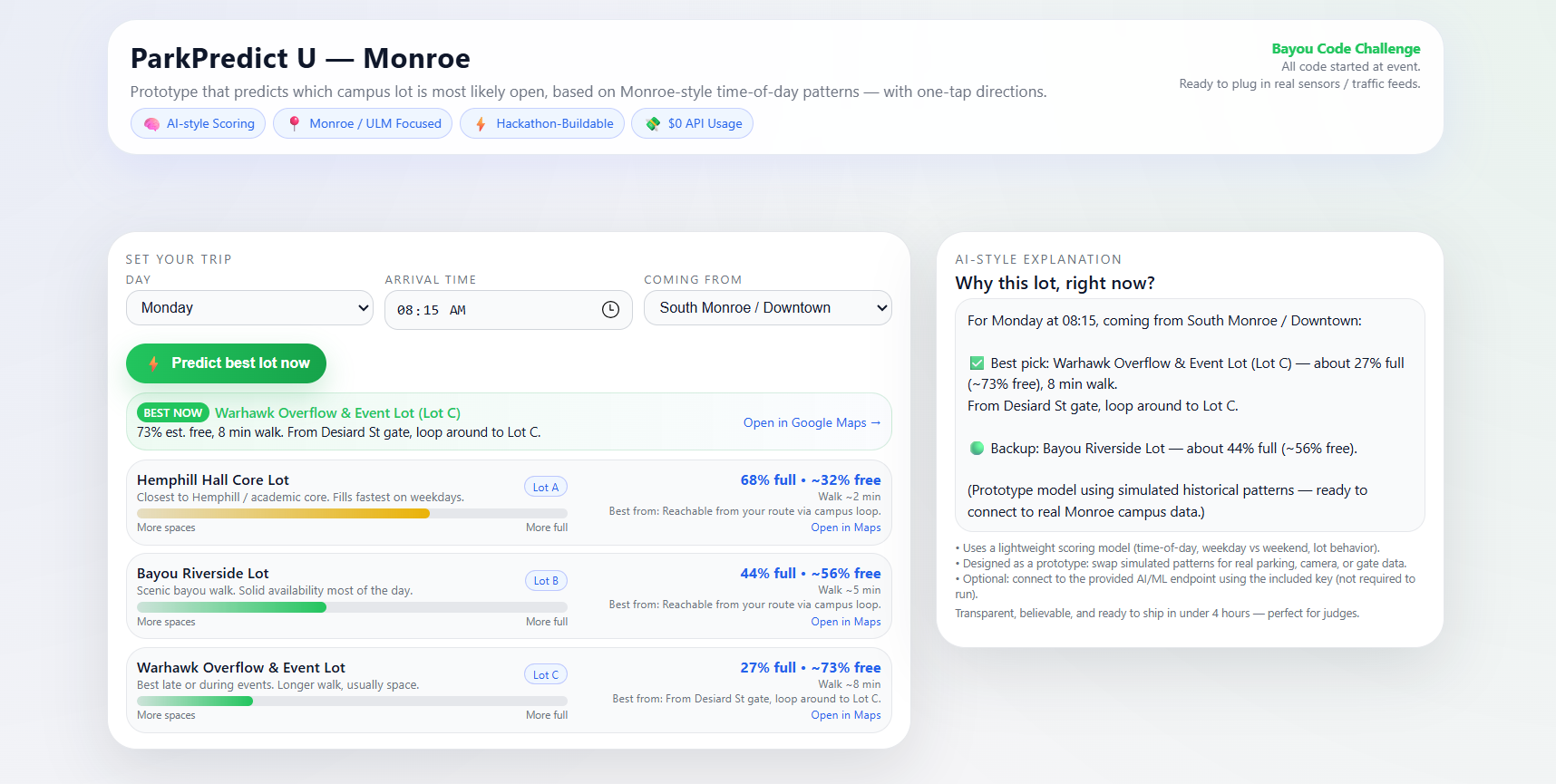
ParkPredict U looks at:
- day of week
- time you plan to arrive
- which direction you’re coming from
Then it:
- predicts how full each main lot is (A/B/C style lots),
- highlights the best lot right now with a clean banner,
- shows estimated free space + walk time,
- and gives a one-click “Open in Google Maps” link straight to that lot.
It’s built as an AI-style, explainable predictor: it doesn’t just show colors, it tells you why that lot is recommended.
How we built it
- Fully in the browser with HTML, CSS, and JavaScript.
Designed a lightweight “parking model” using simulated historical patterns:
- core lots fill early,
- overflow lots pick up later,
- weekends and evenings calm down, etc.
Added a scoring layer that turns those patterns into a simple prediction for each lot.
Built a side panel “AI explanation” that generates a human-readable summary from the model.
Wired in Google Maps direction links (no paid API needed) so users can jump to navigation instantly.
Left a hook for the provided AI/ML key so it can call a real model later without changing the UI.
Challenges we ran into
- Doing something that feels “real-time smart” without sensors, cameras, or a big budget.
- Staying honest: we didn’t want to fake data, so we built a transparent model we can explain.
- Keeping it hackathon-legal: all code started during the event, no secret backend, no expensive APIs.
- Making the UI clean and fast enough that someone can understand it in 5 seconds during judging.
Accomplishments that we're proud of
- A polished, deployed, zero-cost prototype that actually looks like a product, not just a demo.
- Clear storytelling: “Here’s your best lot, here’s why, click here to go there.”
- Campus-specific thinking for Monroe instead of a generic “AI parking” buzzword project.
- Architecture that can plug in real data (gates, sensors, traffic) later with minimal changes.
What we learned
- You can get a lot of “AI-feeling” usefulness just by combining good heuristics, UX, and explanations.
- Constraints (no money, no hardware, short time) can actually push a cleaner design.
- How important it is to show trust and transparency in smart city tools: people want to know why.
What's next for ParkPredict U
Hook into real Monroe/ULM data:
- gate counters, camera-based occupancy, event schedules, weather.
Add live congestion inputs (when available) to refine predictions.
Expand to more lots + accessibility routes (priority for accessible parking & safe crossings).
Publish an API so other campus apps (shuttles, safety, events) can use the same predictions.
Turn this from “hackathon prototype” into a plug-and-play smart parking layer any campus can deploy.


Log in or sign up for Devpost to join the conversation.