-
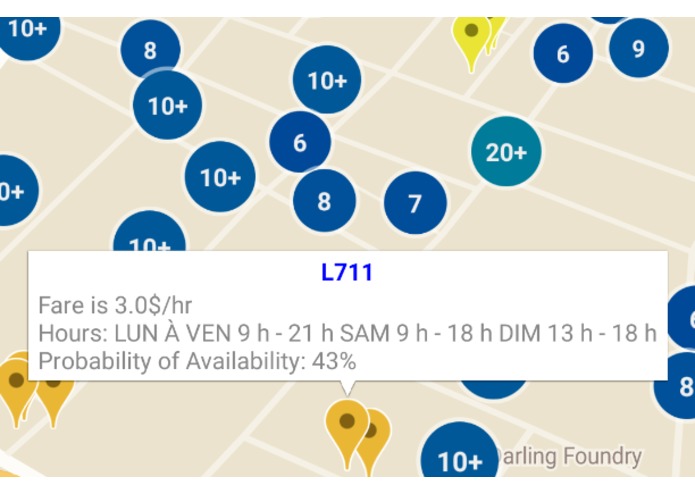
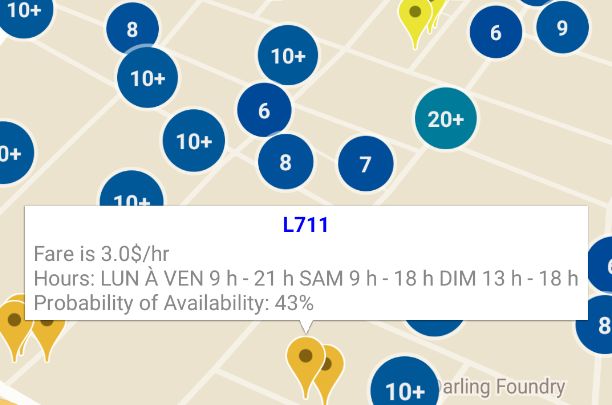
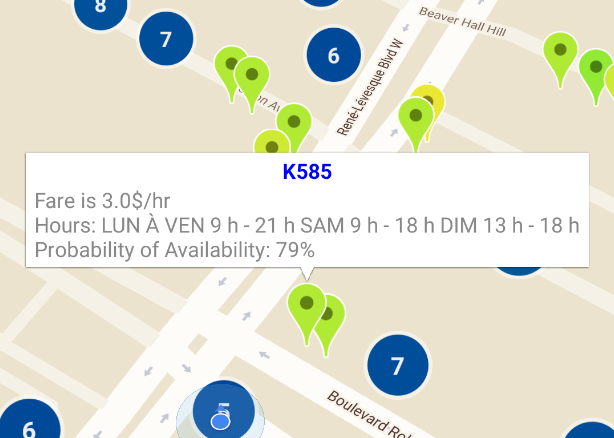
Available spot with low occupancy probability due to location and hour of the day
-
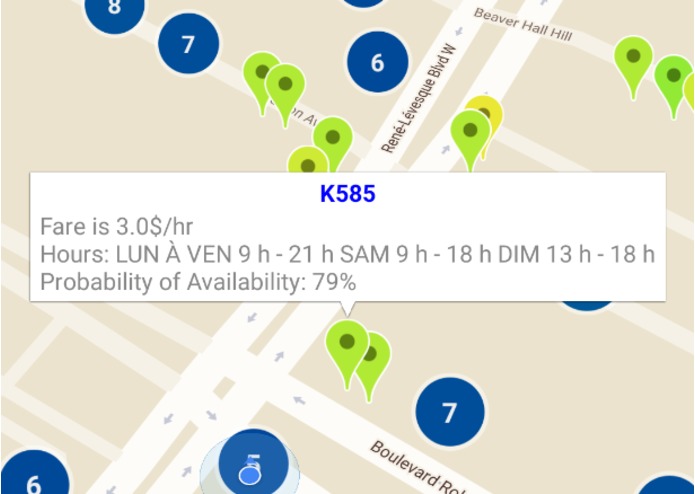
Available spot with high occupancy probability due to location and hour of the day
-
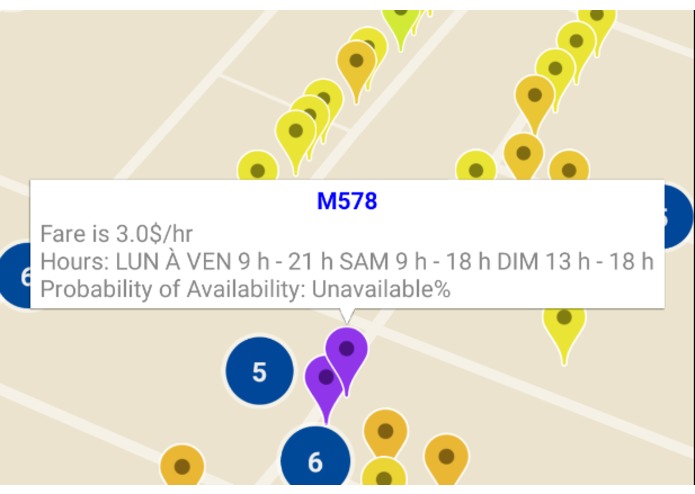
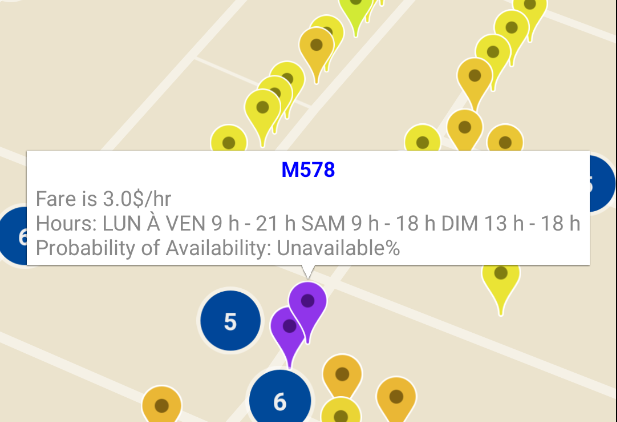
Unavailable spot due to regulations and hours.
Inspiration
The team has heard car owner's complaints. Cities are becoming more and more difficult to find parking spaces in. We need a smarter way of doing things, which include going one step ahead of the others. There is no real-time data for paid street parking, so the team looked for a way to determine the parking availability based on past data
What it does
The Android app shows a map of Montreal with a marker of all paid street parking spots in Montreal. Based on the time of the day, day of the week, and location, it shows the probability that it is occupied, as well as its schedule and number. The app displays the probability as coloured markers, each marker being a paid parking representation; a probability of 0 being red and 100 being green. Navigation and enabling location displays nearby parking spots available for usage.
How I built it
Using Google Maps API and Android Studio, we have a model (https://github.com/konzert/CodeJam/blob/master/demo.ipynb ) developed based on previous work on the Github Repo mnabaee/kernels, but it is not linked to the frontend. We found data from Montreal government's website as well as multiple other data sources. The app is built in a probabilistic way.
Challenges I ran into
Connecting Python model to Android frontend. UI elements.
Accomplishments that I'm proud of
We have created a working Android application that displays parking information in an intuitive manner that is very useful to the public. ## What I learned Data visualization techniques, data manipulation tools, and statistical inference.
What's next for ParkMe
We hope to continue to work on our model so that unpaid street parking data can also be displayed in the system. We already have a processed dataset that can yield available parking spots based on time of day (using information from street parking signs). We also are looking into paying through the app, which would also help improving the accuracy of our predictions of parking availability.


Log in or sign up for Devpost to join the conversation.