-
-
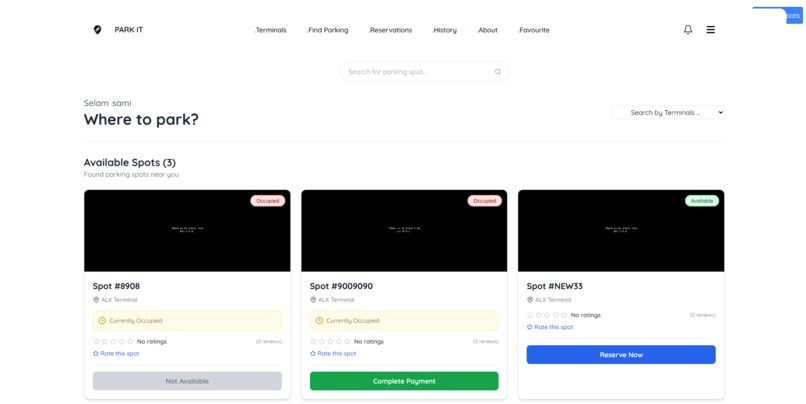
Driver Homepage
-
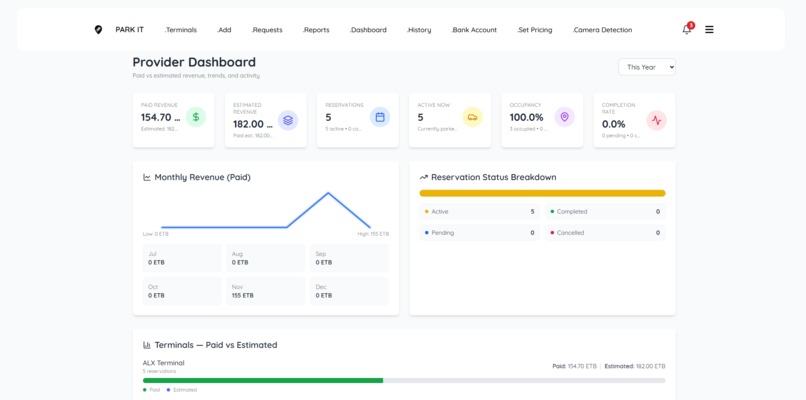
Service Provider Dashboard
Inspiration
Cities across the world are growing rapidly, but parking systems remain inefficient. Drivers waste time circling for available spaces, increasing congestion, fuel consumption, and emissions.
I first observed this challenge in Addis Ababa, Ethiopia, where rising vehicle density has intensified parking difficulties. To validate the problem, I conducted a survey among local drivers. The results confirmed frequent parking struggles, time loss during peak hours, and strong interest in a real-time digital solution.
Although my research began locally, the issue is global.
I asked a simple question:
What if parking was intelligent, real time, and optimized everywhere?
That question became PARK IT.
Now in the final stage of testing and deployment, PARK IT is designed as a scalable smart parking platform ready to support cities worldwide.
What It Does
PARK IT is a smart parking management platform that I built to connect drivers to available parking spaces in real time.
The system allows users to:
View live parking availability
Reserve or access spaces efficiently
Reduce time spent searching for parking
For administrators, I provide:
Parking space management
Real time occupancy monitoring
Secure role based access control
By digitizing and optimizing parking allocation, I reduce traffic congestion, save fuel, lower emissions, and improve the overall urban mobility experience.
How I Built It
PARK IT was built as a full stack, scalable smart parking platform designed for performance, security, and real-time efficiency.
I developed a responsive frontend interface that allows users to view parking availability and interact with the system seamlessly. The backend was built using a RESTful architecture to handle authentication, parking logic, and real-time updates.
The system includes:
Secure user authentication with role based access (Admin & User)
Dynamic parking space management
Structured database design for users, spaces, and activity tracking
Production ready server configuration for deployment
Before full development, I conducted a survey to validate the problem and guide feature prioritization. I am now in the final stage of testing and deployment, ensuring the system is stable, secure, and scalable.
PARK IT was built with modular architecture so I can easily expand it to support IoT sensors, predictive analytics, and smart city integrations in the future.
Challenges I Ran Into
Backend Deployment – Deploying the backend to a production environment presented unexpected configuration and server management challenges. Ensuring stable hosting, proper server setup, environment configuration, and secure production deployment required troubleshooting and optimization under tight time constraints.
Real Time Data Management – Keeping parking availability accurate and synchronized across multiple users in real time.
Security & Role Control – Ensuring only authorized admins could modify parking data while users had controlled access.
Scalability – Designing the system to support city-level expansion without major architectural changes.
Time Constraints – Building a stable, production ready system within the hackathon timeframe required careful prioritization.
User Experience – Making the platform intuitive for both drivers and administrators while handling complex backend logic.
Despite these challenges, iterative testing and persistence allowed me to create a robust, deployable solution.
Accomplishments That I'm Proud Of
Validated a real world problem – I conducted surveys in Addis Ababa to confirm parking inefficiencies and user needs.
Built a fully functional MVP – I developed a responsive, real-time smart parking platform from scratch.
Secure and scalable system – I implemented role-based authentication and a backend architecture ready for city level expansion.
Optimized urban mobility – I reduced the time and frustration of finding parking through intelligent space allocation.
Hackathon ready deployment – The system is now in final-stage testing, fully deployable, and designed for future integrations like IoT and predictive analytics.
These accomplishments reflect both my technical skills and my commitment to solving a global urban challenge.
What I Learned
Urban problems are universal – Parking inefficiency affects cities worldwide, not just Addis Ababa.
Validation is key – Conducting surveys before development helped me focus on real user needs.
Simplicity matters – Even with complex backend logic, a simple and intuitive interface ensures adoption.
Scalability and security can’t be an afterthought – Building them from the start prevents future issues.
Focus accelerates innovation – Careful prioritization allowed me to deliver a deployable MVP under time constraints.
What's Next for PARK IT
IoT Integration – I will connect parking sensors to provide automatic, real-time availability updates.
Predictive Analytics – I will use machine learning to forecast parking demand and optimize allocation.
Mobile App – I will develop iOS and Android apps for seamless driver access on the go.
Smart Payments – I will integrate digital payment solutions for effortless, contactless parking.
City-Level Expansion – I will scale the system to support multiple urban areas, locally and globally.
Data-Driven Insights – I will provide analytics dashboards for city planners to reduce congestion and improve urban mobility.
Built With
- chapa
- django
- postgresql
- react
- tailwind

Log in or sign up for Devpost to join the conversation.