-
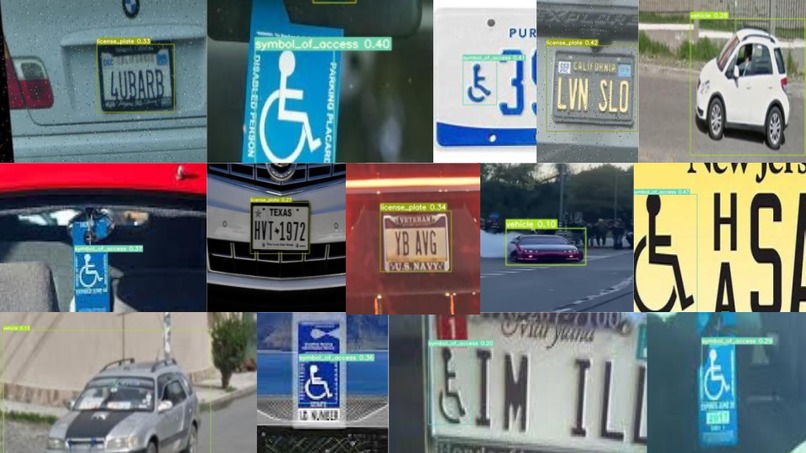
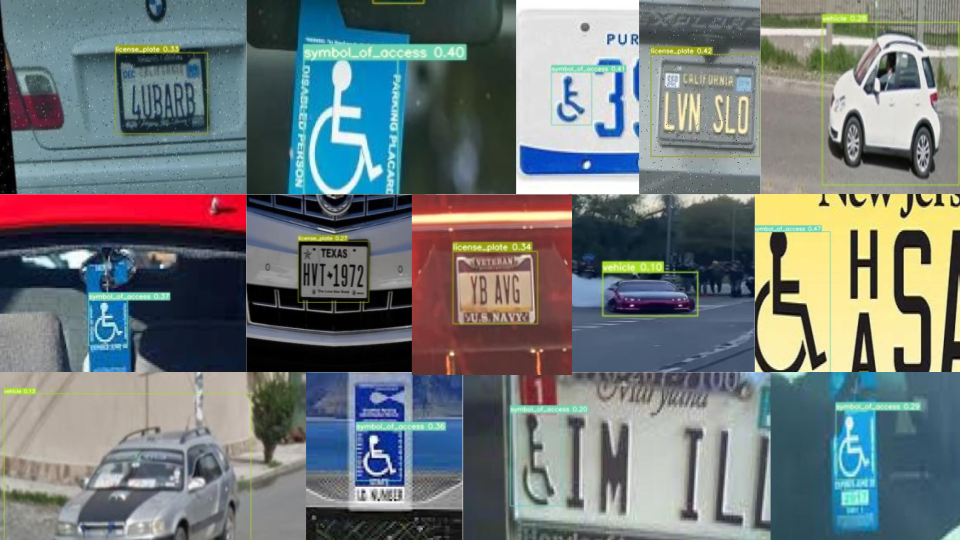
Inferences displayed on test images after model training
Inspiration
We chose to create this project because we wanted to learn more about artificial intelligence and computer vision technologies. We also wanted to gain hands-on experience with curating and manipulating datasets. Moreover, we liked the idea of being able to contribute to accessibility initiatives, using these technologies for us or other people to make a difference in the community.
What it does
Our project uses computer vision technology to detect accessible vehicles video streams by identifying the International Symbol of Access displayed on vehicles. It works by scanning video frames for the symbol, which could appear on license plates, windows, or other parts of a vehicle. Once detected, the system outlines the symbol of access, vehicle, and license plate (if applicable). This allows identification and tracking of accessible vehicles, which can be useful in the future for monitoring accessibility compliance and improving mobility solutions.
How we built it
We started by gathering and annotating a robust dataset from Universe Roboflow, focusing on images of vehicles, license plates, and the International Symbol of Access. We used Roboflow to manage and prepare this dataset, applying transformations like resizing, cropping, and noise addition to enhance the model's robustness.
We selected the Roboflow 3.0 Object Detection (Fast) model with a COCOn checkpoint to enhance its overall accuracy and performance. The model was then trained using YOLOv7 in a Google Colab notebook.
We used the YOLOv7 PyTorch export feature from Roboflow to obtain our custom annotated dataset and used a Jupyter notebook snippet to integrate the dataset into our Google Colab workspace. Once the model was completed, we evaluated its performance on test images and videos.
After completing training and evaluation, we deployed our model by exporting the weights, which encapsulate all the learning and parameters the model uses to make predictions.
Challenges we ran into
Due to our limited amount of time, our initial training was conducted over just 1 epoch to quickly validate our setup and make sure the model was learning from our data. While this allowed us to complete initial testing, it became pretty clear that more training was necessary to increase our model's accuracy.
Additionally, our whole team is new to computer vision and dataset manipulation, so we encountered a significant learning curve that impacted our project's progression. A lot of our time went into understanding the theoretical aspects of these technologies in order to build a functional system. However, this learning process pushed us to quickly learn new skills, which we know will greatly benefit us in the future.
Accomplishments that we're proud of
Our biggest accomplishment is the way we leveraged different open-source tools, such as Roboflow for dataset management and Google Colab for model training. Additionally, despite the time constraints and initial lack of knowledge, we're proud of our completion of the majority of the project. With this base we created, we look forward to optimizing our model in the future to increase its accuracy and efficiency.
What we learned
Throughout this project, we gained experience in applying computer vision techniques, which enhanced our knowledge of neural networks and how datasets and preprocessing can impact a model's performance. Additionally, we learned about dataset creation and annotations, as well as fundamental knowledge about available resources that support AI projects. Overall, this project gave us many technical skills and allowed us to gain a deeper understanding with AI and its technologies, and how they can contribute to real-world scenarios.
What's next for Accessible Vehicle Locator
Looking ahead, our immediate focus is to extend our model's training by increasing the number of epochs from 1 to potentially between 100 and 200. With this, we hope to significantly increase the accuracy of computer vision algorithm. Additionally, we can always keep improving our dataset with more diverse images so our model can function in different environments.

Log in or sign up for Devpost to join the conversation.