-
-
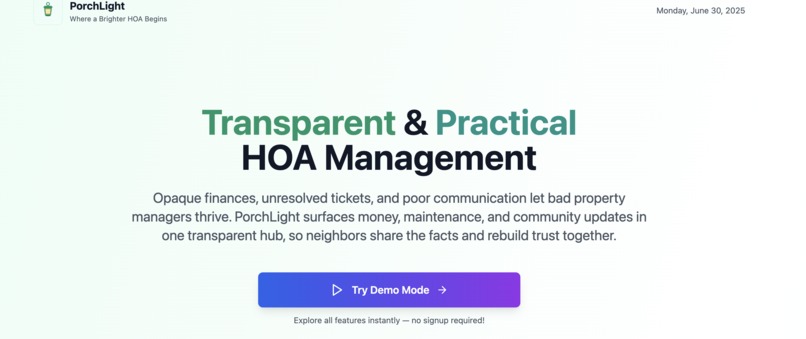
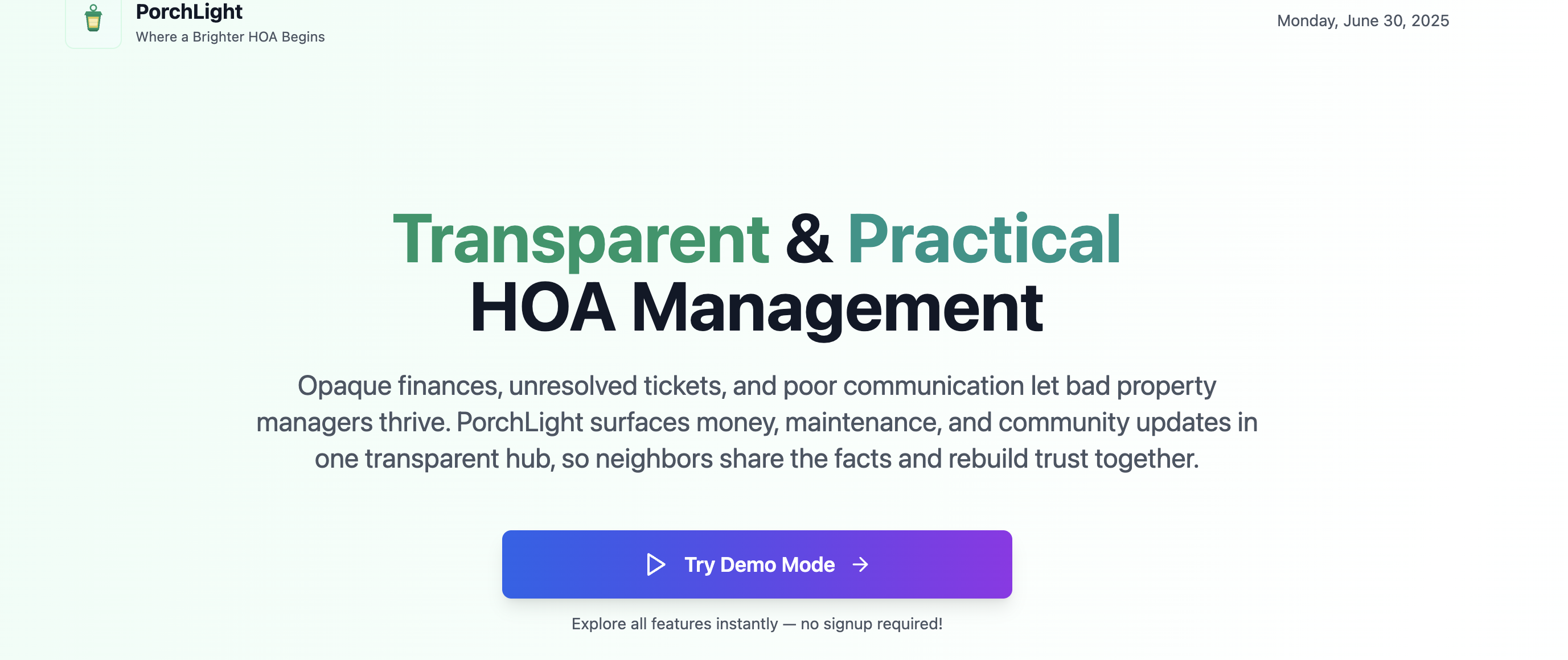
Homepage
-
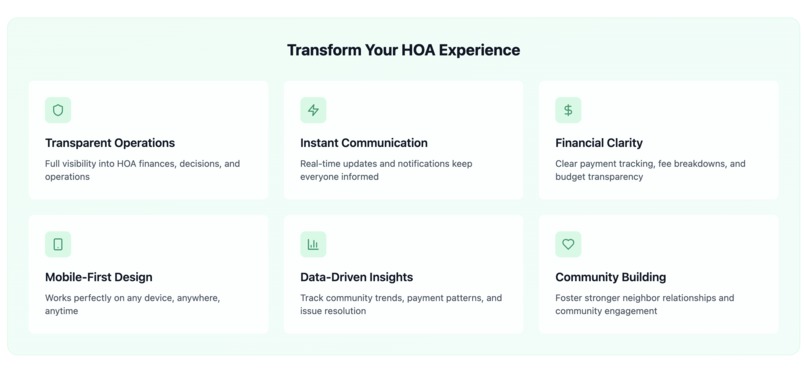
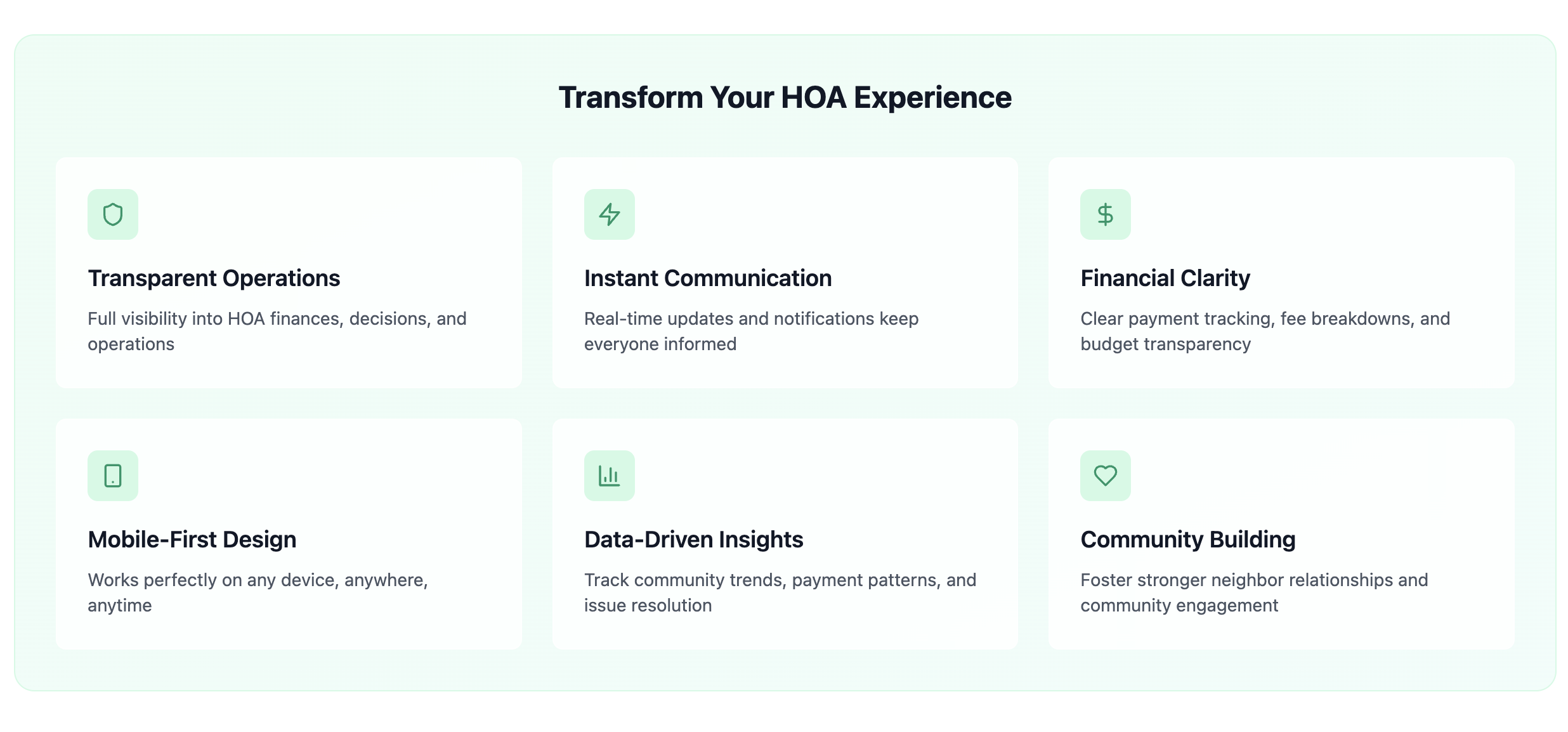
Transform Your HOA Experience
Inspiration
I live in an HOA-managed community and face the same frustrations millions of Americans deal with: slow responses, zero visibility, unaccountable property managers, broken communication, and decisions made in black boxes. Most residents feel powerless, and most board members feel overwhelmed. I wanted to reimagine HOA and community management from the ground up: what would it look like if it were transparent, collaborative, and actually useful?
There are over 350k HOAs in the US, representing ~74 million residents. Yet, almost every tool out there caters to outdated property management workflows. I wanted to flip the script and empower residents, not just management companies.
What it does
Porchlight is a modern, AI-powered community management platform that brings transparency, clarity, and accountability to HOA-managed communities. It shifts power from outdated property management systems to a resident-first, collaborative, and transparent model.
The platform enables residents to submit and track complaints, view a shared calendar of events and maintenance, and access key documents and rules. Board members and property managers can manage tickets, analyze finances, coordinate communications, and evaluate vendor bids, all from one place.
Porchlight also features an AI assistant that answers questions based on uploaded HOA documents, making policies and other documents instantly accessible and reducing friction in communication.
By centralizing information, enhancing visibility, and using AI to simplify access and operations, Porchlight transforms HOA living into something far more functional, transparent, and resident-friendly.
Find more here: https://getporchlight.site/
How I built it
I built Porchlight entirely using Bolt’s no-code AI platform, which allowed me to move fast while integrating structured workflows with generative AI. The app is hosted on Netlify, with Supabase powering the backend—handling authentication, database, file storage, and real-time updates.
All logic, interface, and AI capabilities were created within Bolt, including an assistant that answers resident questions using uploaded HOA documents. This setup helped me deliver a fully functional, scalable platform as a solo builder within the hackathon timeline.
Challenges I ran into
This was a big idea with many moving parts. When I began building with Bolt, I ran into technical issues. The authentication flow was broken, which meant I couldn’t even log in to test. To work around this, I created a demo mode to simulate the experience. Once that was set up, I saw that many nested pages existed, but none of them were functional. I had to go through each one, identify what was broken, and then escalate the issues to the Bolt team so they could fix them across the board.
Another technical challenge was the time spent troubleshooting the user experience. Many pages looked good on the surface but were not interactive or wired up properly. Making the entire prototype functional took a lot more work than expected and was the biggest area of effort.
Over time, the project grew in size, and Bolt began warning me about token limits. That was hard to navigate since there wasn’t a clear way to understand or manage token usage within the interface.
I also ran into problems with Bolt’s "enhance prompt" feature. It sometimes removed key instructions from the original prompt or changed the intent completely. While it worked well in some cases, I had to be cautious when using it and often reverted to writing or editing prompts manually to retain control.
Accomplishments that I am proud of
I'm happy with how this turned out. Porchlight feels like something that could become a real product. If something like this existed in my own community, I’d use it. It brings much-needed visibility and transparency to how communities operate.
One thing I noticed while building was how the ideas kept evolving. The core features are table stakes, tickets, calendar, events, but the ones I’m most proud of are the tailored tools for financial analysis, communication management, AI-assisted document management, and issue tracking. These features aren’t generic. They reflect how real HOA communities and property managers work.
I’m proud that I was able to pull this together into a functional prototype that feels thoughtful, usable, and grounded in reality. It’s not just a concept. It addresses a real and widespread pain point.
What I learned
One of the biggest takeaways for me was learning how to navigate challenges step by step, debugging, validating each interaction, and making sure everything worked end-to-end. Working in a no-code environment with LLMs also reinforced how important it is to break your asks into smaller, modular prompts. Overloading a prompt with too many instructions often leads to confusing or unintended outputs.
Being clear, specific, and incremental helped me get better results and maintain control over what was being built. In many ways, this mirrored how product development works in the real world: tight feedback loops, clear scoping, and constant iteration.
What's next for Porchlight ✨🏮
Now that I have a functional prototype, the next step is to start thinking through the real-world complexities. In an actual deployment, each HOA would have a dedicated setup, with secure authentication, access for board members and property managers, document upload capabilities, and the ability to feed financial data and community rules directly into the system.
The AI assistant will need to be fine-tuned for each community’s context, understanding uploaded documents, financial reports, and bylaws. Every feature built so far has deeper sub-features that require careful planning and thoughtful execution.
This prototype is a solid starting point, but turning Porchlight into a real, scalable product will take time. I’ll need to break the roadmap down into focused pieces and tackle them one by one. It’s a long and winding road, but the foundation is finally in place.
Built With
- bolt
- nelify
- postgresql
- react
- supabase
- typescript

Log in or sign up for Devpost to join the conversation.