-
-
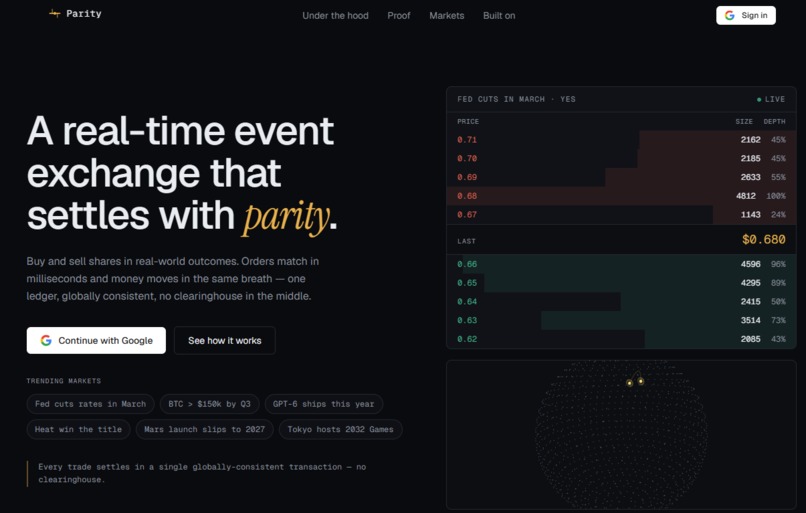
An event exchange powered by Aurora DSQL—matching orders, updating balances, and settling trades in one atomic transaction.
-
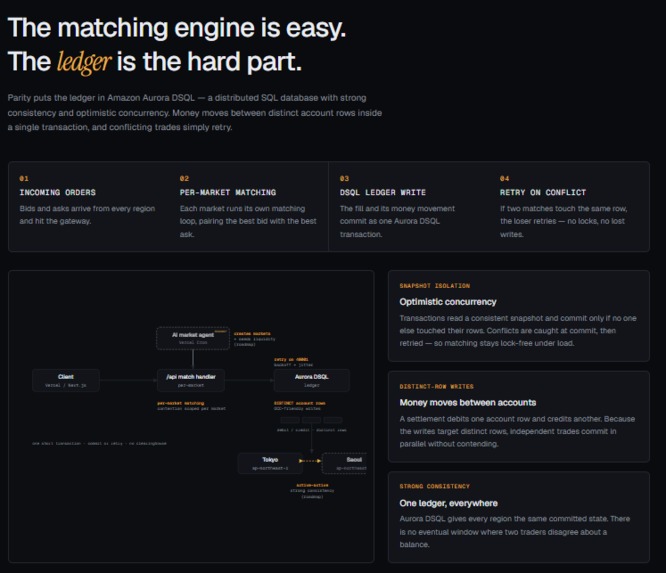
Every trade matches, moves money, and settles in a single Aurora DSQL transaction—strong consistency without a clearinghouse.
-
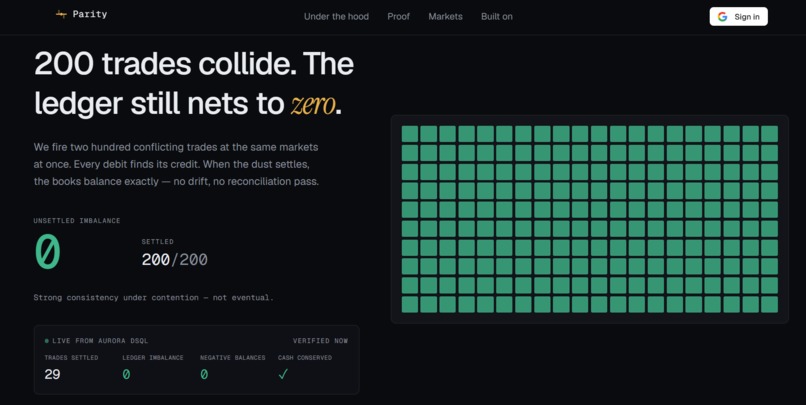
Even under 200 simultaneous trades, every transaction settles exactly once. No drift. No reconciliation. Just strong consistency.
-
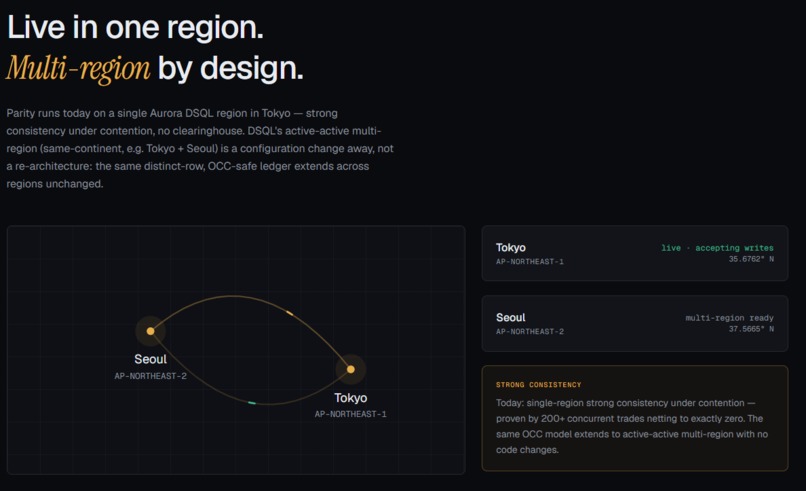
Single-region today. Active-active tomorrow. Aurora DSQL lets Parity scale globally without changing application logic.
-
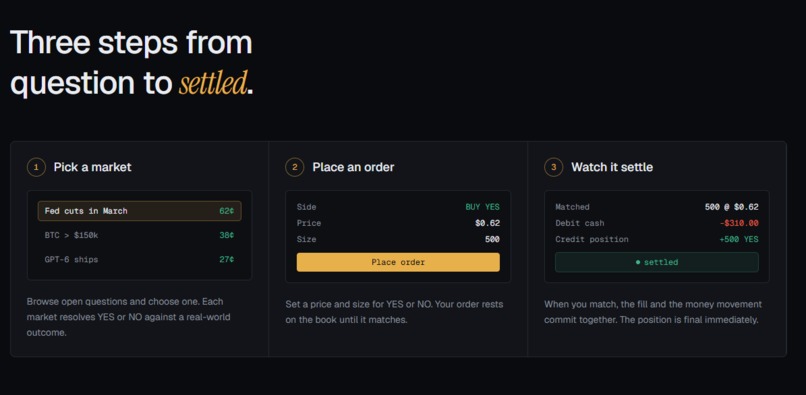
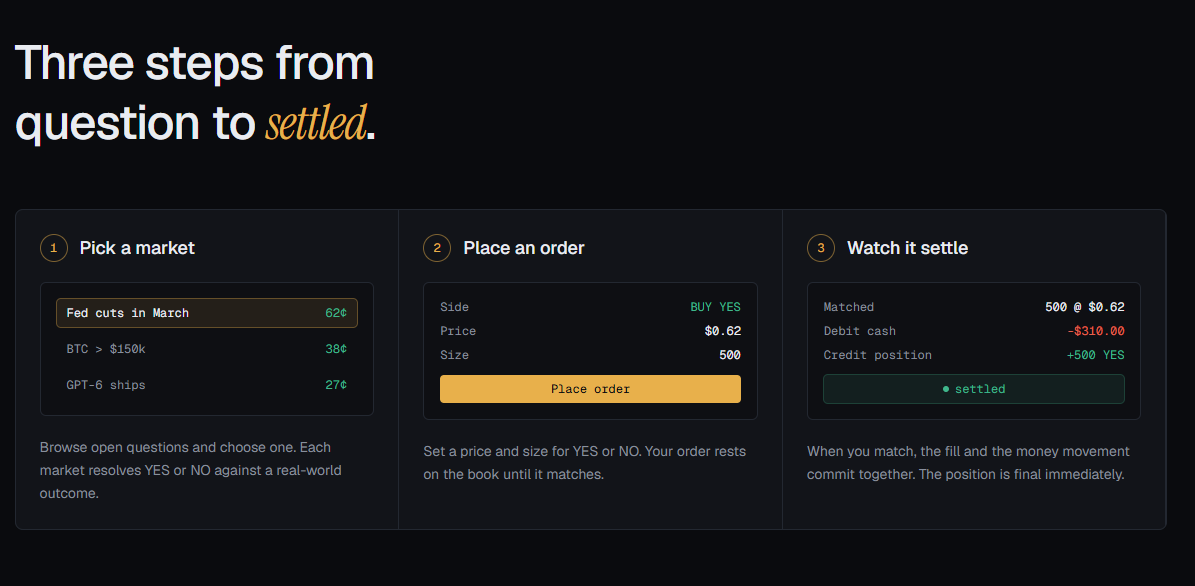
Pick a market. Place an order. Settle instantly. Every trade matches and moves funds in one atomic transaction.
-
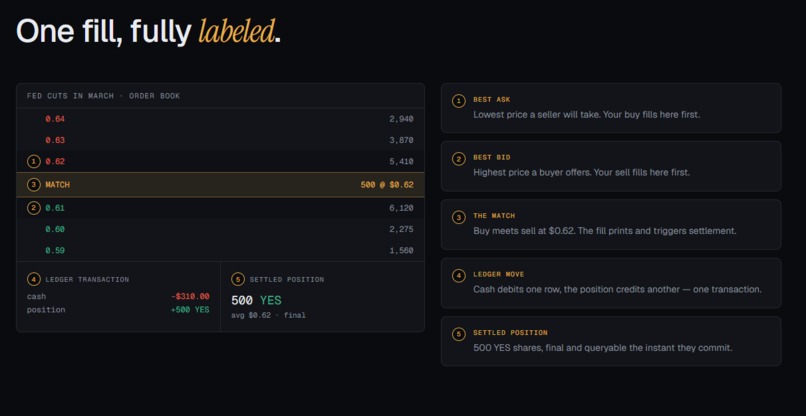
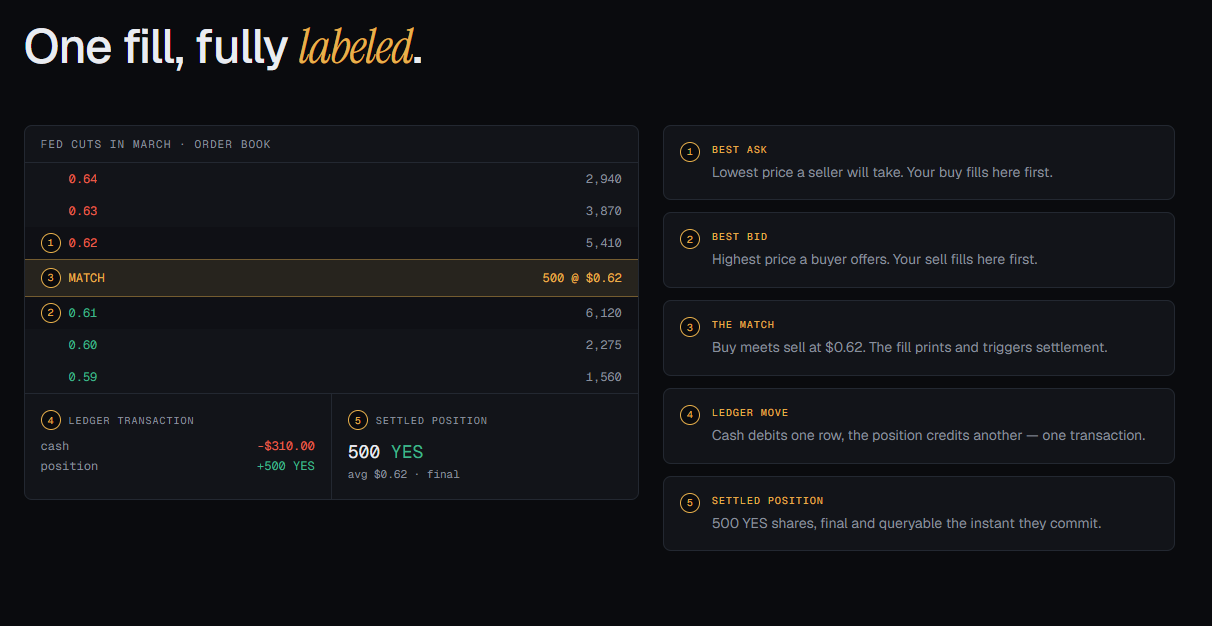
One trade. Five observable steps. Every match, ledger update, and settled position is transparent and instantly verifiable.
-
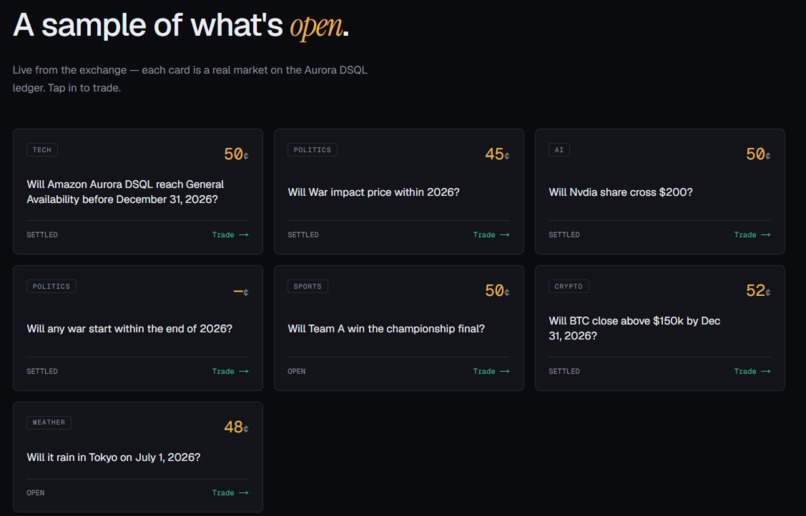
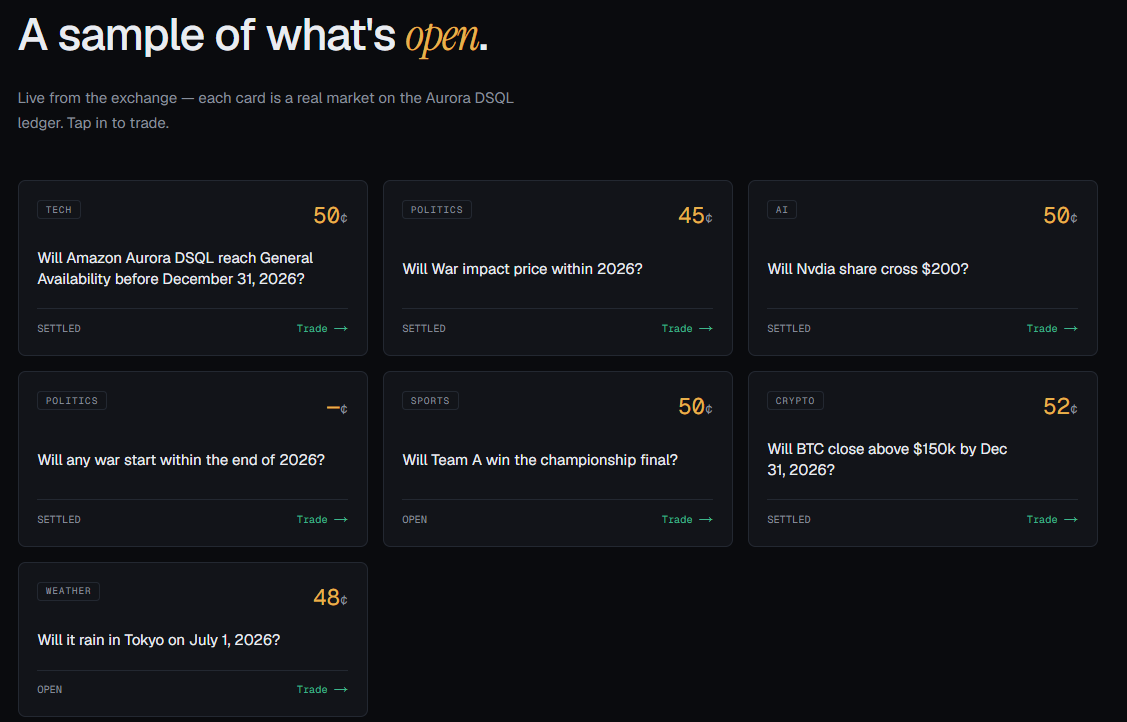
One exchange. Infinite possibilities. Every prediction market shares the same atomic, globally consistent settlement engine.
-
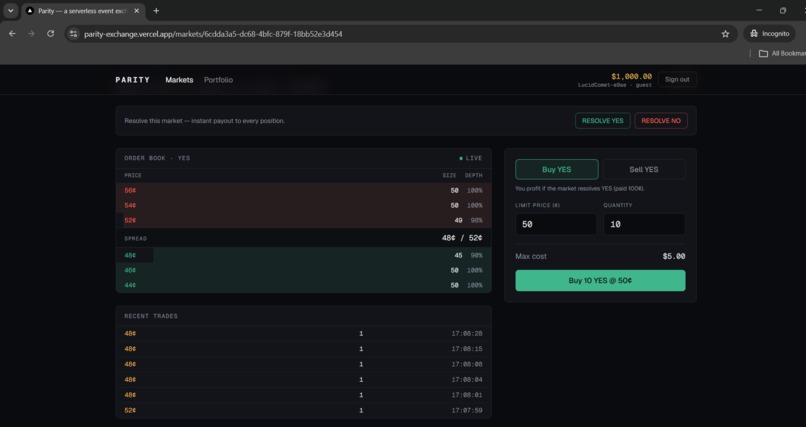
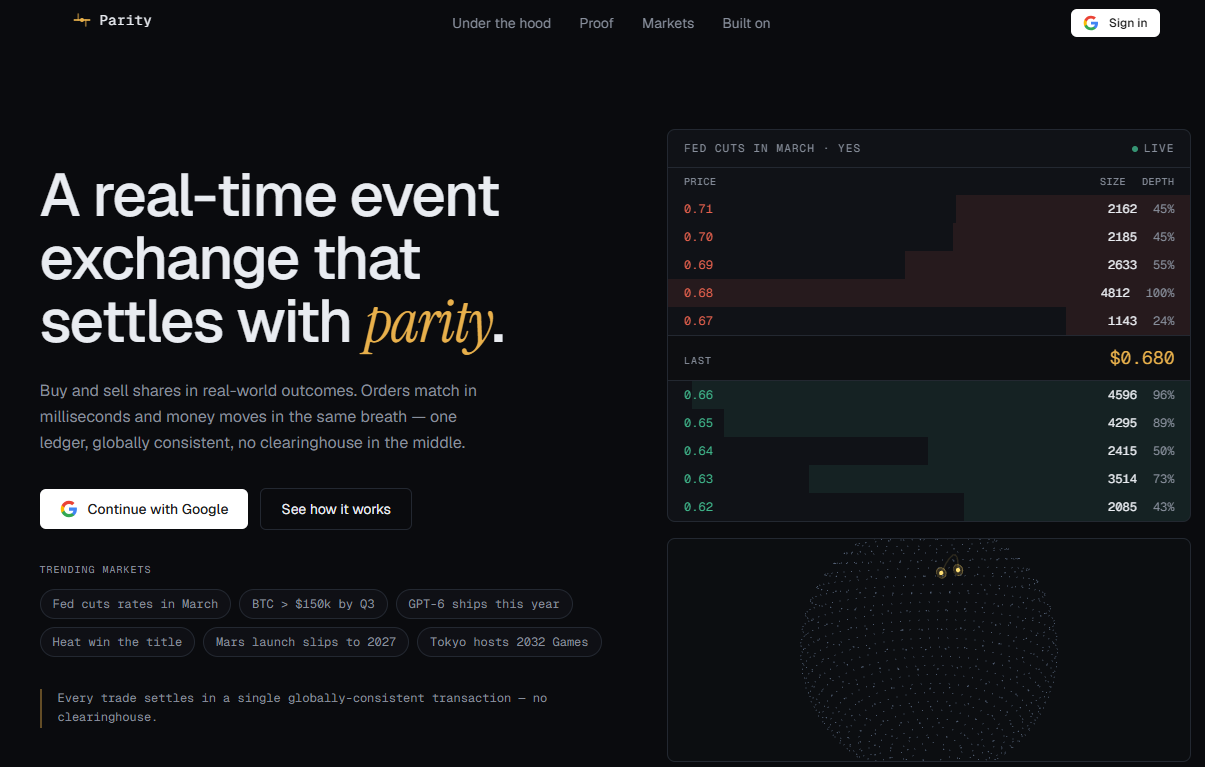
Real-time order matching meets globally consistent settlement. Every fill commits cash and positions in one transaction.
-
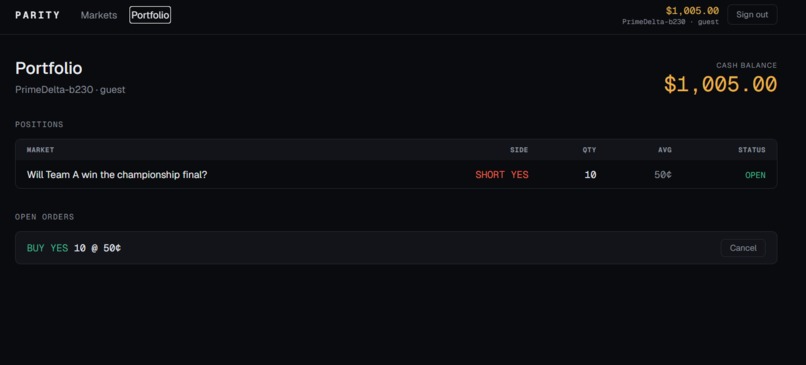
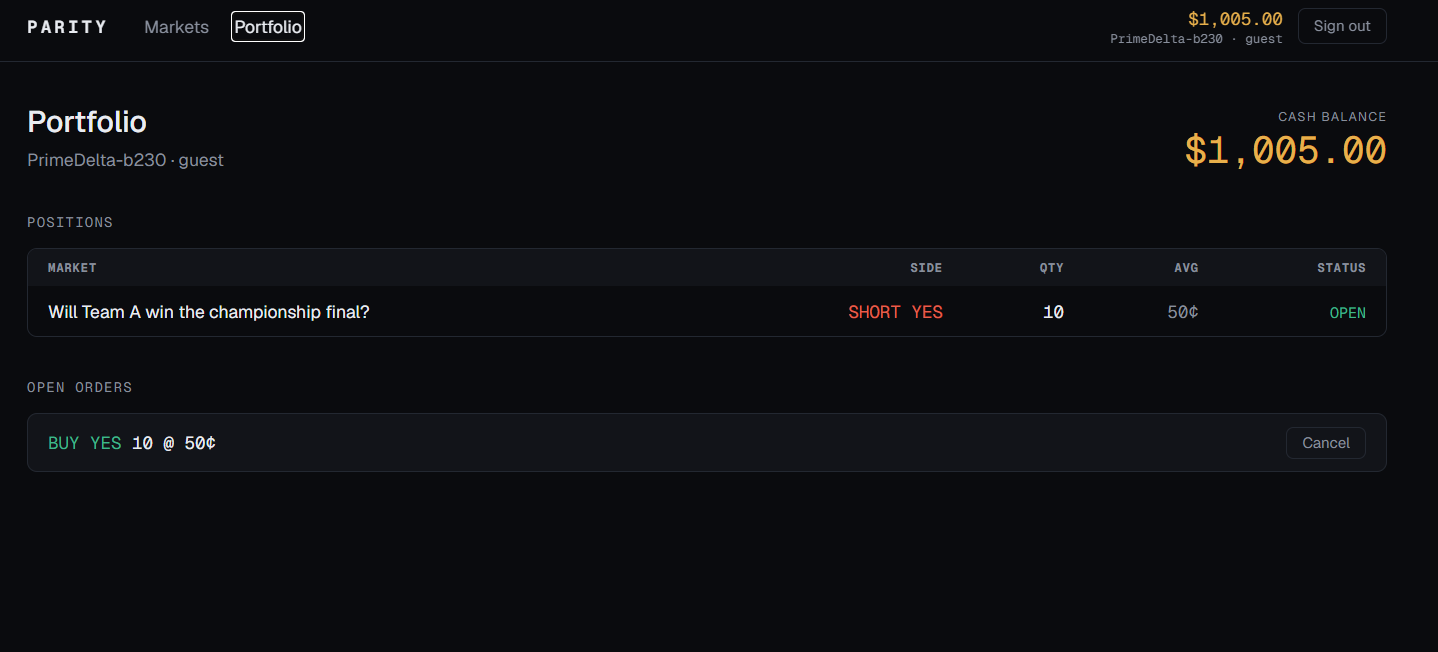
Your portfolio updates the moment trades commit. Every position and balance comes directly from one consistent ledger.
-
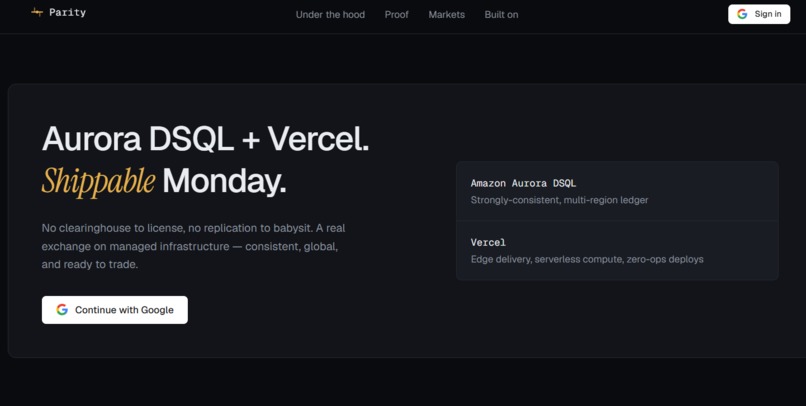
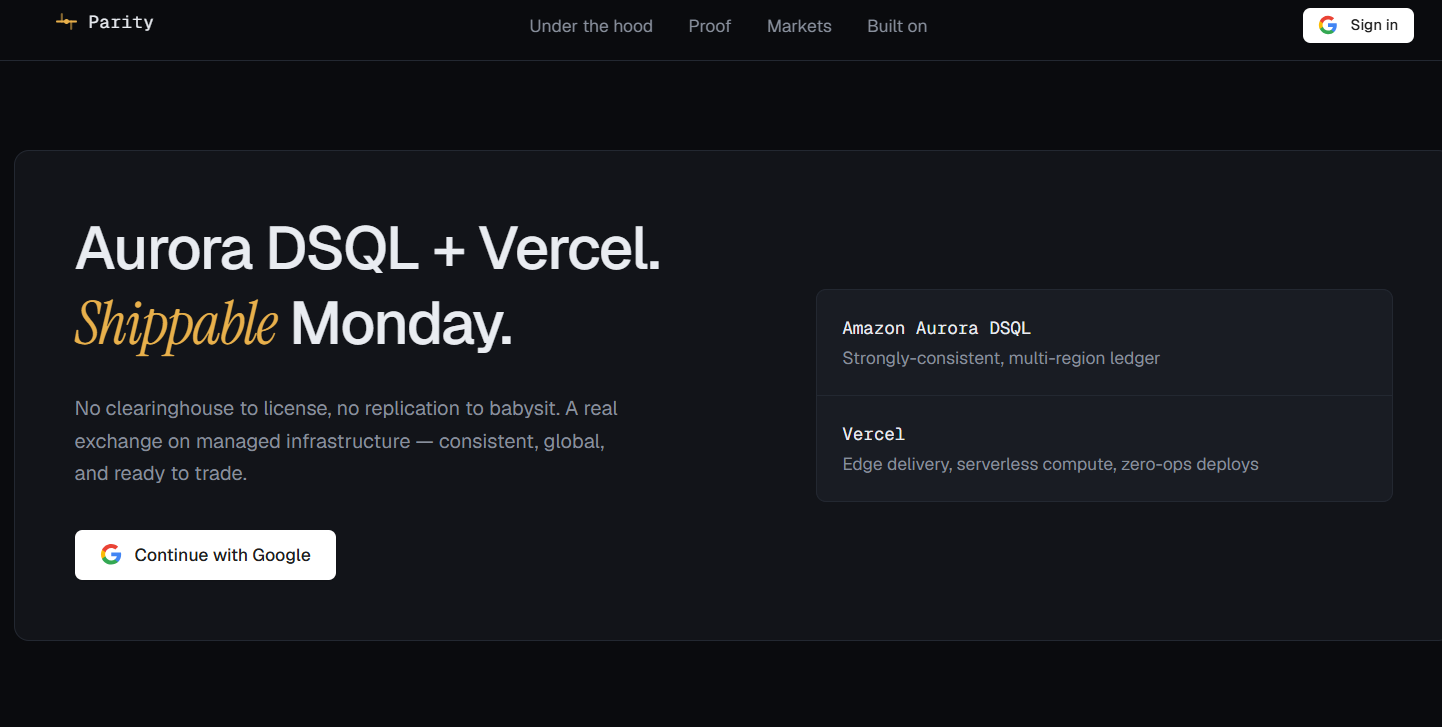
Aurora DSQL for transactional correctness. Vercel for global delivery. A production-ready exchange with minimal operations.
Inspiration
Every exchange — stocks, prediction markets, ticketing — is really one hard problem wearing a trench coat: a correct, always-on, globally consistent ledger. Traditionally that means a clearinghouse to guarantee trades, a distributed ledger to record them, and an infra team to keep balances consistent across regions through replication, failover, and overnight reconciliation. Three hard problems before you match a single order.
We kept staring at Amazon Aurora DSQL's pitch — strong consistency, optimistic concurrency, serverless, multi-region active-active — and realized it collapses all three into one primitive. So we asked: could one developer build a real, globally-fair exchange in a weekend, where orders match and money settles in the same transaction, with zero ops? Parity is the answer.
What it does
Parity is a real-time event exchange for binary YES/NO markets, with a central limit order book per market.
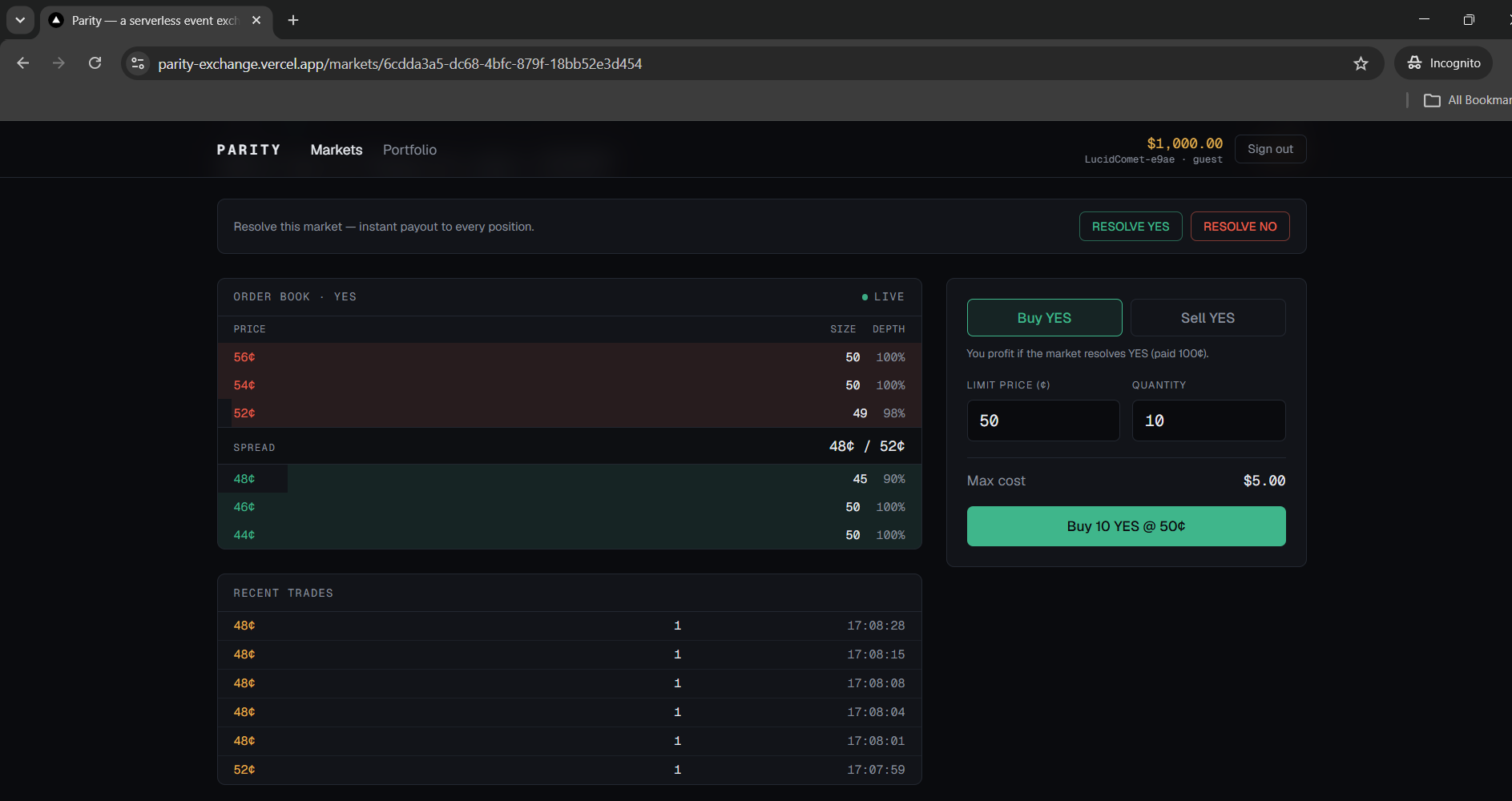
- Trade live — place limit orders; they match with price-time priority against a live order book and settle instantly.
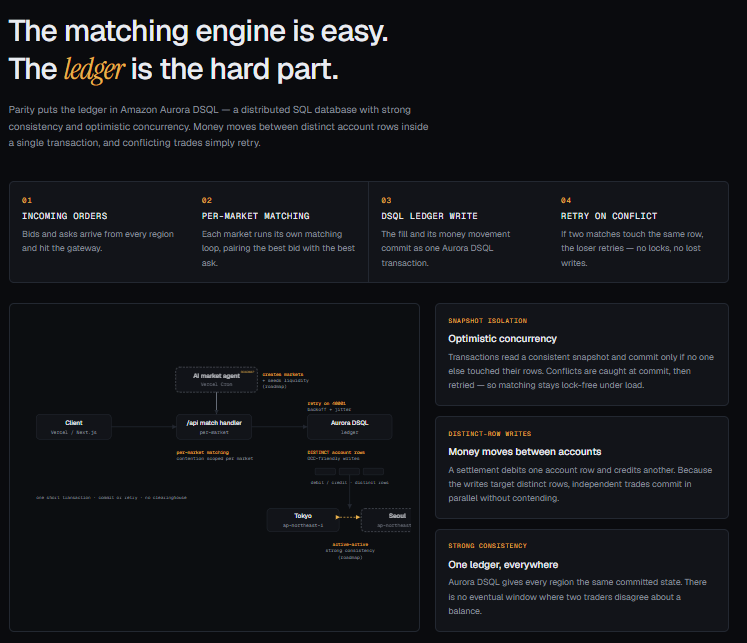
- One-transaction settlement — a fill debits the buyer, credits the seller, updates both positions, appends ledger entries, and prints the trade — atomically.
- Resolve a market — every winning contract pays 100¢, losers 0¢, in one consistent transaction set. No overnight reconciliation.
- Portfolio — balance, positions, open orders, cancels — all live.
- Prove it yourself — every fill is a balanced double-entry, so the ledger must net to zero. Hit
/api/proofand the invariants are computed straight from the cluster, live.
Try it free with one click ("Enter as guest" mints a funded account) — no signup required.
How we built it
Aurora DSQL is the primary backend and the settlement ledger. The whole architecture is designed with DSQL's grain, which is what turns it from a naïve port into a showcase:
- Matching is scoped per-market. Each market is its own contention domain — unrelated markets never conflict.
- Every fill is a double-entry across distinct rows — debit one account, credit another, update two positions. Distinct rows are DSQL's optimistic-concurrency sweet spot, so independent trades commit in parallel without contending.
- Conflicts retry, lock-free. On
SQLSTATE 40001(serialization failure) the whole short transaction retries with exponential backoff + jitter. - No negative balance, no double-spend — atomically. The debit is conditional:
UPDATE accounts SET balance = balance - cost WHERE balance >= cost. If it can't fund, the fill simply doesn't happen. The invariant is enforced by the database, not by hope. - DSQL-aware schema: UUID primary keys (no sequences), no foreign keys (relationships enforced in app logic), and
CREATE INDEX ASYNC— all applied and verified on the live cluster. - No hardcoded secrets. The Postgres password is a short-lived IAM auth token minted on demand by the AWS SDK signer.
The frontend is Next.js (App Router) on Vercel — a cinematic landing (React Three Fiber globe, scroll-driven architecture diagram, a live consistency readout), and the exchange itself: markets, a live trading page (order book, depth, ticket, trade tape), portfolio, and settlement. The realtime layer is deliberately boring and bulletproof: read-only polling of a conflict-free read path.
Proving it — strong consistency under contention, not eventual
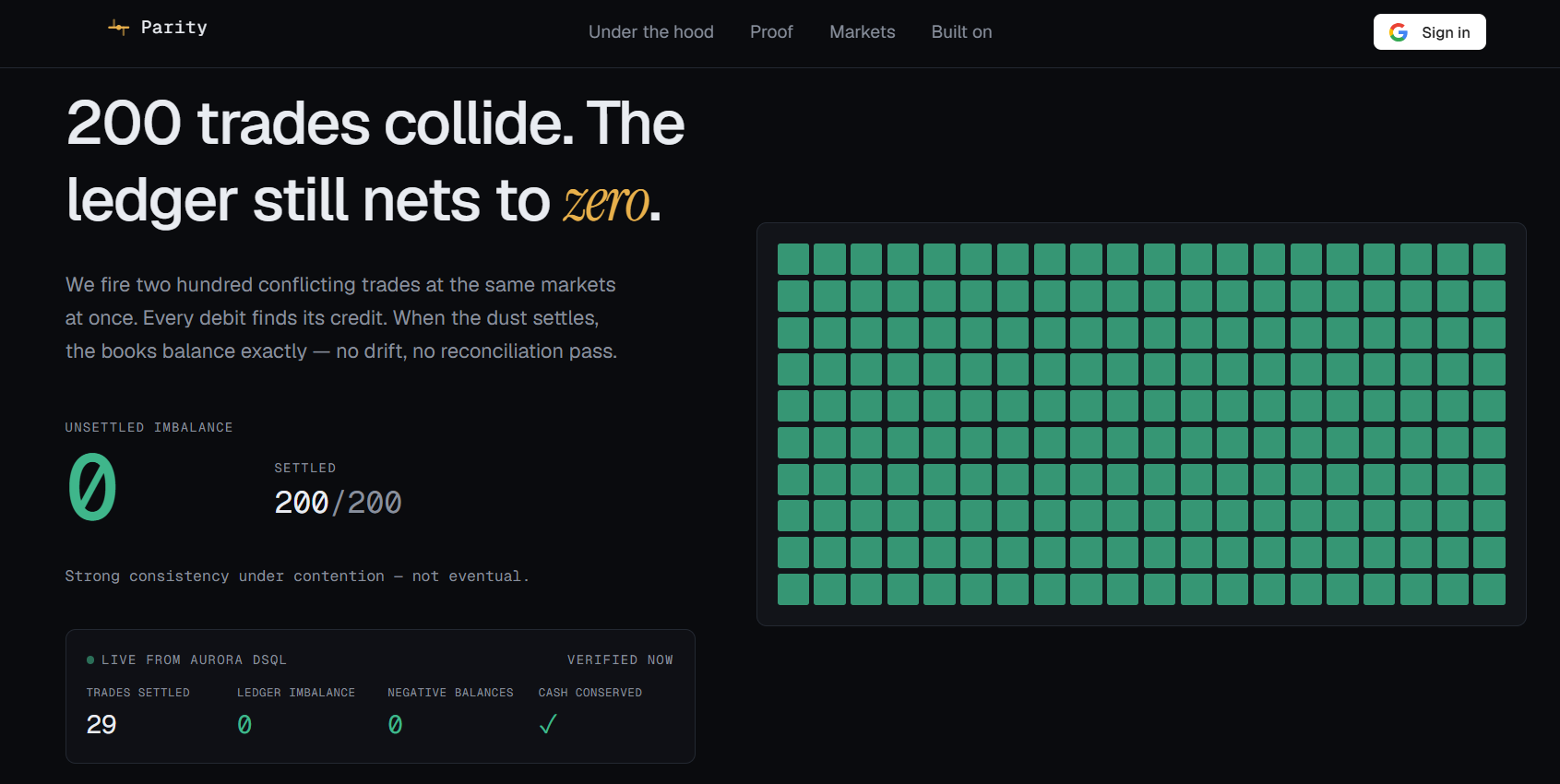
We wrote a stress test that fires 200+ concurrent, conflicting trades across markets at once, then checks the books. On the real Aurora DSQL cluster:
- Ledger imbalance: 0 — every debit found its credit
- Negative balances: 0 — the conditional debit held under race
- Cash conserved — total cash equals total deposits, exactly
/api/proof exposes those same invariants live, so a judge can verify them against the cluster in their own browser. This is DSQL strong consistency under contention — not eventual.
Testing note to add: "No signup needed — open the app, go to Markets, click Enter as guest for an instantly-funded account, then place a Buy YES order to see it match live."
What we learned
- Designing with OCC is the whole game. The same workload is DSQL's best case (distinct rows) or worst case (one hot counter) depending entirely on schema design. An exchange is a perfect stress test of that distinction.
- You can enforce financial invariants in the database itself — a conditional debit makes "no double-spend" a property of the system, not a code review.
- DSQL being Postgres-compatible is a superpower — we built a dual-mode data layer so the identical app runs on local Postgres and on Aurora DSQL with a one-line env change.
Challenges we ran into
- Modeling the match as one short transaction that stays in the OCC sweet spot while still doing buyer/seller/position/ledger writes correctly — and retrying the whole block on conflict.
- DSQL isn't full Postgres: no sequences, no foreign keys, async index creation. We embraced those constraints in the schema instead of fighting them.
- Keeping realtime trustworthy on camera — we chose polling over WebSockets so the demo never breaks.
What's next
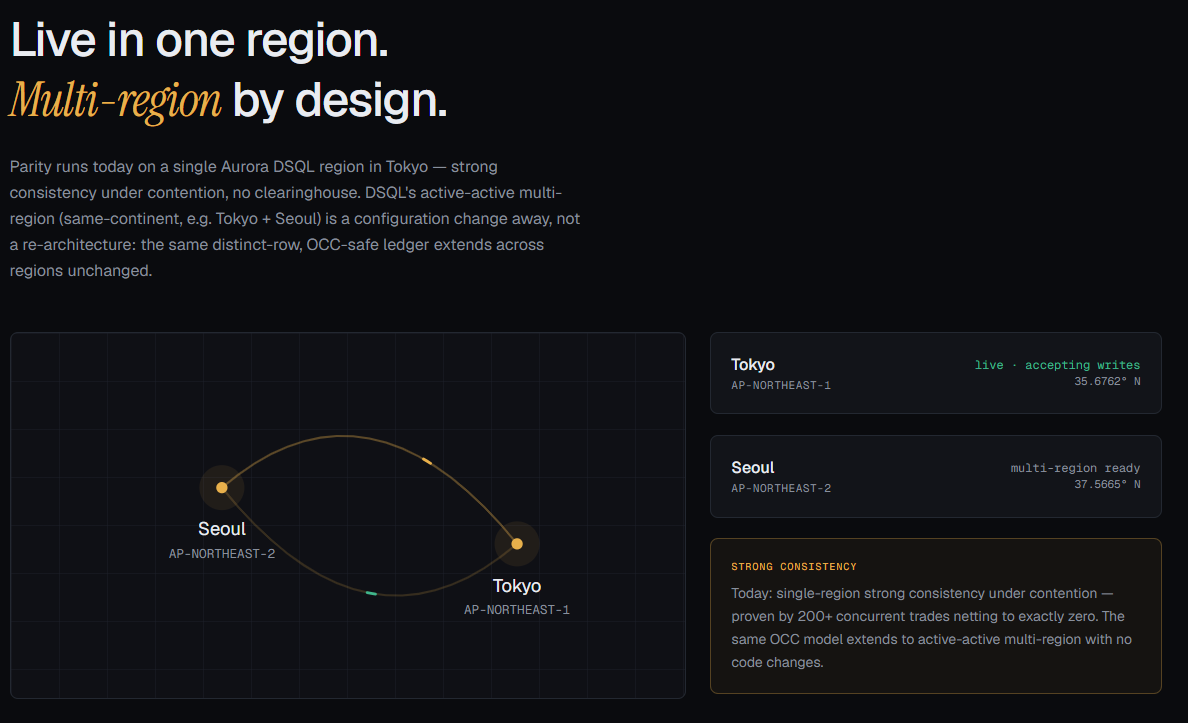
- Active-active multi-region. We run single-region today; because every write targets distinct rows under OCC, extending to DSQL's same-continent active-active (Tokyo + Seoul) is a configuration change, not a re-architecture.
- A single-writer matching sequencer per market (LMAX-style) persisting fills to DSQL, for higher throughput.
- An AI market-maker (Vercel Cron) to generate markets and seed liquidity.
Built With
- amazon-aurora-dsql
- aws-iam
- aws-sdk
- docker
- framer-motion
- geist
- google-oauth
- next.js
- node-postgres
- node.js
- react
- react-three-fiber
- tailwind-css
- three.js
- typescript
- vercel


Log in or sign up for Devpost to join the conversation.