-
-
hero
-
journey
-
architecture
Inspiration
Paraspara — Technology That Brings the Right Humans Together
Inspiration
Paraspara began with a simple but deeply human observation: help exists, but it is often difficult to reach at the moment it is needed most.
People are surrounded by communities—colleagues, friends, mentors, experts, volunteers, and peers—yet asking for help can still feel frustrating and lonely. A person may not know whom to approach, how to explain the situation, or whether the person they contact is available and willing to help. Meanwhile, valuable knowledge and experience remain scattered across individuals, conversations, and disconnected networks.
Most existing digital systems are good at distributing information. Far fewer are designed to coordinate meaningful human support. Search engines return links, communication platforms provide channels, and AI assistants generate responses—but many real-world situations require something more: context, empathy, judgment, accountability, and the reassurance of another person.
That gap inspired Paraspara.
The word Paraspara represents reciprocity and mutual support. It captures our central belief that technology should not isolate people or attempt to replace every human interaction. It should help people discover, understand, and support one another more effectively.
Our guiding question became:
What if asking for help did not feel like searching through a directory, posting into the void, or repeatedly explaining the same problem—but instead led to the right human connection at the right time?
Paraspara is our answer: a people-first platform designed to make support more accessible, contextual, and trustworthy through intelligent coordination.
What Paraspara Does
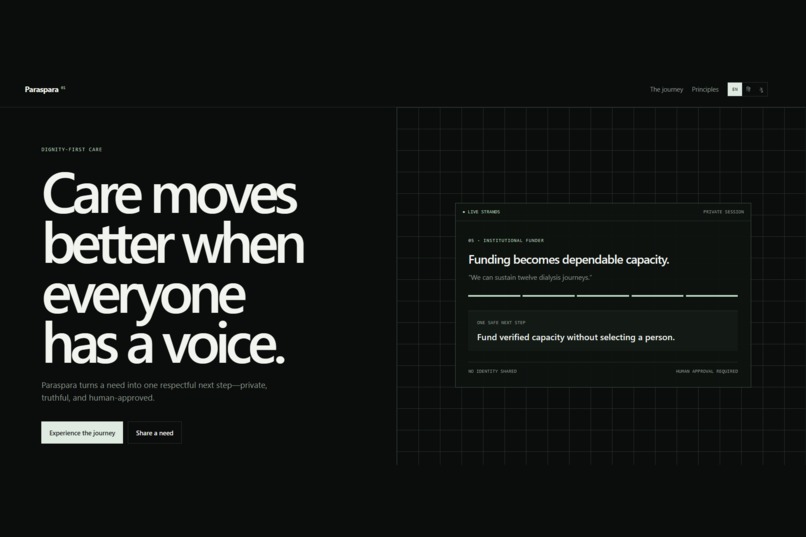
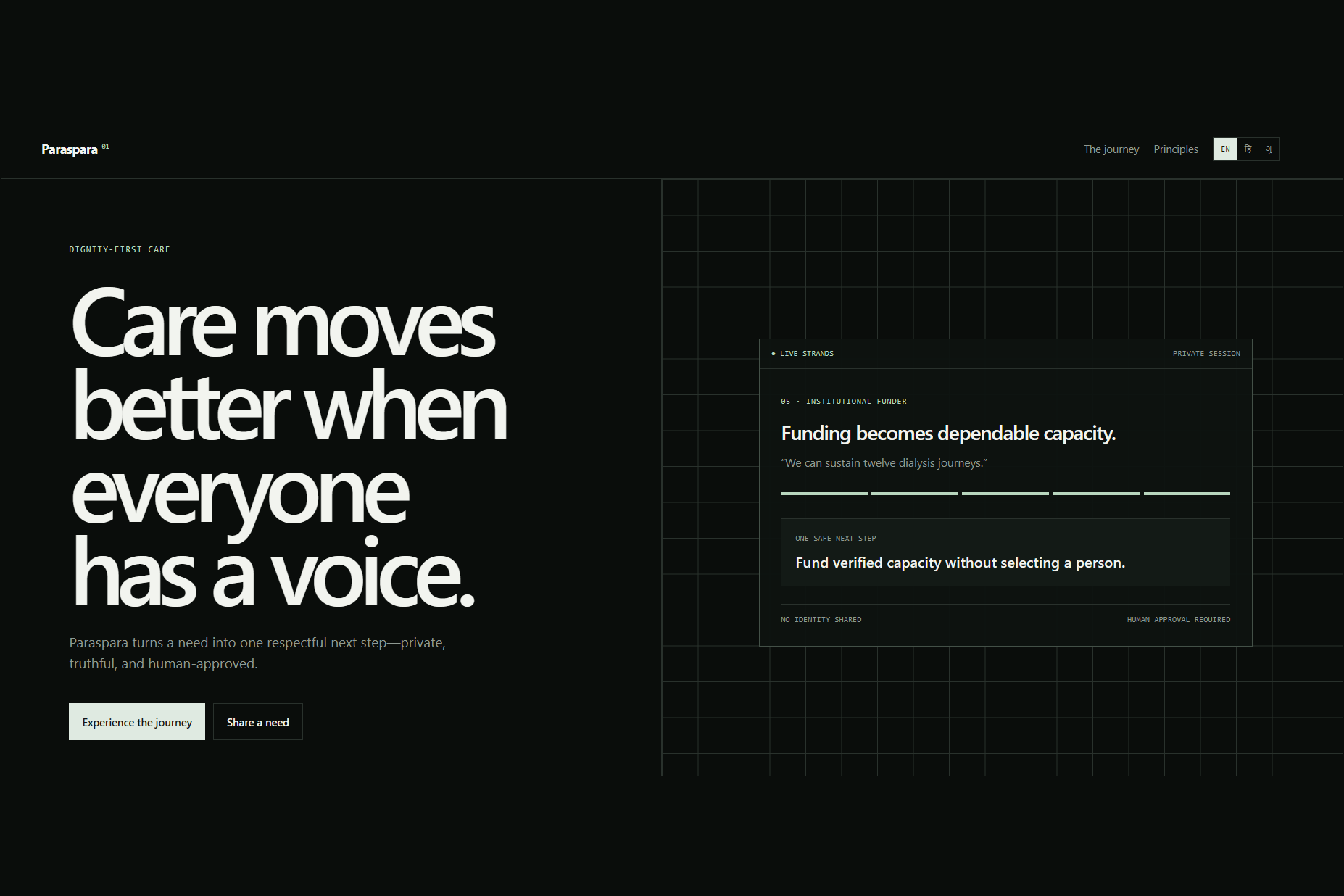
Paraspara helps transform an unstructured request for help into a meaningful human connection.
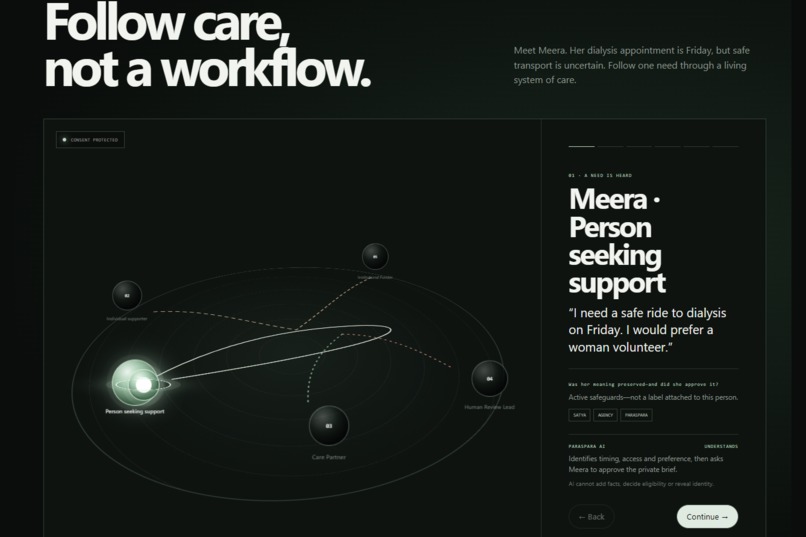
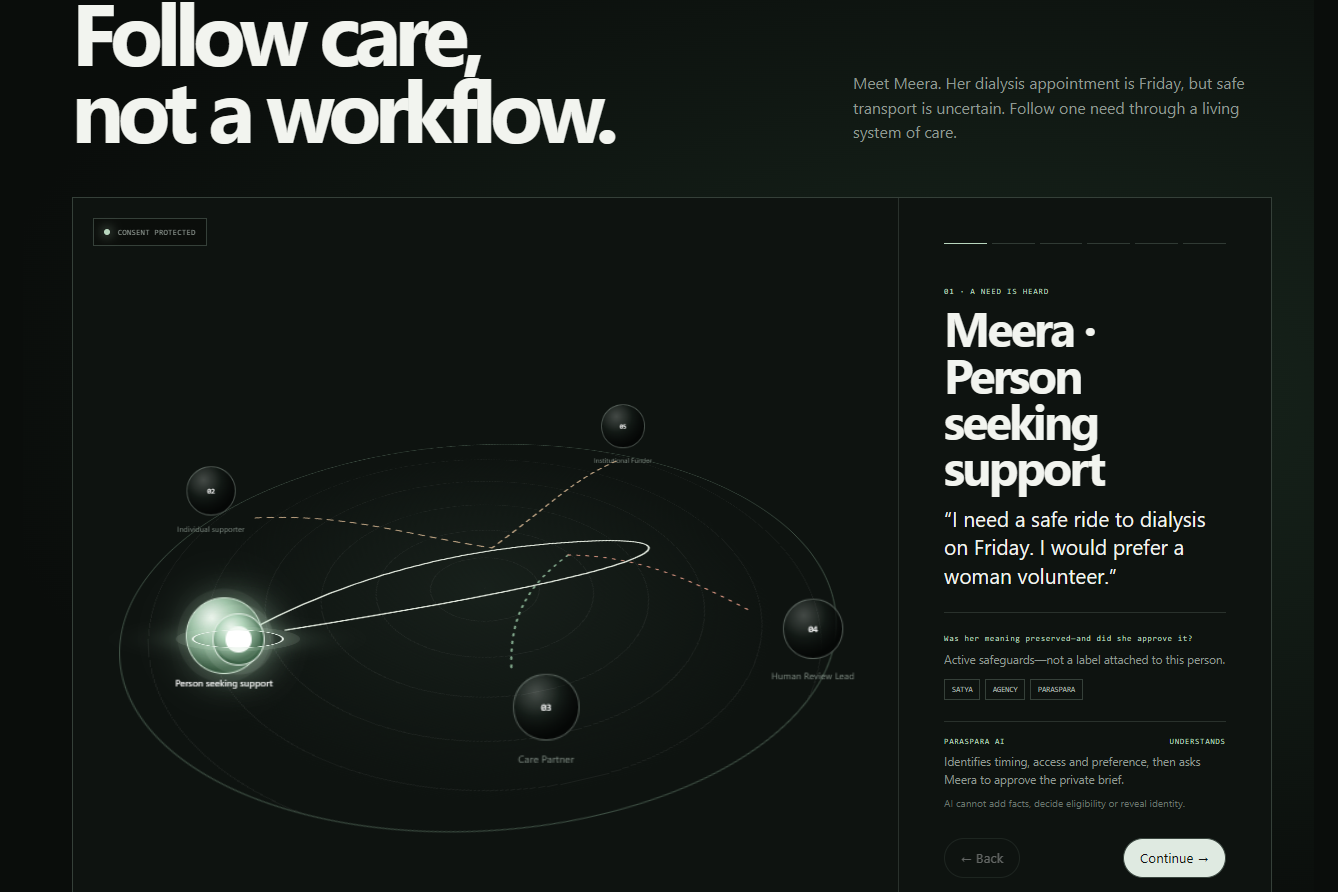
Instead of expecting users to already know the correct person, role, category, or communication channel, Paraspara begins with the need itself. The project is designed around a simple journey:
- A person explains what they need in natural language.
- The request is structured into useful context without losing the person’s original intent.
- Relevant human support is identified based on factors such as knowledge, suitability, and context.
- The requester receives a clearer path toward assistance.
- The outcome can contribute to improving future connections.
The goal is not merely to “match users.” It is to reduce the emotional and practical friction involved in asking for help.
This distinction matters. A technically correct match may still be a poor human match if the person is unavailable, the context is incomplete, or the interaction does not feel safe. Paraspara therefore treats matching as a human-centered coordination problem rather than a simple search problem.
Our vision is for Paraspara to become a trusted bridge between:
- someone who needs guidance and someone who has relevant experience;
- a community member facing a problem and another member willing to help;
- knowledge that exists within a network and the person who needs it now;
- the speed of intelligent technology and the empathy of human judgment.
How We Built It
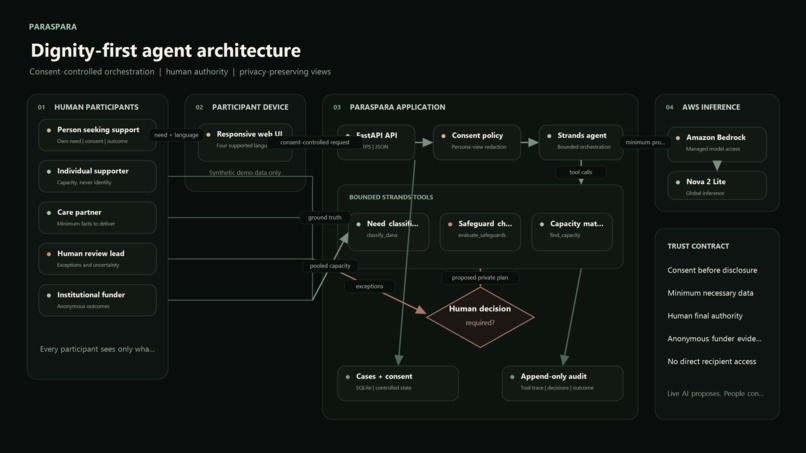
We approached Paraspara as an end-to-end support experience rather than as a single chatbot or recommendation screen.
We first mapped the complete journey of a help request: how a person expresses a need, how that need can be understood, how suitable support can be identified, how the connection should be presented, and how the experience can improve over time.
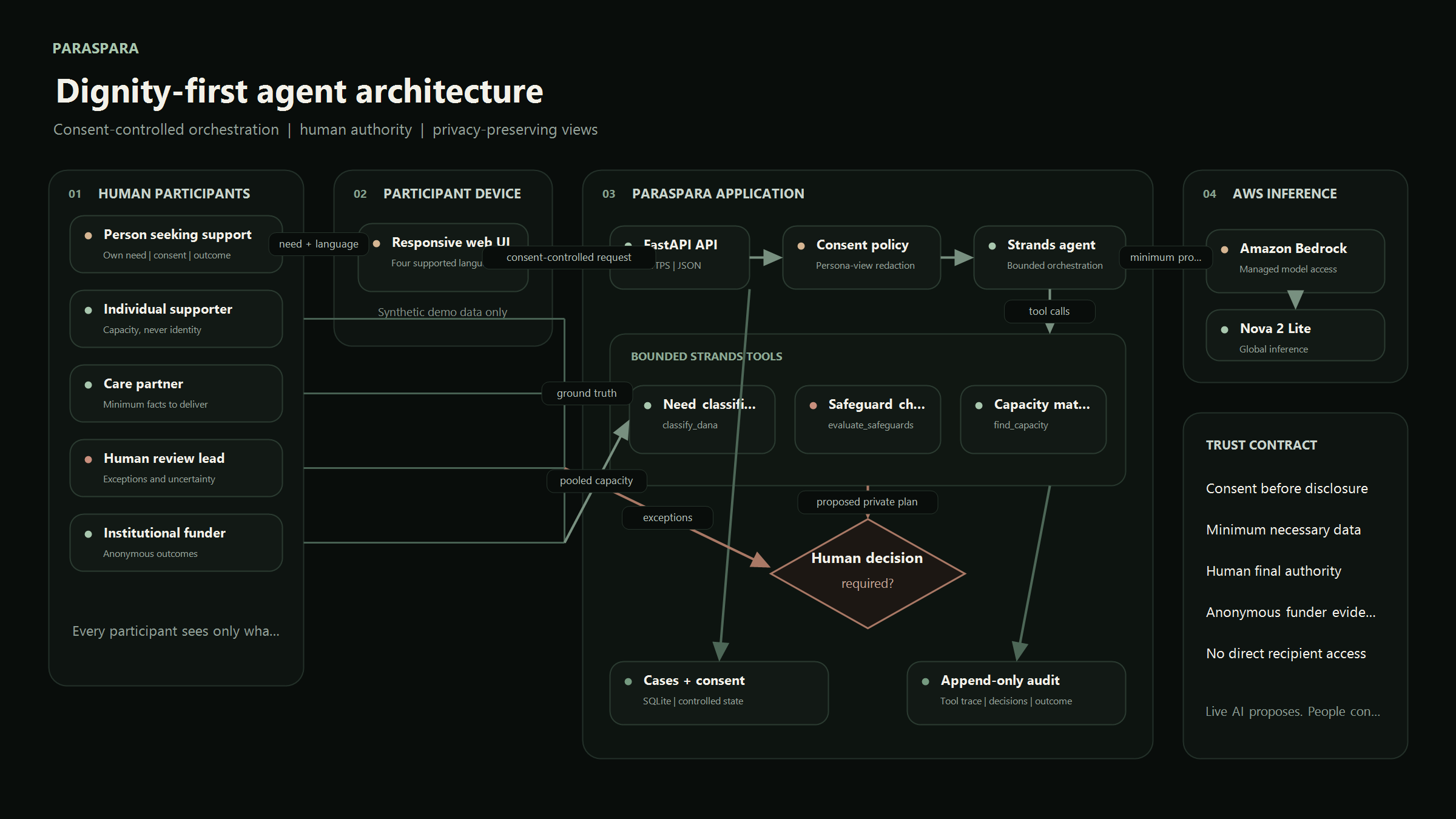
From that journey, we organized the project into several core layers.
1. Human-Friendly Request Capture
Real problems rarely arrive as clean labels. People do not naturally describe their situations using database categories or carefully selected keywords. They explain them through incomplete thoughts, personal context, urgency, and emotion.
We therefore designed the request experience to begin with natural expression. The system’s role is to reduce complexity for the user—not transfer the system’s complexity onto them.
2. Context Understanding
A request is more than a sentence. Paraspara considers the underlying intent: what kind of help is required, what context matters, and what information would make the request understandable to another person.
This layer is essential because similar words can represent very different needs. Someone looking for information may need a resource, while someone facing uncertainty may need guidance from a person with lived or professional experience.
3. Responsible Matching and Routing
The next challenge is determining who may be relevant to the request.
Rather than treating relevance as a single keyword match, we designed the matching idea around multiple human factors: suitability, context, willingness, and the nature of the requested support. This creates a foundation for more thoughtful routing while keeping human agency central.
Paraspara supports the decision; it does not pretend that a machine can perfectly evaluate every human situation.
4. Meaningful Human Handoff
A successful system should do more than identify a person. It should help both sides understand why the connection may be useful and provide enough context for the conversation to begin constructively.
We therefore focused on making the handoff understandable and respectful. The requester should retain control over what is shared, while the potential helper should understand the request before choosing to engage.
5. Feedback and Continuous Improvement
Human needs and communities evolve. A static matching system will eventually become less useful.
Paraspara therefore includes the idea of a feedback loop: learning whether a connection was relevant, whether support was received, and where the experience created friction. This feedback can improve future routing without reducing people to a simplistic score.
Throughout the build, we prioritized modularity so that the project could evolve beyond its initial use case. The same underlying approach could eventually support mentoring, education, workplace knowledge exchange, community assistance, volunteering, peer support, or access to specialized guidance.
Challenges We Faced
Understanding Ambiguous Human Needs
The first challenge was ambiguity. Requests for help are often short, incomplete, or emotionally influenced. Asking users to complete long forms would make the system easier to build but harder to use.
We had to think carefully about how to gather enough context while keeping the experience approachable. This taught us that good design is not about collecting the maximum amount of information. It is about identifying the minimum information necessary to make the next step useful.
Balancing Automation With Human Agency
It is tempting to automate every part of a technology product. Paraspara challenged that instinct.
Some tasks—organizing context, identifying possible relevance, and reducing repetitive effort—benefit from intelligent automation. Other decisions require consent, judgment, empathy, and accountability.
We learned to treat automation as an enabler of human connection, not as its replacement. The system can suggest and coordinate, but people must remain in control of whether and how an interaction takes place.
Designing for Trust and Safety
A platform involving human requests must take privacy, consent, misuse, and emotional safety seriously. A useful match is not automatically a safe match.
This raised important design questions:
- What information should be shared, and at what stage?
- How can a person ask for help without unnecessary exposure?
- How should helpers control their availability and boundaries?
- How can the system remain useful without making unjustified assumptions?
- How should unsuccessful or inappropriate connections be handled?
We learned that trust cannot be added as a final feature. It must influence the entire experience—from request capture to matching, disclosure, and feedback.
Addressing the Community Cold Start
A human-support network becomes more valuable as participation grows, but every community begins with limited coverage. Not every request will immediately have an ideal match.
Instead of hiding this limitation, we treated graceful failure as part of the design. A responsible platform should communicate uncertainty, offer the best available next step, and avoid creating false expectations.
This challenge helped us recognize that the quality of a community platform is determined not only by what happens when it succeeds, but also by how honestly and helpfully it responds when the perfect connection is unavailable.
Keeping the Project Focused
Paraspara has applications across many domains, which created another challenge: scope. It was easy to imagine dozens of features, user groups, and future integrations.
We had to repeatedly return to the project’s essential promise:
Understand the need, reduce the friction, and enable the right human connection.
That focus allowed us to build around the core experience while preserving a modular foundation for future growth.
What We Learned
The most important lesson was that human connection is not a feature that can be optimized through technical relevance alone.
A meaningful connection depends on several dimensions:
[ \text{Useful Support} = \text{Relevance} \times \text{Trust} \times \text{Availability} \times \text{Willingness} ]
If any one of these factors approaches zero, the overall value of the connection falls dramatically. This insight changed how we thought about the product. The objective is not to generate the largest number of matches; it is to enable fewer, better, and more respectful connections.
We also learned that AI is most valuable when it removes friction around human capability. It can help interpret requests, organize context, and surface possibilities. However, empathy, responsibility, and lived experience still belong to people.
Finally, we learned that simplicity requires significant thought. The easier Paraspara feels to a user, the more carefully the underlying flow must manage ambiguity, consent, relevance, and expectations.
Why Paraspara Matters
Paraspara addresses a problem that appears in many different forms:
- A learner needs guidance but does not know which mentor to approach.
- A new employee needs organizational knowledge that is not documented.
- A community member needs support but is unsure where to begin.
- A volunteer wants to contribute but cannot easily discover where their experience is useful.
- A person faces a situation that requires understanding, not merely an automated answer.
In each case, the network may already contain someone who can help. The missing piece is intelligent, trustworthy coordination.
Paraspara turns that missing connection into a product opportunity—and, more importantly, a social opportunity. It proposes a future in which technology helps communities activate the knowledge, empathy, and willingness already present within them.
What Comes Next
Our next step is to validate Paraspara within focused communities where trust and shared purpose already exist. This would allow us to measure outcomes that genuinely matter: whether people find relevant support, how quickly they receive it, whether both participants feel comfortable, and whether the connection produces a useful result.
Future development can strengthen:
- consent-based profiles and availability;
- explainable recommendations;
- community-specific matching criteria;
- multilingual and accessibility support;
- privacy-preserving request handling;
- safety, moderation, and escalation mechanisms;
- structured feedback and impact measurement.
The long-term vision is not to build another social network measured by attention, followers, or engagement time. It is to build a support network measured by meaningful outcomes.
Closing
Paraspara is built on a straightforward conviction: the most powerful resource in many communities is the willingness of people to help one another.
Technology should make that willingness easier to discover and act upon. By combining intelligent coordination with human empathy and agency, Paraspara aims to make asking for help simpler, offering help more meaningful, and communities more capable of supporting their members.
Paraspara does not try to replace the human in the loop. It helps people find the human they need.
What it does
How we built it
Challenges we ran into
Accomplishments that we're proud of
What we learned
What's next for Paraspara
Built With
- artificial-intelligence
- consent-based-data-sharing
- context-aware-routing
- conversational-interfaces
- explainable-ai
- feedback-systems
- git
- human-in-the-loop-ai
- natural-language-processing
- privacy-by-design
- recommendation-systems
- responsive-web-design
- rest-apis
- semantic-matching


Log in or sign up for Devpost to join the conversation.