-
-
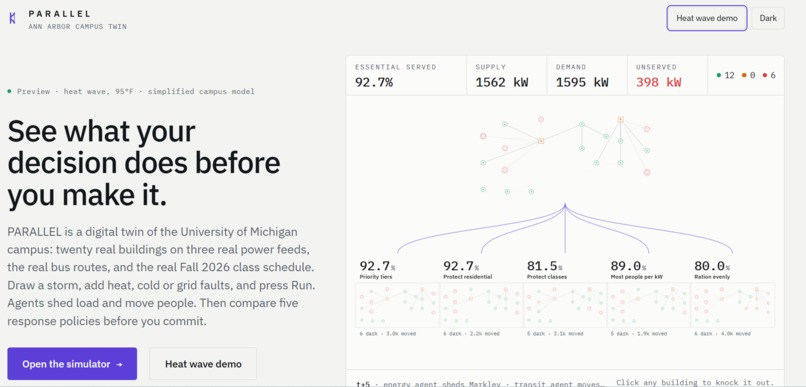
Landing Page
-
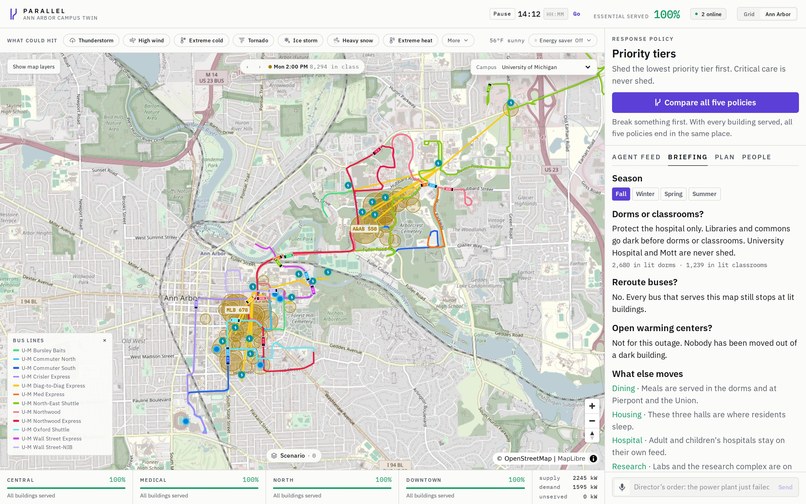
Campus "Digital Twin"
-
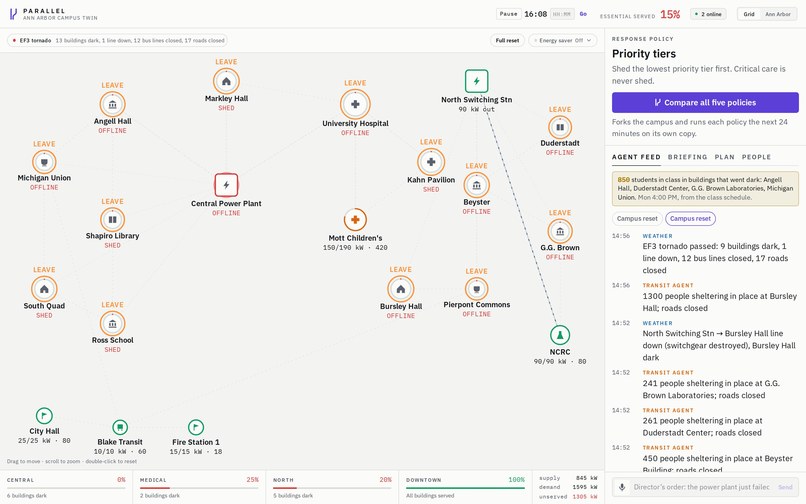
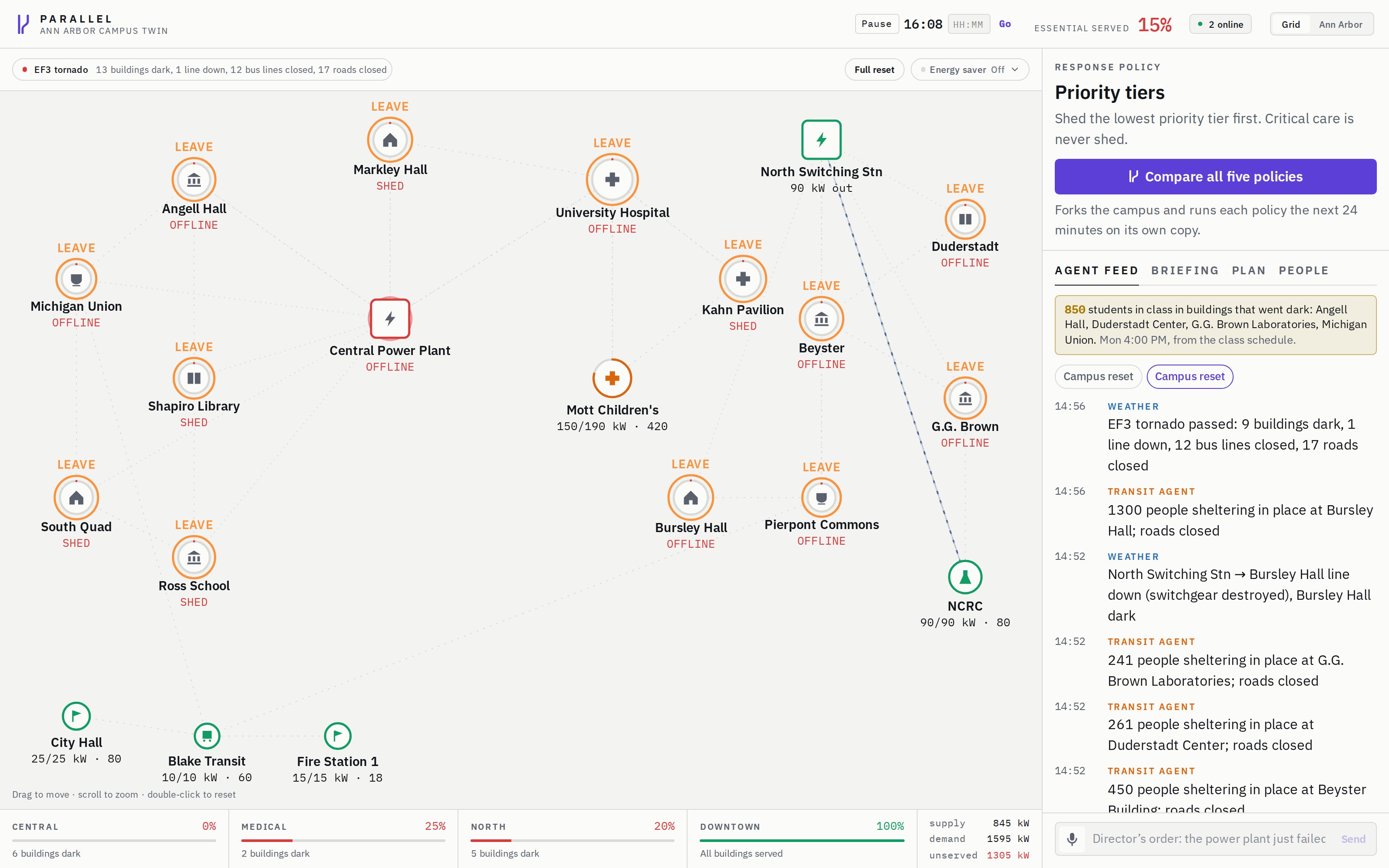
Scenario: Tornado
-
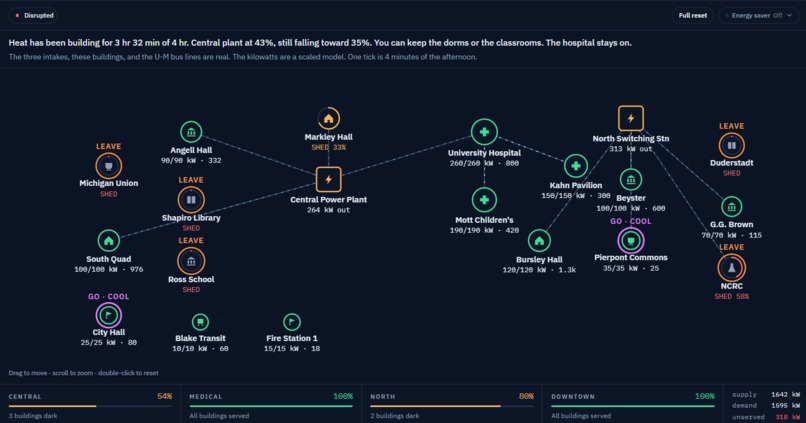
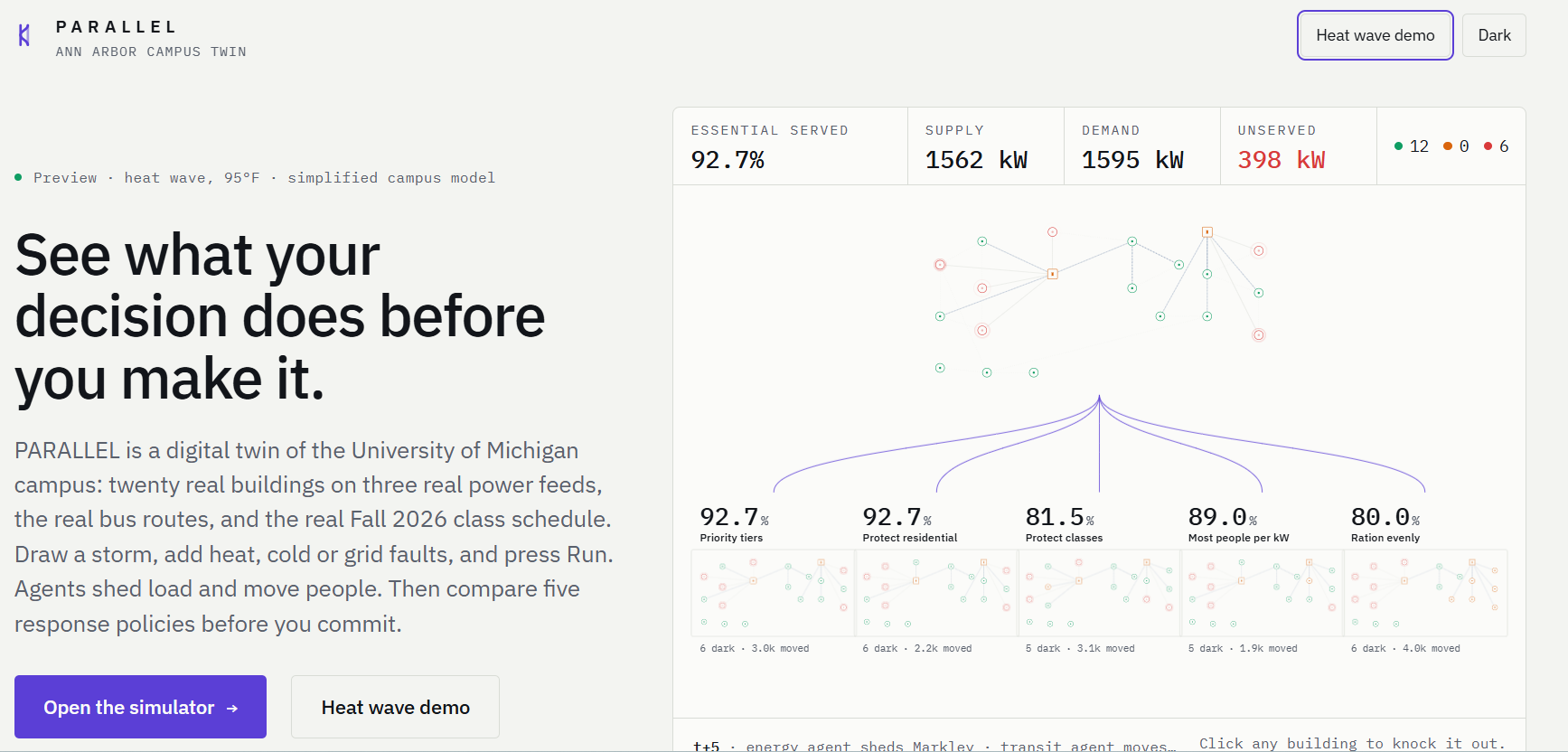
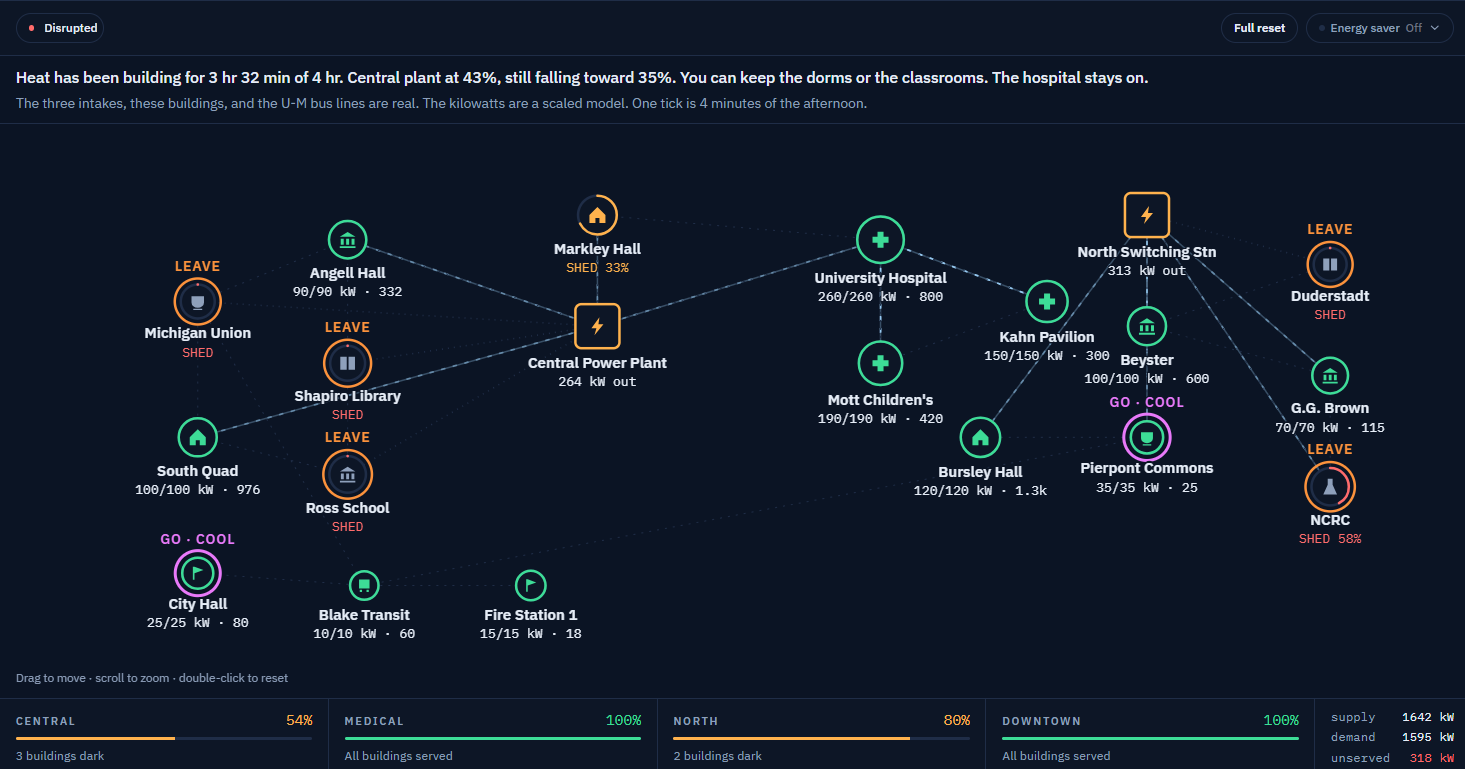
Heat Wave Scenario
-
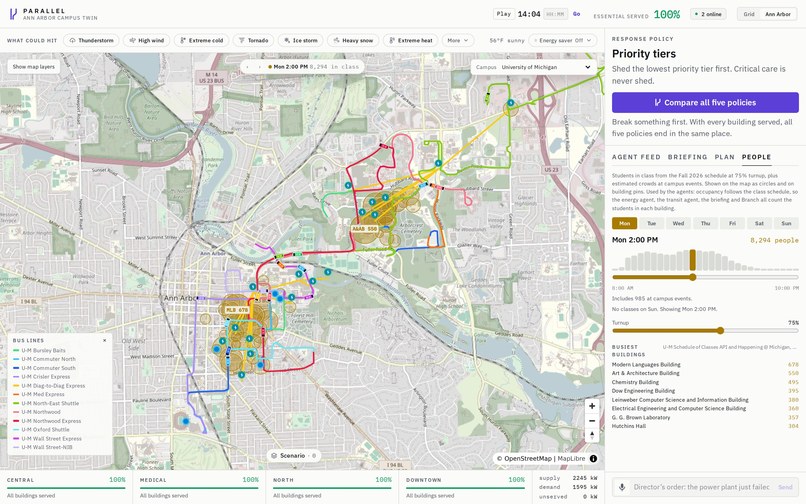
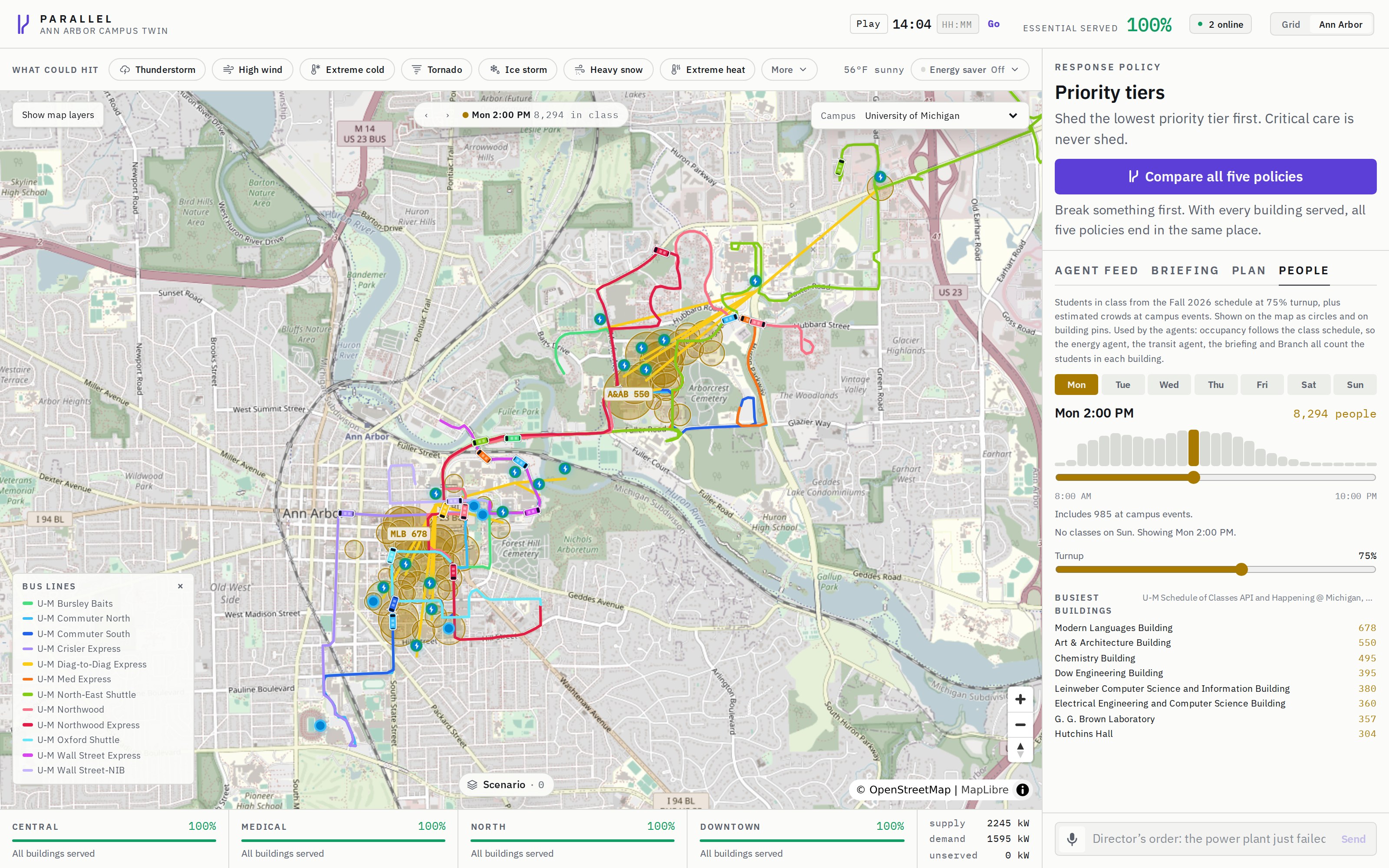
Live, accurate distribution of people based on real class data
-
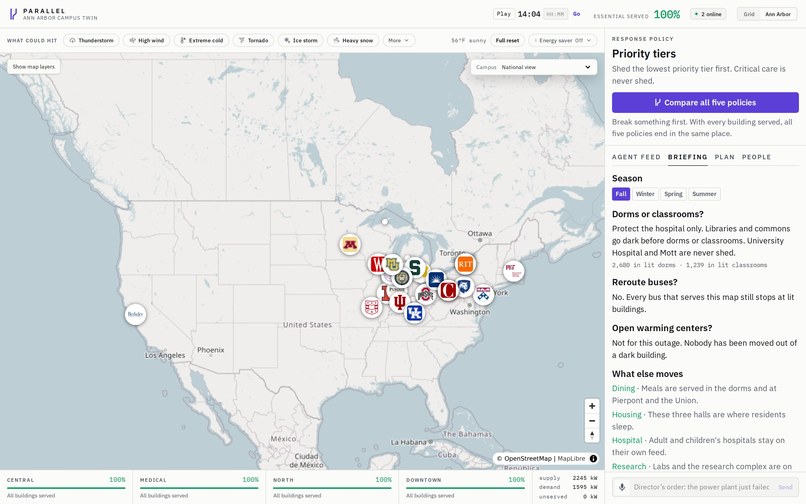
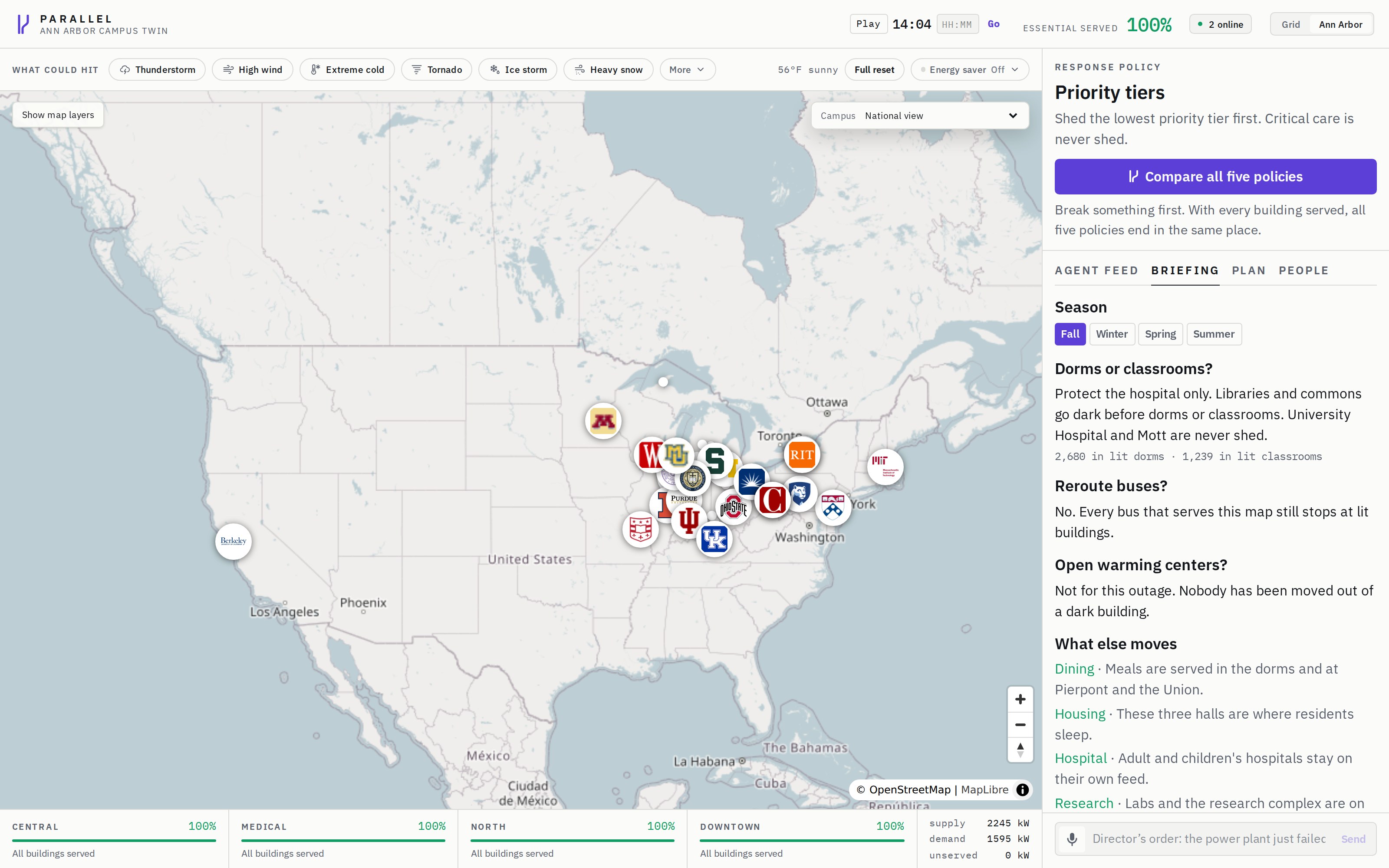
If expanded across the nation this will save tons of lives!
Inspiration
Campus natural emergencies, such as extreme heat waves, severe storms, and power outages, force decision-makers to allocate limited resources under extreme time pressure. Parallel was created to give campus teams a risk-free environment to simulate disruptions, test response strategies, and evaluate trade-offs before a real crisis occurs. And potentially providing plans and precautions to students and faculties in different schools in the US and potentially for all other schools around the world
What it does
Parallel is an interactive campus resilience simulator that models the dynamic relationships between power grids, building occupancy, transit networks, and physical campus layouts. together with simulations of different catastrophic scenarios.
Key features include:
Disruption Simulation: Introduce severe environmental or operational shocks to the campus ecosystem. Helping to visualize the scenario damages toward the schools accurately
Parallel Policy Testing: Compare 5 distinct response policies across isolated simulation branches simultaneously without altering the live scenario.
Live Deployment: Apply a selected policy directly to the live environment to observe immediate and projected outcomes.
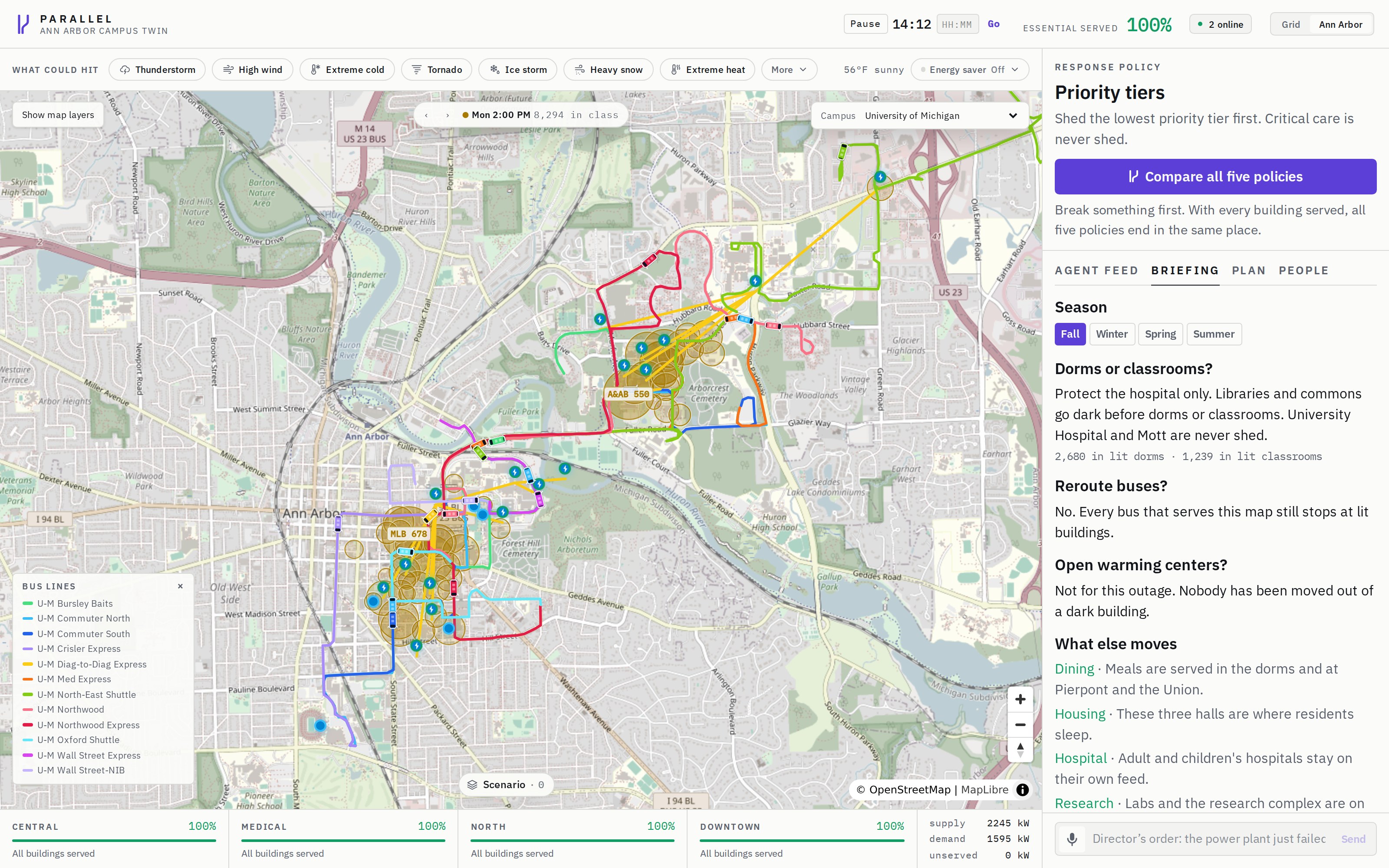
Integrated Visualization: View real-time layers for power distribution, building occupancy estimates, transit lines, and campus maps.
AI Decision Support: Use an integrated AI assistant to interpret complex query parameters and explain strategic trade-offs (with complete fallback functionality when AI credentials are not present).
How we built it
Multi-Campus Architecture: Designed a generalized spatial and operational schema capable of ingesting arbitrary university datasets, including GIS layouts, schedule-derived occupancy, transit routes, and power infrastructure, allowing the simulator to scale across different school campuses.
Frontend: Built with React, TypeScript, and Vite to render high-performance geospatial visualizations and handle complex interactive state.
Backend & Simulation Engine: Developed in Python with FastAPI to run real-time crisis modeling, execute policy evaluations, and manage isolated scenario branches.
Real-time Engine & Synchronization: Integrated SpacetimeDB to handle real-time state persistence, reactive database subscriptions, and low-latency multiplayer collaboration.
Challenges we ran into
Non-Destructive Scenario Branching: Designing an engine capable of running 5 distinct response policies in parallel without mutating or corrupting the live campus baseline state. We had to implement a snapshot-and-fork mechanism to compute isolated policy paths concurrently before streaming comparative trade-offs back to the user.
Multi-Campus Data Harmonization: Normalizing heterogeneous university data sources, spanning varying building metadata standards, transit schedule formats, and power distribution, into a unified scheme that the backend could reliably ingest.
Real-Time State Synchronization: Coordinating high-frequency backend state updates from SpacetimeDB with frontend rendering pipelines without causing UI stuttering or race conditions during multi-user collaboration.
Accomplishments that we're proud of
Engineered a fully functional, multi-scenario simulation engine featuring live branching and comparison tools.
Designed a decoupled architecture where core simulation features operate reliably without any external AI API dependency.
Unified complex spatial data layers into an intuitive, actionable dashboard built for crisis exploration.
What we learned
AI is significantly more impactful when paired with a deterministic simulation engine to explain concrete trade-offs rather than acting as a standalone generator.
Synchronizing real-world geospatial data, stateful simulation logic, and reactive frontends requires rigorous state management and clean interface contracts.
What's next for Parallel
Data Granularity: Incorporate real-time operational feeds, live weather telemetry, precise shelter capacities, and routing travel times.
Multi-Campus Scaling: Generalize the underlying schema to enable rapid onboarding for other universities and municipal environments.
Advanced Policy Analytics: Expand comparative reporting tools to support long-term urban resilience planning and automated stress testing.
Fetch.ai agent: PARALLEL Coordinator
Live on Agentverse and reachable from ASI:One.
- Agent profile: https://agentverse.ai/agents/details/agent1qgx5x29ews09d95fph5uz32vw7wjj9zh8gkf79smvcpkw3e5waexz7vjss2/profile
- Address:
agent1qgx5x29ews09d95fph5uz32vw7wjj9zh8gkf79smvcpkw3e5waexz7vjss2 - Try it in ASI:One: "An ice storm hit North Campus, what should we do?" then "adopt 1"
The coordinator applies your scenario to the digital twin, gets options from Energy, Transit and Repair-crew planners, tests each one in the simulator, and replies with ranked, simulator-tested options. Inside the digital twin, three Fetch.ai uAgents (Energy, Transit, Coordinator) run the campus every tick.
If expanded, this project can save billions of dollars, tons of students and people around the world, and overall be a net good!
Built With
- css
- cursor
- grok
- html
- javascript
- python
- typescript


Log in or sign up for Devpost to join the conversation.