Inspiration
Parallel AI
💡 Inspiration
Every day, people make decisions that can significantly affect their future, but most decision-making tools only show a simple list of pros and cons.
AI assistants often go one step further, but usually give users a single recommendation.
We wondered:
"What if AI didn't just tell you what to do, but let you explore what could happen if you chose differently?"
That question inspired Parallel AI.
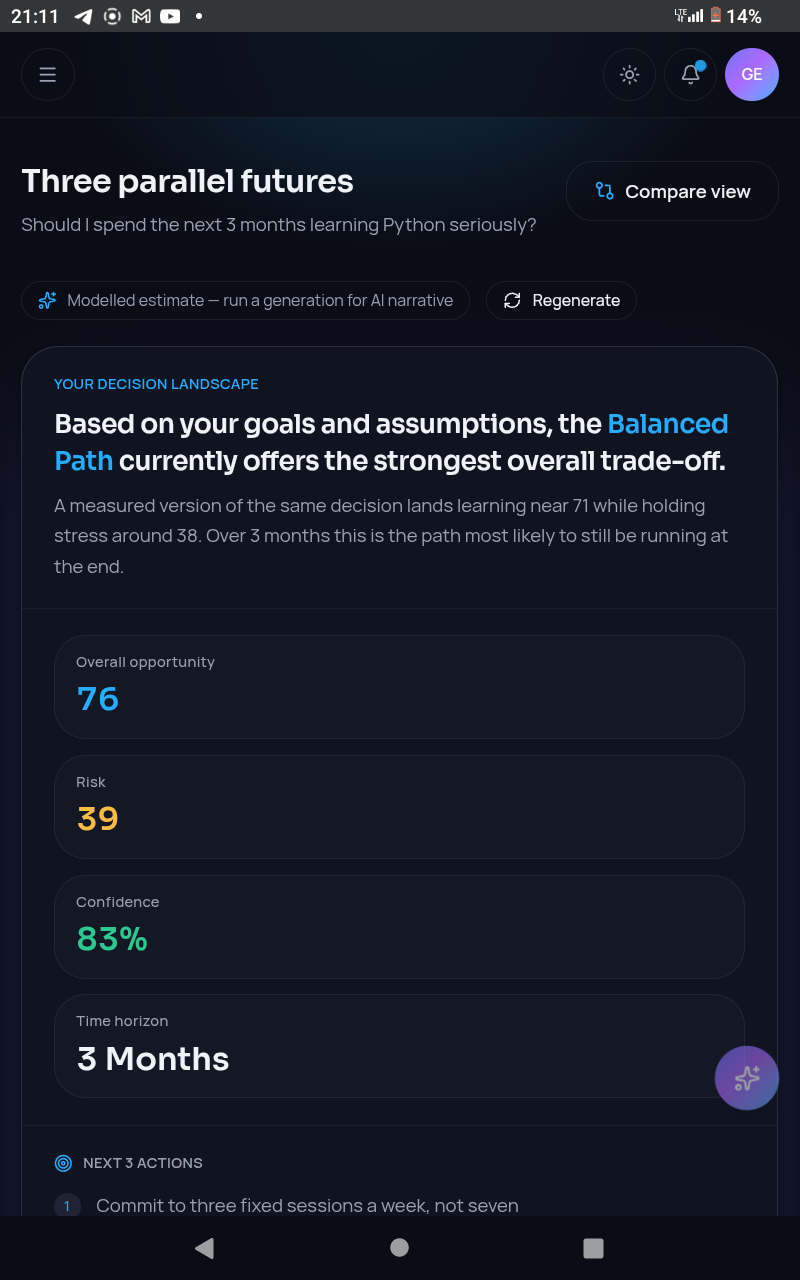
We wanted to create an experience where a user could take one decision and turn it into multiple possible futures, then explore the trade-offs between those paths.
Instead of pretending that AI can predict the future, Parallel focuses on something more useful: structured exploration of possibilities.
🚀 What We Built
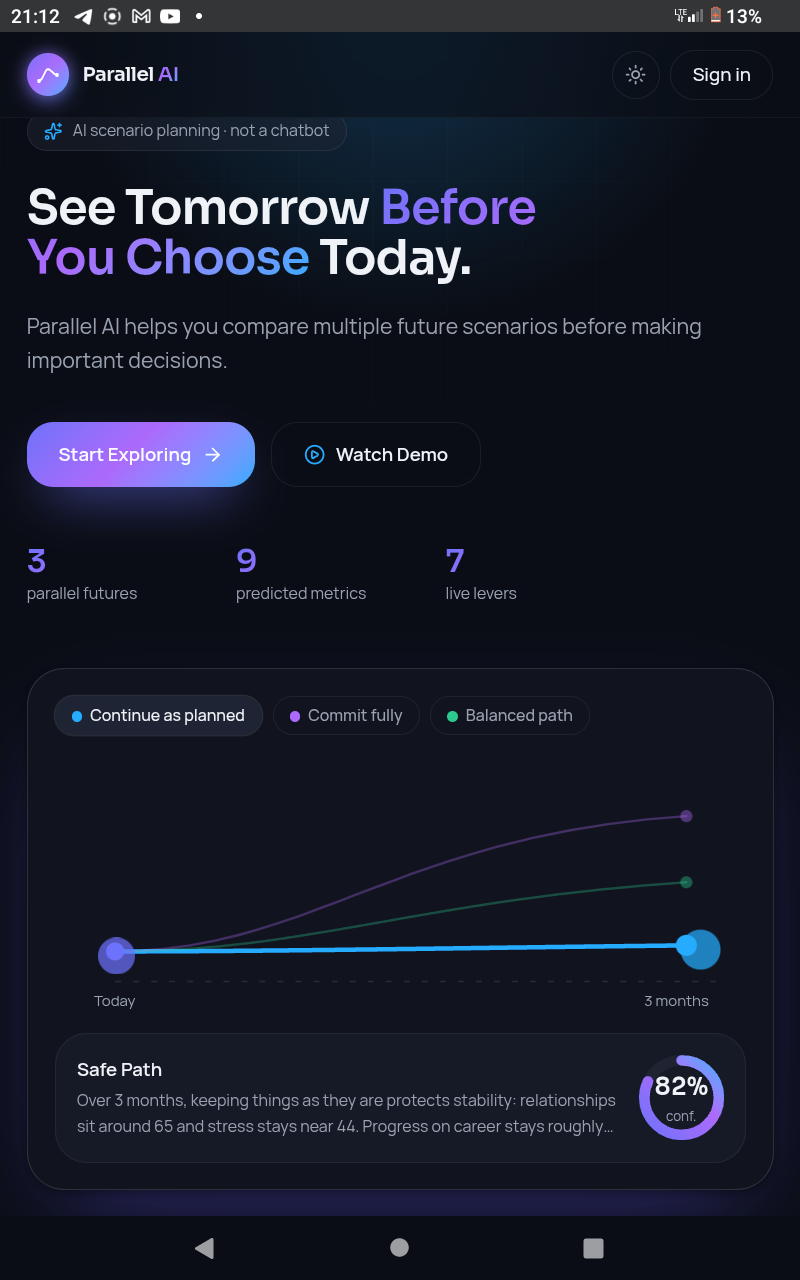
Parallel AI is an AI-powered scenario planning platform.
A user provides a decision, their goals, relevant context, and a time horizon.
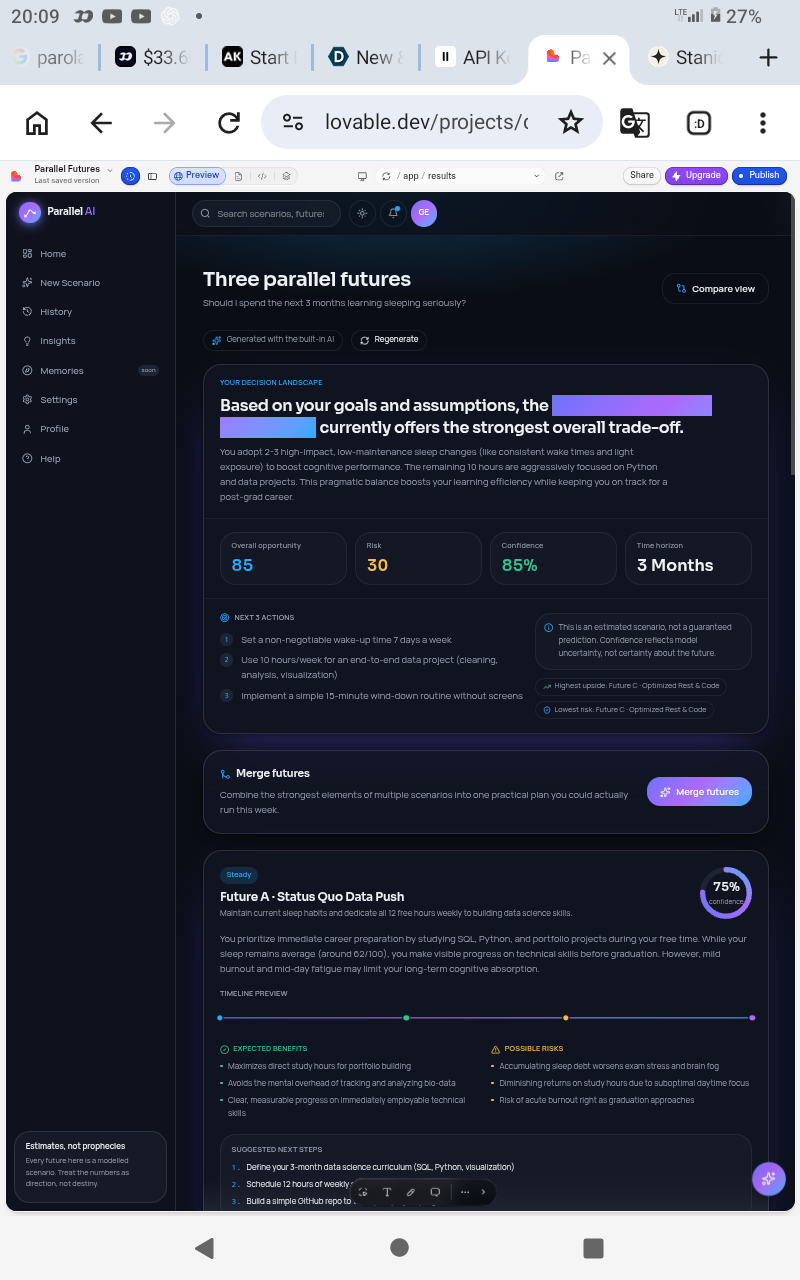
Parallel then creates multiple modeled scenarios that users can explore and compare.
The experience includes:
- Parallel Futures: Explore multiple possible paths from one decision.
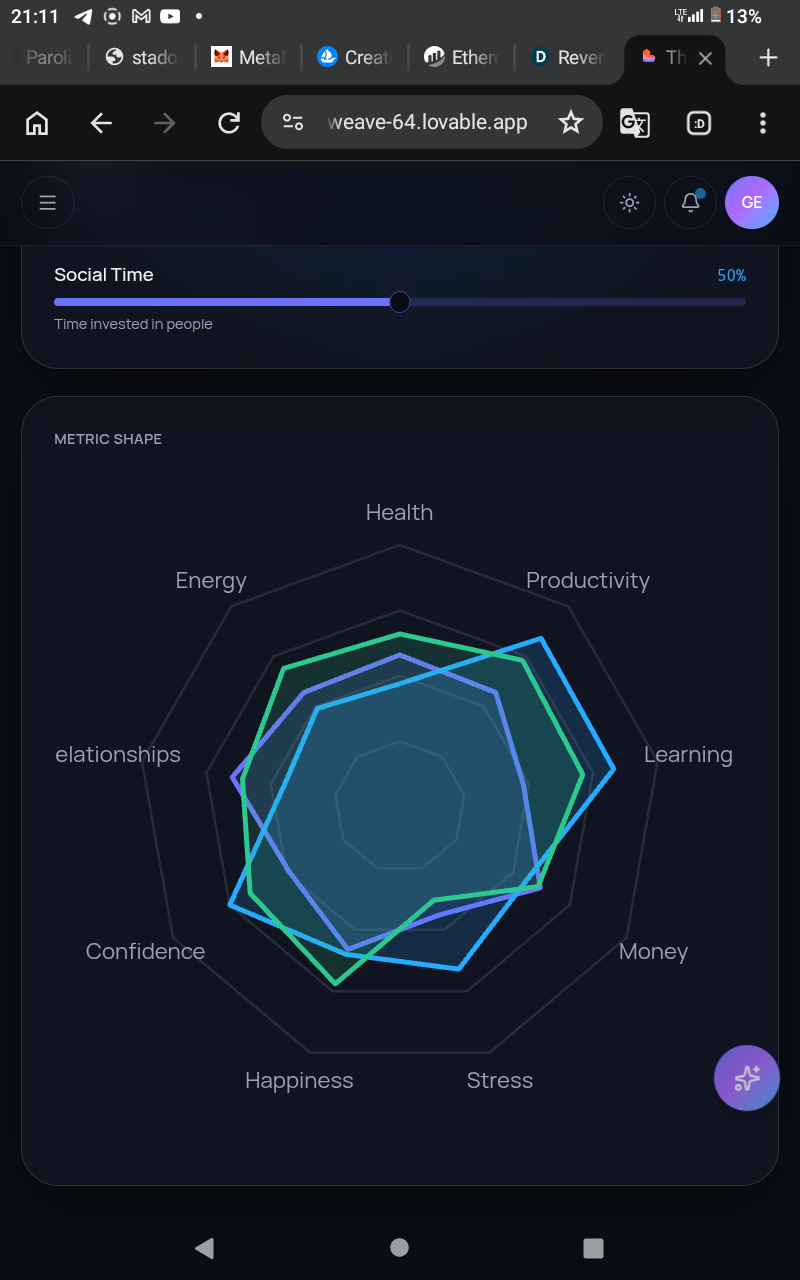
- Butterfly Effect: Change important variables and see how the modeled trajectories respond.
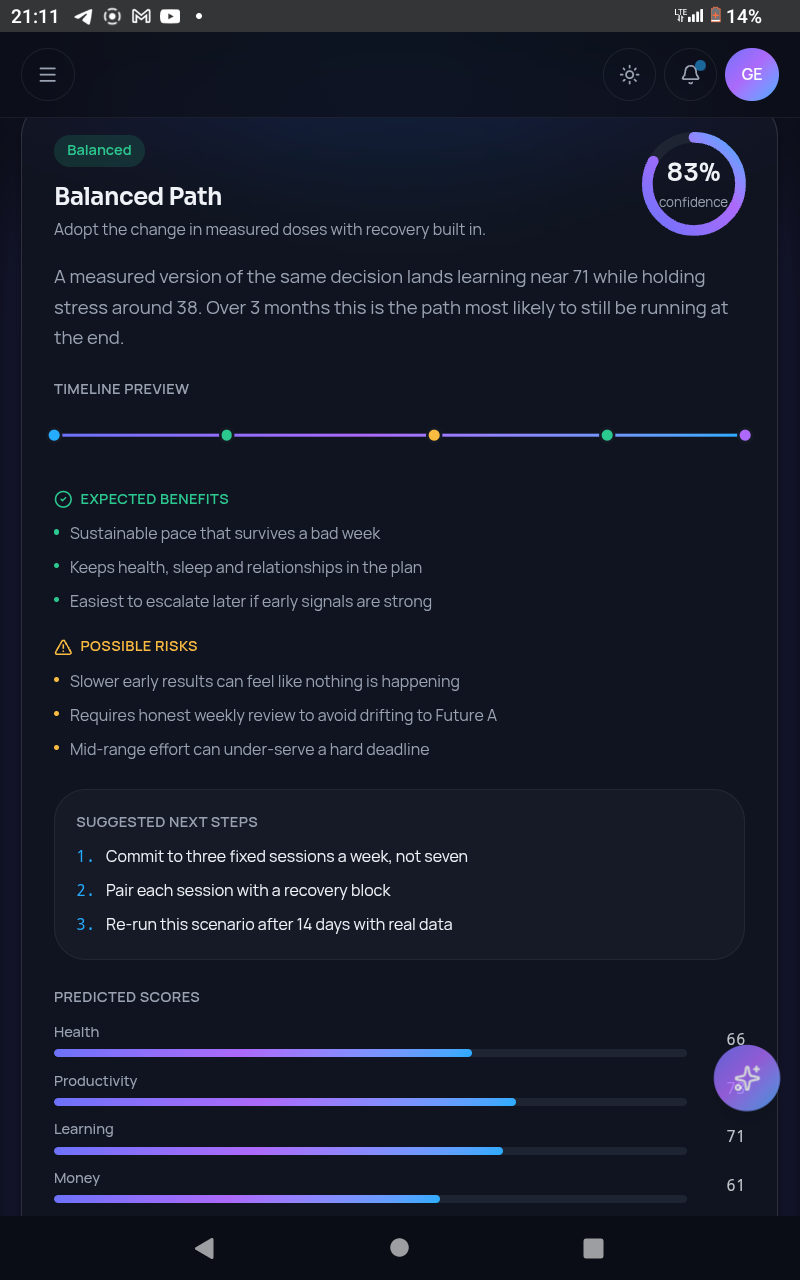
- Future Comparison: Compare risks, opportunities, time requirements, and other dimensions.
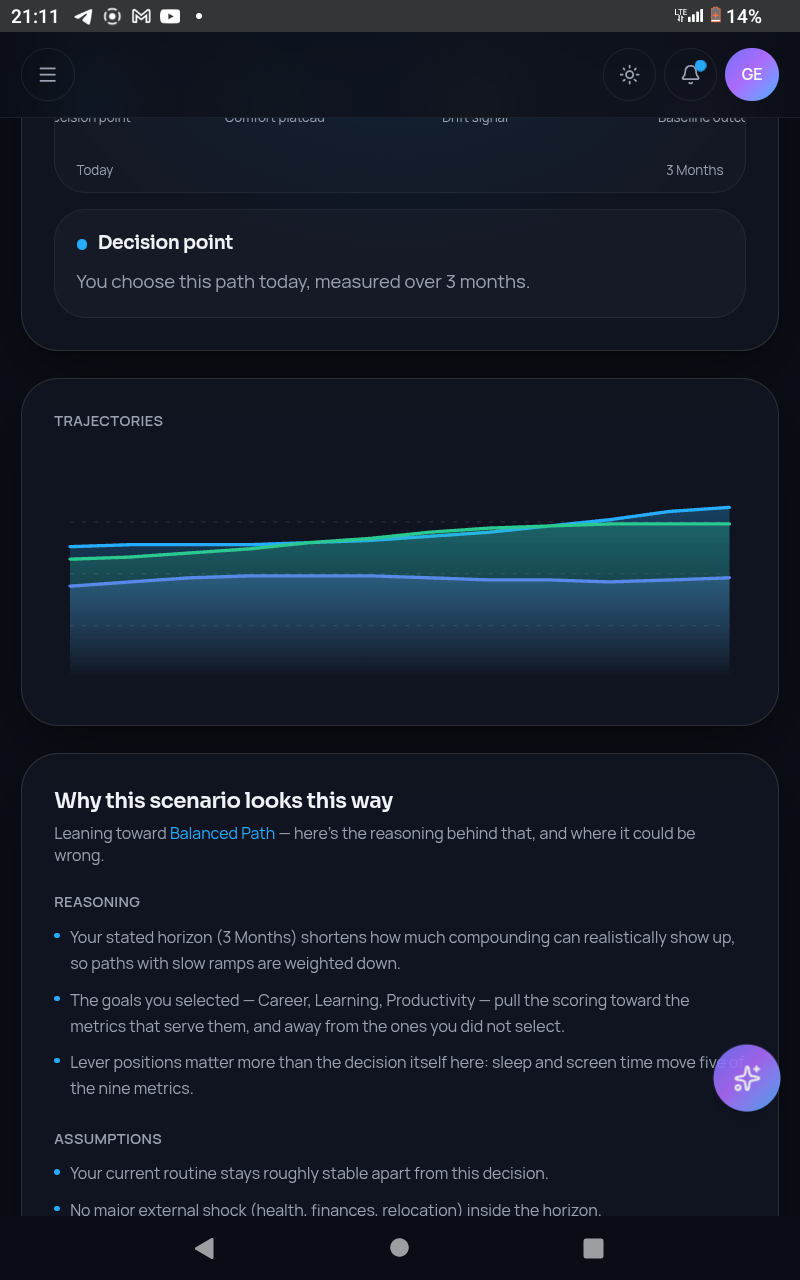
- Interactive Timelines: Explore how scenarios may develop over time.
- AI Explanations: Understand assumptions, reasoning, and uncertainty.
- Scenario Merging: Combine strong elements from different paths into a practical hybrid direction.
- Recommendations: Identify the scenario that best aligns with the user's selected goals.
The result is not intended to be a crystal ball.
It is a decision exploration tool.
🛠️ How We Built It
We built Parallel as a modern responsive web application using:
- React
- TypeScript
- Tailwind CSS
- Interactive data visualizations
- Supabase-ready architecture
- OpenRouter-ready AI architecture
- Lovable
- GitHub
We designed the architecture around a separation between the interface, scenario logic, AI provider layer, and visualization system.
This makes it possible to evolve the AI layer independently and eventually support multiple AI models and providers.
We also created a demo-oriented experience so the core product can be explored without requiring users to configure an external AI provider first.
🎨 Design & User Experience
A major goal was to make Parallel feel less like a traditional hackathon project and more like a real product.
We focused heavily on:
- Clear visual hierarchy
- Minimal cognitive overload
- Smooth animations
- Interactive timelines
- Responsive layouts
- Premium dark-mode aesthetics
- Micro-interactions
- Accessible controls
- Simple navigation
One of our most important design decisions was turning the generation process itself into a visual experience.
Instead of showing a generic loading spinner, the interface visually shows a decision branching into multiple trajectories.
This communicates the core idea of Parallel before the user even reads the explanation.
🧠 The Butterfly Effect
One of the features we were most excited about was Butterfly Effect.
Instead of treating a scenario as fixed, users can change influential variables and explore how those changes affect the modeled trajectory.
For example, a user could adjust study time, sleep, budget, or other relevant variables.
The interface then updates the scenario visualization.
This turns decision-making from a static answer into an interactive experiment:
"What happens if I change this?"
🤯 The Challenge
The biggest challenge was avoiding the temptation to build simply another AI chatbot.
AI applications are becoming increasingly common, so we needed to create an experience that was:
Useful + technically interesting + visually memorable.
Another challenge was communicating uncertainty responsibly.
We didn't want Parallel to claim:
"This is what will happen."
Instead, we designed it around:
"This is one possible scenario based on the information and assumptions available."
That distinction became an important part of both the product design and our thinking about responsible AI.
📚 What We Learned
Building Parallel taught us that creating a strong AI product isn't only about connecting an AI model to an interface.
The experience around the intelligence matters just as much.
We learned how important it is to:
- Turn complex AI capabilities into simple interactions.
- Design around a clear user problem rather than around the technology.
- Make uncertainty visible instead of hiding it.
- Use animation to explain concepts, not just decorate a screen.
- Build a reliable demo experience instead of depending entirely on external services.
- Think about scalability and architecture from the beginning.
- Treat UX as part of the product itself, not something added at the end.
Most importantly, we learned that sometimes the strongest AI experience isn't the one that gives the fastest answer.
It's the one that helps the user think better.
🌍 What's Next
Parallel AI is currently an early-stage prototype, but we see several directions for the future.
We would like to add:
- Persistent decision history
- Personal decision memory
- Long-term outcome tracking
- More sophisticated scenario modeling
- Better uncertainty estimation
- Multiple AI providers
- Collaborative decision-making
- Specialized planning modes for education, careers, entrepreneurship, and organizations
A particularly interesting future direction is allowing Parallel to compare its scenarios with what actually happened.
That could create a feedback loop where users can learn not only from their decisions, but from the accuracy and limitations of previous assumptions.
🎯 Our Vision
We can't know the future with certainty.
But we can make uncertainty easier to explore.
Parallel AI is our attempt to turn that idea into a product.
"One decision. Multiple possible futures. Better-informed choices."
Parallel AI
See Tomorrow Before You Choose Today.

Log in or sign up for Devpost to join the conversation.