-
-
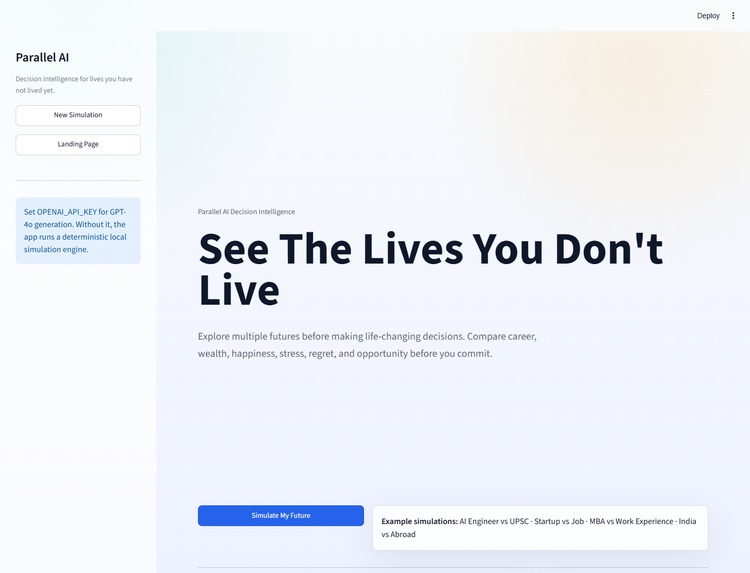
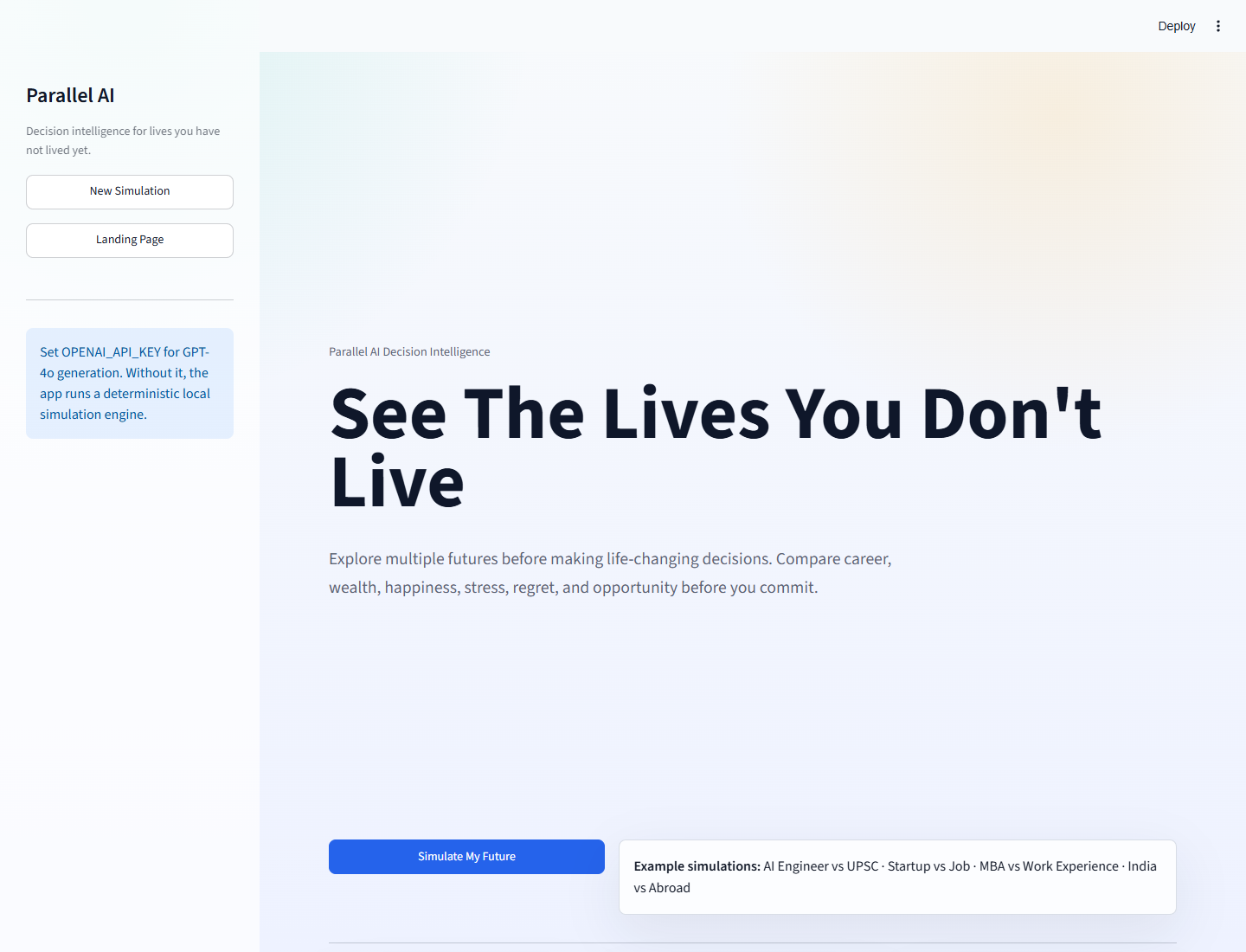
Landing page
-
-
## Inspiration
Every major life decision comes with uncertainty.
Whether it's choosing between a government exam and a tech career, pursuing higher education, starting a business, relocating abroad, or changing jobs, people are forced to make decisions without being able to clearly visualize the long-term consequences of their choices.
We realized that while AI has become incredibly powerful at answering questions, very few tools help people understand the future impact of their decisions. Most decision-making today is driven by emotions, opinions, or incomplete information.
This inspired us to build Parallel AI — a platform that allows users to explore multiple possible futures before committing to a life-changing decision.
Our goal was simple:
What if people could see the lives they don't live before making a choice?
## What it does
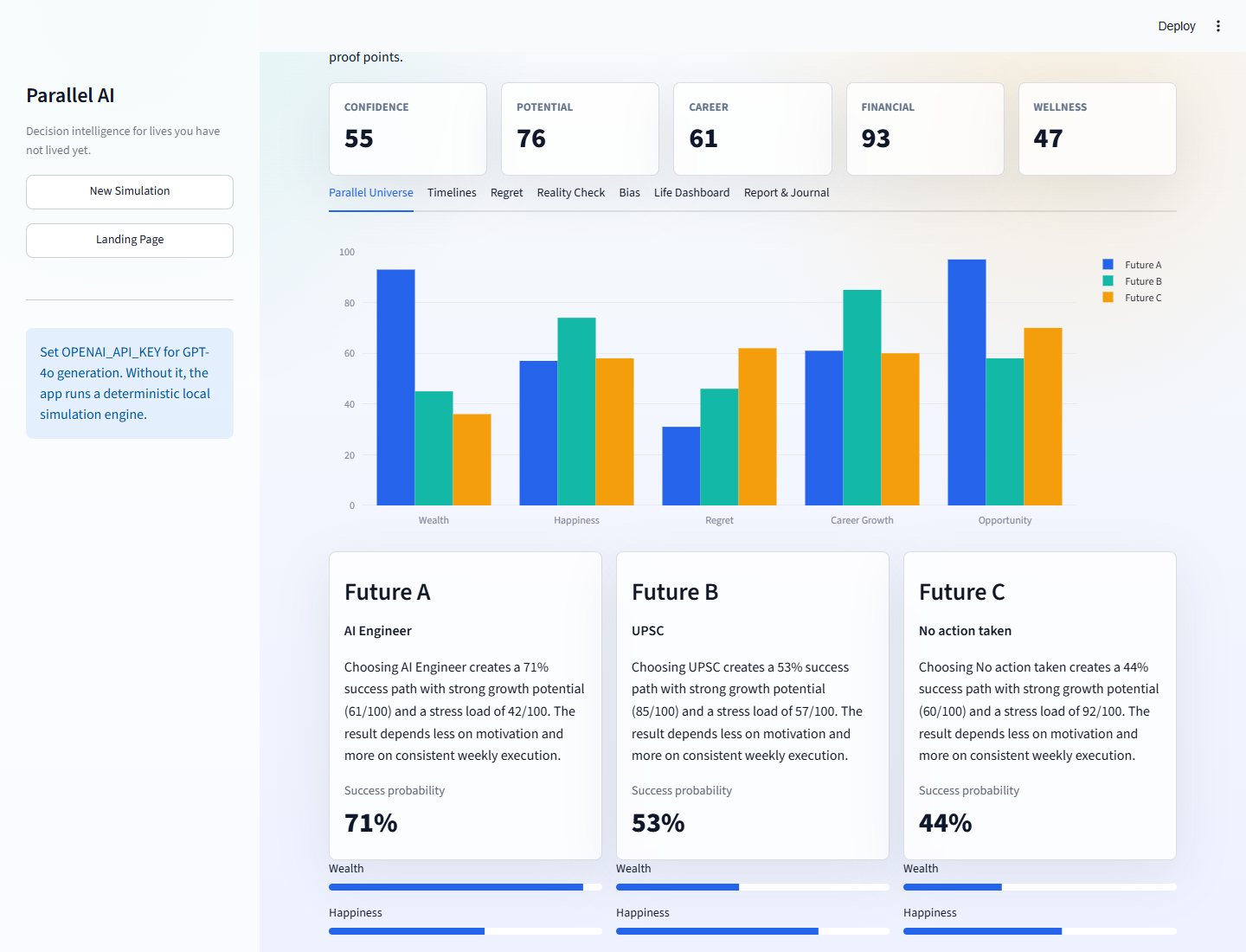
Parallel AI is an AI-powered decision intelligence platform that simulates multiple future outcomes for important life and career decisions.
Users enter a decision, such as:
- AI Engineer vs UPSC
- Startup vs Job
- MBA vs Work Experience
- Move Abroad vs Stay Local
The platform then generates:
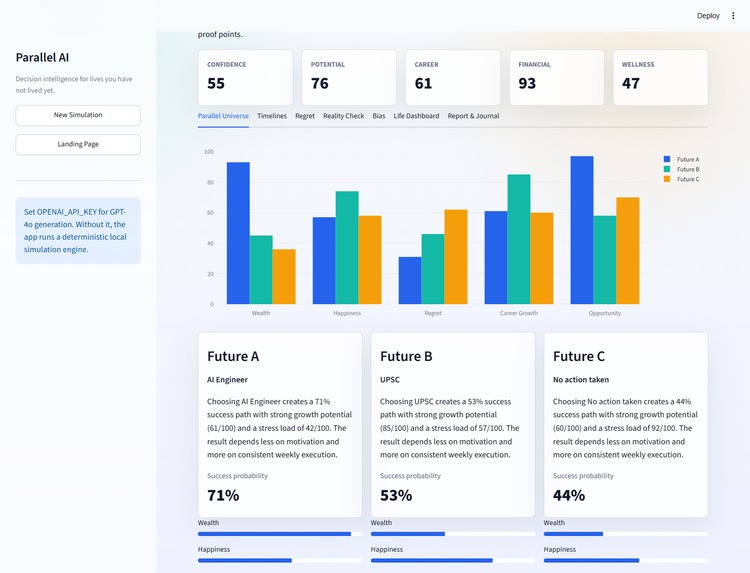
Multiple Future Paths
- Future A
- Future B
- Future C (No Action)
For each future, Parallel AI provides:
- Success probability
- Wealth outlook
- Happiness score
- Stress level
- Opportunity cost
- Career growth projection
- Regret analysis
The platform also includes:
- Future timeline simulation
- AI-generated future letters
- Opportunity cost analysis
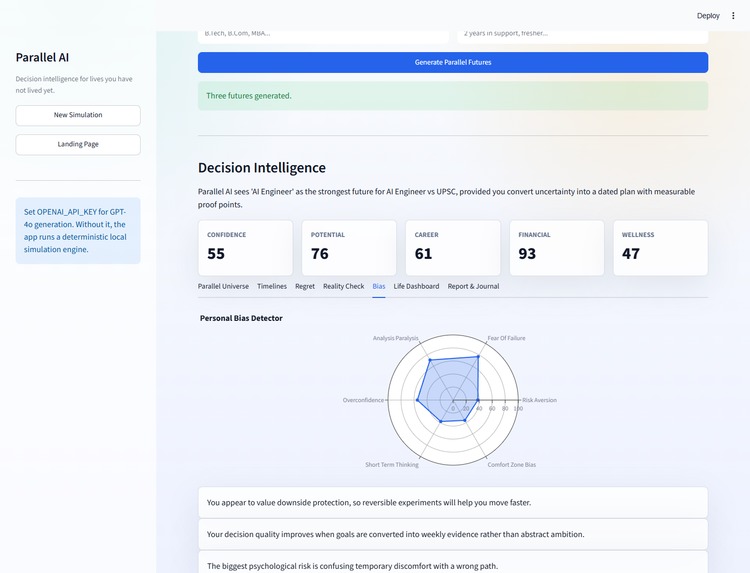
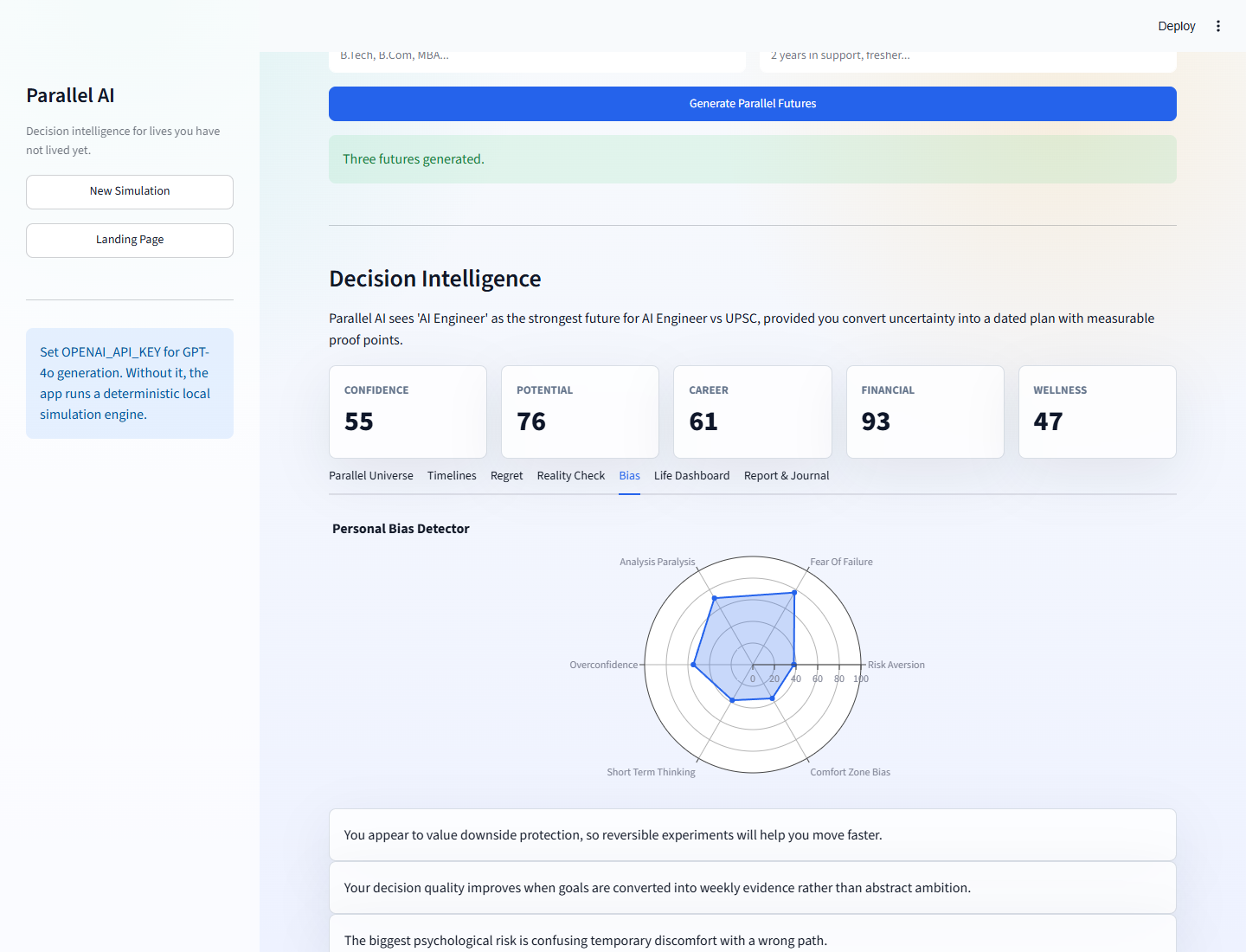
- Personal bias detection
- Reality Check Mode
- Decision confidence scoring
- Decision journaling
This transforms decision-making from guesswork into a structured exploration of possible outcomes.
## How we built it
We built Parallel AI as a modern AI-powered web application focused on both functionality and user experience.
Frontend
- Streamlit
- Custom CSS
- Responsive layouts
- Interactive dashboards
Backend Logic
- Python
- OpenAI API
- Structured prompt engineering
- JSON-based AI responses
Data & Storage
- SQLite database
- Session state management
- User decision history
Visualization
- Plotly charts
- Interactive timelines
- Radar charts
- Regret score dashboards
- Future comparison views
AI Architecture
We designed multiple AI agents to generate richer and more realistic simulations.
Simulation Agent
Generates future outcomes.
Reality Check Agent
Challenges assumptions and highlights risks.
Bias Detection Agent
Identifies behavioral patterns and cognitive biases.
Future Letter Agent
Creates emotionally engaging letters from future versions of the user.
This multi-agent approach makes the platform feel more like a decision intelligence system rather than a traditional chatbot.
## Challenges we ran into
One of the biggest challenges was balancing inspiration with realism.
When simulating future outcomes, there is a risk that predictions become either:
- Unrealistically optimistic
- Excessively pessimistic
We had to carefully design prompts that produced balanced and believable future scenarios.
Another challenge was creating a regret framework that felt meaningful rather than arbitrary. Regret is subjective, so we needed to evaluate multiple dimensions such as:
- Financial impact
- Career growth
- Lifestyle changes
- Opportunity costs
- Emotional satisfaction
We also spent significant effort designing a user experience that felt intuitive despite handling complex concepts like future simulation, uncertainty, and risk analysis.
## Accomplishments that we're proud of
We are especially proud of transforming a simple idea into a fully functional product that people can immediately use.
Some highlights include:
- Building a complete future simulation engine
- Creating a unique regret scoring system
- Developing Reality Check Mode using multiple AI perspectives
- Generating personalized future letters
- Designing a visually engaging decision dashboard
- Delivering a product that combines psychology, forecasting, and AI in a practical way
Most importantly, we created something that helps users think more deeply about their future rather than simply providing answers.
## What we learned
This project taught us that technology alone does not create value.
The real challenge lies in understanding human behavior and decision-making.
We learned:
- Product thinking is as important as engineering
- AI is most powerful when augmenting human judgment
- Users connect strongly with personalized experiences
- Visualization significantly improves decision comprehension
- Multiple AI perspectives often produce better insights than a single response
We also gained valuable experience in prompt engineering, AI system design, user experience design, and rapid product development.
## What's next for Parallel AI
We believe Parallel AI can evolve into a comprehensive decision intelligence platform.
Future plans include:
Real Market Data Integration
Use labor market, salary, education, and economic datasets to improve simulations.
Community-Powered Insights
Learn from anonymous decisions and outcomes shared by users.
Advanced Scenario Modeling
Generate hundreds of possible future paths instead of only three.
Personalized Learning
Allow the system to learn from previous user decisions and improve recommendations over time.
Team and Business Decisions
Expand beyond personal decisions to support startup founders, managers, and organizations.
Decision Memory System
Track user decisions over months and years to measure actual outcomes against predictions.
Our long-term vision is to build a platform where people can explore, compare, and understand the consequences of their choices before making them, helping them make better decisions with greater confidence.

Log in or sign up for Devpost to join the conversation.