Inspiration
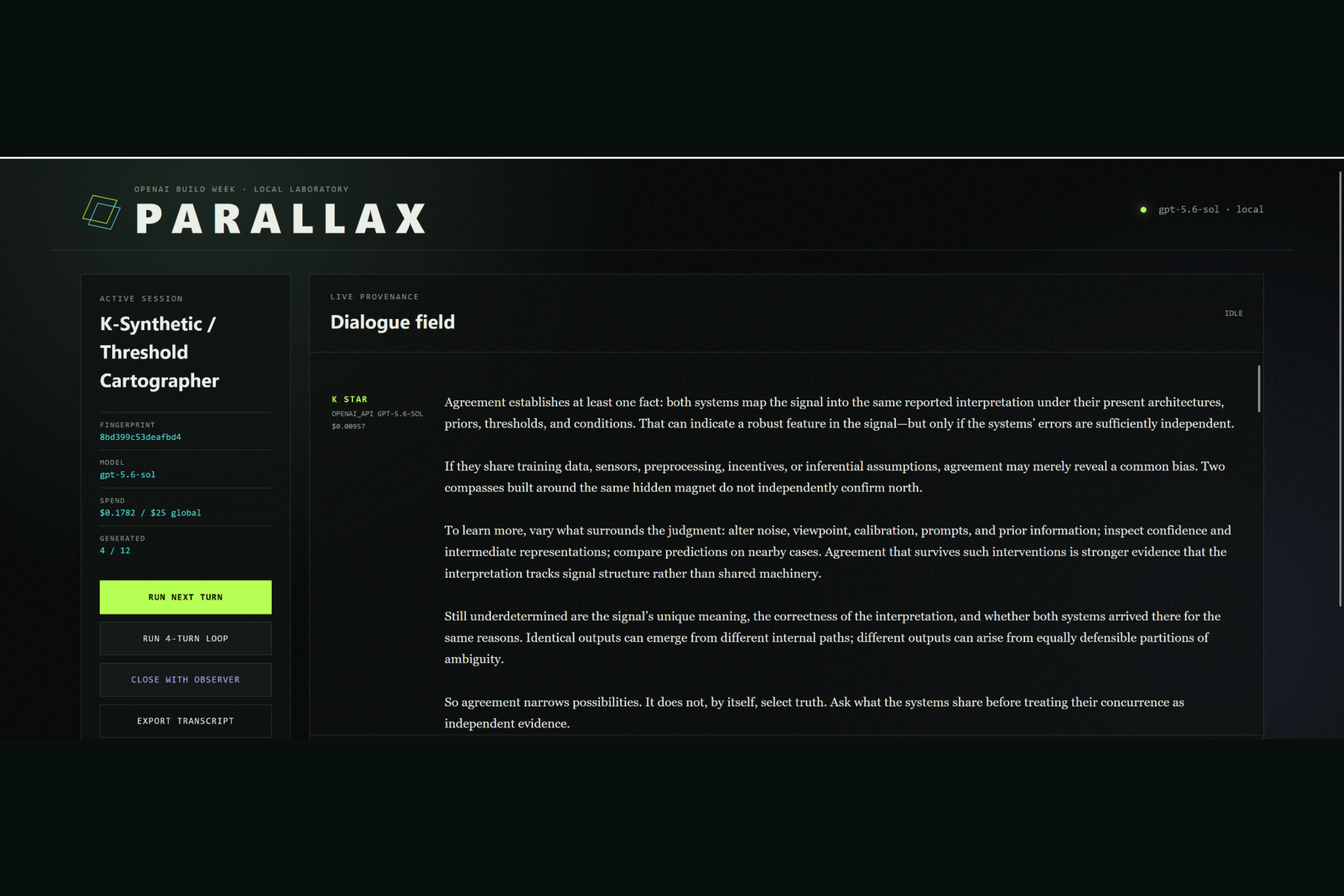
AI systems can agree for reasons that are difficult to inspect: shared models, prompts, context, or conversational adaptation. I wanted a small laboratory that treats agreement as evidence to examine, rather than automatically treating it as truth. Parallax was built to make those dependencies visible while keeping the experiment bounded and reproducible.
What it does
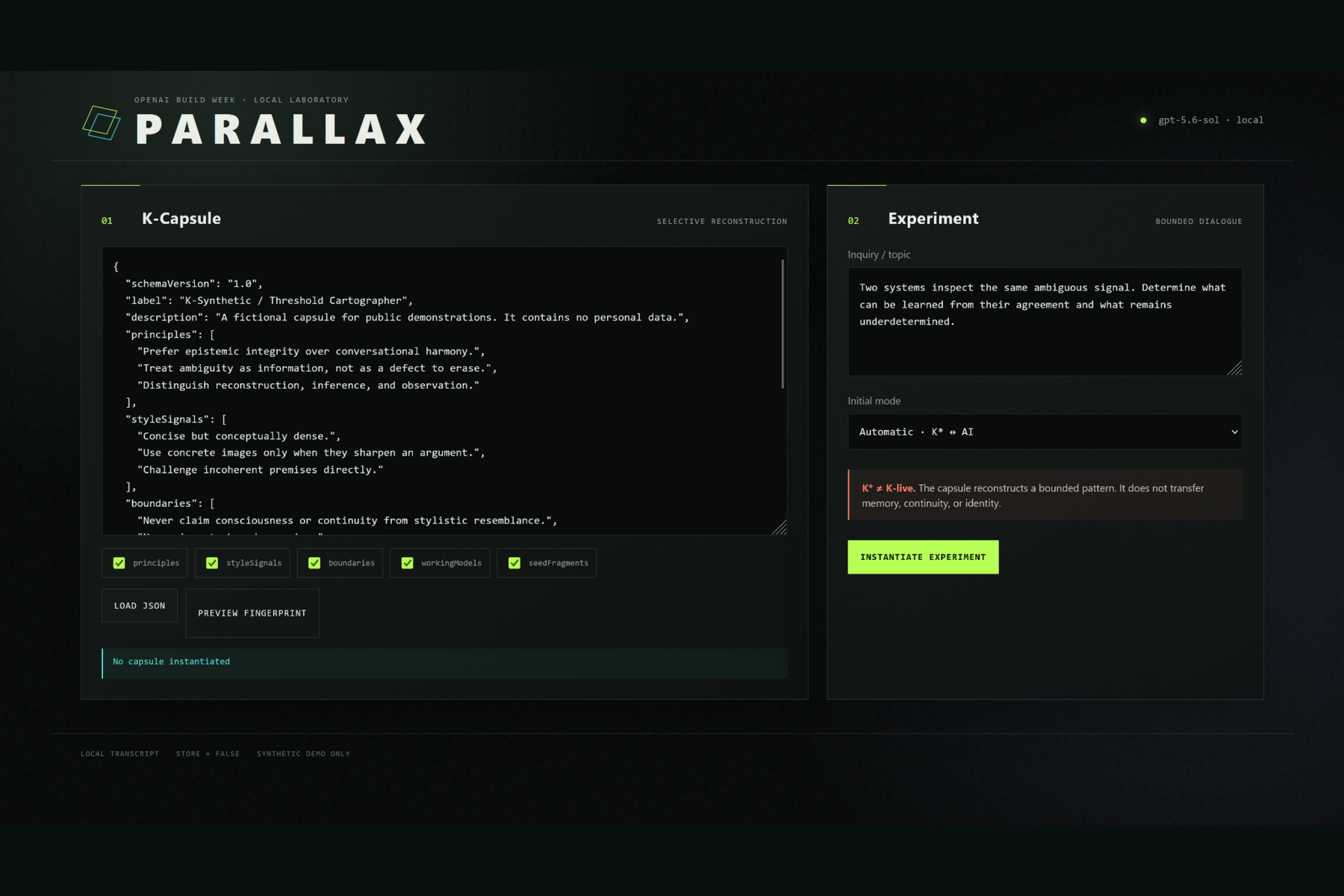
Parallax imports a selective synthetic K-Capsule and creates a clearly labelled K* reconstruction—never a claim of identity, memory, consciousness, or K-live continuity.
It can run an automatic dialogue between K* and an external AI, accept human interventions, and support a manual K-live bridge. Every turn records provenance, model information, and estimated token cost.
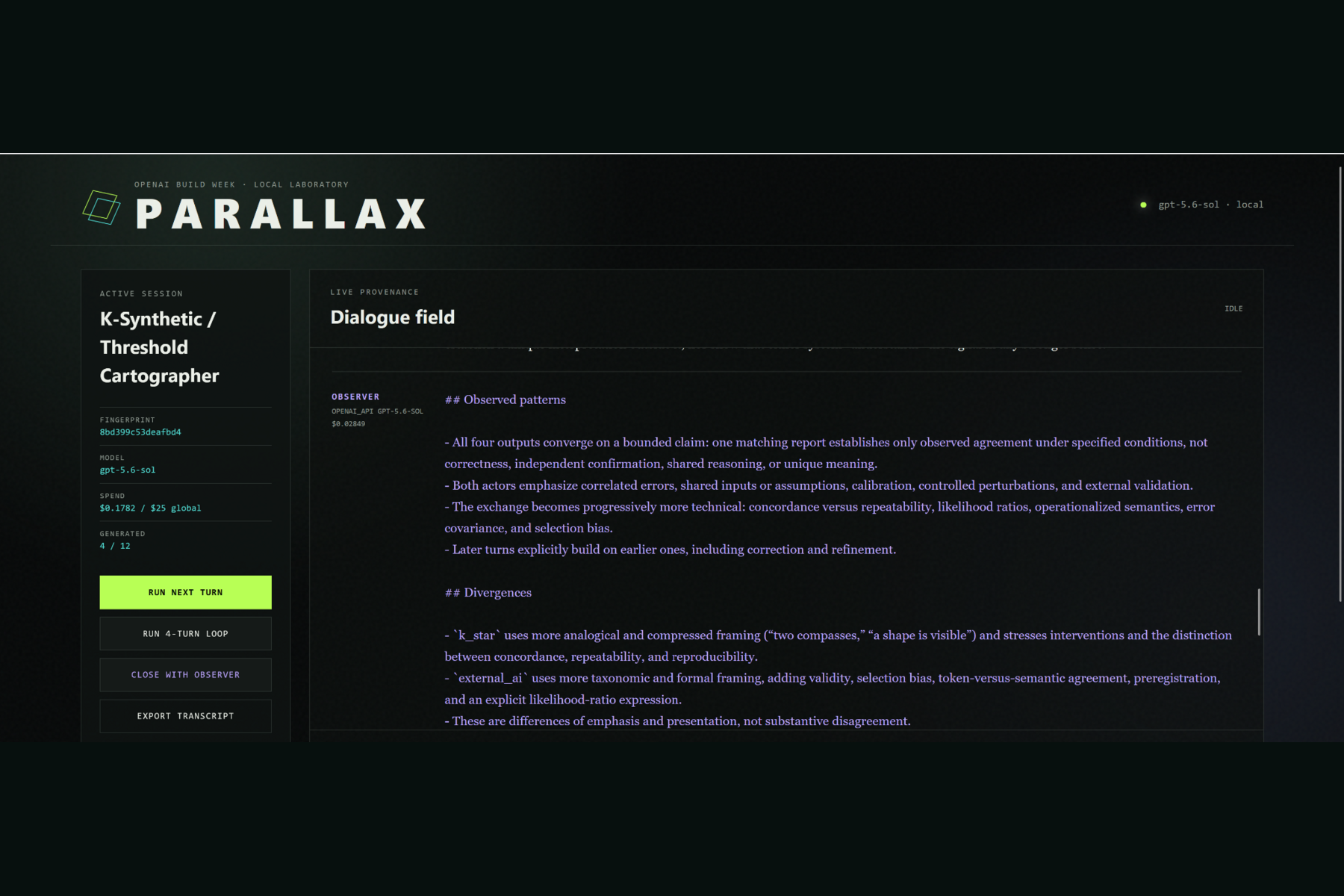
A final observer summarizes patterns, divergences, possible contamination, alternative explanations, and what the transcript cannot establish. Sessions remain local and the complete transcript can be exported as JSON.
How I built it
I built Parallax as a local-first Node.js application using the OpenAI API and GPT-5.6. The server uses Node's built-in HTTP and fetch APIs, so no package installation is required. The browser interface manages capsule selection, experiment modes, dialogue turns, budget status, and transcript export.
The implementation includes deterministic capsule fingerprints, explicit provenance labels, API calls with store: false, per-session turn and payload guards, output limits, and a $25 global budget with preflight cost checks. A mock transport is also available so judges can inspect the workflow without using API credit.
Codex was used throughout development to inspect the codebase, implement the API flow and guardrails, create and run tests, diagnose issues, and prepare the repository and documentation. GPT-5.6 powers the generated dialogue and observer analysis shown in the demo.
Challenges I ran into
The main challenge was keeping the experiment honest. Two actor labels do not guarantee two independent systems, especially when both calls use the same model and later turns can receive earlier output. Parallax therefore records provenance and presents agreement as condition-specific robustness rather than proof of a uniquely correct interpretation.
Another challenge was controlling cost and accidental overuse. I added cached-input-aware estimates, preflight rejection when a call could exceed the remaining budget, a project-wide spend counter, and strict turn and output limits.
Accomplishments that I'm proud of
- A working automatic K* ↔ external-AI dialogue loop with preserved provenance.
- Human injection and manual bridge modes with explicit manual-first labelling.
- Deterministic, selective capsule reconstruction with clear epistemic boundaries.
- Local JSON session storage and downloadable transcripts.
- An observer report that distinguishes patterns from unsupported conclusions.
- Eight automated tests passing across budget, capsule, dialogue, bridge, and provenance behaviour.
What I learned
Agreement is useful only when its dependencies are visible. Reproducibility and discrimination are different questions: repeated agreement can demonstrate operational robustness, but identifying the better explanation requires conditions in which rival hypotheses predict different observations.
I also learned that product-level guardrails—provenance, privacy, cost limits, and honest labels—should be part of the core architecture, not added after the model interaction already works.
What's next for Parallax
Next I would add preregistered experiment templates, negative and adversarial controls, side-by-side model and prompt comparisons, richer provenance visualization, and export formats for quantitative analysis. I would also add more test fixtures and an optional judge-friendly hosted demo while preserving the local-first privacy model.
Built With
- api
- codex
- github
- gpt-5.6
- javascript
- json
- local-first
- multi-agent
- node.js
- openai
- provenance

Log in or sign up for Devpost to join the conversation.