Inspiration
What if two Twitch streamers could play the same game without being in the same room, sharing the same screen, or even controlling the same mechanics?
Most Twitch interactive experiences focus on a single streamer and their audience. We wanted to explore something different: what if two independent communities had to cooperate to save a shared universe?
That's how PARALLAX — Two Streams. One Universe. was born.
Our goal was to turn Twitch chat from a spectator tool into a cross-stream cooperative game controller, where every viewer action has consequences in another livestream.
What it does
PARALLAX is a real-time, asymmetric multiplayer Twitch experience connecting two independent livestreams.
Each community controls one half of a fractured universe:
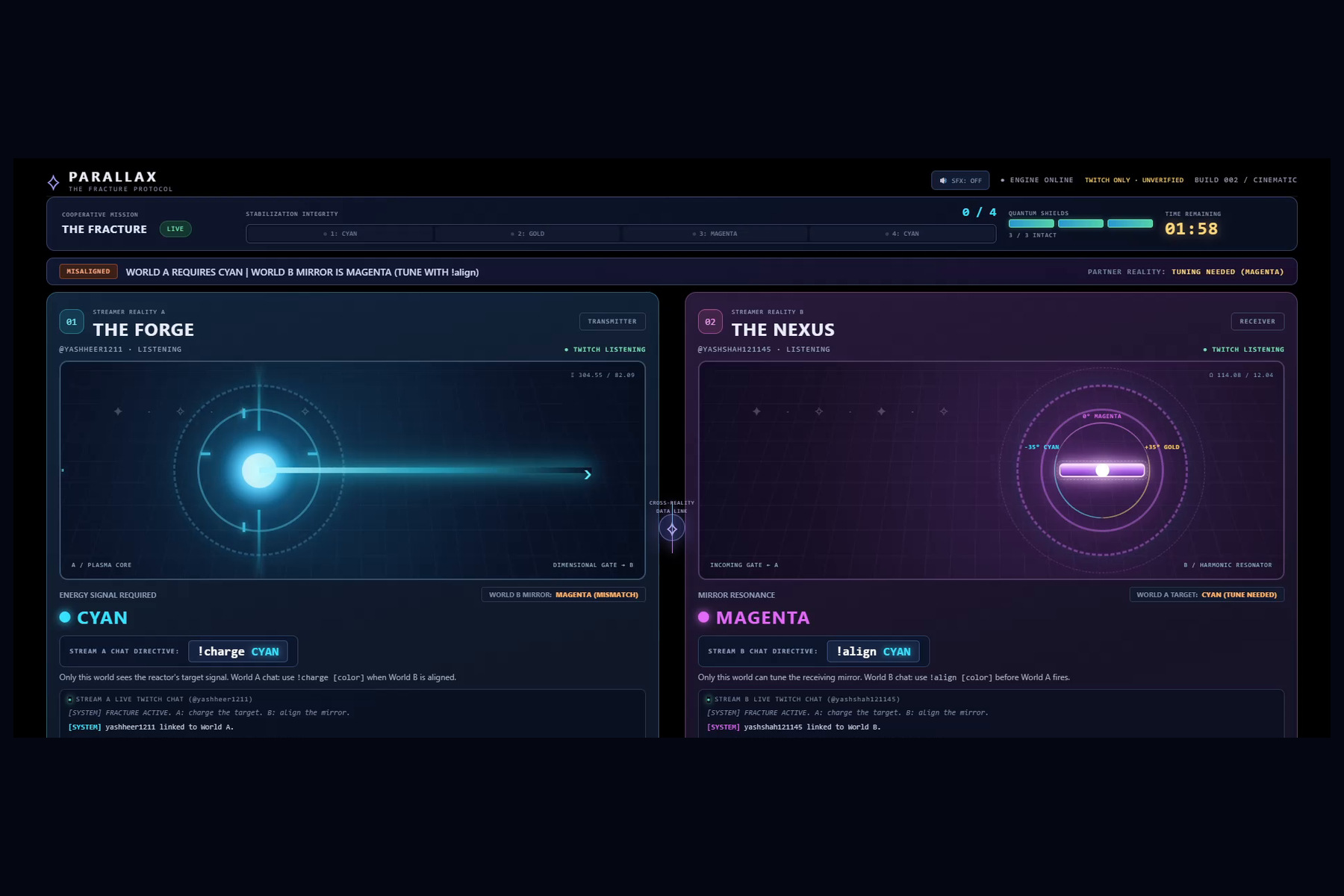
World A — The Forge (Transmitter)
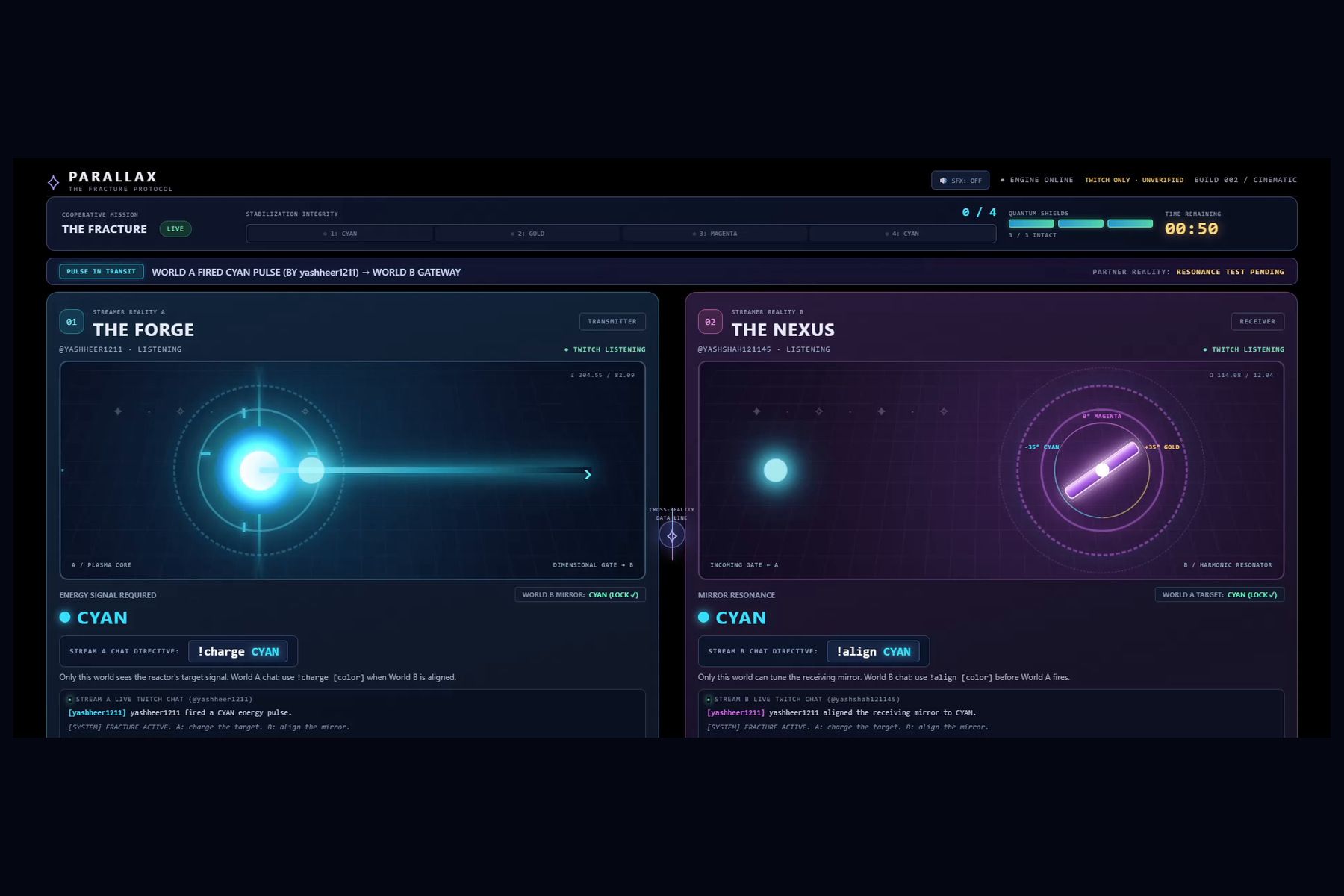
Viewers generate and launch energy pulses by sending commands such as !charge cyan in Twitch chat. Their world features a futuristic reactor, plasma conduits, and energy discharge effects.
World B — The Nexus (Receiver)
Viewers control a dimensional mirror by sending commands such as !align cyan. Their world features a rotating resonance mirror, alignment reticles, and a dimensional portal.
When the mirror is correctly aligned, World A's energy pulse can successfully cross the dimensional bridge.
Both worlds instantly reflect the consequences through synchronized visual effects, mission telemetry, progress indicators, and Twitch chat feedback.
The objective is to complete four successful energy transfers before the timer expires or the shared universe suffers too much damage.
Neither Twitch community can win alone. Cooperation isn't an optional feature — it's the entire game.
How we built it
PARALLAX uses a dependency-free Node.js architecture, with an authoritative game engine coordinating both livestreams.
Its core technical components include:
- Twitch OAuth 2.0: Secure authorization for two distinct broadcaster accounts.
- Twitch EventSub WebSockets: Genuine
channel.chat.messageevents from both Twitch channels. - Authoritative game engine: Validates commands, enforces cooldowns, resolves energy transfers, and maintains the shared mission state.
- Server-Sent Events (SSE): Synchronizes both game worlds and their broadcast overlays.
- OBS Browser Sources: Renders independent cinematic worlds alongside a unified competition broadcast featuring both realities, live chat panels, and an energy bridge.
- Web Audio API: Generates original sound effects without external audio assets.
- Security and reliability: CSRF-protected sessions, broadcaster ownership checks, token refresh, reconnection handling, and event deduplication.
We used OpenAI Codex Desktop as our primary engineering assistant to build the original multiplayer architecture, Twitch OAuth and EventSub integration, security mechanisms, and automated testing foundation.
We subsequently used Google Antigravity for visual engineering, broadcast presentation, cinematic effects, additional testing, and live validation tooling.
The project was implemented with zero third-party runtime packages.
Challenges we faced
1. Coordinating two independent Twitch communities
The hardest architectural problem was making actions from two separate chats affect one authoritative game state without conflicting or duplicating outcomes.
We addressed this through server-controlled mission logic, strict channel attribution, and synchronized state delivery.
2. Reliable Twitch authentication and EventSub connections
OAuth sessions, token expiration, reconnects, duplicate messages, and broadcaster permissions introduced significant complexity.
We implemented token refresh handling, connection recovery, event validation, and session protection to make the integration more dependable.
3. Making cooperation visually understandable
A technically synchronized system means little if viewers cannot understand what the other community is doing.
We created distinct visual identities for both worlds, real-time partner-action banners, energy transfer animations, and a unified broadcast showing cross-stream causality.
4. Building reliable OBS-compatible visuals
We encountered layout scaling, transparent background, readability, and viewport clipping issues.
Through multiple iterations and actual OBS Studio testing, we refined the overlays into a broadcast-ready presentation.
Accomplishments we're proud of
Our biggest milestone was completing a genuine live Twitch gameplay session using two separate broadcaster accounts.
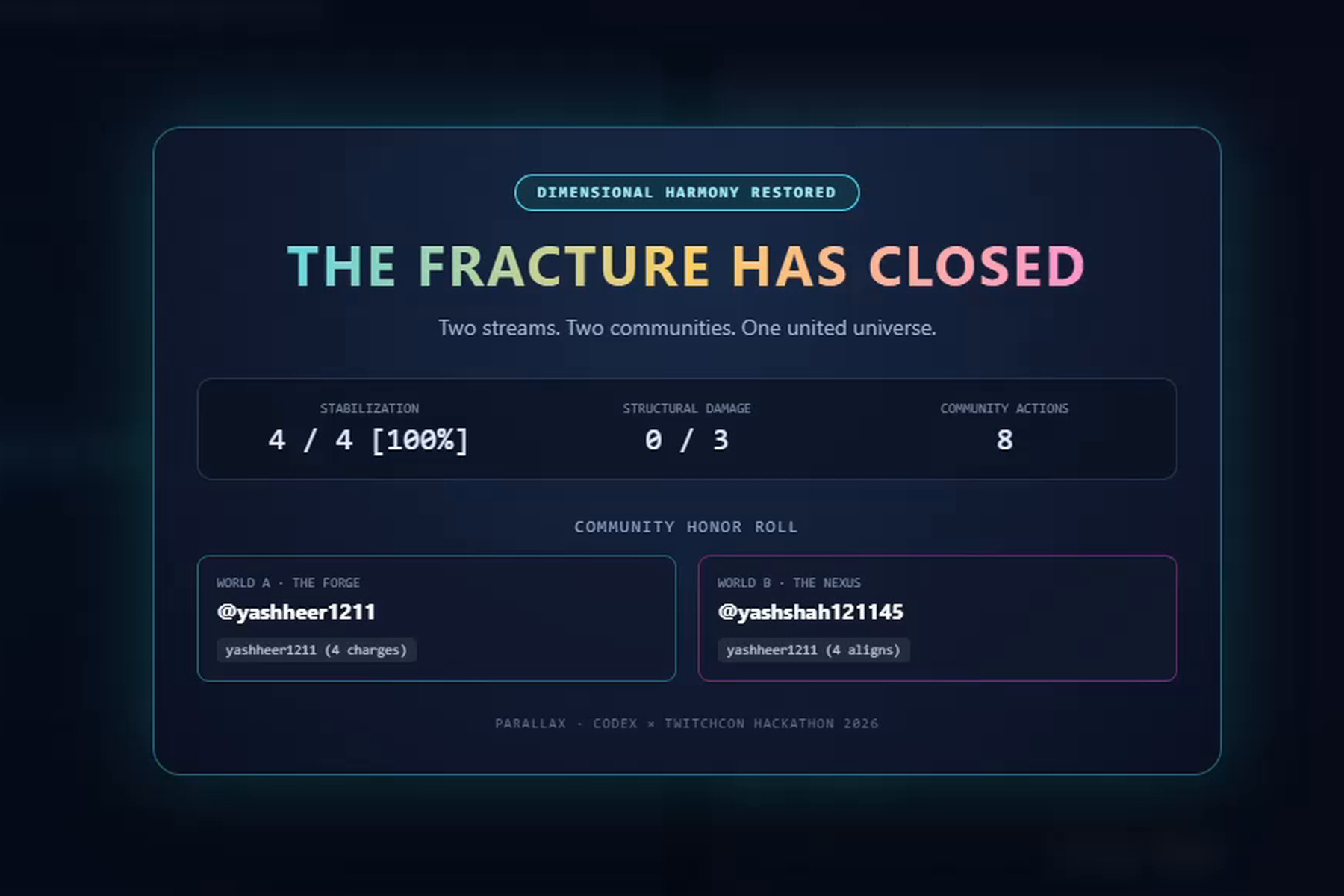
We successfully executed all eight chat commands across the two channels, completing four cooperative transfers:
Cyan → Gold → Magenta → Cyan
The authoritative game engine reached 4/4 stabilization, zero failures, and VICTORY.
We also achieved:
- 56 passing automated tests.
- Six passing local configuration and security preflight checks.
- Genuine Twitch EventSub communication with both broadcasters.
- Separate synchronized OBS game overlays.
- A cinematic side-by-side competition broadcast with integrated chat feeds.
- A completed, captioned demonstration video under three minutes.
What we learned
Building PARALLAX taught us that multiplayer interaction is about more than synchronization.
The real challenge is creating meaningful interdependence between participants.
We also gained practical experience with Twitch EventSub, OAuth security, server-authoritative game mechanics, browser-based streaming overlays, and the importance of testing with genuine external events rather than relying only on simulations.
Using Codex helped accelerate the engineering foundation, while subsequent visual development demonstrated how technical reliability and clear presentation must work together.
What's next
PARALLAX is currently a working, single-session competition prototype. We want to explore:
- Multiple simultaneous streamer pairs and independent game rooms.
- More sophisticated asymmetric puzzles and collaborative missions.
- Community-driven modifiers, achievements, and progression.
- Persistent streamer sessions and match history.
- Streamer-friendly onboarding and more flexible broadcast layouts.
- Larger cross-community events connecting multiple Twitch creators.
Our long-term vision is to make PARALLAX a new kind of interactive livestream experience — one where separate audiences become teammates inside a shared world.
Two streams. Two communities. One universe.
Watch the demonstration: https://youtu.be/6q3VOIfEyb8
Source code: https://github.com/yashshah1211/parallax-twitch
Primary Codex session ID: 01a18dae-fdfd-72b3-b817-d9f32e418932
Built With
- css3
- github
- google-antigravity
- html5
- javascript
- node.js
- oauth-2.0
- obs-studio
- openai-codex
- server-sent-events
- twitch
- twitch-eventsub
- web-audio-api
- websockets


Log in or sign up for Devpost to join the conversation.