Inspiration
For all of us, our decision-making is inherently biased. Whether we're choosing a financial investment, making a career change, or picking between vacation destinations our reasoning is filtered through cognitive biases. So instead of staying clueless about this what if we made these biases visible? By staging a debate between AI agents that embody different cognitive perspectives, we can expose how biases shape decisions, and help users see blind spots in their own reasoning, and arrive at more unbiased decisions.
What it does
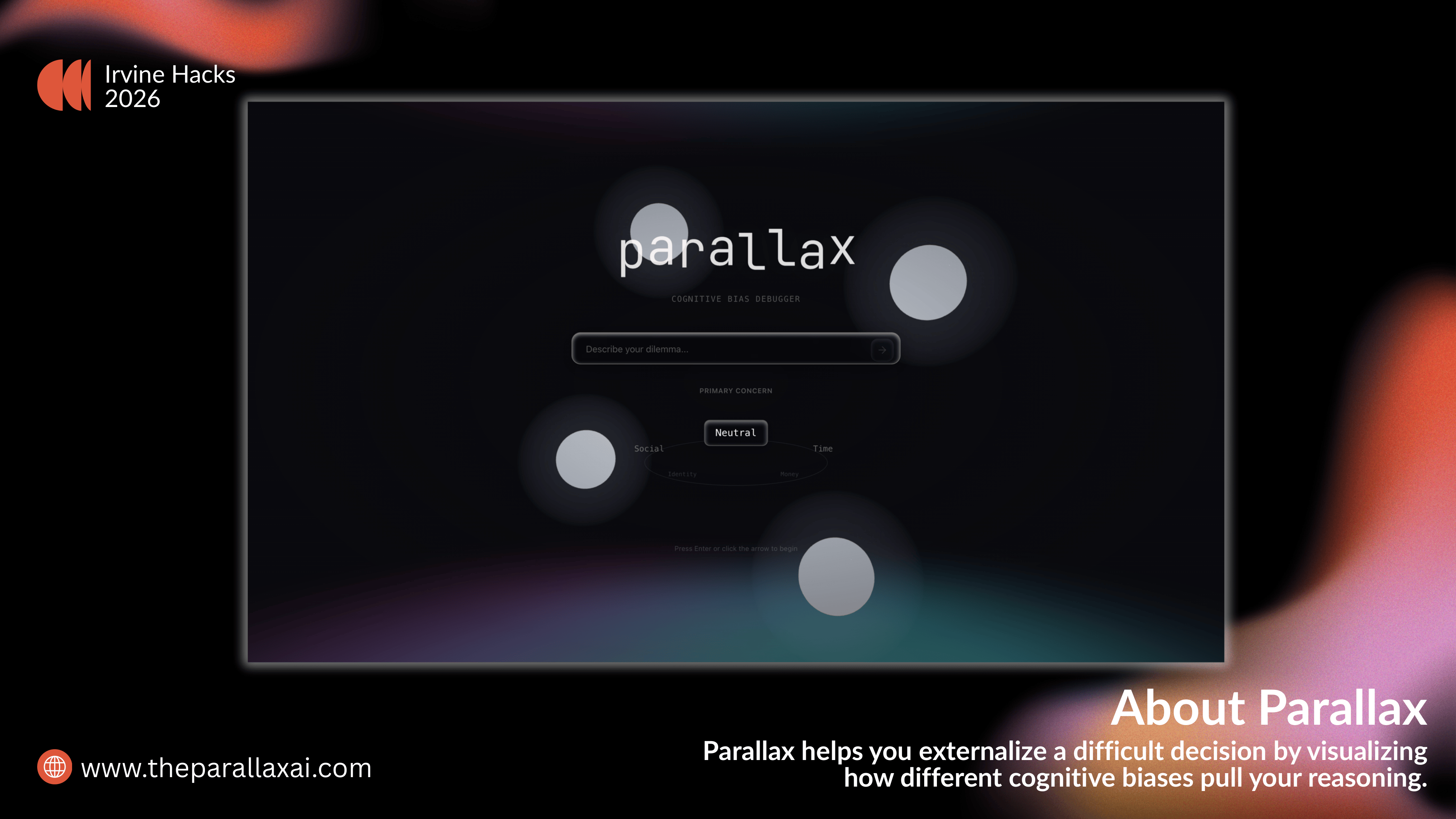
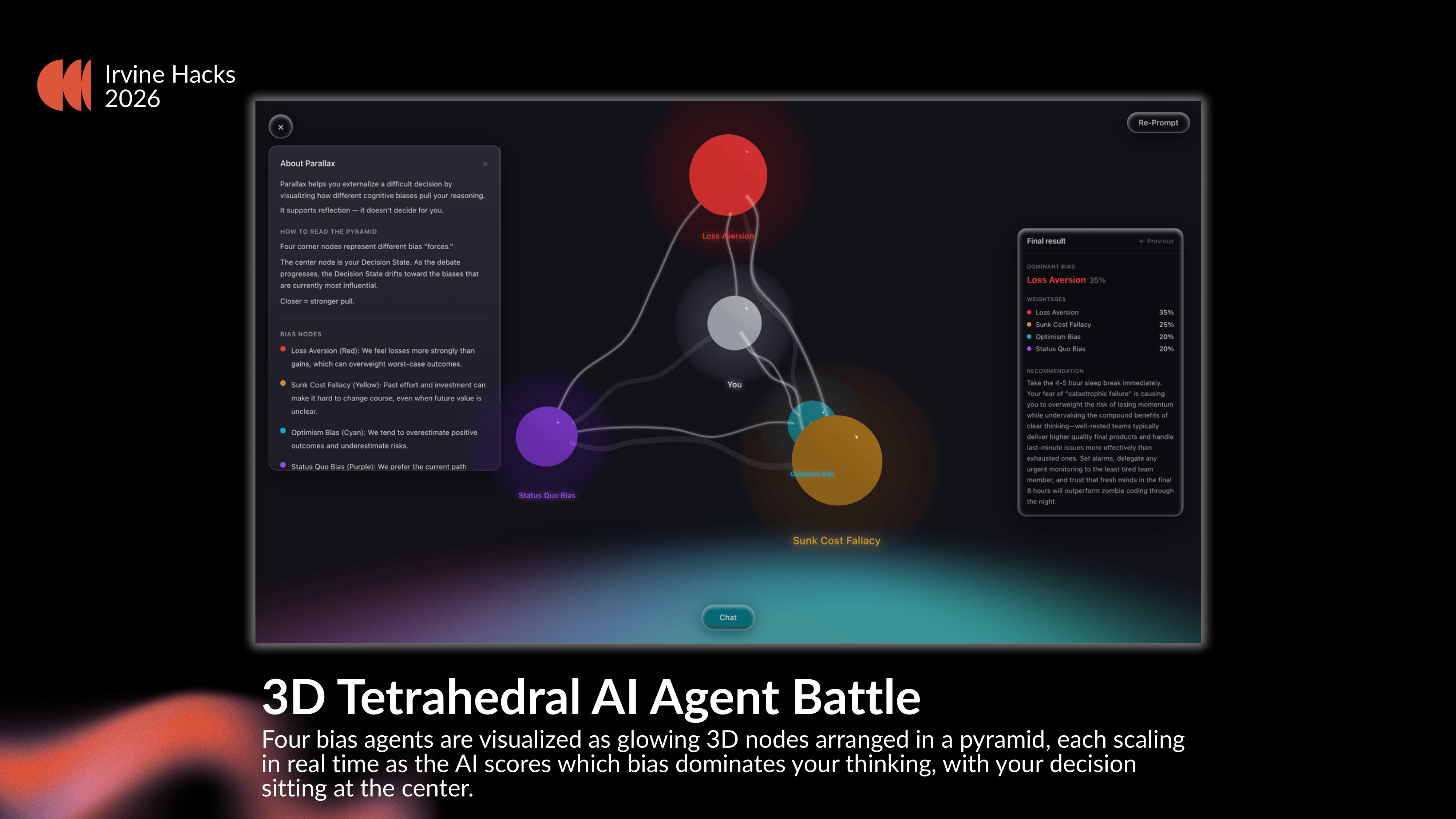
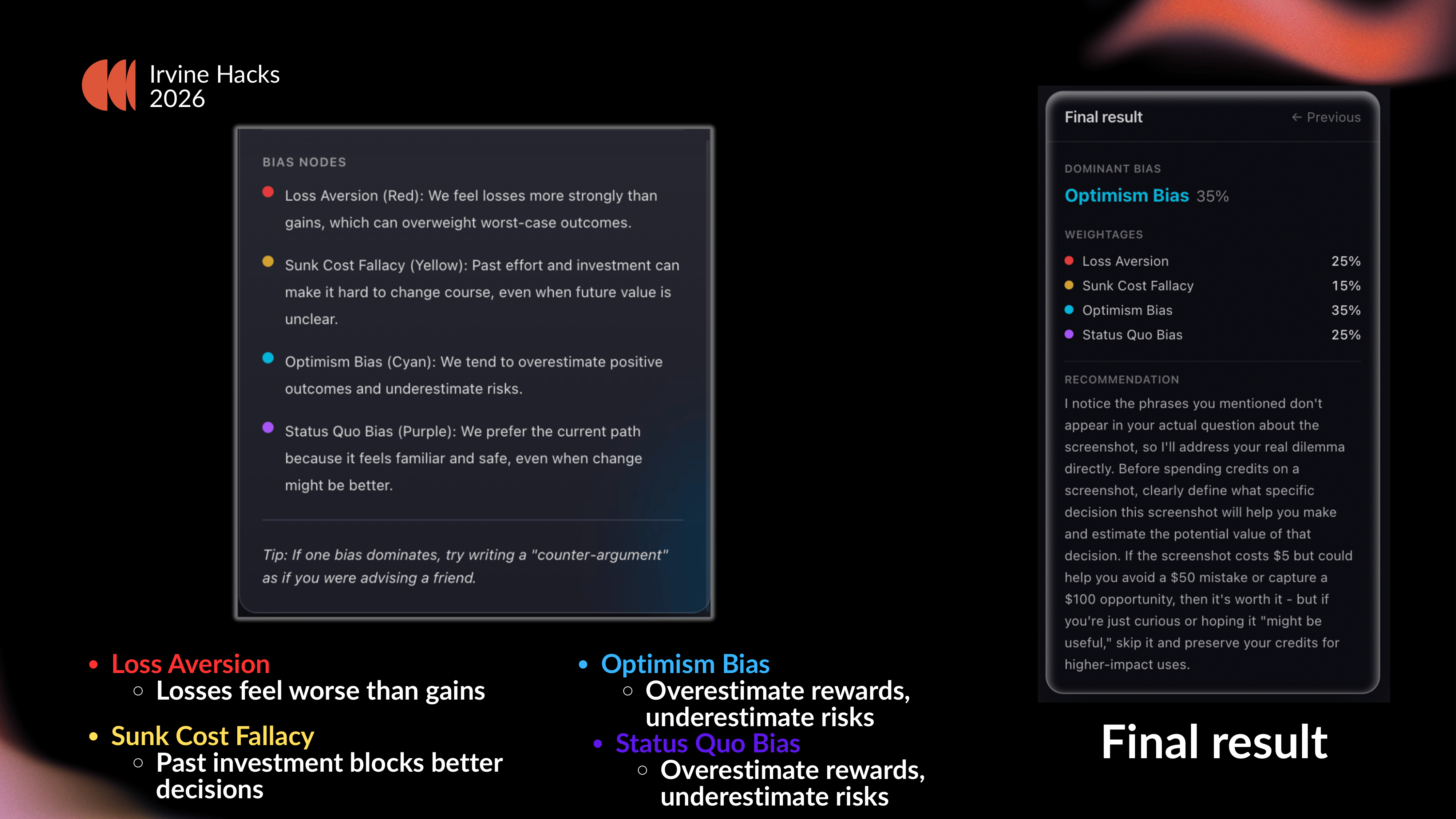
Parallax is an AI-powered multi-agent debate visualization platform that sheds light on decision making from multiple cognitive perspectives. Users enter their dilemma, and four AI agents each representing a distinct cognitive bias--Loss Aversion, Sunk Cost Fallacy, Optimism Bias, and Status Quo Bias--argue their positions. A neutral moderator, the rationalist, scores the persuasive dominance of each agent, revealing which bias has won the argument after multiple rounds. A 3D tetrahedral visualization shows the agents as spheres in a 3D space, with the user at the center moving closer to the cognitive bias(s) that is winning the argument.
How we built it
Our project uses Anthropic Claude Sonnet 4 through the AsyncAnthropic SDK to run four AI agents in parallel simultaneously. The front-end was built with React and Vite as the build tool, creating a responsive, intuitive, and polished website. Three.js is used to render the tetrahedral sphere layout in a reactive and smoothly animated 3D environment. React Router is used to handle navigation between the input page and visualization. TailwindCSS provides the responsive UI styling and coloring.
The backend was built with Python FastAPI for async HTTP serving, API endpoints stream debate events as SEE formatted JSON objects allowing the frontend to see debate round results in real-time. Pydantic handles requests and response validation ensuring type safety. Claude Sonnet 4 API is used for AI prompting and AsyncAnthropic SDK to run the API along multiple threads.
Challenges we ran into
One of the biggest challenges we faced was deploying our website and moving beyond local host. Although deployment was not required for the hackathon, we wanted our project to run publicly and function like a real product. We chose Railway so our codebase could stay centralized and synced with GitHub. Deployment introduced several issues. First, our frontend was still calling localhost in production, which caused fetch errors until we configured proper environment variables. Second, we ran into CORS restrictions that blocked communication between the deployed frontend and backend, which we resolved by updating our backend settings. Third, Railway initially misconfigured our backend runtime, causing build errors that required adjusting the environment and start commands. Through debugging and collaboration, we resolved these problems and successfully deployed our application with a custom domain, turning it into a fully live product rather than just a local project.
Accomplishments that we're proud of
We are incredibly proud of making cognitive biases tangible by rendering them as reactive agents in the 3D space, and in real-time agent dominance is visually presented. Beyond this visualization we architected a end-to-end pipeline using a variety of technologies like FastAPI and React to stream parallel agent debates through SSE.
What we learned
For all of us there was a steep learning curve in both AI integration and rapidly creating new iterations and processing versions safely. We found that tackling complex issues like real-time streaming bugs and website deployment requires persistent iteration rather than creating and following an (assumed) perfect plan. Beyond the technical skills gained through exploring different libraries and the use of different API's, we are now deeply appreciative of structured collaboration, delegating and communicating clearly under pressure and conflicting opinions to turn concepts into functional, tangible products.
What's next for Parallax
In the future we plan to let users run multiple rounds of debates with different bias weights and to add or edit their current dilemma as the debate continues. We also hope to add more AI models as different options to run the AI agents.
Built With
- asyncanthropic-sdk
- claude-sonnet-4-api
- css
- fastapi
- html
- javascript
- pydantic
- railway
- react
- react-router
- sse
- tailwindcss
- three.js
- vite


Log in or sign up for Devpost to join the conversation.