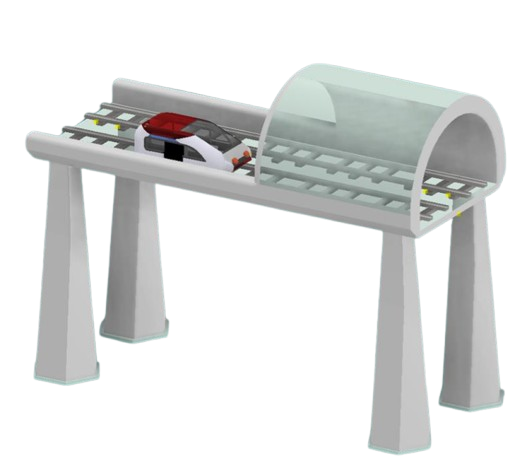
Sstudying emergency response gaps inspired us to rethink how medical care reaches patients over water. Traditional boats are slowed by waves and helicopters are costly and weather-limited. We envisioned a fast, stable, and scalable alternative that could deliver critical care when every second matters. This project pushed us to integrate aerodynamics, structural design, and medical engineering. We learned how air density and speed influence drag and wave formation, and why elevated, streamlined structures reduce slamming forces. We began with concept sketches of a dome-shaped medical pod supported by an elevated bridge. We iterated on bridge height, pillar spacing (60–90 m), and tapered pier geometry to minimize turbulence and structural demand. The paramedic cabin was designed around a central workspace with a shock-absorbing bed, integrated IV/oxygen systems, and vital monitoring to ensure safe in-motion care. The final design balanced performance, cost, and environmental impact. One of the main challenges was designing a structure that could safely operate at high speeds over water while accounting for air density and wave dynamics. Dense air at low elevation transfers energy efficiently to the water surface, leading to large wave formation and dangerous slamming forces on the bridge deck. Balancing bridge height to reduce wave interaction while controlling material use and cost required multiple design iterations. Overall, the project demonstrates how thoughtful engineering can transform emergency response by combining structural efficiency with patient-centered medical design.
Built With
- autdoesk
- cading
- inventor

Log in or sign up for Devpost to join the conversation.