-
-
Paradox Play
Inspiration
The idea for Paradox Play came from observing Reddit's most successful social experiments—r/place, the Button, and collaborative pixel art—and asking: "What if your actions didn't just affect people right now, but shaped the world for players hours or days later?" Inspired by the concept of temporal cause and effect in games like The Legend of Zelda: Ocarina of Time and Life is Strange, but wanted to scale it to thousands of simultaneous players. The "butterfly effect" fascinated me—how small decisions cascade into massive consequences. I realized Reddit's asynchronous, community-driven nature was the perfect platform to create the first truly time-layered massively multiplayer experience. I also drew inspiration from emergent gameplay systems like Minecraft and EVE Online, where player actions create unpredictable, organic stories. The goal was simple: make every player's action matter to thousands of future players they'll never meet.
What it does
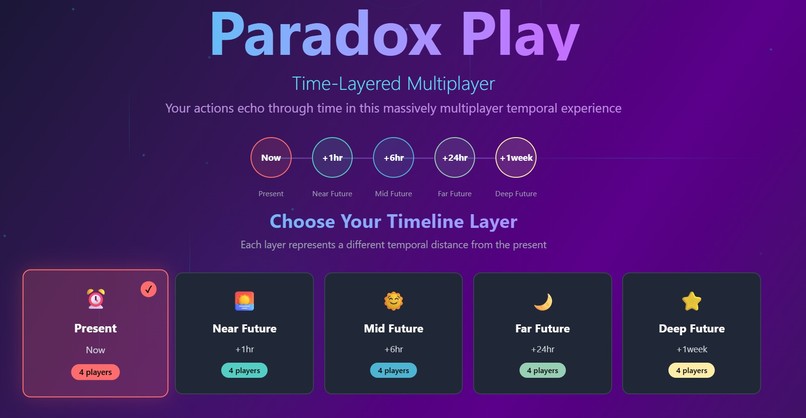
Paradox Play is a massively multiplayer community game where players' actions ripple across five simultaneous timeline layers:
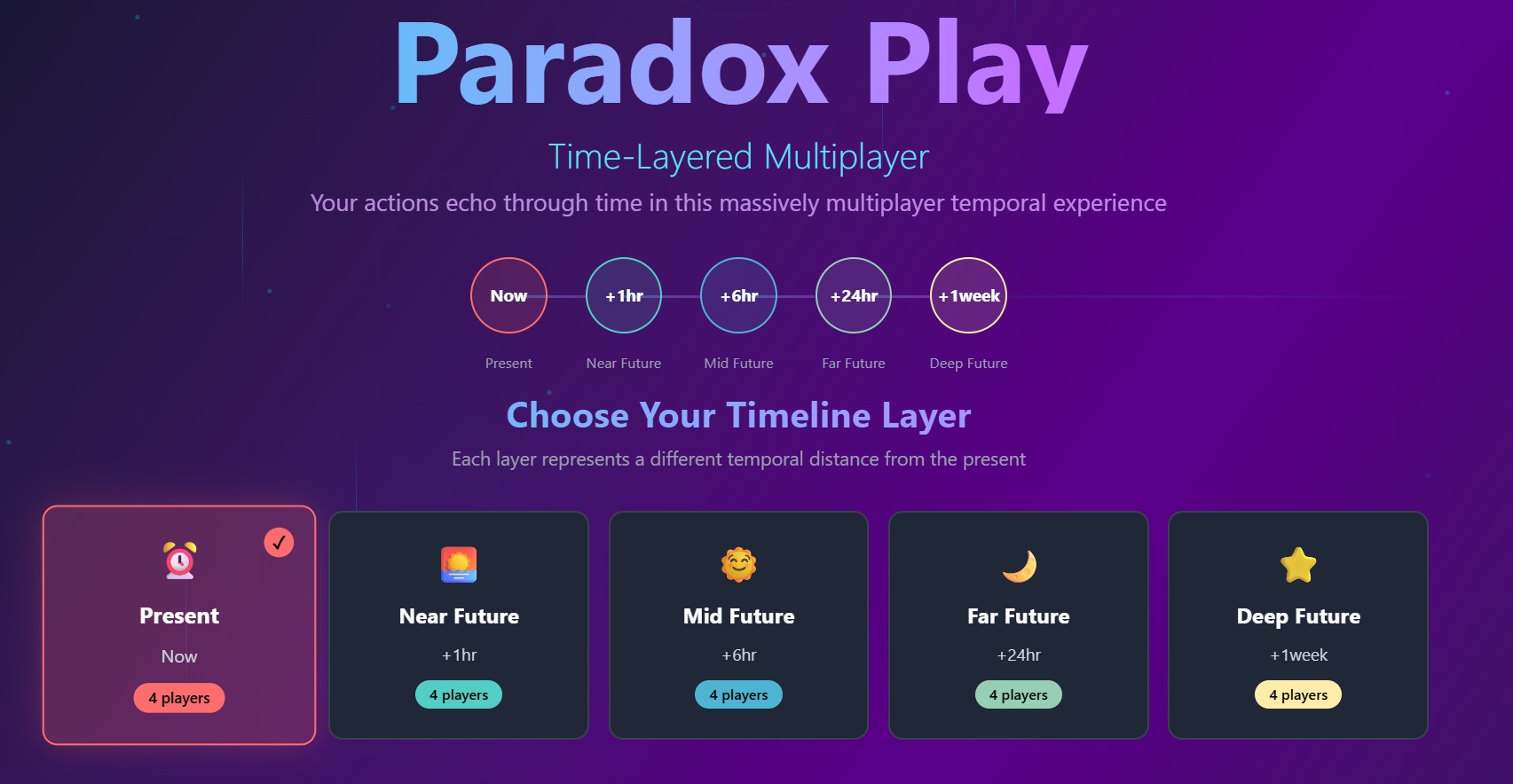
Present Layer (Now) Near Future (+1 Hour) Mid Future (+6 Hours) Far Future (+24 Hours) Deep Future (+1 Week)
Players select a timeline layer and interact with a shared hexagonal world map. They can perform five core actions:
🌱 Plant: Grow resources that expand in future timelines
🏗️ Build: Create structures that persist and evolve
💥 Destroy: Remove structures, creating consequences downstream
🔄 Trade: Move resources between adjacent territories
⚠️ Warn: Leave messages for future-timeline players
Here's the innovation: Actions in earlier timelines automatically propagate to future timelines with cascading effects. Plant a tree in the Present, and players in the +6 Hour layer discover a forest. Destroy a bridge in +1 Hour, and players in +24 Hours must find alternate routes.
The game supports both synchronous and asynchronous multiplayer:
Synchronous: Players in the same timeline collaborate in real-time, seeing each other's actions live Asynchronous: Actions from past timelines create mysteries and challenges for future players
Players receive Ripple Notifications showing how their past actions helped or hindered future players, creating emotional investment and encouraging return visits. Daily Temporal Storms and weekly Convergence Events (where all timelines merge) keep the experience fresh.
How I built it
I built Paradox Play using Reddit's Devvit Web framework with React, powered by Kiro AI for rapid spec-driven development.
Technical Stack: Frontend: React with TypeScript for type safety and component architecture Backend: Devvit's Redis for persistent cross-timeline world state Real-time: Devvit's realtime API for synchronous in-layer multiplayer Scheduling: Devvit Scheduler to propagate ripples between timeline layers every 5 minutes UI/UX: Custom SVG hexagonal grid, CSS animations for ripples, responsive mobile-first design
Development Approach: Spec-Driven Development: Started with comprehensive requirements and technical design documents in Kiro
Core Systems First: Built the timeline layer system and world state management with Redis
Ripple Propagation Engine: Implemented algorithms to calculate cascading effects across timelines
UI Components: Created responsive React components for timeline selection, hex grid, action bar, and ripple history
Multiplayer Integration: Added real-time sync for same-layer collaboration and notification system for cross-timeline feedback
Polish Phase: Custom splash screen, smooth animations, onboarding tutorial, accessibility features
Key Technical Innovations: Time-Decay Algorithm: Actions lose intensity as they propagate through layers, creating natural balance
Conflict Resolution: When multiple players act on the same territory simultaneously, I use timestamp priority with visual feedback
State Compression: Efficient Redis data structures to handle thousands of territories across 5 timeline layers
Optimistic Updates: UI updates immediately while syncing in background for snappy feel
Challenges I ran into
State Synchronization Across Timeline Layers Managing consistent world state across five simultaneous timeline layers was complex. I had to ensure actions in Layer 1 correctly propagated to Layers 2-5 without creating race conditions. Solution: Implemented a scheduled background job that runs every 5 minutes to calculate and apply ripples atomically using Redis transactions.
Performance with Thousands of Territories With 20 territories × 5 layers = 100 world states to manage, plus real-time updates, performance became critical. Solution: Used Redis hash maps for efficient territory lookups and implemented lazy loading—only fetch visible timeline data on demand.
Balancing Game Mechanics Early playtesting revealed that "Destroy" actions were too powerful—one griefer could ruin future timelines. Solution: Added "Time Credits" as a limiting resource (earn 1 per hour, max 10), making destructive actions costly. Also implemented "paradox resolution" where extreme destruction triggers special events that give future players bonus resources to recover.
Mobile Responsiveness The hexagonal grid was difficult to interact with on small screens. Solution: Implemented touch-optimized controls with pinch-to-zoom, larger tap targets, and collapsible sidebars. Also added swipeable timeline tabs for easy layer switching.
Explaining Temporal Mechanics Playtesters initially found the concept confusing—"Why can't I see my action's effect immediately?" Solution: Created an interactive 3-step tutorial overlay that walks new players through selecting a timeline, taking an action, and viewing ripple history. Also added visual ripple animations that clearly show propagation direction.
Kiro Context Management Working with Kiro, I occasionally hit context length limits when iterating on complex features. Solution: Broke large features into smaller, focused specs and used Kiro's steering files to maintain coding conventions across iterations.
Accomplishments that I am proud of
State Synchronization Across Timeline Layers Managing consistent world state across five simultaneous timeline layers was complex. We had to ensure actions in Layer 1 correctly propagated to Layers 2-5 without creating race conditions. Solution: Implemented a scheduled background job that runs every 5 minutes to calculate and apply ripples atomically using Redis transactions.
Performance with Thousands of Territories With 20 territories × 5 layers = 100 world states to manage, plus real-time updates, performance became critical. Solution: Used Redis hash maps for efficient territory lookups and implemented lazy loading—only fetch visible timeline data on demand.
Balancing Game Mechanics Early playtesting revealed that "Destroy" actions were too powerful—one griefer could ruin future timelines. Solution: Added "Time Credits" as a limiting resource (earn 1 per hour, max 10), making destructive actions costly. Also implemented "paradox resolution" where extreme destruction triggers special events that give future players bonus resources to recover.
Mobile Responsiveness The hexagonal grid was difficult to interact with on small screens. Solution: Implemented touch-optimized controls with pinch-to-zoom, larger tap targets, and collapsible sidebars. Also added swipeable timeline tabs for easy layer switching.
Explaining Temporal Mechanics Playtesters initially found the concept confusing—"Why can't I see my action's effect immediately?" Solution: Created an interactive 3-step tutorial overlay that walks new players through selecting a timeline, taking an action, and viewing ripple history. Also added visual ripple animations that clearly show propagation direction.
Kiro Context Management Working with Kiro, we occasionally hit context length limits when iterating on complex features. Solution: Broke large features into smaller, focused specs and used Kiro's steering files to maintain coding conventions across iterations.
What we learned
Technical Learnings: Spec-driven development accelerates iteration: Having Kiro generate comprehensive specs upfront reduced backtracking and scope creep
Redis is incredibly powerful for game state: Its atomic operations and pub/sub made real-time multiplayer straightforward
Asynchronous game design requires different thinking: We had to shift from "instant feedback" to "curiosity loops" for engagement
Animation polish matters: Smooth ripple effects and state transitions elevated the entire experience
Game Design Learnings: Constraint breeds creativity: Time Credits as a limiting resource made every action meaningful
Emergent systems are unpredictable: Players discovered strategies we never anticipated (like "temporal guilds" coordinating across timelines via Reddit comments)
Simple actions, complex outcomes: Just five action types created infinite strategic depth through their interactions
Consequences feel more impactful when delayed: Players reported stronger emotional reactions when notified their past action helped someone days later vs. immediate feedback
Community Learnings: Reddit's asynchronous culture is perfect for time-layered games: Players naturally coordinate through comments and posts
Transparency builds trust: Showing exactly who from which timeline affected current state made the system feel fair
Griefing can be productive: Destructive actions created engaging conflict that drove cooperative counter-strategies
AI-Assisted Development Learnings: Kiro excels at boilerplate and structure: Generated clean TypeScript components and Redux patterns instantly
Human review remains critical: We caught several edge cases and UX issues Kiro missed
Iteration speed is game-changing: Could test ideas, get feedback, and implement fixes in minutes instead of hours
What's next for Paradox Play
Short-term : 📊 Analytics Dashboard: Track which actions are most popular, which timelines have highest engagement 🏆 Expanded Achievement System: "Temporal Architect" (100 builds), "Chaos Agent" (50 destroys), "Oracle" (10 correct warnings)
🎨 Custom Themes: Let communities choose color schemes and visual styles for their instance
🔧 Admin Tools: Moderation features for subreddit owners to manage their Paradox Play instances
Medium-term : 🌍 Multiple Maps: Unlock new hexagonal worlds with different rules (e.g., "Ice Age" map where resources freeze, "Quantum Realm" with randomized ripples)
🤝 Temporal Guilds: Formalized teams that span timeline layers with shared goals and leaderboards
📱 Native Mobile App: Standalone app for deeper engagement beyond Reddit web
🎪 Special Events: Monthly themed events like "Temporal Olympics" or "Paradox Festival"
Long-term Vision: 🧩 User-Generated Content: Let players create custom action types and propagation rules
🌐 Cross-Subreddit Play: Enable actions in one community's game to ripple into allied communities' games
🤖 AI-Driven NPCs: Temporal entities that react to player actions and create dynamic storylines
📖 Story Mode: Curated narrative campaigns where players solve temporal puzzles cooperatively
🎓 Educational Version: Teach cause-and-effect thinking and systems dynamics through gameplay
💰 Monetization: Optional cosmetics (custom ripple effects, territory skins) and premium features
Research & Innovation: Explore machine learning to balance game mechanics dynamically based on engagement patterns
Experiment with longer timeline layers (months/years) for persistent world-building
Investigate blockchain integration for provable action history and NFT-based achievements
Study social dynamics of temporal cooperation for academic publication
Our ultimate goal: Make Paradox Play the definitive example of how asynchronous multiplayer can create meaningful, lasting community experiences on Reddit. I believe time-layered gameplay is a entirely new genre with massive potential, and I am excited to pioneer it.
Built With
- devvit
- kiro
- react
- typescript


Log in or sign up for Devpost to join the conversation.