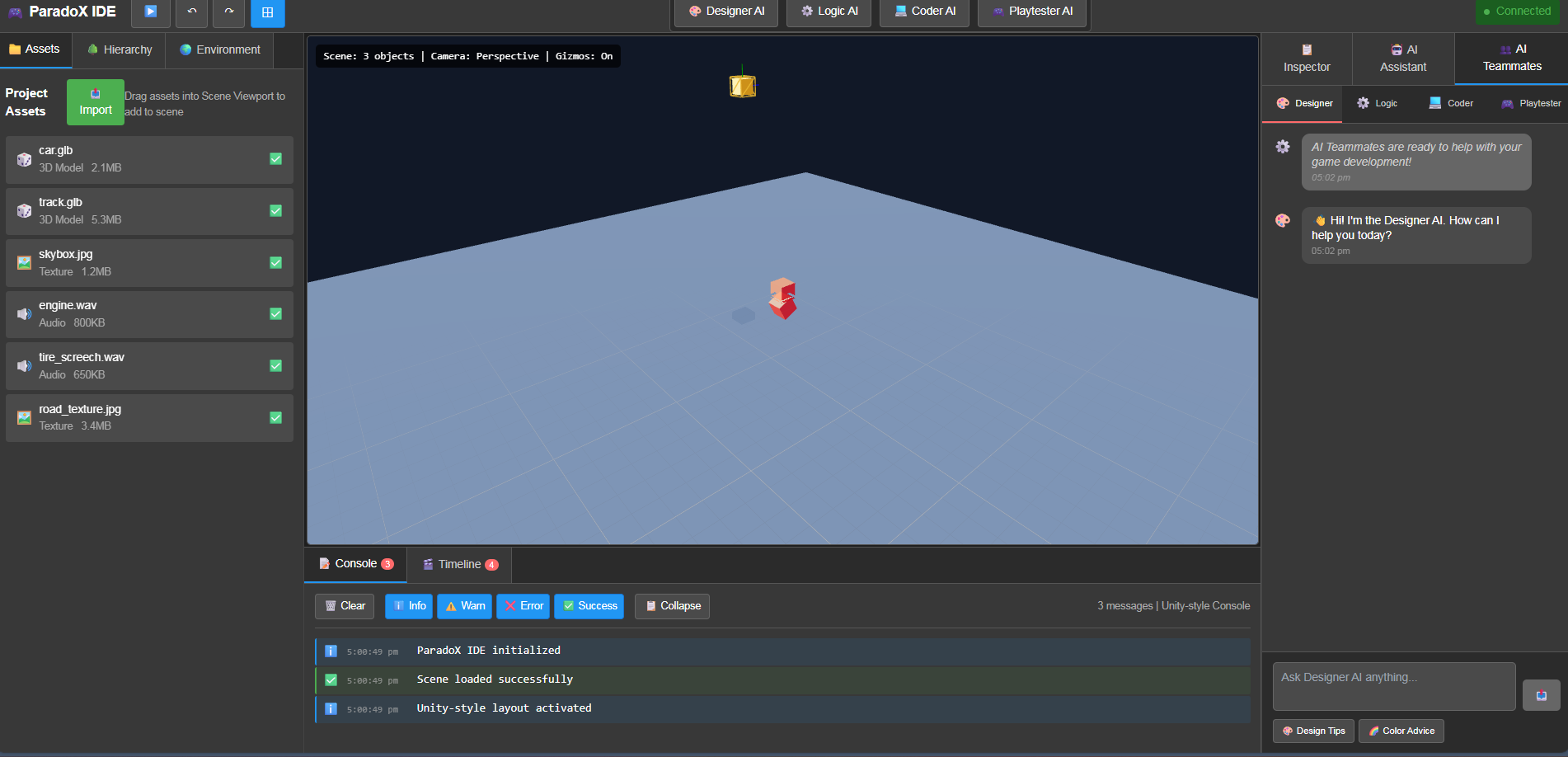
Inspiration: I was inspired to build ParadoX IDE to explore how AI can fundamentally change game development. Traditional IDEs require a lot of manual effort for coding, asset management, and testing. I wanted to create an environment where AI can assist throughout the development process — from designing levels to writing code, testing gameplay, and debugging — making game creation faster, smarter, and more accessible.
What I Built: ParadoX IDE is an AI-powered game development environment that supports 2D, 3D, and 4D games. The IDE includes:
AI Teammate System: Four AI roles (Coder, Designer, Playtester, Debugger) that collaborate on tasks.
Scene Designer & Asset Management: Drag-and-drop asset placement, multi-format support (GLB, GLTF, FBX, PNG, JPG, WAV, MP3), and persistent storage.
Code Editor & Game Preview: Real-time syntax highlighting, IntelliSense, and instant game testing.
Crash-Proof System: Error boundaries and fallback mechanisms to prevent IDE crashes.
For the hackathon demo, due to limited time, I focused on a basic game design, which I created entirely with the help of the AI Teammate system.
Challenges Faced:
Integrating multi-dimensional game support (2D/3D/4D) with a consistent workflow.
Ensuring real-time asset loading and placement without crashes.
Coordinating multiple AI roles to handle complex tasks without conflicts.
What I Learned:
How to design AI-assisted workflows for collaborative game development.
Effective handling of real-time 3D rendering, asset management, and error recovery.
Best practices for spec-driven development and integrating local AI models like LM Studio.
Impact: ParadoX IDE demonstrates how AI can assist developers in not just writing code faster, but making better architectural decisions, smarter asset management, and faster game prototyping. This hackathon version is a proof of concept, showcasing the potential of AI-assisted game development.
💻 Note: My laptop cannot handle very large AI models, so I used a smaller LM Studio model: DeepSeek R1 Distill Qwen 1.5B Q8_0. You can test the IDE with larger models for more advanced AI capabilities.
Built With
- ai
- codemirror
- fastapi
- javascript
- jwt
- lighting
- lm
- python
- react
- three.js
- zustand


Log in or sign up for Devpost to join the conversation.