-
-
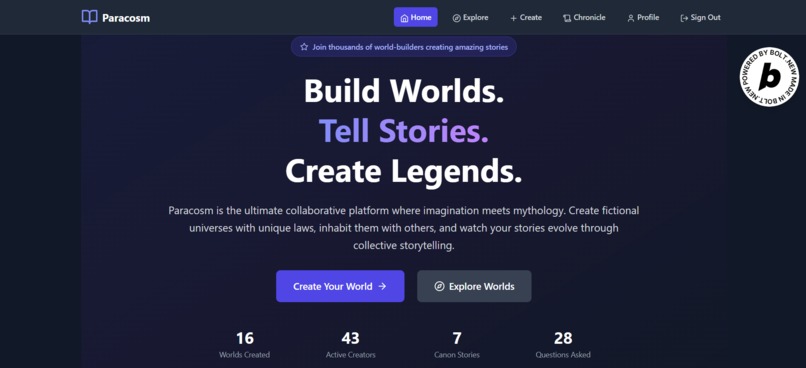
Paracosm Landing Page Hero Section
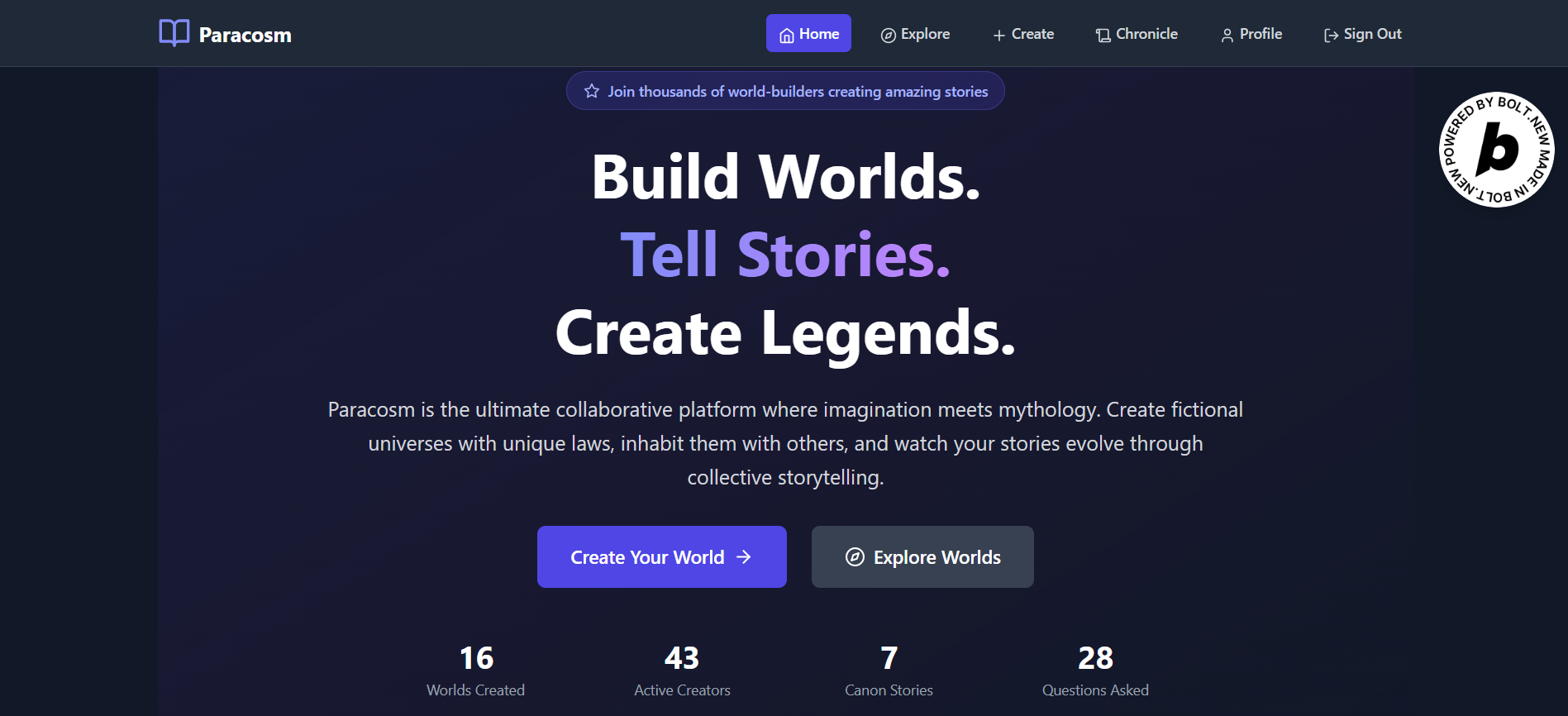
🌌 Inspiration
We noticed a recurring pain point across worldbuilding communities: despite immense creative effort, most fictional worlds end up scattered across Google Docs, Reddit posts, and forgotten folders. We came across countless Reddit threads asking:
- “Where can I actually collaborate on a fictional world?”
- “I’ve built my world for 5 years but have no one to share it with.”
- “How do I organize timelines, roles, or lore without overwhelming myself?”
At the same time, we saw that existing platforms either feel too academic, overly complex (like World Anvil), or socially disconnected. Nothing truly captured the energy, messiness, and joy of live creative exploration.
Paracosm was born from that unmet need — a tool to create, expand, and share entire fictional worlds, while letting others step in not as readers, but as inhabitants.
🛠️ What it does
Paracosm is a collaborative worldbuilding platform where anyone can:
- Create and manage their own fictional world with laws, roles, timelines, and lore.
- Share it via a unique “Ticket to My World” — a beautiful card others can use to explore and join.
- Assign roles and rules, allowing other users to join their world as specific characters or personas.
- Fork worlds to remix existing concepts while giving credit to the original creator.
- Answer questions, build paradoxes, and post scrolls to deepen the lore in real-time.
- Add timelines (e.g. “Age of Collapse”) and world records (e.g. “The Fall of the White Star”) to structure evolving narratives.
- Interact through built-in community posts, scrolls, and comments tied to each world — all while keeping the creator at the center.
Worlds aren’t static documents. In Paracosm, they’re living, interactive realms with an active creator dashboard and visible feedback loops.
🧱 How we built it
We built Paracosm entirely in one-shot using Bolt.new, optimizing token usage down to every last component. Here's a quick breakdown:
- Frontend: Auto-generated using Bolt’s powerful React+Tailwind engine with 6 main screens: Landing Page, Explore Worlds, Create World, World View, World Dashboard, and Profile.
- Data: Stored and managed through Supabase, enabling real-time CRUD operations, user auth, forking logic, and content updates without paid APIs.
- World Architecture: Designed a flexible schema to accommodate nested lore structures like timelines, scrolls, laws, world records, and forks — all mapped to their respective creators.
- Collaboration Flow: Users can ask questions, suggest ideas, and receive responses from the world’s creator, building a structured-yet-fluid creative exchange.
Despite the complexity, the entire MVP was built under 3 million tokens, without using paid AI tools, backend APIs, or custom servers.
🧗 Challenges we ran into
- Egress limitations on Supabase: After scaling past 30 users in 48 hours, our app started hitting bandwidth limits, forcing us to implement optimization techniques and caching strategies to prevent downtime.
- Fitting ambitious UX into Bolt: Designing a fully-fledged collaborative worldbuilding engine within one prompt meant abstracting complex UX into highly structured, minimalistic flows. We iterated fast and had to sacrifice visual flair for functional clarity.
- Avoiding feature bloat: With endless creative ideas from users, we had to distinguish between tools that help worldbuilding and features that distract from it.
- Emotional complexity: Many users treat their worlds as deeply personal, so we had to build features (like scrolls and forks) that respect authorship while still inviting interaction.
🏆 Accomplishments that we're proud of
- Organically attracted 43 users and 12 fully developed worlds within 7 days — purely through community buzz and soft mentions on Reddit.
- Saw real-time roleplay unfold in multiple worlds. Some users even created entire governments, paradoxes, and factions — unprompted.
- Our “Ticket to My World” feature became a surprise hit — many users shared their worlds across Discord with it.
- Forking became a creative engine: one user expanded an existing world into a twisted parallel dimension — with permission from the original creator.
- Received incredibly moving feedback from users who had never shared their world before but felt safe doing so on Paracosm.
📚 What we learned
- Creativity craves boundaries. Giving users a structure (laws, timelines, scrolls) helped them go deeper, not shallower.
- Worldbuilding is lonely — but it doesn’t want to be. Many creators aren’t looking for followers or fans. They want conversations. Paracosm enables that.
- You don’t need AI to be magical. We focused on human interaction, thoughtful UX, and emotional detail — and users loved it.
- Collaborative fiction is real, but fragile. Letting others into your world takes trust, and trust is earned through clarity, respect, and design.
- Reddit is still the internet’s best early validator. With the right post, tone, and feedback loop, niche communities can give you gold.
🔮 What’s next for Paracosm
- World Maps and Image Uploads: Users can upload custom maps and gallery images to visualize their realms.
- Spell Cast & Magic Systems: For fantasy creators, we’re launching a flexible framework to add spells, magic rules, and consequences.
- World Boards: Each world gets a public board for updates, lore drops, and creator announcements.
- Rich Forking Mechanics: Let users fork worlds with changelogs, alternate canons, and even diverging timelines.
- Mobile Optimizations: The current experience is desktop-first; we’re planning a mobile-first rebuild to reach a wider audience.
- Creator Analytics: Let creators track engagement, lore depth, and “world health” metrics to keep them motivated.
Paracosm isn’t just a writing tool. It’s a narrative playground for creators, dreamers, rebels, and lore nerds.
It’s Google Docs meets Middle-earth. And it’s just getting started.
Built With
- bolt.new
- postgresql
- supabase
- typescript
- vercel
- vite


Log in or sign up for Devpost to join the conversation.