Inspiration
The Nintendo 3DS made me want photos I could look into.
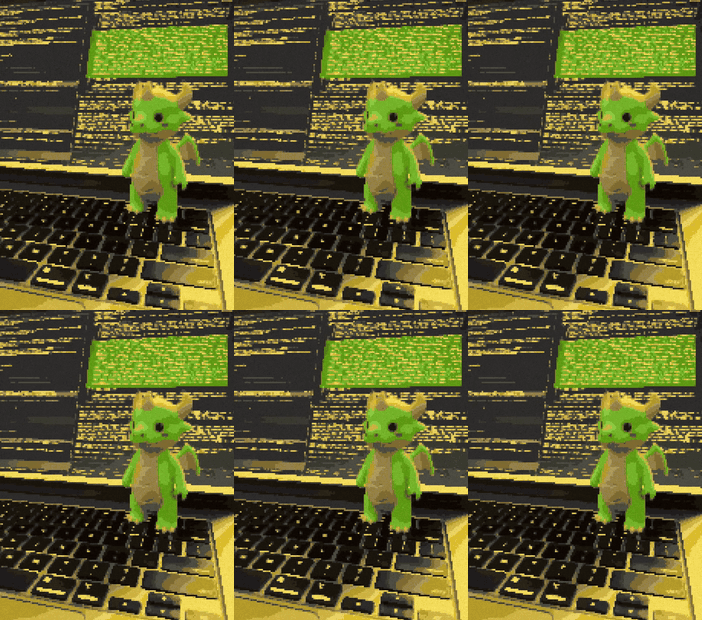
ParaEditor started with that fascination. I wanted to take an ordinary photo, give it depth, and make its perspective respond to the person looking at it. Phones and tablets already have cameras and motion sensors. I wanted to use them to make images that feel alive.
Then I wanted an editor built around that idea.
What it does
ParaEditor turns ordinary photos into interactive scenes with depth and perspective. Head tracking or device tilt changes the view as you move. You can edit the image, apply mathematical treatments, draw your own marks, and turn the composition into a moving piece.
The effect system is where things get interesting. Effects are built from mathematical blocks. You can rearrange those blocks, open the functions inside them, and get down to the executable source that draws the image.
That makes the effects themselves part of the creative process. A texture can become a photo treatment or the basis of a custom brush. You can experiment with the math, see what happens, and keep the result as something you made.
Radeon Cloud GPUs handle the heavier AI preparation while your device handles the creative interaction and rendering. The iPad becomes the place where you take the photo, work on it, and explore the result. A public gallery gives those pieces somewhere to go.
How we built it
I built ParaEditor with Claude Code coordinating Codex agents for implementation and review.
The editor uses Preact and a custom WebGL2 renderer, with hand-written shaders for the mathematical effects and perspective rendering. Cloudflare Pages and Workers host the application and its APIs. Radeon Cloud provides GPU processing for depth and background preparation. Neon Postgres stores project records, while Cloudflare R2 stores image assets and published gallery pieces. Figma was used for user experience planning.
Challenges we ran into
The biggest challenge was building an entire editor in 36 hours.
A parallax effect sounds like a contained project. Once you want people to create something with it, you need selection tools, layers, drawing, history, saving, and export. Each feature has to work with the others. As a solo developer, choosing where to spend that time was difficult.
Mobile memory was another major obstacle. Running the larger models in the browser pushed my phone and iPad beyond their limits. Radeon Cloud gave me a way to move that preparation onto GPUs and keep the editor usable on those devices.
That changed how I thought about the project. The cloud could make more demanding creative tools available on the hardware people already have.
Accomplishments that we're proud of
I’m proud of making something I wanted to exist.
Taking a flat photo and seeing its perspective respond to movement is still my favorite part. Opening an effect, changing how it works, and carrying that texture into a brush gives the editor another kind of possibility.
I like visuals with some crunch and imperfection. I wanted a tool that leaves room for people to make those choices themselves, and to make things I would never have thought of.
What we learned
I learned how much of an image’s character comes from math. A few functions, their parameters, and the order they run in can produce very different results.
Cloud GPUs were my favorite discovery. Being able to connect a browser editor to remote compute opened up possibilities I had ruled out after hitting mobile memory limits.
I also learned a lot about working with coding agents. They helped me build far more than I could have written alone in the time available. Choosing the scope, coordinating the pieces, and testing the actual experience still took attention.
What's next for ParaEditor
I’m keeping ParaEditor open source so people can explore the rendering, take apart the effects, and build on the ideas.
There’s plenty left to polish. I want to make it easier to create and share effects and brushes, and keep exploring what depth and perspective can bring to an image editor.
The Radeon Cloud GPU service will shut down after the hackathon. I plan to keep the website online for as long as I can afford it, with desktop hardware running the models locally. Keeping the same cloud assisted iPad experience available will depend on future GPU hosting.
Built With
- cloudflare
- computational-photography
- computer-vision
- figma
- glsl
- neon-postgres
- onnx-runtime
- open-source
- parallax
- photo-editing
- preact
- procedural-art
- radeon-cloud
- typescript
- webgl2


Log in or sign up for Devpost to join the conversation.