Inspiration
Two of the drugs that actually work against malaria came out of plants that people were already using against fever. Quinine was isolated from Cinchona bark in 1820. Artemisinin was found in 1972 because Tu Youyou went back and read a fourth-century Chinese fever text.
So the premise is not naive. But two successes do not tell you whether traditional records are predictive in general, because nobody counts the failures. Every plant recorded as a fever remedy that turned out to contain nothing interesting simply never got written up.
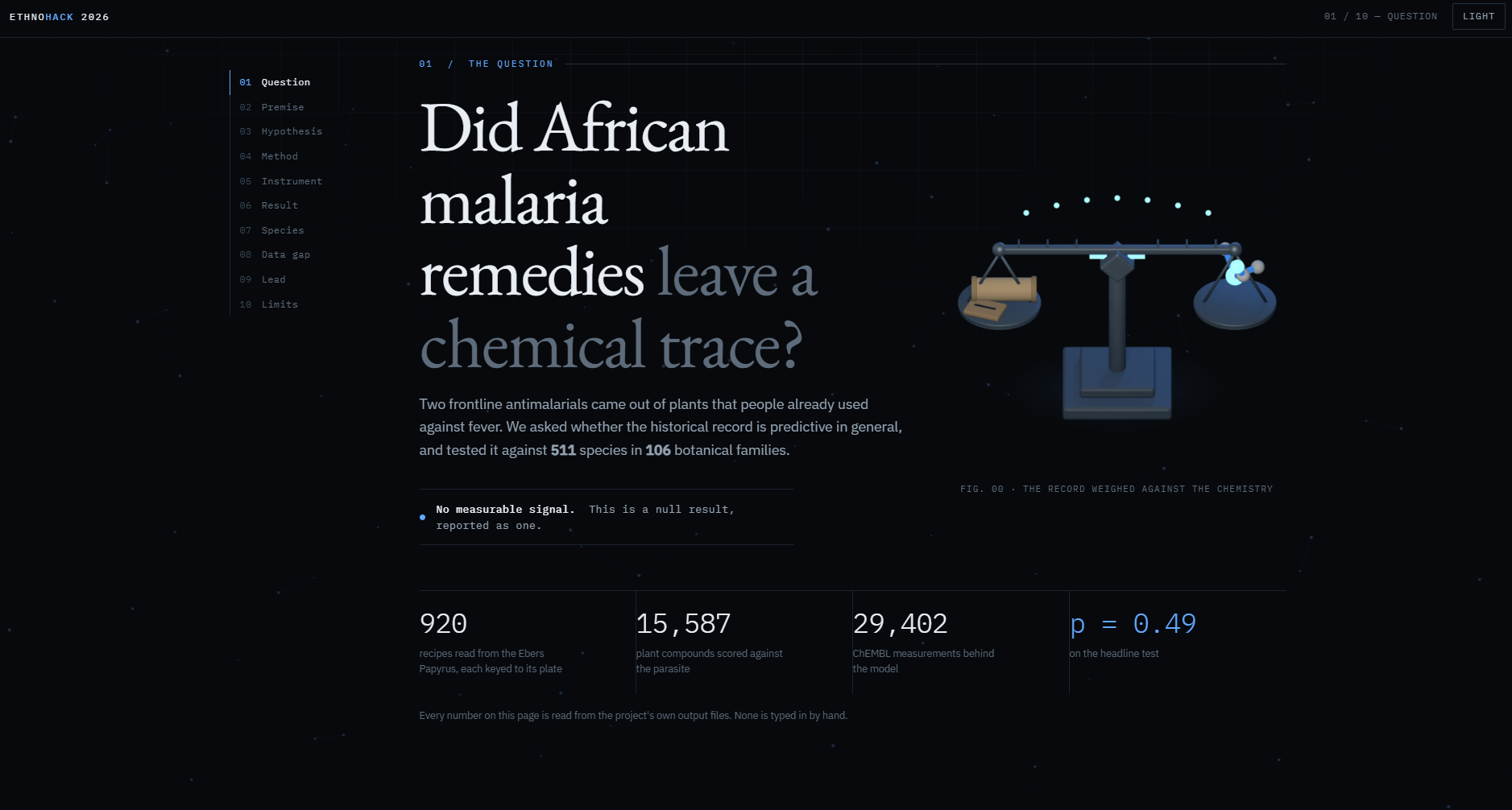
We wanted to count the failures. The question was narrow enough to be falsifiable:
▎ Do plants that African sources record as malaria remedies contain a higher share of compounds predicted active against Plasmodium falciparum than other medicinal plants from the same source?
What it does
Papyrus to Plasmodium is a reproducible pipeline from historical text to statistical test, plus an interactive readout of what it found.
Live demo: ethnohack-malaria.vercel.app
It reads two historical sources, structures every remedy with full provenance, resolves plant names to modern accepted names, pulls the known chemistry of those plants, scores it with a model trained on real antimalarial assays, then runs a pre-specified test.
The answer is no. Across 511 species in 106 botanical families, the difference in mean predicted activity between malaria-use plants and the rest is
$$\Delta = +0.017,\quad \text{95% CI } [-0.038,\ +0.079],\quad p = 0.49$$
and it collapses to $+0.003$ ($p = 0.90$) once species whose score rests on fewer than five compounds are removed. We report that as a null result rather than dressing it up.
The finding worth more: 688 of the 1,210 Southern African medicinal species we looked up have no compound recorded in open natural-product databases at all. Not a gap in our pipeline — a gap in the world's published chemistry.
How we built it
Sources. The Ebers Papyrus (c. 1550 BCE) via H. Joachim's 1890 German translation, public domain, and Watt & Breyer-Brandwijk's The Medicinal and Poisonous Plants of Southern Africa (1932).
Extraction. We segmented Joachim into 716 recipe units, each carrying its Joachim page and papyrus plate number, then translated and structured them into 920 recipes with 3,960 ingredient mentions and 100 candidate plant taxa. Every identification records who proposed it — Joachim, Brugsch, Ebers, or an unambiguous German common name — and a confidence level. Untranslated Egyptian plant names stay untranslated rather than being guessed at.
From Watt (1932) we read all 63 malaria and blackwater-fever statements by hand into 33 structured use records, with 9 further statements excluded for a recorded reason — including the folk belief that the fever tree (Acacia xanthophloea) causes malaria.
Names. 1,236 species reconciled against the GBIF Backbone Taxonomy, synonyms resolved (Sclerocarya caffra → Sclerocarya birrea, Kaempferia ethule → Siphonochilus aethiopicus).
Chemistry. 15,605 compounds from LOTUS via the Wikidata SPARQL endpoint.
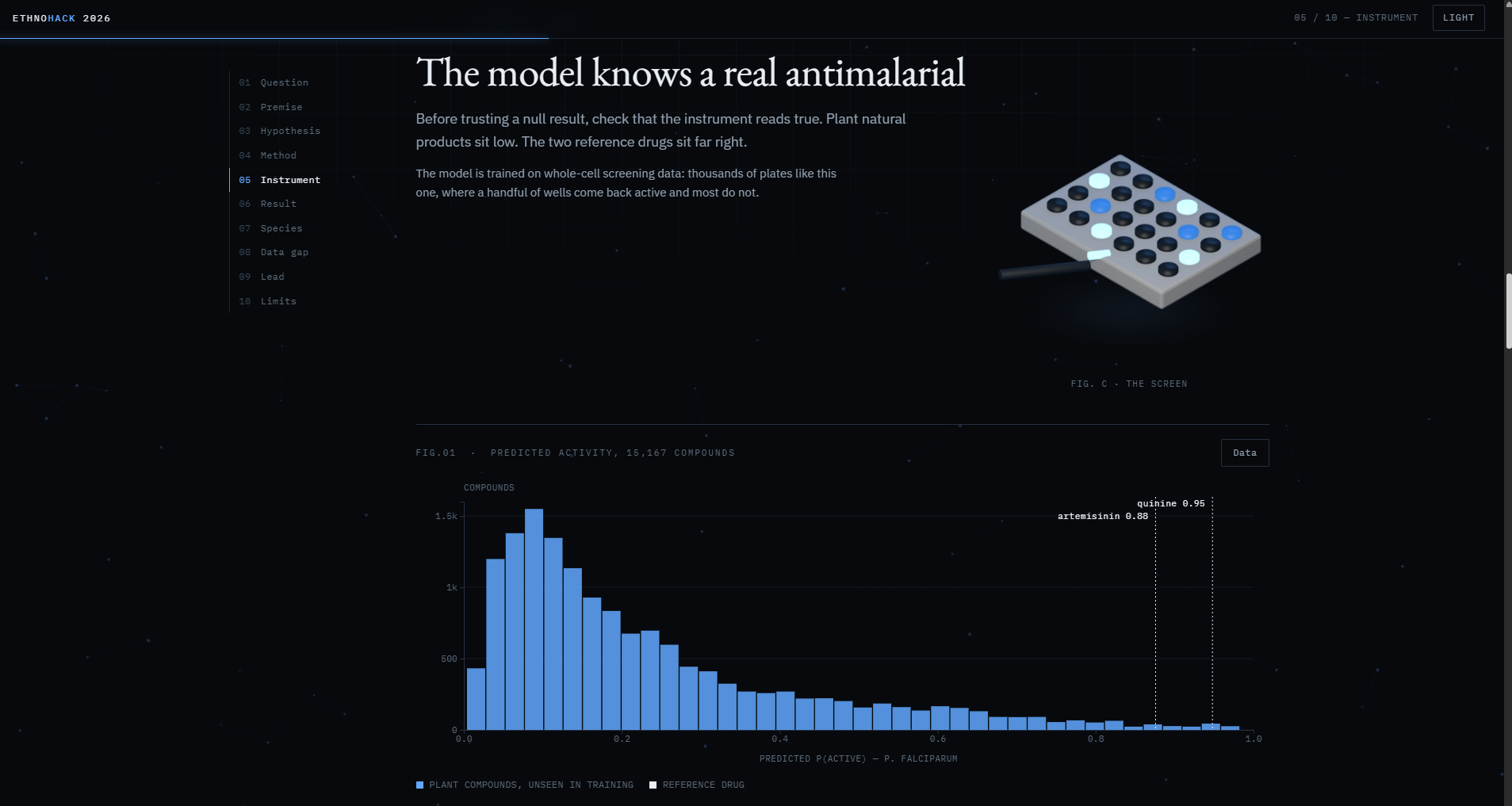
Model. 79,074 IC50/EC50 measurements against P. falciparum (ChEMBL target CHEMBL364), collapsed to 29,402 labelled compounds. Morgan fingerprints plus physicochemical descriptors into a gradient-boosted classifier, evaluated with scaffold-grouped cross-validation, because random splits leak analogue series between train and test and would have inflated the score:
$$\text{ROC AUC} = 0.889 \pm 0.006,\qquad \text{average precision} = 0.933$$
Positive controls pass — quinine $0.948$, artemisinin $0.876$ — and both are then excluded from every analysis.
Test. Permutation of the malaria label within botanical family, because related plants share chemistry and a naive shuffle would overstate significance. Three sensitivity analyses, all pre-specified.
Stack. Python, RDKit, scikit-learn, pandas. The web app is buildless — d3 v7 and vanilla JavaScript, four static files on Vercel. The six isometric dioramas were modelled and rendered in Blender with an orthographic camera at 54.7356°/45°, scripted so they rebuild from source.
Challenges we ran into
The Ebers Papyrus never mentions malaria. Out of 920 recipes, exactly one is explicitly for fever-heat (Plate 44). We had planned the whole test around it. Rather than stretch four weak proxies into a result, we moved the statistics onto Watt (1932) and kept Ebers as a documented historical case study.
West Africa is missing. Dalziel's 1937 Useful Plants of West Tropical Africa has no open full text; the Biodiversity Heritage Library returns HTTP 403 to automated access. We say so rather than quietly dropping it.
Copyright. Watt (1932) is probably still in copyright, so the raw OCR is git-ignored and never deployed. Only paraphrased facts and statement identifiers are published.
Circularity. Malaria plants were often assayed because of their traditional use. Scoring compounds the model had already seen would have manufactured a positive result. Every training compound is excluded — 420 of them.
A silent name-matching error. GBIF fuzzy-matched Ophiocaulon gummifera to Adenia cissampeloides at 96% confidence. It is actually the basionym of Adenia gummifera. Caught by reading all 33 matches by hand; the override is recorded in the code with its reason. This is the kind of error that never surfaces in an aggregate statistic.
Research-effort bias. Better-studied plants do score slightly higher (Spearman $\rho = +0.18$). We checked whether that explained the result: it does not, because malaria plants are not better studied — median 9.5 compounds against 12.0 for the background.
Accomplishments that we're proud of
We pre-specified the analysis before computing anything. The statistic, the permutation scheme and all three sensitivity analyses were written to docs/HYPOTHESIS.md and committed before any result existed. We cannot be accused of fishing for the version that worked.
We can say what we could and could not have detected. The minimum detectable difference at 80% power is $0.064$, about $0.52$ standard deviations. So we rule out a moderate-to-large effect and explicitly cannot rule out a small one. "We found nothing" and "we could not have found anything" are different claims, and most null results never distinguish them.
Every claim is traceable. Each recipe carries its page and plate number. Each malaria use carries the statement identifiers it was read from. Each excluded statement carries its reason.
We published a null result rather than an overclaimed hit. With 167 compounds scoring above 0.5, it would have been easy to write a different submission.
What we learned
Absence in the record is itself a finding. A 20-metre medical papyrus with 920 remedies and one fever-heat entry tells you something real about what ancient Egyptian physicians were treating — and about the limits of reading modern disease categories backwards into old texts.
Continuity across the record is weaker than the story suggests. Zero of the Ebers fever plants appear in Watt's Southern African malaria records — not at species level, not even at genus level. Three and a half thousand years and five thousand kilometres apart, with different floras, the overlap is nil. The quinine-and-artemisinin narrative makes that sound inevitable; it is not.
Traditional efficacy and parasite killing are different things. Many recorded uses are emetic, diaphoretic or diuretic. A plant that made a feverish patient sweat could earn a lasting reputation without ever touching Plasmodium. Watt himself doubted several, calling marula bark "extremely unlikely" to benefit malaria.
The binding constraint is chemistry, not text. Digitising more ethnobotany will not help while most of these plants have never had their compounds described.
What's next for Papyrus to Plasmodium
Close the data gap, because it is the real bottleneck. The ranked list of 961 untested compounds from malaria-use plants exists and is in the repository. 167 score above 0.5. They need an assay.
Cassia abbreviata first. It is the only plant in Watt (1932) carrying a clinical observation rather than a report of custom: a physician in East Africa found a root decoction helped in blackwater fever, and a fluid extract was manufactured and prescribed. It is also the highest-scoring malaria plant with more than ten recorded compounds. The caveat is in the write-up — its top compounds share an identical predicted score, so they are near-identical structures, a handful of scaffolds rather than eleven findings.
West Africa. If Dalziel (1937) can be obtained legally, the same pipeline runs on it unchanged and roughly triples the malaria-use sample. Twenty species cannot carry this question.
Expert review. The historical extraction is AI-assisted and labelled throughout as a draft. It needs a pharmacognosist and an Egyptologist before anyone builds on it.
Responsible use
No plant named in this project is shown to treat malaria. Every prediction is a hypothesis for laboratory testing, not medical advice or a validated finding.
AI disclosure. Generative AI (Claude) was used for the German-to-English translation and structured extraction of the historical texts, and to assist with code. All AI-produced extractions are labelled as drafts in the repository pending expert review. The statistical design, the curation decisions and the interpretation are ours. Every figure on the site is generated from the project's output files; none is hand-entered.
Built With
- blender
- canvas
- chembl
- cheminformatics
- css3
- d3.js
- data-visualization
- drug-discovery
- gbif
- html5
- javascript
- machine-learning
- matplotlib
- natural-language-processing
- numpy
- pandas
- pillow
- python
- rdkit
- scikit-learn
- sparql
- svg
- vercel
- wikidata

