-

Landing Page
-
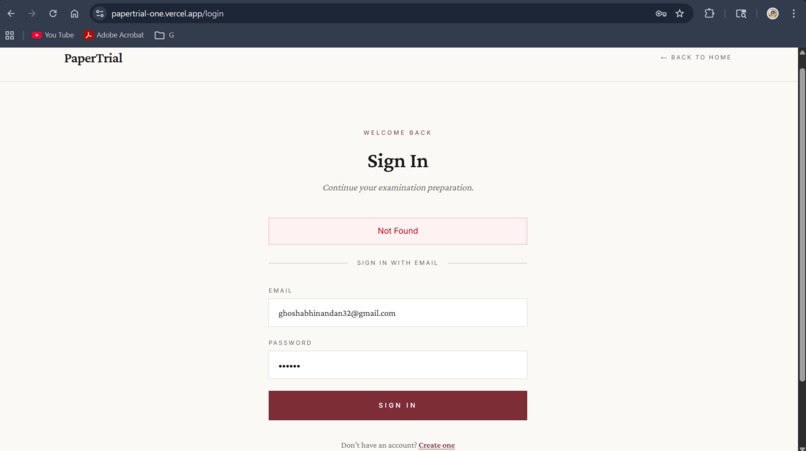
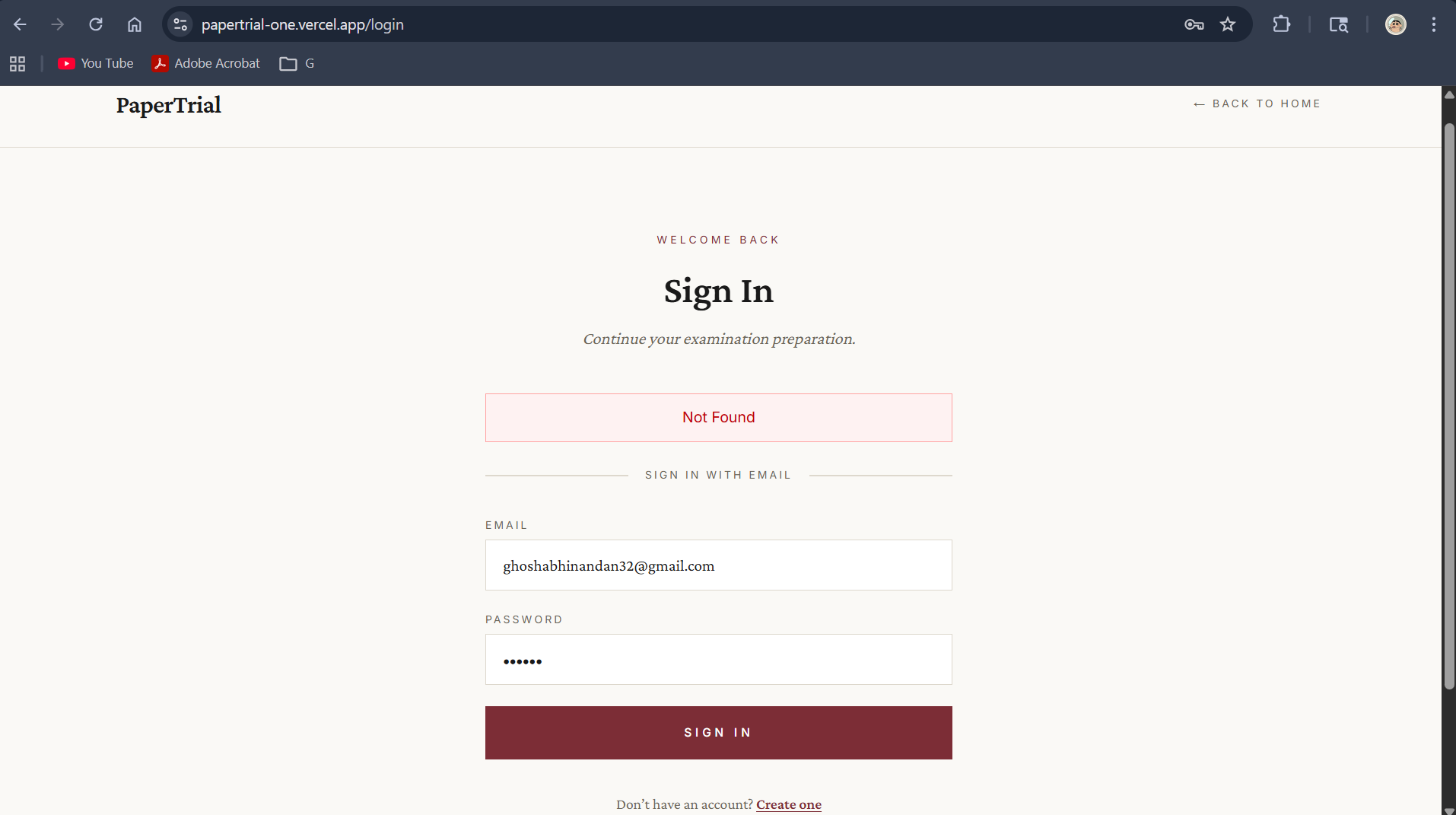
Log in Page
-
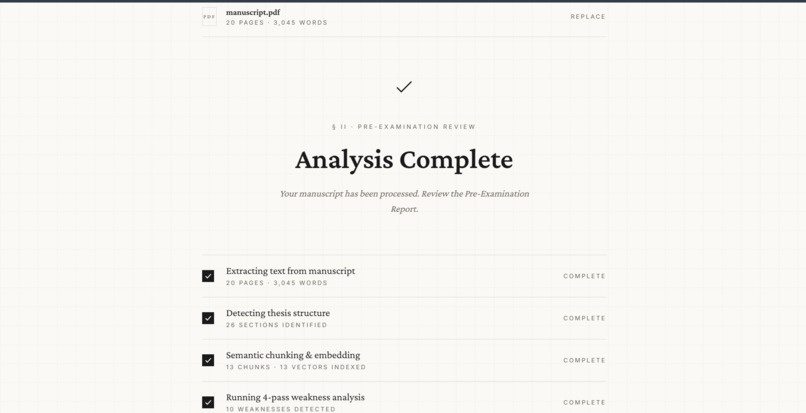
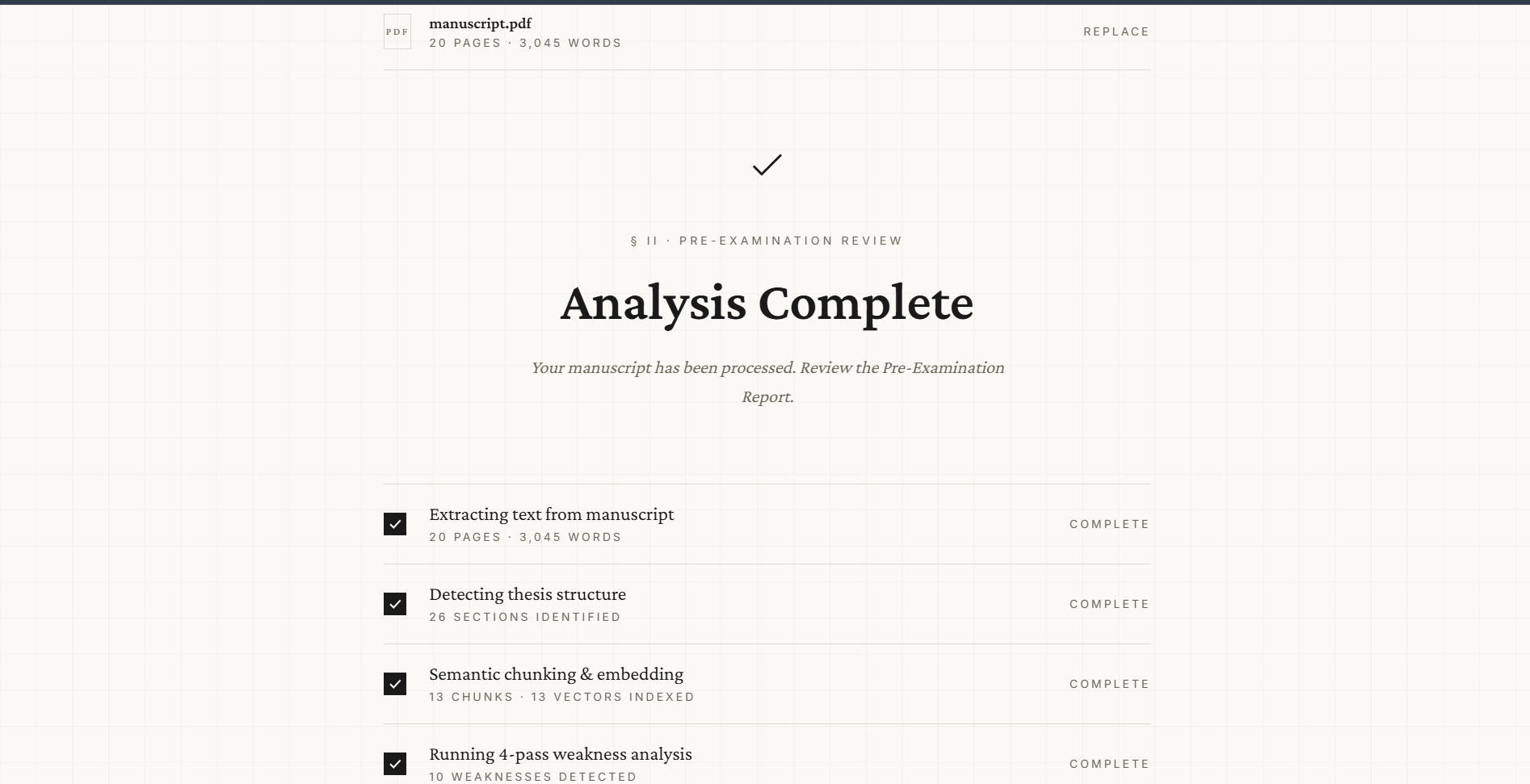
Pre Analysis
-
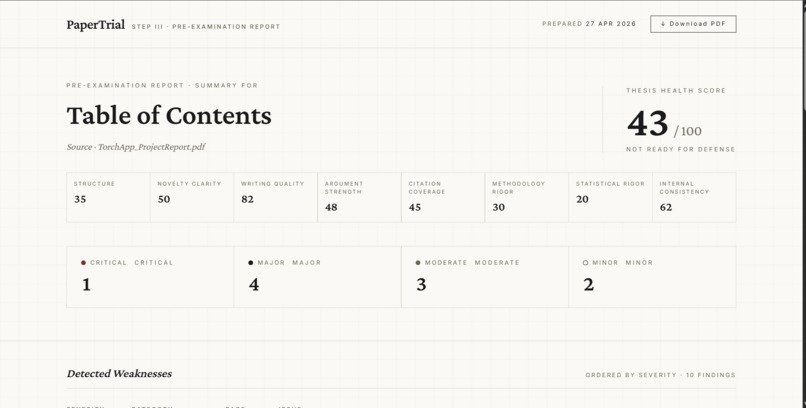
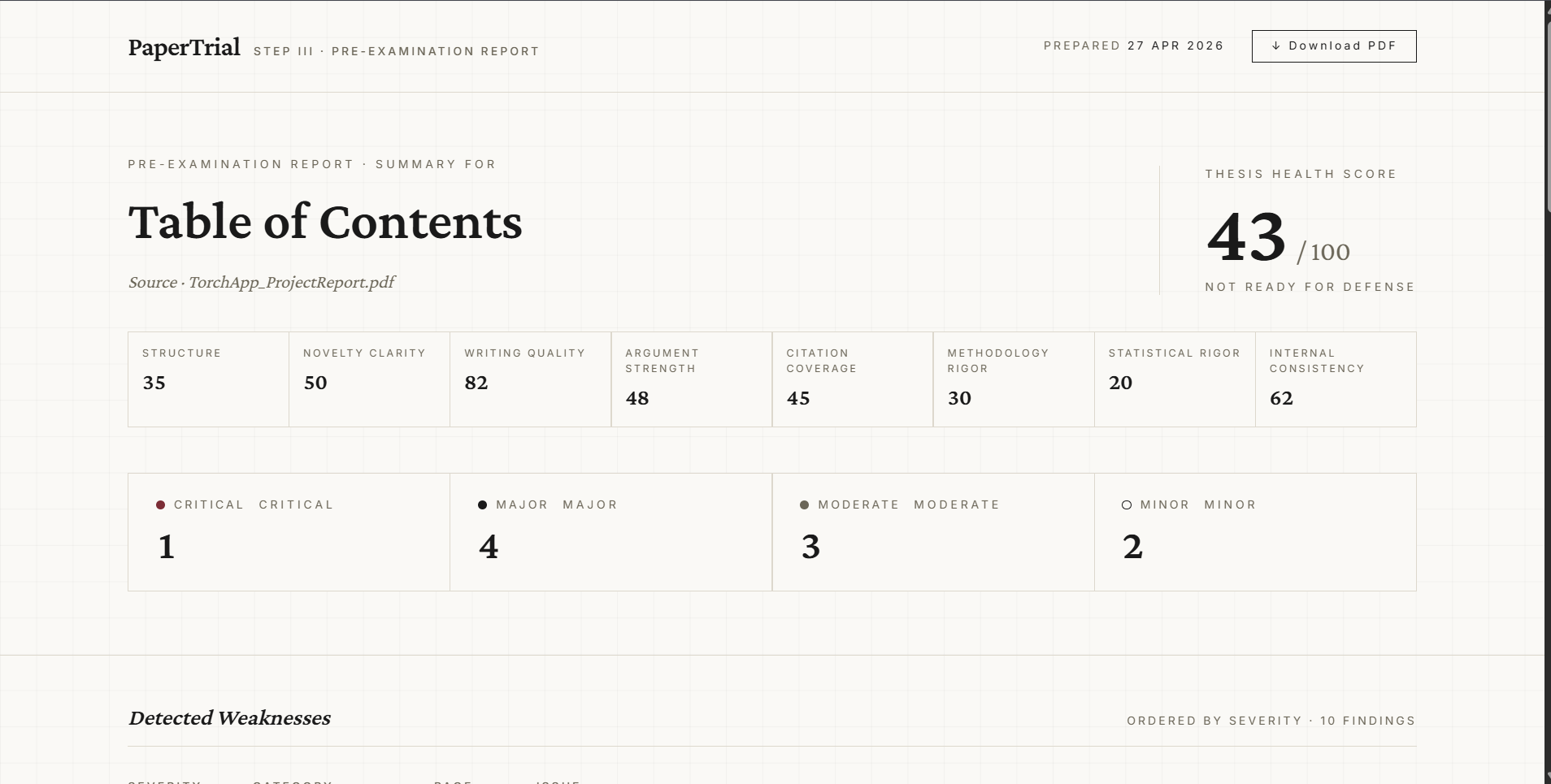
pre exam report
-
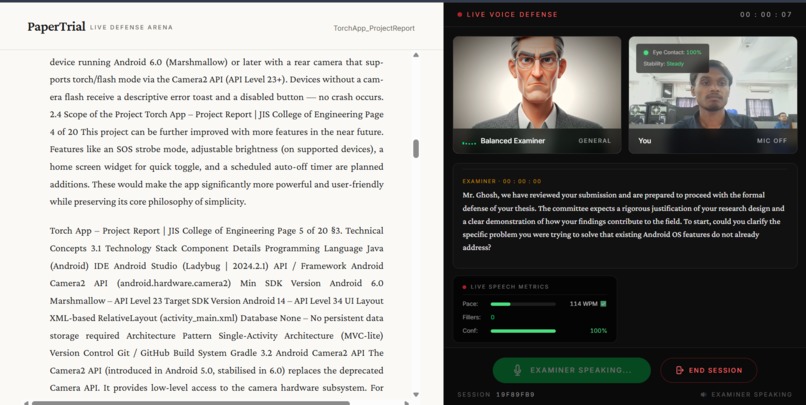
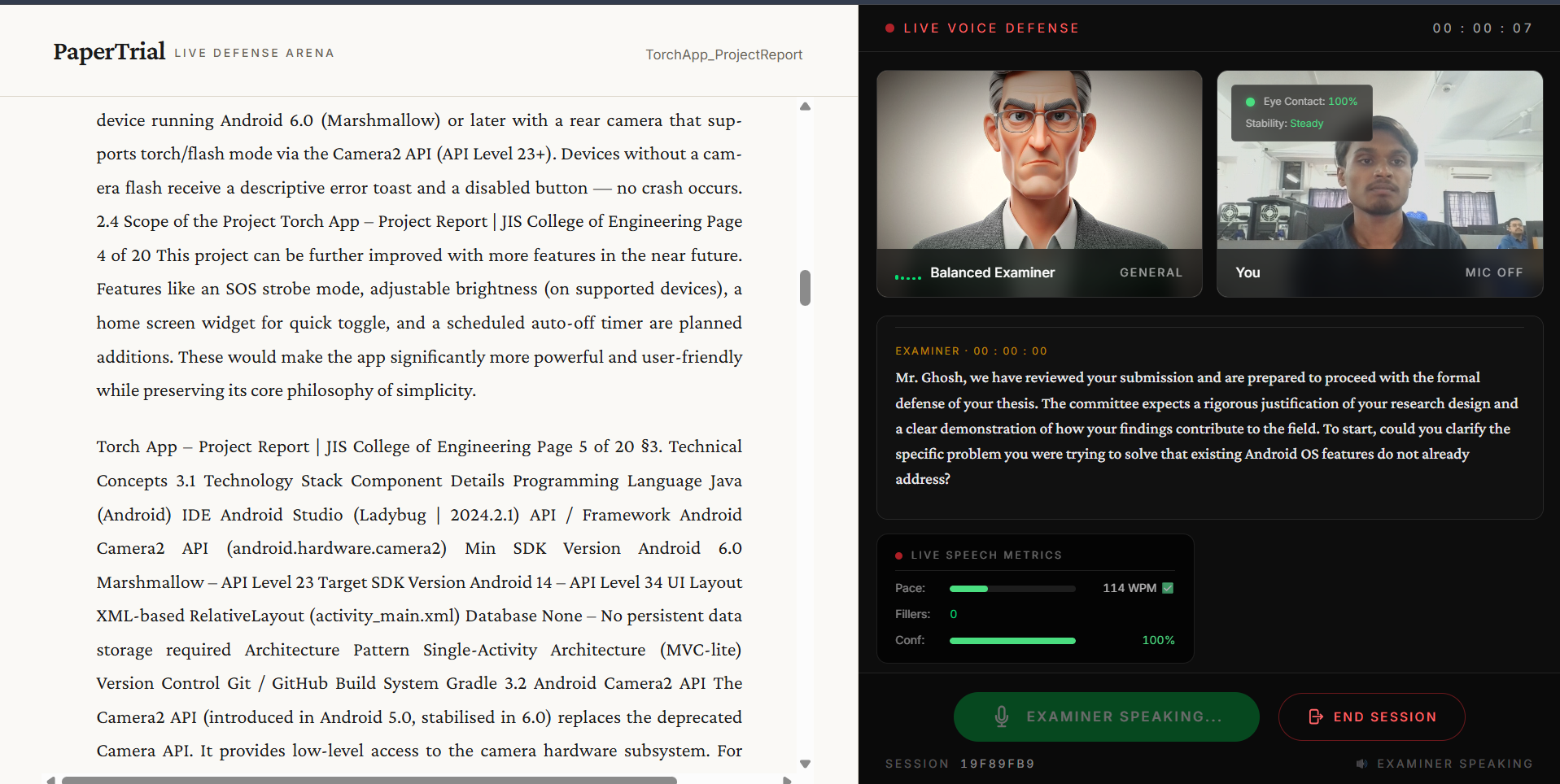
Interview Defence
-
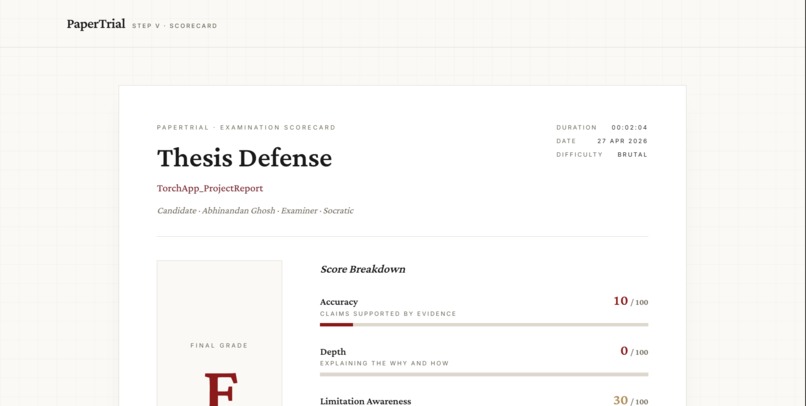
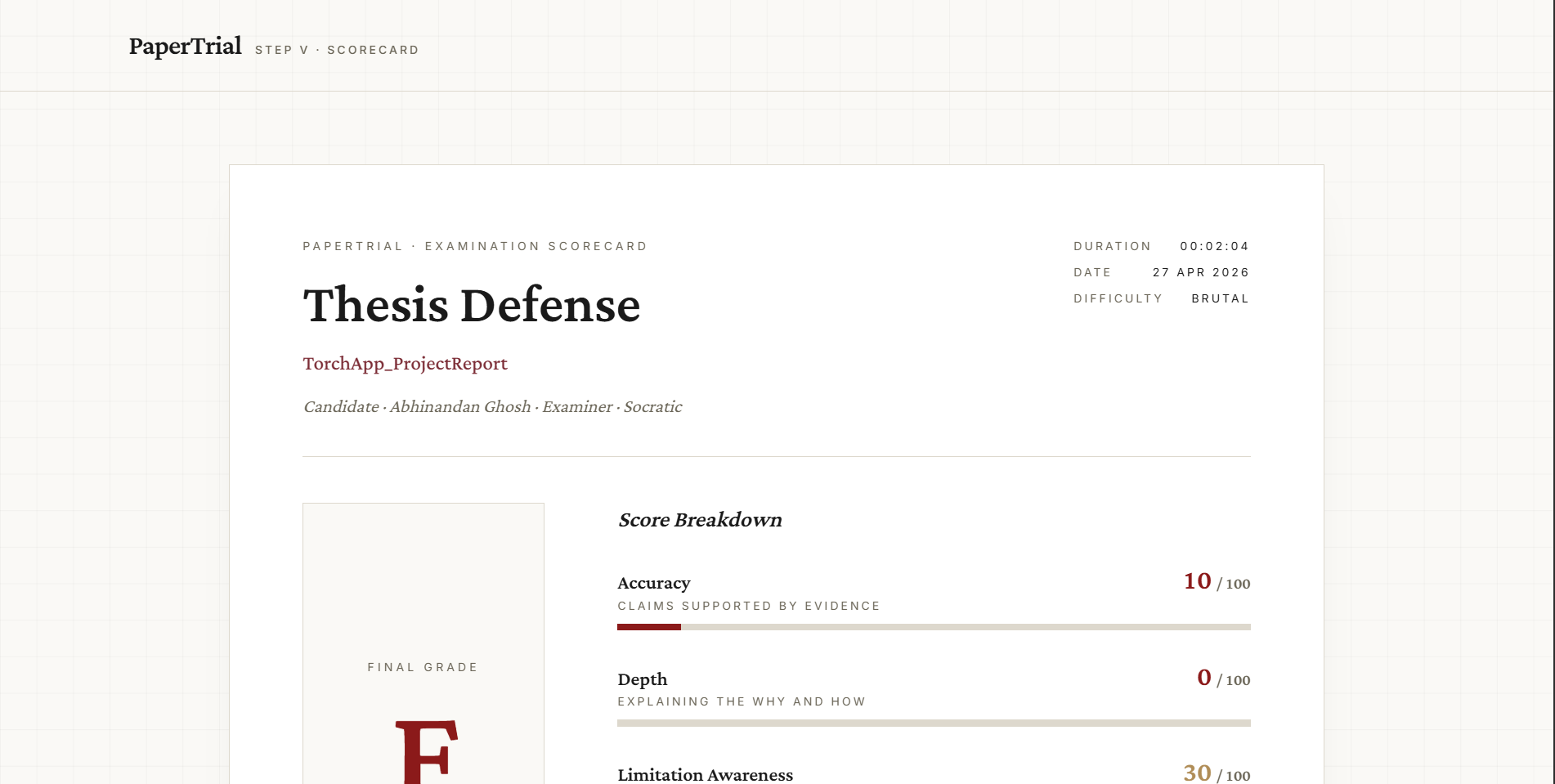
Final Scorecard

🎯 Inspiration
Every year, millions of graduate students walk into their thesis defense woefully unprepared. The statistics are brutal:
- \( 70\% \) of PhD candidates report severe anxiety before their defense.
- The average student gets less than 2 hours of mock practice before the real thing.
- Friends give shallow feedback. Advisors are too busy. There is no tool that attacks your methodology the way a real committee does.
I asked myself: What if an AI could read your entire 100-page thesis, find every weak point, and then grill you on it — live, with voice, under real pressure?
That question became PaperTrial.
🛠️ How I Built It
PaperTrial is a full-stack distributed system built across 5 computation phases:
Phase 1 — Ingestion Pipeline
I use PyMuPDF to extract raw text from uploaded PDFs, preserving page-level metadata. The text is split into semantic chunks using LangChain's RecursiveCharacterTextSplitter with:
$$\text{chunk_size} = 500, \quad \text{overlap} = 50$$
Phase 2 — Vector Embedding (RAG Foundation)
Each chunk is embedded into a \( 768 \)-dimensional vector using Google Vertex AI (text-embedding-004) and stored in a PostgreSQL database with the pgvector extension. I use an HNSW index for sub-millisecond cosine similarity retrieval:
$$\text{similarity}(A, B) = \frac{A \cdot B}{|A| \cdot |B|}$$
Phase 3 — Weakness Detection
Gemini 2.5 Flash performs a multi-pass structural analysis on the vectorized chunks, hunting for sampling biases, missing citations, and logical fallacies. Gemini 2.0 Flash then synthesizes these into exactly 5 targeted attack questions.
Phase 4 — Live Audio Defense Engine
The student enters a real-time voice session:
- 🎙️ Deepgram (WebSocket STT) transcribes speech in real-time
- 🧠 The transcript is embedded and matched against the thesis via RAG
- 📝 Gemini grades the answer for Accuracy, Depth, and Coherence
- 🔊 ElevenLabs vocalizes the AI Professor's response via TTS
- 👁️ A
visibilitychangeIntegrity Tracker monitors for cheating (alt-tab detection)
Phase 5 — Grading & Report
Backend merges AI rubric scores with voice confidence metrics (WPM) and integrity penalties, then generates a professional PDF scorecard using fpdf2.
Tech Stack:
Next.js · FastAPI · PostgreSQL + pgvector · Google Gemini · Vertex AI · Deepgram · ElevenLabs · LangChain · Clerk Auth
🧠 What I Learned
- RAG architecture is everything. Without grounding the AI in the actual thesis text, every answer was a hallucination. The moment we added cosine similarity retrieval from
pgvector, the grading accuracy skyrocketed. - Latency kills immersion. A 3-second delay between speaking and hearing the AI respond breaks the "real defense" illusion. We optimized the STT → RAG → LLM → TTS pipeline to keep round-trip latency under \( \sim 2 \) seconds.
- Cheating is a real UX problem. When I first tested, every user instinctively alt-tabbed to check their notes. Adding the Integrity Tracker completely changed user behavior and made the simulation feel authentic.
- Voice metrics reveal confidence. Words Per Minute (WPM) is a surprisingly strong proxy for how well a student actually understands their own research:
$$\text{WPM} = \frac{\text{Total Words Spoken}}{\text{Session Duration (min)}}$$
⚡ Challenges I Faced
| Challenge | How I Solved It |
|---|---|
| STT Latency | Switched from REST-based transcription to Deepgram WebSockets for streaming, cutting latency by \( \sim 80\% \). |
| LLM Hallucinations | Implemented strict RAG grounding — the AI can only reference text that exists in the uploaded PDF. Prompt engineering forces page-number citations. |
| PDF Parsing Edge Cases | Academic PDFs are messy (multi-column layouts, LaTeX artifacts). I tuned PyMuPDF extraction with page-aware chunking to handle real-world thesis formats. |
| Browser Integrity Tracking | The visibilitychange API behaves differently across Chrome, Firefox, and Safari. I normalized the event handling to ensure consistent cheating detection. |
| Audio Feedback Loops | When the AI Professor speaks via TTS and the mic is still active, the system would "hear itself". I implemented automatic mic muting during TTS playback to prevent echo loops. |
Built With
- clerk-(authentication)
- cosine-similarity-search
- elevenlabs-(text-to-speech)
- fastapi
- fpdf2
- google-gemini-2.0-flash
- google-gemini-2.5-flash
- google-vertex-ai
- hnsw-vector-indexing
- javascript
- langchain
- mediarecorder-api
- next.js
- pgvector-apis:-deepgram-(speech-to-text)
- postgresql
- pymupdf
- python
- rag
- react
- recharts
- render
- server-sent-events-(sse)
- sqlalchemy
- supabase
- typescript
- vercel
- websockets


Log in or sign up for Devpost to join the conversation.