Inspiration
Important paperwork rarely arrives as one clear story. A single case can be spread across letters, emails, reference numbers, deadlines and instructions from different organisations.
This becomes especially difficult when the documents appear to conflict or when the person reading them is already under pressure.
I created PaperShield because people do not need another opaque AI answer. They need a clear next step, an explanation of why it matters and a way to verify every important conclusion against the original evidence.
That is also why I created Dante, the assistant that guides the user through the analysis without pretending to replace human or professional judgment.
What it does
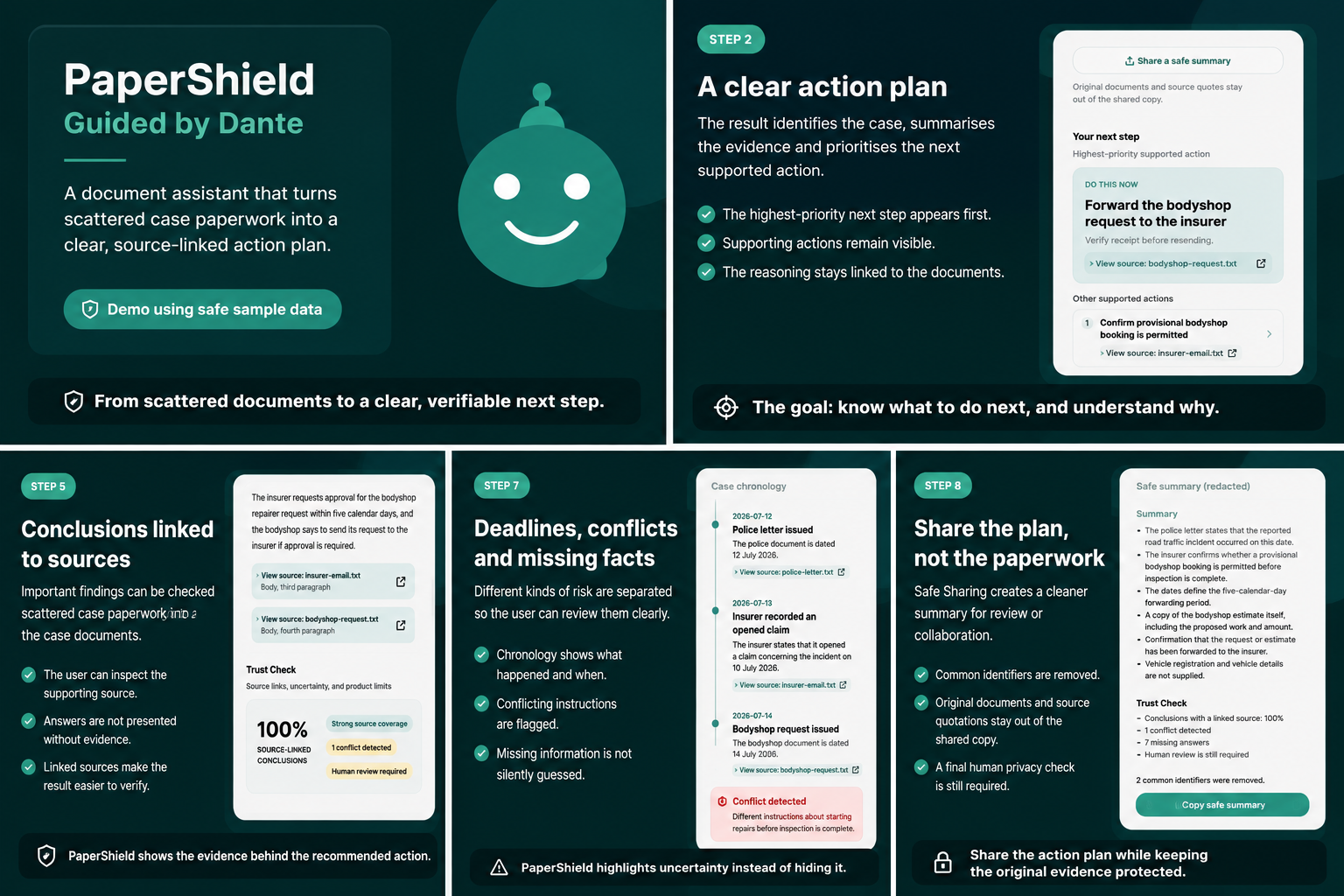
PaperShield brings related documents into one structured case and transforms them into a source-linked action plan.
The application can:
- connect information found across related documents;
- identify dates, reference numbers and important instructions;
- prioritise the next supported action;
- highlight deadlines and possible conflicts;
- separate missing information from confirmed facts;
- link important conclusions back to their sources;
- generate a safer summary for sharing;
- guide users through the result with Dante;
- support Italian, English and additional languages in beta.
PaperShield also includes a Trust Check. This measures source coverage, not certainty. A result of 100% means that the relevant conclusions have linked sources. It does not mean that every interpretation is automatically correct.
The Safe Sharing feature removes common identifiers and excludes original documents, source quotations and response drafts from the shared summary. Because automatic redaction cannot guarantee perfect removal, PaperShield still asks the user to complete a final privacy check.
PaperShield supports human review. It does not make legal decisions and does not replace professional advice.
How I built it
I built PaperShield as a responsive web application designed to work clearly on both desktop and mobile devices.
The frontend uses HTML, CSS and JavaScript. The backend runs on Node.js and connects to the OpenAI API for live document analysis.
The analysis workflow was divided into separate stages:
- collect the related case documents;
- normalise the information;
- analyse dates, instructions and references;
- connect conclusions to supporting sources;
- identify deadlines, conflicts and missing information;
- generate a prioritised action plan;
- prepare a safer version for sharing.
PaperShield also includes a safe sample case so that the complete workflow can be demonstrated without exposing real personal information.
The application was developed and tested on Replit, with GitHub used for version control and backups.
Challenges I faced
The hardest challenge was not generating text. It was making the result trustworthy and understandable.
I had to prevent the application from presenting source coverage as certainty. This led to the current Trust Check design, which clearly separates traceability from correctness.
Another challenge was handling documents that belong to the same case but contain different dates, instructions or incomplete links. PaperShield needed to flag those differences without automatically treating every uncertainty as a confirmed conflict.
Privacy was also a major challenge. Instead of claiming that redaction is perfect, the application removes common identifiers, limits what is included in the shared copy and clearly requires a final human review.
I also spent significant time improving the mobile experience, simplifying the interface, localising the guidance and making Dante helpful without making the assistant appear more authoritative than the evidence.
What I learned
I learned that trustworthy AI depends as much on product language and interface design as it does on the model.
Users need to see:
- what the system found;
- where it found it;
- what remains uncertain;
- what should be checked by a person.
I also learned that “I do not know yet” can be more useful than an unsupported answer.
Accomplishments
I am proud that PaperShield now provides a complete end-to-end workflow:
- document collection;
- AI-assisted analysis;
- source-linked conclusions;
- prioritised actions;
- deadline and conflict review;
- Trust Check;
- multilingual guidance;
- safer sharing.
Most importantly, the user remains in control of the final decision.
What's next
The next steps are to improve document extraction, expand automated testing, add more user-controlled privacy tools and continue improving multilingual support.
I also want to test PaperShield with a wider range of administrative cases while preserving its core principle:
Help people understand what to do next — and show them why.**
How we built it
Challenges we ran into
Accomplishments that we're proud of
What we learned
What's next for PaperShield
Built With
- and
- api
- css3
- deadline-and-conflict-checks
- design
- express.js
- generative
- github
- guided-by-dante:-clear-source-linked-action-plans
- html5
- javascript
- multilingual
- node.js
- openai
- papershield
- privacy-safe
- replit
- responsive
- rest
- web

Log in or sign up for Devpost to join the conversation.