📄 PaperPal — AI Research Paper Explainer
🚀 Elevator Pitch
Turn any research paper into simple explanations, slides, and instant answers with Gemini.
💡 What Inspired Me
As a solo hacker and student, I constantly ran into the same problem: research papers are dense, technical, and time-consuming to digest. Even after reading for hours, equations and experimental sections often remained unclear.
Many tools summarize documents, but few teach them.
I wanted to build something that felt like a personal tutor—an AI that doesn’t just shorten a paper, but walks you through it step by step, explains the math, and helps you prepare to present it.
That idea became PaperPal.
🛠️ What I Built
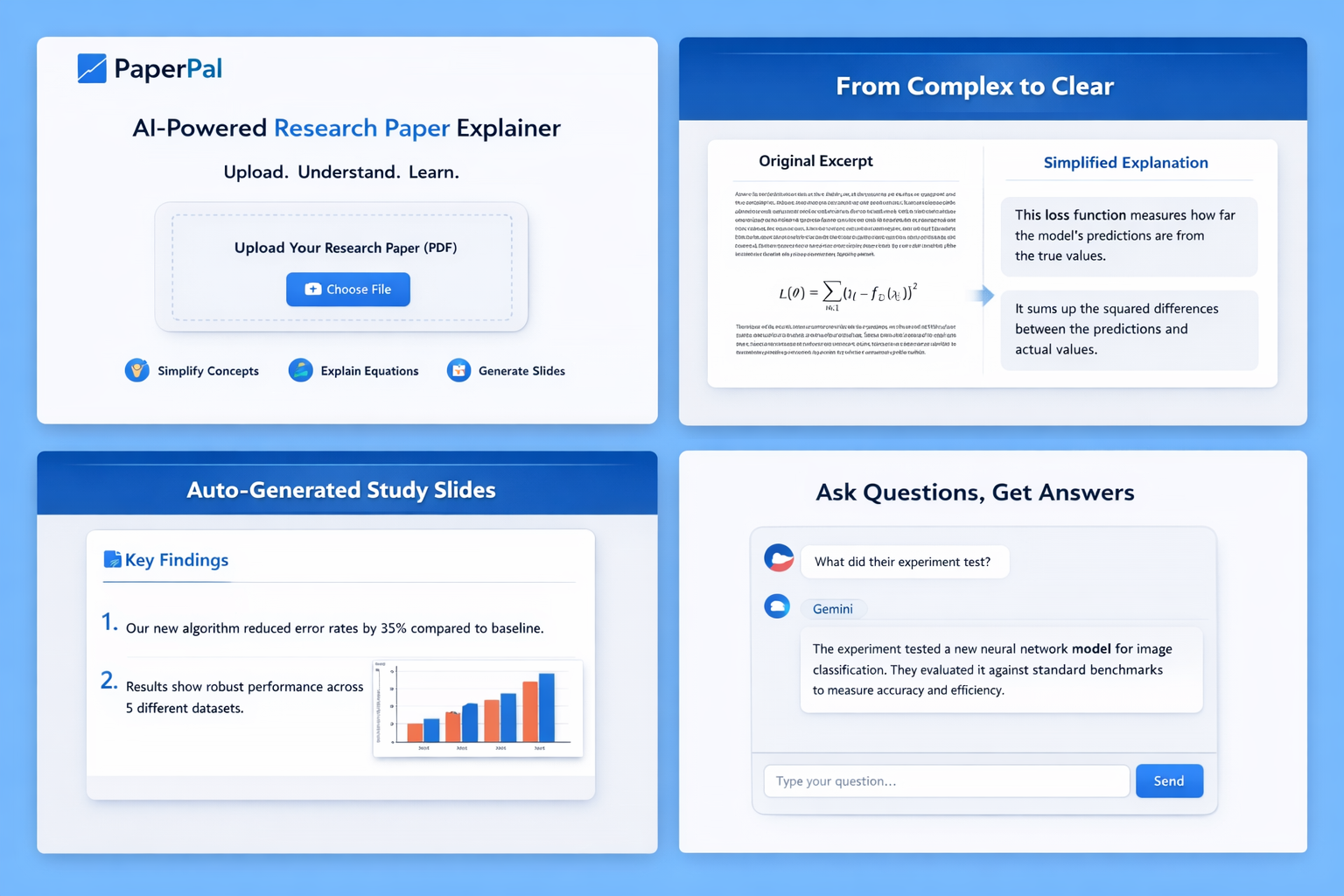
PaperPal is a web application where users upload academic PDFs and interact with them conversationally.
Once a paper is uploaded, the system:
- Extracts structured text from the PDF.
- Splits the content into logical sections.
- Sends those sections to Gemini with carefully designed prompts.
- Generates:
- Plain-English summaries
- Section explanations
- Equation breakdowns
- Slide outlines
- Flashcards
- Plain-English summaries
- Supports real-time Q&A grounded in the document.
When mathematical expressions appear, PaperPal rewrites them in LaTeX and adds intuition.
For example, a loss function like:
[ L(\theta) = \sum_{i=1}^{n} \left(y_i - f_\theta(x_i)\right)^2 ]
is translated into:
This formula measures how far the model’s predictions ( f_\theta(x_i) ) are from the real values ( y_i ). Training minimizes this total squared error.
🧠 What I Learned
Building PaperPal taught me several important lessons:
- Prompt design is everything. Small wording changes drastically improved explanation quality.
- Chunking large documents matters. Long papers needed to be broken into sections before being sent to the model.
- User experience drives adoption. Features like “Explain Simply” and “Generate Slides” made the tool intuitive.
- Trust and transparency are crucial. I added guardrails so outputs always referenced the provided paper rather than hallucinating new facts.
🧱 How I Built It
Tech Overview:
- Frontend: Next.js + React + Tailwind CSS
- Backend: FastAPI
- AI: Google Gemini API
- PDF Parsing: pdfplumber
- Math Rendering: KaTeX
- Diagrams: Mermaid.js
- Cloud: Google Cloud Run
- Storage & Auth: Firebase
Pipeline:
- PDF upload → server processing.
- Text extraction + section detection.
- Semantic chunking.
- Prompted Gemini calls for explanation, math interpretation, and slide generation.
- Streaming responses back to the UI.
- Chat interface for follow-up questions.
⚠️ Challenges I Faced
📚 Handling Long PDFs
Some papers exceeded token limits. I solved this by:
- summarizing each section individually,
- then synthesizing a final overview from those summaries.
📐 Explaining Mathematics Reliably
Generic prompts produced vague explanations. I introduced targeted instructions like:
“Explain this equation step by step and give an intuitive interpretation.”
This significantly improved clarity.
🧪 Reducing Hallucinations
Occasionally the model invented datasets or results. To mitigate this:
- I always passed the exact paper excerpt,
- asked Gemini to stay strictly grounded in the provided text,
- and requested paragraph-level references.
⏱️ Solo Time Constraints
With limited time, I prioritized features that created the strongest demo: upload → explain → ask questions → generate slides. Advanced exports and collaboration were saved for future work.
🌟 What’s Next
With more time, PaperPal could grow into a full research assistant:
- 📊 Auto-generated architecture diagrams
- 🔗 Section-level citations
- 👥 Collaborative study rooms
- 📤 Export to PowerPoint or Google Slides
- 📚 Personal research libraries
- 🔍 Cross-paper comparisons and literature maps
- 🗣️ Voice-based Q&A
🙌 Final Thoughts
PaperPal demonstrates how Gemini can move beyond summarization to become a genuine learning partner—helping students and researchers unlock complex ideas faster.
Built solo for the Gemini Hackathon.
Built With
- fastapi
- firebase
- google-cloud-run
- google-gemini-api
- katex
- mermaid.js
- next.js
- pdfplumber
- python
- typescript


Log in or sign up for Devpost to join the conversation.